
Written by: Dr. Akash Chandawarkar, Board Certified Plastic Surgeon, Mirror Plastic Surgery
Key Takeaways for Mommy Makeover Recovery
- A mommy makeover with tummy tuck combines breast restoration and abdominoplasty. The tummy tuck portion sets the overall recovery pace because of rectus muscle repair.
- Recovery follows a structured timeline. Weeks 1–2 require full-time help and strict lifting limits, while full activity usually returns between 6 and 12 months.
- Pain control uses multimodal, opioid-sparing protocols. Nerve blocks, acetaminophen, NSAIDs, and proper positioning work together to reduce discomfort.
- Patients must arrange dedicated childcare support for the first 2–4 weeks and follow strict lifting restrictions to protect the muscle repair and lower complication risk.
- Schedule your personalized consultation at Mirror Plastic Surgery to receive a recovery plan tailored to your anatomy, family responsibilities, and safety priorities.
How Painful Is a Tummy Tuck on a Scale of 1 to 10?
Tummy tuck patients usually experience moderate to severe discomfort during the first few days after surgery.1 Tension on the repaired rectus muscles and incision-site inflammation drive most of this pain. Discomfort peaks in the early days and improves significantly by day seven as swelling decreases and tissue tension eases.1
Evidence-based, opioid-sparing multimodal analgesia now represents the standard of care. Enhanced Recovery After Surgery (ERAS) protocols combine acetaminophen, NSAIDs, gabapentinoids, and regional nerve blocks to reduce opioid needs. Intraoperative long-acting nerve blocks such as liposomal bupivacaine can provide up to 72 hours of coverage. Scheduled acetaminophen (1,000 mg every six hours) with surgeon-cleared NSAIDs targets separate pain pathways and reduces reliance on narcotics. Beyond medication, how you position your body during recovery significantly affects your pain level.
Positioning plays a major role in comfort. Maintaining a 30–45 degree elevated torso with a pillow under the knees reduces tension on the abdominal plication and lowers overnight pain scores. Properly fitted compression garments worn nearly 24 hours a day for the first four to six weeks stabilize the repair and measurably reduce reported pain by controlling swelling. Pain management also requires addressing a common side effect of the medications themselves.
Constipation compounds discomfort and strains healing tissue. Opioids slow intestinal movement and harden stool, so surgeons typically recommend stool softeners starting on day one, adequate hydration, and short gentle walks after meals as standard preventive measures. Filling prescriptions for pain relievers, antibiotics, and stool softeners before surgery ensures they are available as soon as you return home.
Safely Lifting Children After a Tummy Tuck
Abdominoplasty includes rectus plication, which means suturing the separated abdominal muscles back to the midline to repair diastasis recti. This repair remains under tension for several weeks. Any load that engages the core before the suture line has healed increases the risk of dehiscence, widened scars, and prolonged recovery. A toddler often weighs more than 20 pounds and a car seat with an infant weighs even more, placing both well above safe limits during early healing. The following timeline shows when specific parenting activities usually become safe as your muscle repair strengthens.
Lifting restrictions by phase:
- Weeks 1–2: No lifting, bending, or carrying children at all. Full-time help is required.
- Weeks 3–4: Verbal supervision of older children and simple meal preparation are usually feasible. Toddler lifting and car seat handling remain prohibited.
- Weeks 5–6: Light parenting tasks resume, but lifting toddlers should still be avoided or done only sparingly if your surgeon approves.
- After week 6: Surgeon-cleared return to normal lifting based on your individual healing pattern.
Meeting these lifting restrictions requires advance planning. Use this checklist to prepare your household and support system before surgery so daily life runs smoothly while you heal.
Childcare and daily logistics checklist for Tampa-area mothers:
- Arrange a dedicated adult caregiver for weeks 1–2 who can lift, carry, and transport children. This person becomes your primary support for the most physically demanding parenting tasks.
- Pre-schedule school drop-offs and pick-ups through carpool or a trusted adult for at least four weeks, covering the transition period when you can supervise but still should not lift.
- Set up a ground-floor recovery station to eliminate stair climbing with a child in arms, reducing physical strain even when a caregiver is present.
- Install a step stool so older toddlers can climb into bed or a chair independently, limiting the need for you or your helper to lift them.
- Prepare and freeze meals before surgery to reduce bending, lifting, and time on your feet in the kitchen during early recovery.
- Confirm a backup caregiver for nights when pain or fatigue peaks in week one, so you are not forced to push beyond your limits.
- Discuss school-age children’s activity schedules with teachers to temporarily reduce physical demands on you as the recovering parent.
Blood Clot Prevention After Mommy Makeover
Deep vein thrombosis after abdominoplasty occurs infrequently in published studies, yet the risk remains real and requires a structured prevention plan. Extended operative time, reduced postoperative mobility, and abdominal compression all contribute to venous stasis and potential clot formation.
Standard prevention measures work together as a coordinated strategy:
- Light walking beginning within the first day after surgery supports circulation and reduces blood clot risk. This early mobility works in tandem with compression garments worn continuously for the first three to six weeks, which mechanically support venous return while you gradually increase activity.
- Cessation of all nicotine at least four to six weeks before and after surgery is equally critical, because smoking impairs blood flow and increases clot risk even when other prevention measures are in place.
- Stopping blood-thinning medications and supplements two to four weeks preoperatively, under surgeon guidance, reduces bleeding risk while allowing safer use of compression and early ambulation.
- Surgeon-prescribed chemical prophylaxis, when indicated by your risk profile, adds a pharmacologic layer of protection to the mechanical and lifestyle measures above.
These clinical protocols work best when paired with a practice model that allows careful monitoring. Surgical volume directly affects clot risk. High-volume practices performing five to ten procedures daily cannot provide the same level of perioperative monitoring that a limited-volume model affords. At Mirror Plastic Surgery, Dr. Akash performs one to two surgeries per day, a deliberate policy that ensures the entire clinical team maintains focused attention on each patient before, during, and after the procedure.
Schedule your clot-risk assessment with Dr. Akash to review your individual risk profile and the prevention protocol that will be built into your surgical plan.
Weight Changes, Scars, and Sensation After Tummy Tuck
Stable weight serves as a prerequisite for durable tummy tuck results. Candidates should maintain a stable weight at or near their target for at least three to six months before surgery. A BMI above 35 markedly raises complication rates, and most surgeons recommend achieving a stable BMI under 30 before proceeding.
Modest weight loss after a tummy tuck generally improves contour. A study of 188 abdominoplasty patients found that those who maintained their weight continued to lose small amounts of weight over a five-year follow-up period.1 While your weight stabilizes, your incision site undergoes a separate healing process that affects both appearance and sensation.
Scar and sensation changes over 12 months follow a predictable arc:
- Weeks 1–2: Wound healing phase, with a pink scar, swelling, and tightness.
- Months 2–3: Peak redness, firmness, and itch, often called the “angry scar” phase.
- Months 3–6: Early softening and flattening, with most patients noticing significant improvement in abdominal sensation.
- Months 6–12: Final maturation into a fine, pale line within the bikini line, with final contour typically visible at 3–6 months.
After surgical repair, peripheral nerve axons typically regenerate at a rate of approximately 1 mm per day, although clinical studies report rates ranging from 1.5–5 mm per day depending on sensory or motor fiber type. This regeneration pace explains why most patients notice return of sensation within 6 to 12 months, although some small areas of diminished feeling may persist permanently.1 During this same 12-month window while nerves are regenerating, UV exposure can cause permanent hyperpigmentation of the scar, making high-SPF sunscreen or physical barriers essential throughout the entire sensation recovery period.
When to Call Your Surgeon After Surgery
Contact your surgical team immediately if you experience any of the following after a mommy makeover with tummy tuck:
- Fever above 101°F (38.3°C) or chills
- Sudden one-sided leg swelling, warmth, or calf pain (possible DVT)
- Shortness of breath or chest pain (possible pulmonary embolism, call 911)
- Rapidly increasing pain not controlled by prescribed medication
- Wound drainage that is foul-smelling, cloudy, or increasing in volume
- Redness spreading beyond the incision margins
- Sudden or significant increase in swelling at any surgical site
- No bowel movement for several days accompanied by severe abdominal pain, vomiting, or inability to pass gas
Provider Expertise at Mirror Plastic Surgery
Dr. Akash holds a medical degree from Harvard Medical School, completed a seven-year integrated plastic and reconstructive surgery residency at Johns Hopkins University, and completed an aesthetic surgery fellowship at the Manhattan Eye, Ear and Throat Hospital (MEETH). His undergraduate training at MIT in neuroscience and nuclear engineering, combined with a Stanford University Biodesign Innovation Fellowship, supports a surgical approach grounded in anatomy, engineering precision, and evidence-based technique.
Dr. Akash has been recognized as one of America’s Best Plastic Surgeons by Newsweek for two consecutive years. He serves on the Next Generation Editorial Board of the Aesthetic Surgery Journal, has testified before the U.S. Food and Drug Administration on breast implant safety, and is board certified by the American Board of Plastic Surgery, a credential that provides privileged hospital access in the rare event of a surgical complication.
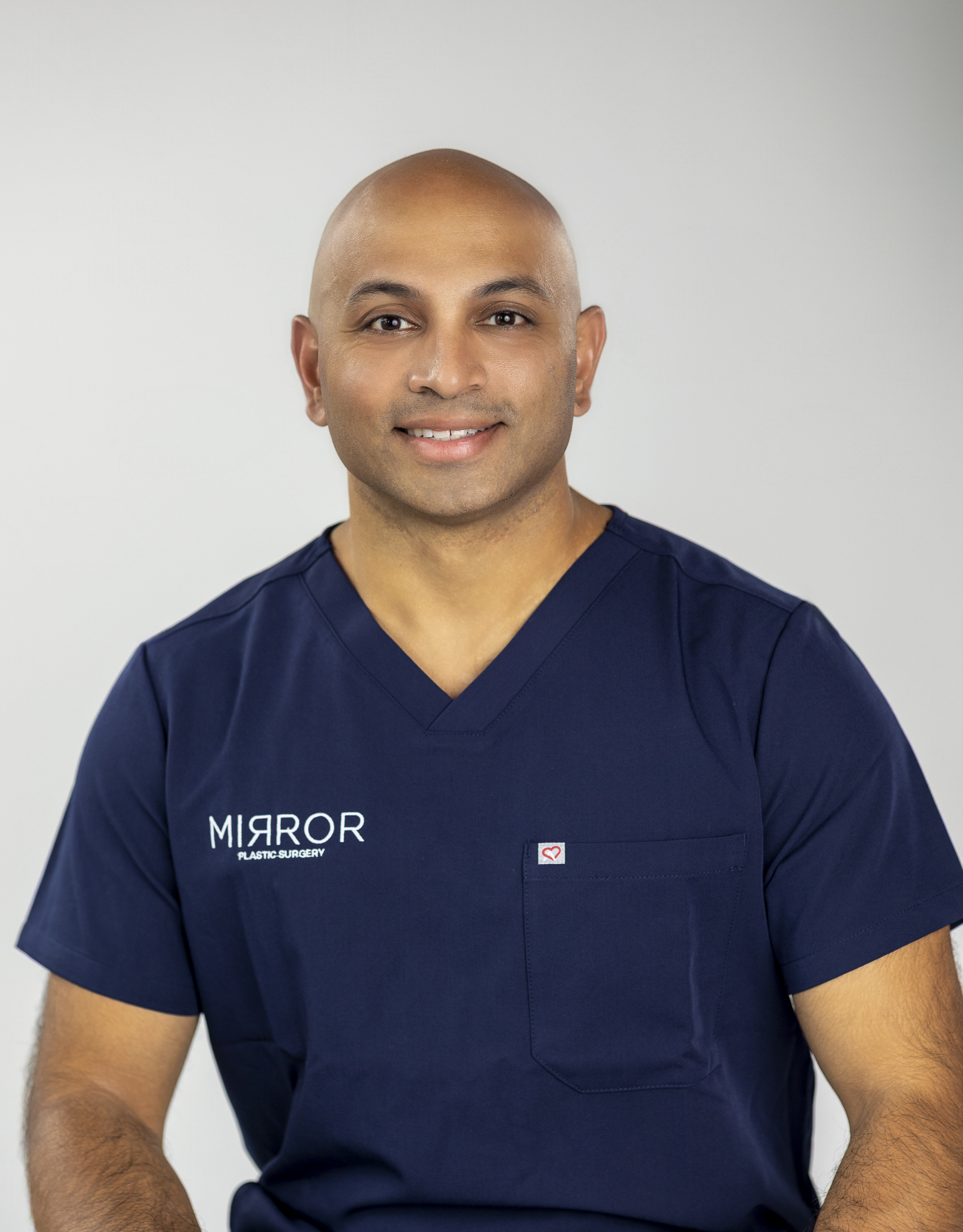
Mirror Plastic Surgery’s tummy tuck approach focuses on restoring the entire abdominal musculature from chest to pubic area for true functional restoration. This strategy avoids limited techniques that address only the lower abdomen and can result in residual pooching. The practice performs one to two surgeries per day, contrasting with high-volume practices that may perform five to ten daily. This policy functions as a structural safety measure that ensures focused preoperative evaluation, attentive intraoperative monitoring, and responsive postoperative care for every patient.
Meet with Dr. Akash at Mirror Plastic Surgery’s St. Petersburg location to discuss your anatomy, your recovery logistics, and a surgical plan built on safety first, function second, and aesthetics third.
Frequently Asked Questions
How long does full recovery from a mommy makeover with tummy tuck take?
The timeline mentioned earlier breaks down into specific activity milestones. Desk work typically resumes at two to three weeks, and light exercise at six weeks with surgeon clearance. Swelling continues to resolve through month six, revealing your final contour as described in the healing timeline above. Scar maturation continues for 12–24 months after tummy tuck.1 The tummy tuck component sets the pace because muscle repair affects every core movement throughout recovery.
Is a mommy makeover with tummy tuck safe when performed as a combined procedure?
Major complications occur in approximately 2.1% to 4% of abdominoplasty cases, including combined mommy-makeover procedures, when performed by board-certified plastic surgeons in accredited facilities.1 Patient selection remains the primary safety variable. Ideal candidates have completed childbearing, maintain a stable BMI under 30, have no uncontrolled chronic conditions, and have been nicotine-free for at least four to six weeks. The limited surgical volume mentioned earlier, combined with Mirror Plastic Surgery’s protocols, provides additional time for monitoring and individualized care.
Will a tummy tuck repair my separated abdominal muscles?
Yes. Rectus plication, the suturing of separated abdominal muscles back to the midline, is a core component of abdominoplasty and directly addresses diastasis recti caused by pregnancy. Liposuction alone cannot repair muscle separation or significant skin laxity. Dr. Akash’s approach restores the entire abdominal musculature from chest to pubic area, prioritizing functional restoration alongside aesthetic improvement. A prior cesarean scar can often be incorporated into the excised tissue during the same procedure.
When is it safe to get pregnant again after a mommy makeover?
Mommy makeover suits patients who have completed childbearing. A subsequent pregnancy can re-stretch the surgically repaired rectus abdominis muscles, reverse abdominal contour results, and alter breast shape after a lift or augmentation. Most surgeons require waiting at least six to twelve months after childbirth and until breastfeeding has fully stopped for three to six months before performing the procedure. Patients who are not certain they have completed their family are usually advised to delay surgery.
What does the scar look like after a tummy tuck, and does it fade?
The tummy tuck scar is positioned low on the abdomen, within or just above the bikini line. The scar follows the maturation timeline described earlier, transitioning from pink and swollen in the first weeks to a pale, fine line by 12 months. Consistent scar care, including silicone gel or sheets, taping, and high-SPF sun protection during the first 12 months, has a significant effect on final scar quality. UV exposure during this window can cause permanent hyperpigmentation.
1 Results may vary from person to person. Editorial content, before and after images, and patient testimonials do not constitute a guarantee of specific results.