
Written by: Dr. Akash Chandawarkar, Board Certified Plastic Surgeon, Mirror Plastic Surgery
Key Takeaways
- Gynecomastia surgery treatment options in Tampa for men fall into four categories: liposuction alone, gland excision alone, combined liposuction and excision, and skin excision. Each option is chosen based on whether the chest contains fat, glandular tissue, skin excess, or a combination.
- Glandular tissue is firm and does not respond to liposuction, diet, exercise, or GLP-1 medications. Accurate pre-operative identification of tissue type helps prevent residual lumps and reduces the chance of revision surgery.1
- Combined liposuction and gland excision is the most common approach for mixed chests. Skin excision with or without nipple repositioning is reserved for significant skin redundancy, often after major weight loss.
- Choosing the wrong operation can lead to crater deformity, residual firmness, or the need for revision.1 A thorough consultation that includes tissue assessment and medication review lowers these risks.
- Mirror Plastic Surgery provides anatomy-first consultations in the Tampa Bay area. Dr. Akash dedicates up to an hour per patient to match the correct operation to each man’s chest.
Get An Anatomy-First Assessment
What Gynecomastia Actually Is: Gland, Fat, And Skin
Gynecomastia is enlargement of the male chest caused by glandular breast tissue, fat, or a combination of both, sometimes with excess skin. The 2026 clinical practice guidelines from the Italian Society of Andrology and Sexual Medicine (SIAMS), published in the Journal of Endocrinological Investigation, define it as a generalized benign growth of glandular tissue in the male breast. The guidelines distinguish it from pseudogynecomastia, which is excess fat deposition without glandular proliferation, by comparing palpation of subareolar tissue with adjacent subcutaneous fat in the chest wall.
The anatomical distinction matters because the two tissue types behave differently under every treatment modality:
- Glandular tissue is firm, rubbery, and disc-like, located directly behind the nipple and areola. It does not respond to liposuction, diet, exercise, or GLP-1 medication-induced weight loss, so it typically requires surgical excision. Liposuction may still be used to remove surrounding fat and contour the chest, and GLP-1-induced weight loss can make the remaining glandular tissue more prominent.
- Fat is soft, diffuse, and spread across the chest. It responds to liposuction and can change with weight loss.
- Skin excess develops when the overlying skin has been stretched beyond its elastic recoil capacity, most commonly after significant weight loss. This factor influences whether skin removal or nipple repositioning must be added to the plan.
The four surgical approaches map directly onto these tissue types. Liposuction alone removes fat. Gland excision alone removes the glandular disc. Combined liposuction plus excision removes both. Excision with skin removal or nipple repositioning addresses significant skin excess or a low nipple position. Ultrasound is increasingly used pre-operatively to assess tissue composition and help plan the procedure before a single incision is made. That assessment is what determines which of the four surgical approaches fits, and those approaches differ in ways that matter.
The Four Surgical Approaches, Compared
The four approaches are not interchangeable. Each one is defined by what it removes and, just as importantly, by what it leaves behind. The table below maps each approach to the tissue it addresses, the problem it cannot solve, and the chest type it suits, so you can see why the wrong match produces the outcomes men fear most.
| Approach | Tissue Addressed | What It Cannot Fix | Typical Candidacy |
|---|---|---|---|
| Liposuction Alone | Fat (adipose tissue) | Glandular disc; liposuction alone cannot reliably remove a dense gland under the nipple, which can leave residual firmness | Soft, fat-predominant chest with good skin elasticity and minimal or no glandular component |
| Gland Excision Alone | Firm glandular disc behind the nipple-areola complex | Diffuse chest fat; this approach does not contour the broader chest | Isolated glandular tissue with minimal surrounding fat and good skin elasticity |
| Combined Liposuction And Excision | Both fat and glandular tissue | Significant skin redundancy; in Rohrich grade III–IV cases, this approach alone may be insufficient and associated with postoperative recurrence1 | Mixed chests with both a central glandular component and surrounding fat; the most common presentation in practice |
| Skin Excision With Or Without Nipple Repositioning | Excess skin; repositions nipple-areola complex when position is too low after tissue removal | Cannot substitute for gland excision or liposuction; addresses skin only | Significant skin redundancy, often after major weight loss; Rohrich grade III–IV gynecomastia |
A critical point about gland and liposuction comes from a 2026 retrospective cohort study. A 2026 retrospective cohort study of 177 gynecomastia patients published in Frontiers in Surgery confirmed that liposuction alone has limited ability to eliminate glandular tissue. The same study reported that leaving approximately 1 cm of subareolar glandular tissue protects nipple-areola complex vascularity. The surgeon’s judgment about how much tissue to retain is therefore as important as how much is removed.
Non-surgical options such as exercise, weight loss, and GLP-1 receptor agonists like semaglutide can reduce fat and may modestly shift the hormonal environment. However, none of these interventions act on established glandular tissue. Once glandular tissue has been present for approximately 12 months, dense fibrosis predominates and spontaneous resolution becomes significantly less likely. The 2019 American Society of Andrology and European Academy of Andrology clinical practice guidelines state that the use of selective estrogen receptor modulators or aromatase inhibitors for gynecomastia is generally not recommended.
Find Out Which Operation Fits Your Chest
How To Evaluate A Gynecomastia Surgeon In Tampa
A strong gynecomastia consultation in Tampa starts with clear questions about your anatomy, history, and safety. Before choosing a surgeon, a man should be able to answer, or have his surgeon answer, the following questions in a logical sequence.
Start with tissue type and cause:
- What tissue is actually causing the chest fullness: fat, gland, or both?
- Is the enlargement recent or long-standing? Glandular tissue present for 12 months or longer is unlikely to resolve without surgery.
- Is the enlargement painful, rapidly changing, or asymmetric? These features warrant an endocrinology or medication review before surgery is scheduled.
- Are any medications, supplements, or substances involved? Drug-induced gynecomastia accounts for 20–25% of all cases, and some cases are reversible once the causative agent is stopped.
Then clarify skin and logistics:
- How much skin excess is present, and will the skin retract on its own after tissue removal?
- What anesthesia approach and recovery timeline fit the patient’s life and health status?
Recent-onset, painful, asymmetric, or medication-associated enlargement warrants an endocrinology or medication review before surgery. The European Academy of Andrology’s 2019 clinical practice guidelines recommend a baseline laboratory panel including total testosterone, estradiol, LH, hCG, and prolactin, with additional tests guided by clinical findings. Elevated estradiol, marked hypogonadism, elevated hCG, or a testicular mass should prompt specialist referral before any surgical planning begins.
Choosing the wrong operation has documented consequences. A systematic review published in Aesthetic Plastic Surgery identifies contour problems as the leading reason men return for revision. Removing too much gland under the nipple leaves a dished or saucer-shaped hollow, often called a crater deformity. Removing too little leaves residual firmness. The same review found that leaving gland behind with liposuction alone brings the chest back approximately 35% of the time, versus under 10% once the gland is properly excised1.
At Mirror Plastic Surgery, the consultation model is built around the anatomy-first assessment this decision requires. Dr. Akash spends up to an hour in consultation, conducting a top-to-bottom assessment guided by a safety-first, function-second, aesthetics-third philosophy. The practice limits itself to one to two surgeries per day, so the entire team’s focus remains on a single patient before, during, and after the procedure. This structure contrasts with high-volume practices that may perform five to ten surgeries daily. Mirror Plastic Surgery is supplier-neutral and evidence-based, and the team will tell a man he does not need surgery when that is the honest answer.
This is the standard men should expect when evaluating gynecomastia surgery treatment options in Tampa: an anatomy-first assessment that matches the operation to the tissue.
See How Our Consultation Process Works
Meet Dr. Akash
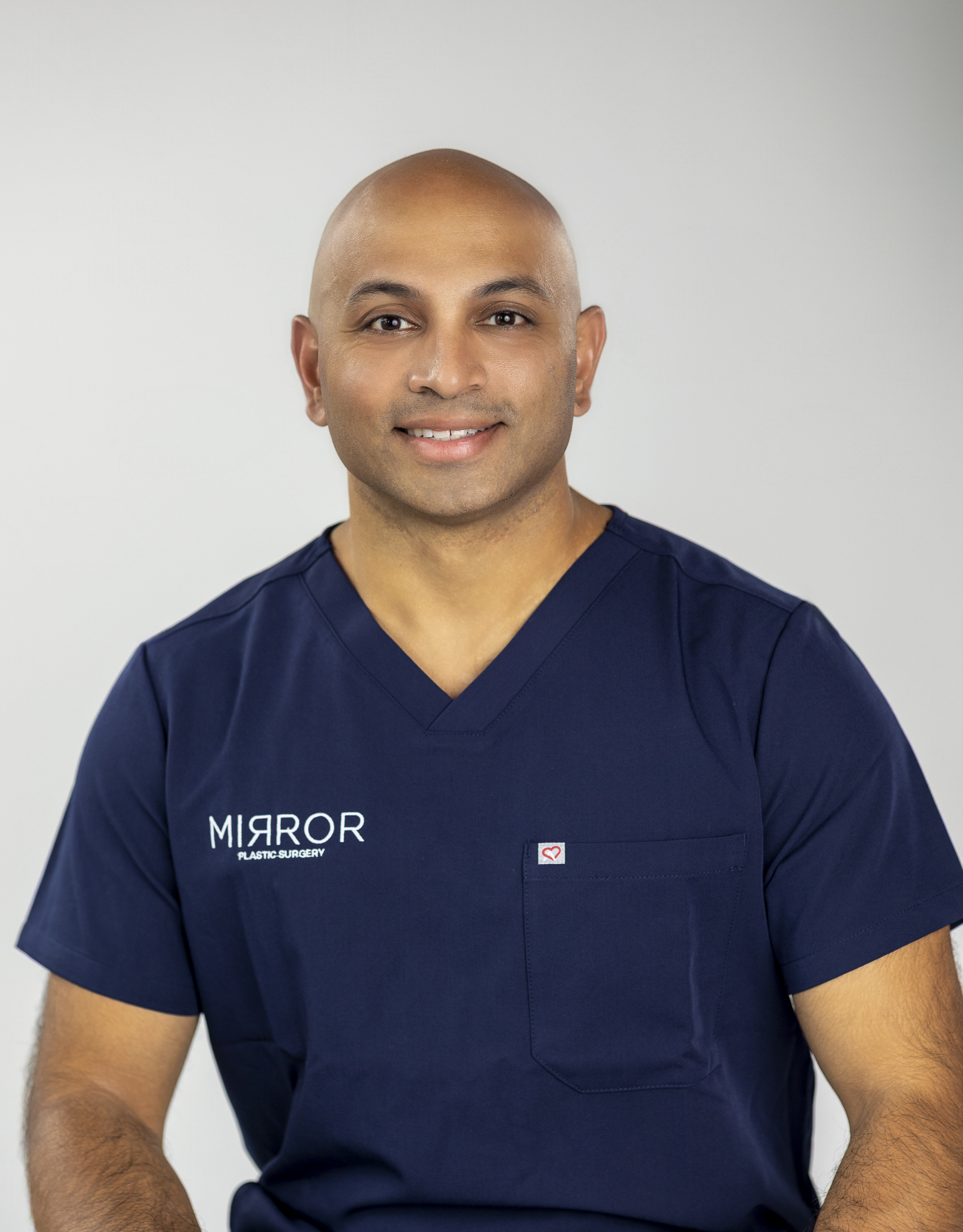
Dr. Akash, referred to throughout this practice as Dr. Akash, is board certified by the American Board of Plastic Surgery. His undergraduate studies were completed at the Massachusetts Institute of Technology (MIT) in neuroscience and nuclear engineering. He earned his medical degree from Harvard Medical School through the Harvard-MIT Division of Health Sciences and Technology, graduating with honors. His surgical training was completed during a seven-year integrated plastic and reconstructive surgery residency at Johns Hopkins University, one of the world’s leading training programs. During residency he rotated at Johns Hopkins Hospital, the R Adams Cowley Shock Trauma Center, and the Curtis National Hand Center.
Following residency, Dr. Akash completed an aesthetic surgery fellowship at the Manhattan Eye, Ear and Throat Hospital (MEETH), one of the most competitive aesthetic surgery fellowships in the country. He also completed the Stanford University Biodesign Innovation Fellowship, a program that trains physician-innovators to identify unmet clinical needs and develop technological solutions. He serves on advisory boards for companies developing new technologies in aesthetic surgery and is a Next Generation Editor for the Aesthetic Surgery Journal.
Dr. Akash was named in America’s Best Plastic Surgeons 2025 by Newsweek for two years in a row.
Risks, Limitations, And Misconceptions
Several persistent misconceptions lead men to delay appropriate evaluation or pursue ineffective treatments, and understanding them helps set realistic expectations.
Will 100 pushups a day get rid of moobs? No. Glandular tissue does not respond to physical training. Chest-focused resistance training can improve overall chest contour and reduce the visual prominence of fat-predominant pseudogynecomastia, but it cannot remove a glandular disc. Spot reduction of fat through targeted exercise is not supported by scientific evidence.
Can Ozempic or weight loss cure gynecomastia? GLP-1 receptor agonists such as semaglutide reduce body fat, and fat loss can reduce the aromatization of androgens to estrogens in adipose tissue. However, once glandular tissue becomes fibrotic, a process that tends to occur after approximately 12 months of persistent enlargement, it is unlikely to resolve through weight loss or lifestyle changes alone. GLP-1 medications address fat, not gland.
Can stage 2 gyno go away on its own? Pubertal gynecomastia resolves spontaneously in 75–90% of adolescents within 6 months to 1–2 years as hormone levels stabilize. Adult-onset gynecomastia is less likely to resolve on its own, particularly once the glandular tissue has been present for 12 months or longer and fibrosis has set in.
Does gyno mean low testosterone? Gynecomastia reflects an altered ratio between estrogens and androgens at the breast tissue level rather than absolute testosterone deficiency alone. Even after detailed evaluation, no identifiable cause is found in approximately 25% of gynecomastia cases. Hypogonadism accounts for roughly 27% of gynecomastia cases, so most men with gynecomastia do not have low testosterone as the primary driver.
The specific failure modes men fear most, including crater deformity, residual lump, asymmetry, and poor scarring, are real and documented. Over-resection of glandular tissue under the nipple produces a dished or saucer-shaped hollow, and under-resection leaves residual firmness1. A 2022 systematic review by Innocenti and associates in Aesthetic Plastic Surgery, analyzing 94 articles covering 7,294 patients, found that combined surgical excision plus aspiration had a complication rate of 11.76%, compared with 30.64% for surgical excision alone. Technique selection therefore has a measurable impact on risk. Revision surgery is sometimes needed, and a surgeon’s revision policy is a legitimate question to ask before committing to any procedure.
Ask About Risks And Revision Policy
Frequently Asked Questions
How To Tell If Gyno Is Permanent?
Glandular gynecomastia that has been present for 12 months or longer is generally considered to have entered the fibrotic stage, in which dense collagen deposition makes spontaneous resolution significantly less likely. Pubertal gynecomastia that appeared recently and is still tender may still resolve on its own. A physical exam, and in some cases ultrasound, can help distinguish active, early-stage tissue from established, fibrotic gland that will not regress without surgery.
What Is The Difference Between Liposuction And Gland Excision For Gynecomastia?
Liposuction removes fat through suction cannulas and is effective for soft, diffuse chest fullness caused by adipose tissue. Gland excision removes the firm, disc-shaped glandular tissue directly behind the nipple through a small periareolar incision. The two approaches address different tissues. Liposuction cannot reliably remove a dense glandular disc, and gland excision alone does not contour the surrounding fat. Most men with true gynecomastia require a combination of both techniques.
How Do I Choose A Surgeon For Gyno Surgery In Tampa?
Look for a board-certified plastic surgeon who performs a thorough pre-operative assessment, including tissue identification, medication review, and hormonal evaluation when indicated, before recommending a specific operation. Ask whether the surgeon will tell you if surgery is not the right answer for your anatomy. Evaluate the consultation model. A rushed consultation that skips tissue differentiation and moves directly to booking is a warning sign. A surgeon who limits daily surgical volume and spends meaningful time on pre-operative assessment is better positioned to match the operation to your specific chest anatomy.
Conclusion: Match The Operation To The Tissue
Knowing what tissue is in the chest, whether fat, gland, skin, or a combination, is the first and most important step in choosing among gynecomastia surgery treatment options in Tampa for men. The four surgical categories exist because the anatomy varies, and forcing the wrong operation onto the wrong tissue produces the outcomes men fear most, including residual lumps, crater deformities, and revision surgery.
Education, realistic expectations, and a surgeon who will explain your anatomy clearly are the main takeaways from this guide. The right operation is the one that matches what is actually in your chest and fits your goals and health status.
Match Your Operation To Your Tissue
Contact And Next Step
Mirror Plastic Surgery is located in St. Petersburg, Florida, serving the greater Tampa Bay area. To schedule a consultation with Dr. Akash, contact the practice directly:
- Address: 780 4th Ave S, St. Petersburg, FL 33701
- Phone: 727-361-6515
- Email: hello@mirrorplasticsurgery.com
Schedule Your Tampa Bay Consultation
1 Results may vary from person to person. Editorial content, before and after images, and patient testimonials do not constitute a guarantee of specific results.