
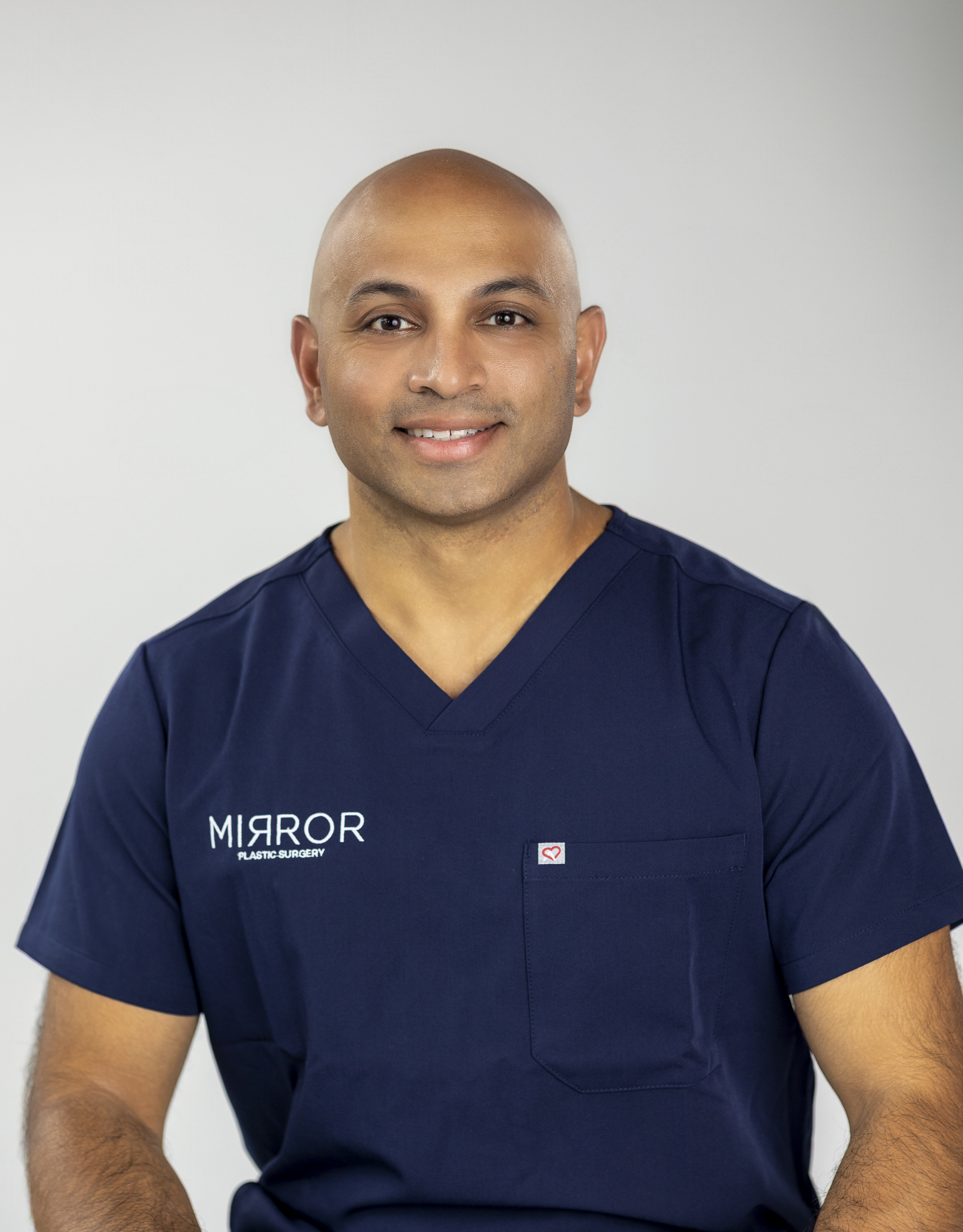
Written by: Dr. Akash Chandawarkar, Board Certified Plastic Surgeon, Mirror Plastic Surgery | Last updated: July 19, 2026
Key Takeaways for Buttock Fat Grafting Safety
- Buttock fat grafting (BBL) carries the highest mortality risk of any cosmetic surgery when fat is injected into or beneath the gluteal muscle, which can cause pulmonary fat embolism.
- Modern subcutaneous-only injection, performed above the gluteal fascia with real-time ultrasound guidance, has dramatically reduced the risk of fatal fat embolism.1
- Board-certified plastic surgeons who operate in accredited facilities and keep daily case volumes low achieve near-zero mortality rates under current safety protocols.1
- Patients should confirm their surgeon’s credentials, facility accreditation, and strict use of subcutaneous-only technique before moving forward with surgery.
- Discuss your candidacy and safety concerns with Dr. Akash at Mirror Plastic Surgery during a personalized consultation.
How Buttock Fat Grafting Works and Why Fat Embolism Is the Main Risk
Buttock fat grafting combines liposuction from donor sites, typically the abdomen, flanks, or thighs, with purification and reinjection of that fat into the buttocks. Patients gain contouring at the harvest areas and added volume in the buttocks using their own tissue instead of an implant.
The primary mortality risk is pulmonary fat embolism (PFE). Cadaveric dissection studies of BBL fatalities found that in 100% of confirmed deaths, injected fat was located deep within the gluteus maximus or submuscular space, and no deaths occurred when fat remained exclusively in the subcutaneous plane. The 2017 ASERF Task Force survey confirmed that deep muscle injection increases the risk of pulmonary fat embolism.
Current Safety of Fat Transfer to the Buttocks
Safety depends heavily on technique and provider. A 2023 analysis in the Aesthetic Surgery Journal concluded that the Brazilian butt lift remains the deadliest aesthetic surgery, with fatalities staying high despite safety advisories. Studies show that the risk of clinically significant fat embolism is low when fat injection stays within the subcutaneous plane.1
Mortality has improved as subcutaneous-only guidelines have been adopted.1 Under these protocols, published career mortality rates have fallen according to surgeon surveys. Deaths in 2026 occur predominantly in medical tourism destinations with weak regulatory oversight and among non-board-certified practitioners working outside accredited facilities.
Why Intramuscular Injection Greatly Increases Fat Embolism Risk
The gluteus maximus contains the superior and inferior gluteal veins, which are large, thin-walled vessels that connect directly to the internal iliac veins and inferior vena cava. The unsafe intramuscular zone lies immediately below the deep gluteal fascia, often less than 1 cm thick, and inadvertent entry into this zone can perforate these veins, which sit close to the inferior vena cava, so injected fat can be aspirated into the central circulation and cause a massive pulmonary embolism that is typically fatal within 24 hours.
Macroscopic fat emboli travel to the right ventricle and main pulmonary arteries, causing sudden right-sided heart failure and death on the operating table. Subcutaneous placement above the fascia, without entering the muscle belly, removes this anatomical pathway. The Multi-Society Gluteal Fat Grafting Task Force formalized this requirement in 2018 and updated its guidelines in 2024 to require subcutaneous-only injection, real-time ultrasound guidance, and accredited facilities.
Comparing Safety: Bum Implants vs. BBL
Gluteal implants and BBL have distinct, non-overlapping risk profiles. Gluteal implants carry zero fat embolism risk but introduce a permanent foreign body. Buttock implants have notable long-term complication rates, including implant displacement, capsular contracture, seroma, and surgical site infection due to proximity to the perianal region.
Research has documented complication and revision rates for buttock implant augmentation, with infection requiring implant removal as a serious event. For patients with adequate donor fat, modern subcutaneous BBL generally shows a lower overall complication burden than implant-based augmentation. Implants remain appropriate for patients with insufficient donor fat or specific anatomical needs.
Fat Embolism Frequency and 10-Year BBL Outcomes
Early surveys reported nonfatal pulmonary fat embolism rates under the older intramuscular technique. These rates decreased after adoption of subcutaneous-only injection, and follow-up surveys of board-certified surgeons using that technique documented zero fatal PFE across more than 12,000 cases performed from 2019 to 2021.1
Long-term data show substantial graft volume retained at extended follow-up, with similar retention at year 10 in weight-stable patients.1 Fat that survives beyond six months establishes its own circulation and, for practical purposes, becomes permanent, behaving like the rest of the patient’s body fat.1 Some patients choose a touch-up procedure to restore volume lost to resorption, aging, or weight changes.
Surgeon Selection Checklist to Lower Fat Embolism Risk
Choosing the right surgeon and facility is the most powerful step a patient can take to reduce risk. A 2023 documentary reported that 92% of Florida BBL deaths occur at high-volume clinics. Use the following checklist, which reflects current multi-society standards.
- Board certification by the American Board of Plastic Surgery (ABPS). ABPS certification requires completion of an accredited plastic surgery residency and passage of written and oral examinations. It differs from self-designated “cosmetic surgery” boards.
- Hospital privileges. A surgeon with active hospital privileges can manage rare serious complications in a higher-acuity setting, which provides a critical safety backstop.
- Accredited surgical facility. Procedures performed in AAAASF-, AAAHC-, or Joint Commission–accredited facilities are subject to external inspection and safety standards, and the 2022 multi-society Practice Advisory by ASPS, ASAPS, and ISAPS formalized these accredited facility requirements as standard of care.
- Confirmed subcutaneous-only injection technique. Ask the surgeon directly whether fat is placed above the gluteal fascia at all times. There should be no exceptions.
- Real-time intraoperative ultrasound guidance. Intraoperative ultrasound should be used during fat placement to confirm that the cannula remains in the subcutaneous plane, with images and video recordings saved.
- Low daily case volume. Surgeons should limit gluteal lipofilling cases to a maximum of three per day to reduce fatigue-related risk. At Mirror Plastic Surgery, Dr. Akash performs one to two surgeries per day, which stays well within this safety threshold and far below the five to ten cases common at high-volume clinics.
- Board-certified physician anesthesiologist. General anesthesia management by a board-certified anesthesiologist, rather than a CRNA alone, adds another layer of intraoperative safety oversight.
Traditional Fat Grafting vs. AlloClae: Comparing Safety and Candidacy
Traditional gluteal fat grafting transfers liposuctioned, processed autologous fat through a cannula into the subcutaneous layer. When surgeons use subcutaneous-only technique with ultrasound guidance, the primary mortality risk, fat embolism, falls to near zero in compliant settings. The main remaining risks include seroma at roughly 5.6% in recent series, minor contour irregularities at about 7.8%, and partial volume resorption that may lead some patients to seek revision.
Some patients feel uneasy about the liposuction harvest step or do not have enough donor fat for a traditional BBL. For these patients, AlloClae, an adipose-derived allograft filler available at Mirror Plastic Surgery, offers an alternative approach that removes the need for fat extraction while avoiding the foreign-body issues associated with implants. AlloClae provides structural support and fat integration characteristics that differ from traditional fat transfer and from biostimulatory fillers, which generally do not deliver comparable long-term volume for buttock augmentation. Dr. Akash serves on the advisory board for Tiger Aesthetics, the company developing AlloClae, and can review candidacy, expected integration, and safety profile in detail during a consultation.
Questions to Ask Your Surgeon Before a BBL
Patients should get clear, specific answers to each of the following questions before committing to buttock fat grafting.
- Do you inject fat exclusively into the subcutaneous plane, above the gluteal fascia, with no intramuscular component under any circumstance?
- Do you use real-time intraoperative ultrasound guidance, and are the images or video recordings saved as part of the operative record?
- What is the accreditation status of the facility where this procedure will be performed?
- How many BBL or gluteal fat grafting procedures do you perform in a single day?
- Do you hold active hospital privileges, and at which hospital?
- What is your protocol if a serious intraoperative complication occurs?
- What cannula diameter do you use, and do you inject only while the cannula is in motion?
- What volume limits do you apply per buttock, and how do you determine the appropriate volume for my anatomy?
Frequently Asked Questions
What is the current mortality rate for BBL with subcutaneous-only technique?
Under the older intramuscular injection technique, BBL had the highest mortality rate of any cosmetic surgery. After the 2018 adoption of subcutaneous-only guidelines, ASERF follow-up data showed improved mortality rates. Surveys from the American Board of Cosmetic Surgery and the World Association of Gluteal Surgeons report lower mortality among surgeons using subcutaneous-only protocols. As noted earlier, follow-up surveys of board-certified surgeons documented no fatal pulmonary fat emboli across more than 12,000 recent cases using this technique. The risk is not absolutely zero, but technique changes have reduced mortality by more than 80–95% and brought it close to abdominoplasty levels when performed correctly in an accredited facility.
How much fat volume is usually retained at 5 and 10 years after a BBL?
Published follow-up studies consistently show substantial grafted volume retained at five years in weight-stable patients. Fat that survives beyond six months establishes its own blood supply and behaves like native body fat, expanding with weight gain and shrinking with weight loss. In patients who maintain a stable weight, 10-year retention appears similar to 5-year retention. The main variable is weight stability, since significant weight loss after surgery reduces retained volume proportionally. Some patients choose a touch-up procedure to address volume lost during the initial resorption phase.
What are the most common non-fatal complications of buttock fat grafting?
The overall complication rate for subcutaneous-only gluteal fat grafting is estimated at 7–10%, with serious complications occurring in fewer than 1% of cases.1 The most frequent non-fatal complications include seroma at roughly 5–6%, minor contour irregularities or asymmetries at about 7–8%, transient numbness, and erythema.1 Fat necrosis can occur and, if it calcifies, may require imaging to distinguish it from other findings. Infection rates below 1% are achievable with antibiotic prophylaxis and careful technique.1 The 2017 ASERF Task Force data, which reflected the older intramuscular technique, reported nonfatal pulmonary fat embolism rates that have since fallen under modern subcutaneous-only protocols.
Is buttock fat grafting or gluteal implant surgery safer overall?
BBL and gluteal implants present different risk profiles that do not overlap. Gluteal implants eliminate fat embolism risk but introduce a permanent foreign body with meaningful long-term complication rates, including capsular contracture, implant displacement, infection, and seroma, along with notable revision rates at five years. Modern subcutaneous BBL, performed with ultrasound guidance by a board-certified plastic surgeon in an accredited facility, carries a lower overall complication rate and, when technique is followed correctly, a near-zero fat embolism risk.1 For patients with adequate donor fat, current evidence generally favors fat grafting for overall safety and long-term complication burden, while implants remain appropriate for patients without sufficient donor fat or with specific anatomical needs that fat grafting cannot address.
How does Mirror Plastic Surgery specifically reduce BBL risk?
Mirror Plastic Surgery follows every layer of the current multi-society safety framework. Dr. Akash is board-certified by the American Board of Plastic Surgery, holds active hospital privileges, and operates only in accredited surgical facilities with board-certified physician anesthesiologists. The practice uses intraoperative ultrasound guidance to confirm subcutaneous-only fat placement in real time. Mirror Plastic Surgery also limits procedures to one to two surgeries per day, which directly addresses fatigue-related risk documented in the surgical literature and contrasts sharply with high-volume clinics that perform five to ten cases daily. Dr. Akash has been recognized in America’s Best Plastic Surgeons 2025 by Newsweek for two consecutive years, reflecting peer recognition and patient outcomes.
Medical Disclaimer and Practice Information
This article is for educational purposes only and does not constitute medical advice, diagnosis, or a treatment recommendation. Individual anatomy, health status, and surgical candidacy vary, and outcomes described here reflect published population-level data rather than guarantees of any individual result. Consult a board-certified plastic surgeon for a personalized evaluation before making any surgical decision.
Mirror Plastic Surgery is located at 780 4th Ave S, St. Petersburg, FL 33701, and serves the Tampa Bay area, including Tampa, St. Petersburg, and Clearwater. The practice is led by Dr. Akash, who trained at Harvard-MIT and Johns Hopkins, completed an aesthetic surgery fellowship at the Manhattan Eye, Ear and Throat Hospital (MEETH), and is a Stanford Biodesign Innovation Fellow. He has been named to America’s Best Plastic Surgeons 2025 by Newsweek for two consecutive years. Mirror Plastic Surgery limits procedures to one to two surgeries per day so that every patient receives focused, individualized care that supports a safety-first approach.
Book a consultation with Dr. Akash for a thorough, evidence-based evaluation of your candidacy for buttock fat grafting in a setting designed around your safety.
1 Results may vary from person to person. Editorial content, before and after images, and patient testimonials do not constitute a guarantee of specific results.