
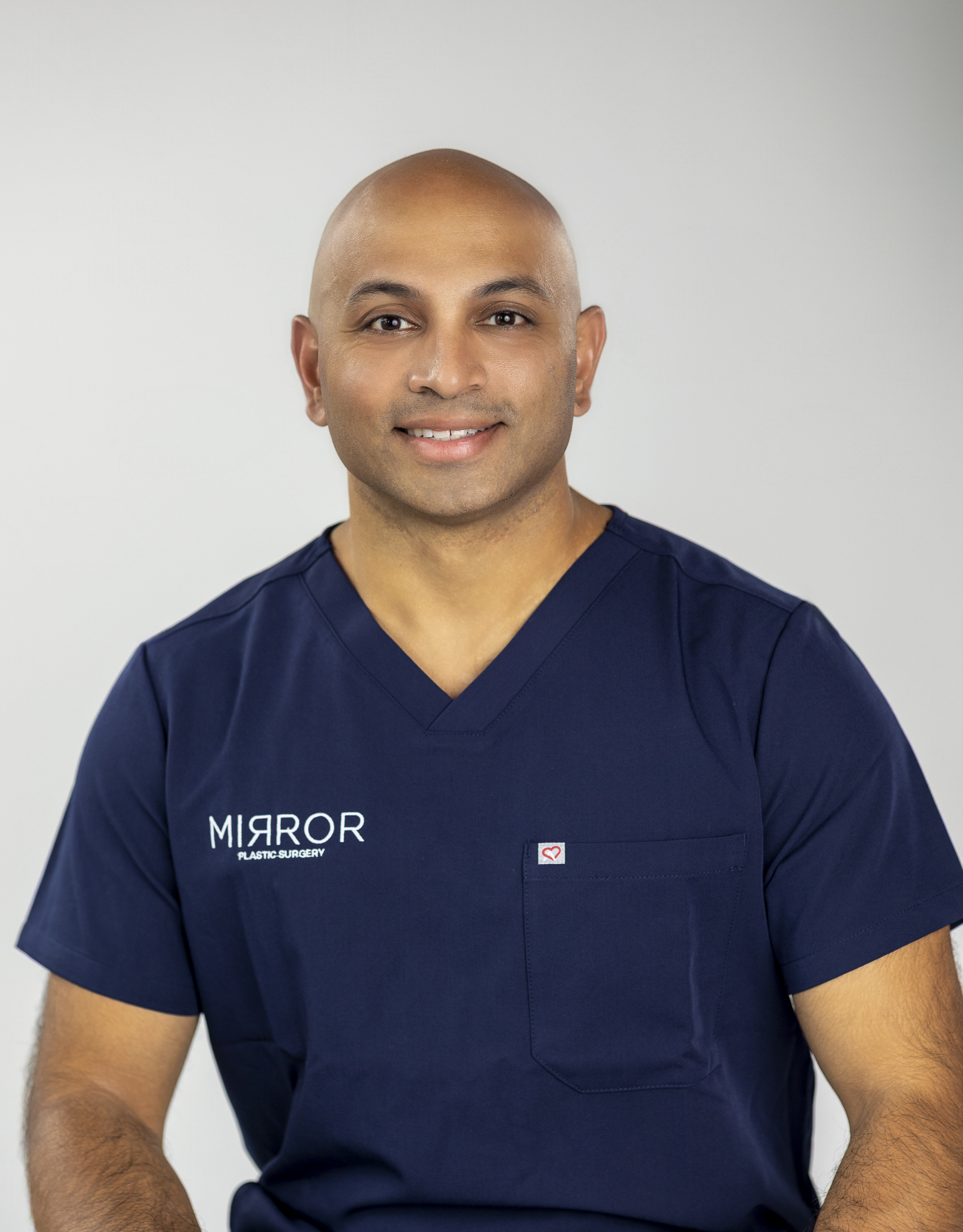
Written by: Dr. Akash Chandawarkar, Board Certified Plastic Surgeon, Mirror Plastic Surgery
Key Takeaways for Buccal Fat Removal at Mirror Plastic Surgery
- Buccal fat removal permanently reduces cheek volume, so every decision starts with a detailed anatomical evaluation.
- Ideal candidates have stable weight, good skin elasticity, and balanced facial proportions. Age, family aging patterns, and facial structure all shape candidacy.
- Long-term hollowing risk rises with age because natural midface volume loss compounds the permanent fat removal, which makes family history review essential.
- Choosing a board-certified plastic surgeon with deep facial anatomy training and a low-volume, safety-first practice model helps minimize complications and supports honest candidacy assessment.
- Schedule your ultrasound-supported facial assessment at Mirror Plastic Surgery to determine whether you are a candidate for buccal fat removal.
What to Expect During a Buccal Fat Removal Consultation at Mirror Plastic Surgery
A meaningful consultation for buccal fat removal goes far beyond a quick photo review. At Mirror Plastic Surgery, Dr. Akash, named to Newsweek’s America’s Best Plastic Surgeons list two years in a row, dedicates a full hour to a top-to-bottom facial assessment before making any recommendation. The practice performs only one to two surgeries per day, so the entire clinical team stays focused on each patient from the first appointment through recovery.
The assessment starts with a structured visual and manual examination. Dr. Akash evaluates cheek fullness at rest, not only during expression. He palpates the buccal fat pad through the cheek to confirm its prominence and reviews preoperative ultrasound measurements of the Bichat fat pad to guide surgical planning. This in-office ultrasound capability supports precise planning and reflects Mirror Plastic Surgery’s safety-first philosophy.
Facial assessment also covers bone structure, skin elasticity, upper-cheek and temple volume, and overall facial proportions from multiple angles. A skilled evaluation examines the whole face, including age, skin quality, bone structure, existing cheek volume, and the likelihood of future volume loss, rather than focusing only on the cheeks.
The consultation framework at Mirror Plastic Surgery follows a deliberate sequence: safety first, function second, aesthetics third. Dr. Akash’s Harvard-MIT medical training, seven-year Johns Hopkins plastic surgery residency, and aesthetic fellowship at the Manhattan Eye, Ear and Throat Hospital (MEETH) provide the anatomical depth needed to distinguish true buccal fat excess from masseter hypertrophy, skeletal width, subcutaneous fat, or skin laxity. These other factors can mimic buccal fullness but require entirely different interventions.
Begin your comprehensive facial assessment with Dr. Akash to start a full evaluation that goes well beyond a surface-level review.
How to Know If You’re a Candidate for Buccal Fat Removal
Candidacy for buccal fat removal depends on objective anatomical criteria, not on the desire for a slimmer face alone. Good candidates typically show persistent lower-cheek fullness at a stable weight that is symmetric and localized to the buccal fat pad area. This fullness must sit within a face that maintains good volume in the upper cheeks, temples, and under-eye area, because removing lower-cheek fat from a face already losing volume elsewhere can accelerate hollowing.
Strong cheekbone structure and reasonable skin elasticity also matter, since they provide the support that helps prevent a gaunt appearance after fat removal. Weight stability for at least 12 months confirms that the fullness represents localized buccal fat rather than fluctuating body fat.
Several objective red flags indicate that buccal fat removal is not appropriate:
- Age under 25. Facial fat distribution continues to evolve through the mid-twenties, which makes early assessment unreliable and extends long-term exposure to hollowing risk.
- Age over 40–45 with early volume loss. After about 40 to 45, fat pads naturally descend and deflate in most patients, so removing fat from a face already showing early volume loss can speed up the aging process.
- Naturally narrow, long, or hollow facial structure. Without prominent cheekbones and baseline fullness, removal can produce a gaunt or prematurely aged appearance.
- Low body-fat percentage or thin skin. Patients with lean or thin faces, minimal cheek fullness, or thin skin rarely benefit from buccal fat removal.
- Family history of significant facial volume loss. The family aging pattern discussed earlier becomes critical here. If relatives show significant thinning through the 40s and 50s, the procedure is usually contraindicated.
- Unrealistic expectations. Candidates need to understand that buccal fat removal creates a subtle, permanent change. Surgeons assess expectations during consultation to avoid operating on patients seeking dramatic, social-media-inspired transformations.
- Unstable weight. Stable weight for at least 6 to 12 months helps confirm that fullness reflects localized buccal fat rather than general body fat.
A board-certified surgeon who sometimes advises against surgery signals quality, not limitation. The clinical question at consultation is not whether the fat can be removed, because that is almost always technically possible. The real question is whether this fat should be removed from this face, given how that face is likely to age.
How Buccal Fat Removal Affects Aging and Hollowing Risk
The most consequential issue in any buccal fat removal consultation involves long-term aging and hollowing risk. The midface naturally loses volume between ages 30 and 60 through aging alone. Buccal fat removal permanently reduces this volume before those changes occur, which increases the chance of compounded hollowing.
Resection of the buccal fat pad has been suggested to speed up the aging process and advance skin-related changes associated with facial aging, while also accentuating low-lying jowls. Long-term follow-up data spanning decades does not yet exist in the published literature, so outcomes in patients in their 50s and 60s remain incompletely characterized.
People who have had buccal fat removal tend to develop a more skeletonized appearance with age in their forties, fifties, and beyond, compared with people who left their buccal fat pads intact.1
Family aging patterns serve as a direct clinical input at Mirror Plastic Surgery. Every consultation for buccal fat removal should include a family photograph review whenever possible, to see how parents, aunts, and older relatives have aged. If the family pattern shows significant thinning through the 40s and 50s, the risk calculus shifts strongly against the procedure.
Some buccal fat removal patients later seek corrective volume restoration because of premature hollowing from the interaction of permanent fat removal and natural aging-related volume loss. Restoration options such as fat grafting or fillers can help, but they rarely produce results as natural as the original buccal fat pad anatomy.
Key Questions to Ask Your Buccal Fat Removal Surgeon
A well-prepared patient gains more value from a consultation. Bring this list to any buccal fat removal appointment:
- Are you board-certified by the American Board of Plastic Surgery, and do you hold hospital admitting privileges?
- How many buccal fat removal procedures do you perform per year, and what is your personal revision rate?
- How much fat do you plan to remove from each side, and how will you maintain symmetry during surgery?
- What is my specific long-term hollowing risk based on my facial anatomy and family aging pattern?
- What technique do you use, and how do you protect the parotid duct and facial nerve branches?
- Is this procedure being performed in an accredited surgical facility?
- What are my options if I develop premature hollowing in 10 to 15 years?
- What findings would lead you to recommend against this procedure for me?
Finding the Right Buccal Fat Removal Surgeon in Tampa Bay
The volume at which a practice operates directly affects the attention each patient receives. High-volume practices that perform five to ten surgeries per day cannot match the individualized assessment that a concierge model offers. Mirror Plastic Surgery limits surgical days to one to two cases, which keeps the focus of Dr. Akash and the entire clinical team undivided throughout every stage of care.
Dr. Akash’s credentials rank among the most rigorous in aesthetic surgery. His medical degree came through the Harvard-MIT Division of Health Sciences and Technology program, where he graduated with Honors. He then completed a seven-year integrated plastic and reconstructive surgery residency at Johns Hopkins University, followed by an aesthetic surgery fellowship at MEETH/Lenox Hill Hospital in New York. He is board-certified by the American Board of Plastic Surgery, holds hospital admitting privileges, and has earned the Newsweek recognition mentioned earlier for two consecutive years.
Operating too close to the facial nerve can cause paralysis, so buccal fat removal should be performed only by experts in facial anatomy. Board certification in plastic surgery, hospital admitting privileges, fellowship training in facial surgery, and surgery in an accredited facility with a board-certified physician anesthesiologist represent the minimum safety standards patients should verify before proceeding. Mirror Plastic Surgery meets all of these standards.
Experience Mirror Plastic Surgery’s concierge assessment model at the St. Petersburg location, where your long-term facial anatomy takes priority over quick bookings.
Recovery Timeline After Buccal Fat Removal
Recovery from buccal fat removal usually follows a predictable pattern.1 Peak swelling occurs around day 3, most patients return to work and normal activity within one to two weeks, and final contour becomes visible after three to six months as residual swelling resolves.1
- Days 1–7: Swelling peaks around day 3 with mild discomfort. A soft diet is recommended, and intraoral incisions require careful oral hygiene.
- Days 7–14: Swelling starts to subside, and most patients resume desk work and light activity.
- Weeks 3–6: Visible improvement in contour appears, and strenuous activity can typically resume.
- Months 3–6: The final result becomes apparent as all swelling resolves. A subtle change, not a dramatic transformation, is the expected outcome.1
Frequently Asked Questions About Buccal Fat Removal at Mirror Plastic Surgery
How should I prepare for a buccal fat removal consultation at Mirror Plastic Surgery?
Bring a list of current medications, any prior surgical history, and photos of family members in their 40s and 50s if available, since Dr. Akash uses family aging patterns as a direct clinical input. Come prepared with your questions and realistic reference photos. Avoid framing goals around a specific celebrity’s appearance, because individual anatomy determines outcomes, not external comparisons. The consultation lasts about one hour and includes a full facial assessment, ultrasound evaluation, and a frank discussion of whether you are a suitable candidate.
Is buccal fat removal performed under general anesthesia?
The procedure can be performed under local anesthesia, light sedation, or general anesthesia, depending on patient preference and the surgical plan. Dr. Akash reviews anesthesia options during the consultation and works exclusively with board-certified physician anesthesiologists at an accredited surgical facility. The anesthesia choice forms part of the safety-first planning process, not a default decision.
How permanent are the results, and can the procedure be reversed?
Buccal fat removal is permanent.1 The buccal fat pad does not regenerate once surgically removed, and the structural change to the midface lasts for life.1 There is no true surgical reversal. If hollowing develops later due to natural aging compounding the surgical volume loss, fat grafting or injectable fillers can improve appearance but do not restore the original anatomical structure. This permanence is a central reason why Mirror Plastic Surgery’s consultation process is so thorough, and only patients with favorable anatomy and long-term projections are advised to proceed.
What is the difference between buccal fat and other types of facial fullness?
The buccal fat pad is a discrete, encapsulated structure located deep in the lower cheek, below the zygomatic bone and above the jawline, behind the muscles of facial expression. It is genetically determined, present from birth, and unaffected by diet or exercise. Facial fullness can also come from masseter muscle hypertrophy, skeletal bone width, subcutaneous fat that responds to weight changes, malar fat compartments, or skin and soft-tissue thickness. Accurate identification of the primary contributor requires hands-on clinical examination and, at Mirror Plastic Surgery, ultrasound evaluation, not a visual assessment alone.
Does Mirror Plastic Surgery ever advise against buccal fat removal?
Mirror Plastic Surgery frequently advises against buccal fat removal when anatomy or aging patterns suggest harm. Patients with naturally narrow or hollow faces, early signs of volume loss, family histories of significant facial deflation, ages outside the mid-20s to early 40s range, or expectations driven mainly by social media trends are often counseled toward alternative approaches or told that no procedure is appropriate at this time. Dr. Akash’s safety-first framework means that the consultation outcome is an honest recommendation, not a sales pitch. Patients who are not candidates for buccal fat removal may be better served by facial fat transfer, structural fillers, or simply monitoring their facial anatomy over time.
Conclusion: Deciding Whether Buccal Fat Removal Fits Your Face
Buccal fat removal ranks among the most permanently consequential procedures in facial aesthetics. The fat does not grow back, natural aging continues to reduce midface volume, and the long-term outcome depends entirely on whether the right anatomy was selected at the right time by a surgeon with the training to make that call accurately. Mirror Plastic Surgery’s hour-long, ultrasound-supported, family-pattern-informed consultation process exists because this decision deserves that level of rigor. Dr. Akash, Harvard-MIT educated, Johns Hopkins trained, MEETH fellowship-completed, and a two-time Newsweek America’s Best Plastic Surgeons honoree, brings that standard to every assessment in Tampa Bay.
Find out whether buccal fat removal aligns with your anatomy, aging trajectory, and long-term goals by scheduling your consultation today.
1 Results may vary from person to person. Editorial content, before and after images, and patient testimonials do not constitute a guarantee of specific results.