
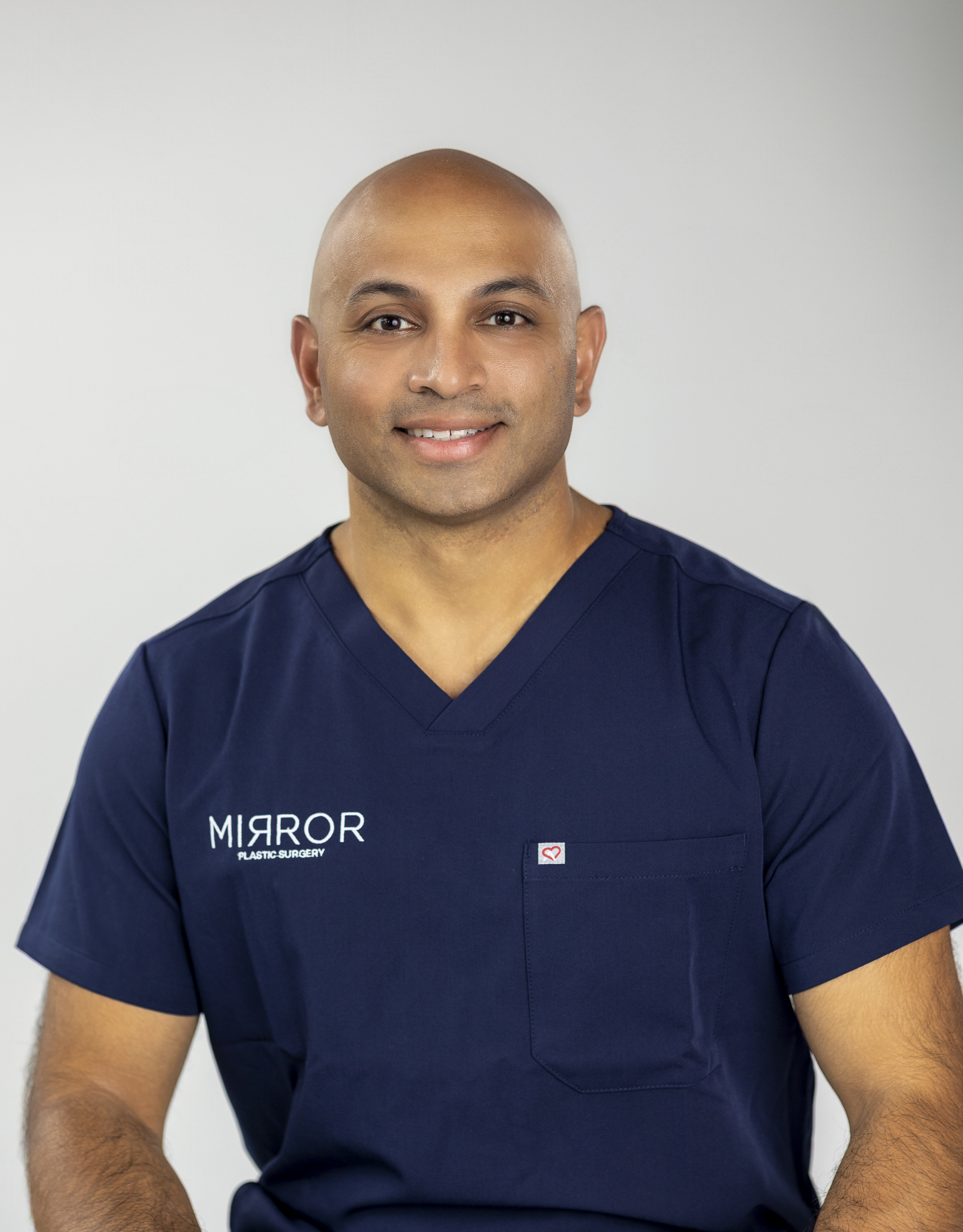
Written by: Dr. Akash Chandawarkar, Board Certified Plastic Surgeon, Mirror Plastic Surgery | Last updated: July 10, 2026
Key Takeaways
- A 2026 BBL at Mirror Plastic Surgery aims for a proportional waist-to-hip change once 30–50% of transferred fat resorbs and swelling settles at 3–6 months.1
- Subcutaneous, ultrasound-guided fat placement by board-certified plastic surgeons in accredited facilities has sharply improved BBL safety and lowered mortality.
- Long-term fat survival typically falls between 50–80%, and surviving cells become permanent living tissue that behaves like native fat with weight changes.1
- Strict 4–6 week sitting restriction and stable weight are the two most controllable factors for strong fat survival and durable results.1
- Schedule your personalized consultation at Mirror Plastic Surgery to review your candidacy and safety profile directly with Dr. Akash.
BBL Safety in 2026 at Mirror Plastic Surgery
The safety profile of Brazilian Butt Lift surgery has changed substantially over the past decade. Three protocol shifts drove the improvement: subcutaneous-only fat placement that avoids the gluteal muscle, intraoperative ultrasound guidance confirming cannula depth in real time, and comprehensive multi-society guidelines from ASPS and ISAPS. The comparison table below shows how these changes translated into lower mortality, fewer pulmonary fat emboli, and more predictable long-term fat retention across the specialty.
| Metric | Pre-Guideline (2017) | Post-Guideline (2019–2026) | Source |
|---|---|---|---|
| Annual BBL mortality rate | Substantially higher | Significantly improved with subcutaneous ultrasound-guided technique | ASERF Task Force / Cansancao et al. |
| Nonfatal pulmonary fat embolism rate | Higher prior to guidelines | Reduced following guideline changes | ASERF follow-up survey |
| Fatal PFE with subcutaneous-only technique | Not tracked separately | No confirmed cases in multiple large series | Post-guideline follow-up surveys |
| Long-term fat retention | 50–80% at 6 months | ABCS / PMC data | |
At Mirror Plastic Surgery, Dr. Akash uses real-time intraoperative ultrasound during every BBL to confirm cannula placement exclusively in the subcutaneous plane. He is certified by the American Board of Plastic Surgery, completed a seven-year integrated residency at Johns Hopkins, and pursued an aesthetic surgery fellowship at Manhattan Eye, Ear and Throat Hospital (MEETH). The practice schedules only one to two surgeries per day so the entire team can focus fully on each patient from induction to recovery.
Realistic BBL Results and Fat Survival
The 50–80% fat survival range mentioned earlier reflects fat cells that successfully establish a blood supply within the first 3–6 months.1 Once integrated, these cells function as permanent living tissue and respond to weight gain or loss in the same way as native fat.
Several technical and patient factors directly influence where an individual falls within that survival range:
- Gentle low-pressure harvesting with small-bore cannulas preserves fat cell integrity.
- Centrifugation at 3,000 rpm for 3 minutes and micro-aliquot reinjection of 0.1–0.5 mL deposits support higher viability.
- Precise placement in subcutaneous layers while avoiding deeper muscle protects fat cells and reduces embolism risk.
- Non-smoking status and a stable BMI at the time of surgery support better healing.
- Strict adherence to the post-operative sitting restriction protects the graft during its most vulnerable phase.
Patients who follow the four-to-six-week sitting restriction closely tend to see stronger long-term fat survival because the graft remains protected while it connects to a new blood supply.1 Surgeons anticipate normal resorption and slightly overcorrect volume within safe anatomical limits so the final contour matches the planned outcome once swelling and early fat loss resolve.1
BBL Mortality Rate and the Role of Ultrasound Guidance
The 2017 ASERF Task Force study confirmed that all BBL deaths were linked to intramuscular fat injection causing pulmonary fat embolism, which explains the elevated mortality rates shown in the earlier safety comparison. Intraoperative ultrasound now allows surgeons to see the cannula tip in real time in relation to the muscle fascia, which helps prevent accidental deep injection.
Modeling published in Aesthetic Surgery Journal projects that continued adherence to subcutaneous-only technique could reduce BBL mortality to between 1 in 25,000 and 1 in 35,000. A 2023 study reported that 92% of BBL deaths in South Florida occurred at high-volume, budget clinics rather than accredited facilities. Facility accreditation, board certification, and daily case volume limits therefore function as direct mortality-reduction variables, not administrative details.
BBL Results Over 20 Years
Long-term BBL outcomes depend primarily on weight stability, skin elasticity, and the volume of fat that survived the initial transfer. The table below maps how transferred fat behaves at each stage of the 20-year timeline, showing when results stabilize, when natural aging begins to influence contour, and when revision procedures often become relevant.
| Time Point | Fat Behavior | Key Variables | Revision Consideration |
|---|---|---|---|
| 0–6 months | 30–50% resorption, volume stabilizes by month 61 | Sitting restriction compliance, swelling resolution | None, results still settling |
| 1–3 years | Surviving fat fully integrated as permanent living tissue1 | Weight stability is the primary determinant | Touch-up fat transfer if donor fat is available |
| 5–10 years | Enhanced shape maintained with stable weight, natural aging begins | Skin elasticity, hormonal changes, lifestyle | Revision considered if significant volume loss develops |
| 10–20 years | Gravity and reduced skin elasticity alter silhouette, improved contour versus pre-surgery often remains | Pregnancy, major weight fluctuation, aging | Buttock lift may address skin laxity if present |
Transferred fat cells respond to weight fluctuations exactly like native fat cells, expanding with weight gain and shrinking with weight loss. Patients who maintain their preoperative body weight usually enjoy the longest-lasting results.1 Pregnancy after BBL can change the outcome because hormonal and metabolic shifts influence the volume of transferred fat cells.
What I Wish I Knew Before a BBL
Informed patients often point to two gaps in typical pre-operative education: how to judge before-and-after photos and how strict recovery restrictions feel in real life.
Photo-Analysis Checklist for BBL Results
- Confirm that photos use the same angle, distance, and lighting in both images.
- Check that the after photo is dated at least 6 months post-surgery, when fat has stabilized.
- Look for consistent clothing or visual reference points to rule out posture manipulation.
- Verify that the named surgeon personally performed the procedure rather than another provider in the clinic.
- Ask whether the patient’s weight changed between photos, since weight stability strongly influences BBL maintenance.
- Request 10-year follow-up photos when available, because few high-volume practices maintain long-term archives.
Two-Week No-Sitting Recovery Protocol
The first two weeks after surgery form the most critical window for fat survival. Evidence supports a structured approach that protects the graft from pressure and supports circulation.
- Zero direct sitting on the buttocks for at least the first two weeks. Injected fat remains soft and mobile during this period, and direct pressure can push it out of place like toothpaste in a tube, which permanently changes the contour. This same pressure principle explains why you must sleep prone or on your side rather than on your back, and why a BBL pillow is required when sitting becomes unavoidable, since it shifts weight to the thighs and keeps pressure off the graft.
- Avoid smoking throughout recovery, because smoking reduces circulation and oxygen delivery and lowers fat graft survival.
- Maintain weight and avoid starting a caloric deficit during the first 6 months after surgery.
- Expect a full sitting restriction of 4–6 weeks for most patients, with final results stabilizing around 6 months once swelling and fat reabsorption complete.
Are BBLs Out of Style in 2026?
Current BBL demand focuses on proportional, anatomy-guided enhancement rather than extreme, artificial volume. Autologous fat transfer creates a softer, more natural look and feel than solid silicone butt implants and also reshapes donor areas such as the abdomen, flanks, and thighs through liposuction. This combination of contouring and augmentation continues to drive steady interest.
The procedures that declined were tied to the pre-2018 era of deep intramuscular injection and high-volume clinic models. The 2022 multi-society Practice Advisory from ASPS, ASAPS, and ISAPS established real-time ultrasound guidance and subcutaneous-only placement as the standard of care, which separated modern evidence-based BBL from the high-risk version that produced earlier mortality statistics. In 2026, a carefully planned BBL by a board-certified surgeon in an accredited facility functions as a different procedure than the one that dominated headlines a decade ago.
BBL Candidate Checklist at Mirror Plastic Surgery
Mirror Plastic Surgery evaluates BBL candidates using a safety-function-aesthetics hierarchy. The criteria below reflect that framework and help determine who benefits most from surgery.
- Safety: Good overall health, no active smoking, BMI within a stable range, no contraindications to general anesthesia, and willingness to complete pre-operative evaluation including ultrasound assessment.
- Safety: Adequate donor fat, usually at least 500–800 cc of purified fat per side for a noticeable change, with very lean patients sometimes not qualifying.
- Function: Realistic understanding that BBL does not correct skin laxity, stretch marks, or sagging from major weight loss, and that patients with loose buttock skin may do better with a buttock lift.
- Function: Commitment to the full sitting restriction and recovery protocol, which directly influences fat survival.
- Aesthetics: Proportional goals based on individual anatomy rather than a specific celebrity or social media image.
- Aesthetics: Completion of family planning when possible, since pregnancy after BBL can change transferred fat volume.
Mirror Plastic Surgery limits its schedule to one to two surgeries per day. This structure allows every pre-operative assessment, intraoperative ultrasound step, and post-operative follow-up to receive full attention from Dr. Akash and the clinical team, which contrasts with high-volume practices where surgeons performing three or more BBLs per day experience higher complication rates.
Frequently Asked Questions
How long does transferred fat last after a BBL?
Fat cells that survive the initial 3–6 month integration period become permanent living tissue.1 They do not have a built-in expiration date and do not require planned replacement. These cells respond to weight changes like native fat, gaining volume with weight gain and losing volume with weight loss. Patients who keep a stable weight after surgery often maintain their results for a decade or longer, with natural aging and skin laxity gradually changing the silhouette over time.
What is the sitting restriction after BBL, and why does it matter?
Most protocols call for avoiding direct pressure on the buttocks for at least two weeks, with a full restriction of four to six weeks for many patients. During this period, transferred fat cells are building a new blood supply and remain vulnerable to compression. Direct pressure can flatten or shift the graft and permanently change the final contour. A BBL pillow that moves weight to the thighs is used when sitting cannot be avoided. The sitting restriction timeline described in the recovery section reflects current evidence on fat cell integration and remains one of the most controllable factors in achieving strong fat survival.
What is the difference between BBL mortality before and after ultrasound guidance?
Before the 2017–2018 guideline changes, BBL carried a significantly elevated mortality rate because fat was often injected into or beneath the gluteal muscle, where it could enter large veins and travel to the lungs as a pulmonary fat embolism. After adoption of subcutaneous-only injection and intraoperative ultrasound guidance, mortality improved in reported series. Follow-up surveys documented no fatal pulmonary fat emboli in cases performed with the subcutaneous technique. In 2026, most remaining risk clusters around medical tourism destinations and non-board-certified practitioners who operate outside accredited facilities.
How much fat should I expect to lose after a BBL?
Patients usually lose 20–50% of the transferred volume during the first 3–6 months, and the remaining 50–80% integrates as permanent tissue.1 Surgeons plan for this by slightly overcorrecting volume within safe anatomical limits. Final volume depends on harvesting technique, fat processing, injection depth, smoking status, and weight stability throughout recovery.
Is a BBL safe when performed at a concierge practice versus a high-volume clinic?
Facility type and daily case volume act as direct safety variables rather than marketing labels. A 2023 study found that 92% of BBL deaths in South Florida occurred at high-volume, budget clinics rather than accredited facilities. Practices that limit daily surgical volume allow the surgeon and anesthesia team to maintain full focus on each patient, reduce operative fatigue, and meet intraoperative ultrasound documentation requirements from the 2022 ASPS/ASAPS/ISAPS Practice Advisory. At Mirror Plastic Surgery, the one-to-two-surgery-per-day model functions as a safety protocol, not a scheduling preference.
Medical Disclaimer
The information in this article is intended for general educational purposes only and does not constitute medical advice, diagnosis, or treatment. Brazilian Butt Lift surgery is a medical procedure with real risks, including but not limited to fat embolism, fat necrosis, asymmetry, seroma, and anesthesia complications. Individual outcomes vary based on anatomy, surgical technique, and adherence to post-operative protocols. All statistics cited reflect published clinical literature and professional society data available as of the article publication date of July 10, 2026. Consult a board-certified plastic surgeon for a personalized evaluation before making any surgical decision.
1 Results may vary from person to person. Editorial content, before and after images, and patient testimonials do not constitute a guarantee of specific results.