
Written by: Dr. Akash Chandawarkar, Board Certified Plastic Surgeon, Mirror Plastic Surgery | Last updated: July 20, 2026
Key Takeaways for St. Petersburg Patients
- Non-surgical cosmetic treatments have surged in popularity nationwide. St. Petersburg residents face accelerated photoaging from Florida’s intense UV exposure, which increases demand for evidence-based options.
- Patients use these treatments to delay surgery, prepare skin before or after procedures, or manage facial volume changes from GLP-1 weight-loss medications.
- Physician-led practices like Mirror Plastic Surgery prioritize safety, function, and aesthetics through extended consultations and supplier-neutral product selection instead of quota-driven recommendations.
- Clear terminology around neuromodulators, HA fillers, RF microneedling, focused ultrasound, and resurfacing helps patients evaluate recommendations and long-term implications.
- Schedule your personalized consultation at Mirror Plastic Surgery to receive an anatomy-focused evaluation of the non-surgical treatments that fit your goals.
The Concierge Care Model at Mirror Plastic Surgery
Mirror Plastic Surgery follows a clear hierarchy that places safety first, function second, and aesthetics third. This sequence reflects a clinical philosophy that guides every treatment recommendation in the practice.
The concierge model gives each patient up to an hour of consultation time for a top-to-bottom anatomical assessment before any treatment is recommended. Non-surgical treatments are planned with the same long-term perspective used for surgical cases. The team evaluates your anatomy, your goals over the next five to ten years, and which combination of treatments best supports your overall well-being. In some cases, that plan includes deliberate restraint from stacking too many procedures.
This patient-centered approach stands in deliberate contrast to many high-volume medspa environments where treatment recommendations may be driven by product quotas, promotional packages, or limited consultation time. At Mirror Plastic Surgery, supplier-neutral product selection means the team chooses the right product in the right amount for your anatomy, not the product with the highest margin or the largest volume.
Meet Dr. Akash: Training, Credentials, and Perspective
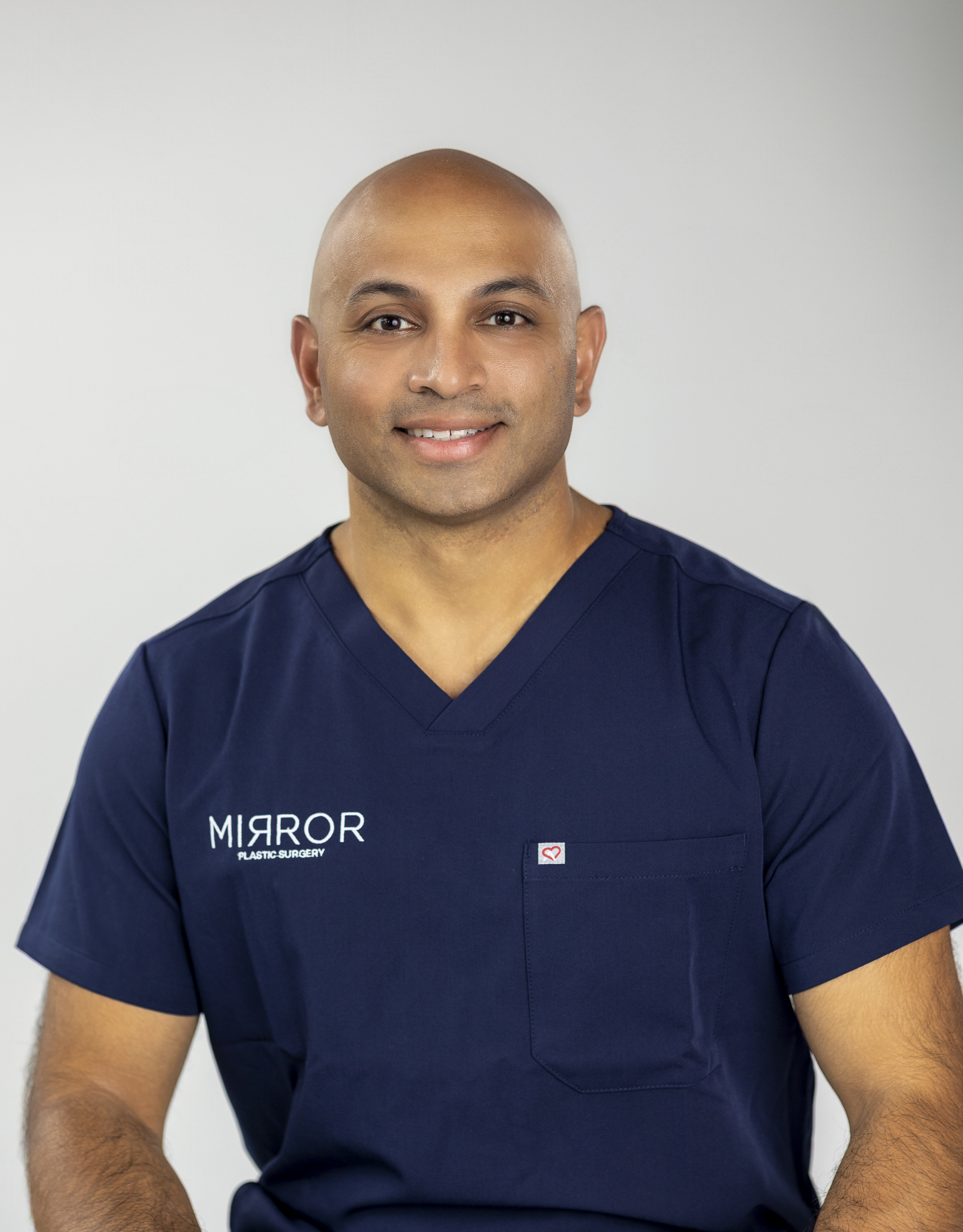
The clinical foundation of Mirror Plastic Surgery is Dr. Akash, a board-certified plastic surgeon with training from several of the most rigorous programs in American medicine. He completed his medical degree through the Harvard-MIT Division of Health Sciences and Technology and graduated from Harvard Medical School with Honors.
His surgical training included a seven-year integrated plastic and reconstructive surgery residency at Johns Hopkins University. He then completed an aesthetic surgery fellowship at the Manhattan Eye, Ear and Throat Hospital (MEETH), one of the most competitive aesthetic fellowships in the country. He also completed the Stanford University Biodesign Innovation Fellowship, which trained him to evaluate emerging technologies with the same critical rigor applied to clinical evidence.
Dr. Akash serves on advisory boards for companies developing technologies such as Morpheus8-adjacent RF platforms, biostimulatory fillers, and minimally invasive facial procedures. This role gives him direct insight into how these devices perform across diverse patient anatomies. He has been named to Newsweek’s America’s Best Plastic Surgeons list two years in a row, including 2025. For patients in St. Petersburg and the broader Tampa Bay area, this depth of training supports non-surgical treatment planning that accounts for long-term surgical implications, which most medspa environments are not equipped to address.
Key Non-Surgical Terms Explained
Clear language around non-surgical aesthetics helps you evaluate recommendations with confidence. The definitions below move from foundational to more advanced concepts.
- Neuromodulators: Injectable proteins derived from botulinum toxin A (brand names include Botox, Dysport, Xeomin, Jeuveau, and Daxxify) that temporarily relax targeted facial muscles to reduce dynamic wrinkles. Complications usually relate to poor injection technique rather than the products themselves, so anatomical knowledge and accurate facial analysis reduce risk.
- Hyaluronic acid (HA) fillers: Gel-based injectables that restore volume and contour by attracting and binding water in the tissue. Results are immediate and reversible with hyaluronidase.1
- Biostimulatory fillers: Injectables such as calcium hydroxyapatite (Radiesse) and poly-L-lactic acid (Sculptra) that stimulate the body’s own collagen production rather than simply adding volume. Effects develop over weeks to months and last longer than HA fillers.1
- Radiofrequency microneedling (RFMN): A minimally invasive device that delivers RF energy through insulated microneedles into the dermis, creating controlled microthermal zones that trigger a wound-healing response with new collagen and elastin. Morpheus8 is the most widely recognized brand in this category.
- Focused ultrasound (Ultherapy): A non-invasive device that delivers micro-focused ultrasound energy to the SMAS layer, the same tissue plane addressed in surgical facelifts, to stimulate collagen without needles or incisions. Ultherapy PRIME received expanded FDA clearance in November 2025 for use on the abdomen and arms as well as the face, neck, and décolleté.
- Fractional resurfacing: Laser or energy-based treatments that create microscopic columns of controlled injury across a fraction of the skin surface. This pattern triggers collagen replacement while leaving surrounding tissue intact to speed healing.
- Non-surgical body contouring: Technologies including cryolipolysis (CoolSculpting), electromagnetic muscle stimulation (Emsculpt Neo), and laser-based fat reduction that modify fat or muscle without incisions.
Current Safety Standards in Non-Surgical Aesthetics
The rapid growth of non-surgical aesthetics has created wide variation in provider qualifications and safety standards. The American Society of Plastic Surgeons has recorded an increase in filler complications attributed to non-physician injectors, driven mostly by vascular occlusion where filler blocks a facial artery and can cause tissue necrosis or blindness.
The FDA has issued several safety communications that matter for patients in Florida. In March 2026 the FDA approved Restylane Contour for temple hollowing, without statements on deep-plane filler technique or injector training requirements. Separately, the FDA issued an October 15, 2025 safety communication warning of burns, scarring, fat loss, disfigurement, and nerve damage associated with certain uses of RF microneedling devices.
The current standard of care for non-surgical treatments requires anatomical knowledge sufficient to avoid vascular structures during injections. It also requires proper device settings tailored to individual skin type and tissue depth, plus a long-term maintenance plan that considers how treatments interact with each other and with potential future surgery. RFMN treatment before a surgical facelift may cause excessive skin tightening, dermal scarring, tissue adhesions, and altered SMAS composition, which can complicate surgical flap elevation and healing. A surgeon-led practice is uniquely positioned to evaluate these interactions.
Major Decision Factors for Non-Surgical Treatment
Choosing a non-surgical treatment involves several intersecting factors. The table below compares key metrics across primary treatment categories, using figures from peer-reviewed and clinical sources cited inline.
| Treatment Category | Typical Downtime | Longevity of Results | Ideal Candidate Profile |
|---|---|---|---|
| Neuromodulators (Botox, Dysport) | No downtime, avoid strenuous activity 24 hrs | 3–4 months | Adults with dynamic wrinkles, late 20s through 60s |
| HA Dermal Fillers | 2–5 days mild swelling or bruising | 6–18 months, some up to 2 years | Mild-to-moderate volume loss, not suitable for severe laxity |
| RF Microneedling (e.g., Morpheus8) | 2–4 days redness and swelling | 12–24+ months, maintenance every 12–24 months | Mild-to-moderate laxity, acne scarring, crepey skin, not for significant jowling |
| Focused Ultrasound (Ultherapy) | Minimal, temporary redness or tenderness | 12–24+ months, maintenance as aging continues | Mild-to-moderate laxity with good skin quality and remaining elasticity |
Beyond the table metrics, patients should weigh the functional implications of each treatment, specifically how today’s non-surgical choices might affect tomorrow’s surgical options. A board-certified plastic surgeon can assess whether a proposed non-surgical plan might complicate future surgical procedures, a conversation that is rarely available in a medspa setting.
Treatment Categories Available in St. Petersburg
Neuromodulators and Injectables: Best Botox in St. Petersburg, FL
Neuromodulators remain the highest-volume non-surgical treatment in the United States. ASPS 2023 data show that neuromodulator injections alone, at 9.5 million treatments, outnumber the combined total of all cosmetic surgical procedures.
At Mirror Plastic Surgery, neuromodulator treatments begin with full facial analysis to avoid the flattened or frozen appearance that follows anatomically uninformed injection patterns. Biostimulatory fillers such as Sculptra and Radiesse are chosen when the goal is long-term collagen stimulation rather than immediate volume alone. Sculptra achieved a 71.6% responder rate at 12 months for cheek wrinkle correction in a peer-reviewed study published in the Journal of Drugs in Dermatology.1
Energy-Based Devices for a Non-Surgical Facelift in St. Petersburg, FL
The term “non-surgical facelift” describes a combination approach using injectables and energy-based devices to address mild-to-moderate volume loss, skin laxity, and surface texture. Non-surgical results are temporary and require ongoing maintenance, while surgical facelifts often maintain visible benefits for 10 years or longer.1 For patients not yet ready for surgery, a well-planned non-surgical approach can meaningfully delay that decision.
Morpheus8 vs. Ultherapy in St. Petersburg: Non-Surgical Skin Tightening
Morpheus8 and Ultherapy both address skin laxity but use different mechanisms and tissue depths. Morpheus8 uses RF microneedling with gold-plated needles that penetrate up to 4 mm to remodel dermis and subdermal fat, triggering collagen production for structural tightening and skin resurfacing.
Ultherapy uses focused ultrasound energy that reaches the SMAS layer, the same layer addressed during surgical facelifts, making it the deepest non-surgical penetration option for brow, neck, and chin lifting. The choice between them depends on laxity severity, skin type, pain tolerance, and whether your long-term plan includes surgery. Neither device is universally superior, so candidacy requires individualized assessment.
Non-Surgical Body Contouring Options
Technologies such as cryolipolysis, Emsculpt Neo, and laser-based fat reduction treat localized fat and mild skin laxity without incisions. Ideal candidates are patients close to their goal weight who have localized fat pockets or mild-to-moderate skin laxity and who understand that results are gradual and modest rather than dramatic.1 When the pinch test reveals significant skin redundancy, surgical body contouring becomes the appropriate recommendation.
Lasers, Peels, and Fractional Resurfacing for Sun Damage
For St. Petersburg patients managing photoaging, fractional laser resurfacing and chemical peels target pigmentation, texture, and superficial laxity. Aggressive treatments such as ablative lasers and deep chemical peels should be scheduled in autumn or winter in high-UV regions to reduce the risk of post-procedure hyperpigmentation.
Strict daily broad-spectrum SPF 30+ use remains non-negotiable before and after any energy-based or resurfacing treatment in Florida’s climate.
Common Misconceptions About Non-Surgical Treatments
Misconception: Non-surgical treatments carry no meaningful risk. Vascular occlusion from filler injection is a medical emergency, which is why hyaluronidase must be kept on-site at any facility performing hyaluronic acid filler injections to allow emergency reversal. Similarly, RF microneedling carries the FDA-documented risks mentioned earlier when untrained operators use improper settings.
Misconception: Any licensed provider can safely perform these treatments. The American Society for Dermatologic Surgery reports that filler complication rates correlate inversely with injector training depth rather than the specific filler brand. Provider credentials and anatomical training remain the primary determinants of safety.
Misconception: Combining multiple treatments always produces better results. Combining treatments without appropriate intervals or anatomical planning can cause excessive inflammation, prolonged swelling, and higher risk of post-inflammatory hyperpigmentation. When combining laser resurfacing with dermal fillers, laser treatment should come first, with a 2–4 week interval before filler placement so the inflammatory response does not affect recently placed filler. More importantly, repeated RFMN treatments increase the risk of dermal fibrosis and tissue adhesions that can complicate future facelift surgery.
Frequently Asked Questions
How do I know if I am a candidate for non-surgical treatments rather than surgery?
Candidacy depends on the degree of skin laxity, volume loss, and structural change in your anatomy. Non-surgical treatments produce meaningful improvements for mild-to-moderate concerns such as early jowling, moderate volume loss, surface texture irregularities, and fine-to-moderate wrinkles.
When significant skin redundancy, pronounced jowling, or deep structural changes are present, non-surgical options alone rarely achieve the desired outcome. A board-certified plastic surgeon is best positioned to make this distinction because they can evaluate your anatomy in the context of both non-surgical and surgical options at the same visit.
What safety signals should I watch for after injectable treatments?
Mild swelling, bruising, and tenderness at injection sites are expected and usually resolve within a few days. Symptoms that require immediate medical attention include sudden skin blanching or mottling, severe disproportionate pain, or any vision changes within 24 hours of filler injection.
These symptoms may indicate vascular occlusion, which is a medical emergency that requires immediate hyaluronidase reversal. Any facility performing hyaluronic acid filler injections should have hyaluronidase on-site. If you experience these symptoms after treatment at any facility, seek emergency care immediately.
How should I prepare for non-surgical treatments in Florida’s climate?
Sun protection forms the foundation of safe non-surgical treatment in Florida. Daily broad-spectrum SPF 30+ sunscreen applied every morning and reapplied every two hours during outdoor exposure is mandatory, especially in the weeks surrounding energy-based or resurfacing procedures.
Ablative laser treatments and deep chemical peels are best scheduled in autumn or winter to lower the risk of post-procedure hyperpigmentation. Retinoids and other topical actives increase photosensitivity, so consistent SPF use remains essential during any active treatment regimen.
How do non-surgical treatments interact with future surgical plans?
Non-surgical choices today can shape what is possible surgically later. Repeated RF microneedling treatments can create subcutaneous fibrosis that makes tissue planes adherent during future facelift surgery, which increases technical difficulty.
Extensive prior filler use can alter tissue planes and may require additional procedures such as fat transfer to correct volume irregularities before or during surgery. Patients who expect to pursue surgical rejuvenation later benefit from having a plastic surgeon design their non-surgical plan with these long-term implications in mind.
How often do non-surgical treatments need to be repeated?
Maintenance frequency varies by treatment type. Neuromodulators usually require repeat treatment every three to four months to maintain effect. Hyaluronic acid fillers last six to eighteen months depending on product and placement.
RF microneedling and focused ultrasound results typically last twelve to twenty-four months, with maintenance sessions recommended as natural aging continues. Biostimulatory fillers such as Sculptra and Radiesse stimulate collagen for longer periods, with effects developing over several months and lasting up to two years or more. A long-term maintenance plan created at consultation helps you avoid reactive, one-off treatment cycles.
Education, Expectations, and Long-Term Planning
Non-surgical cosmetic treatments offer real, measurable improvements when chosen with anatomical precision and realistic expectations. Non-surgical skin tightening can improve skin laxity, yet it does not match the transformation of surgery.1 Knowing this distinction before treatment supports a more satisfying outcome.
Patients who benefit most from non-surgical care view it as part of a long-term plan rather than a single quick fix. That plan requires a provider who understands the full spectrum of options, can recognize when non-surgical treatment is appropriate and when it is not, and will communicate both with equal honesty. At Mirror Plastic Surgery, that standard guides every consultation.
1 Results may vary from person to person. Editorial content, before and after images, and patient testimonials do not constitute a guarantee of specific results.