
Written by: Dr. Akash Chandawarkar, Board Certified Plastic Surgeon, Mirror Plastic Surgery
Key Takeaways
-
Surgeon selection drives BBL safety and long-term satisfaction in Tampa Bay more than any other factor.
-
Verify American Board of Plastic Surgery certification, confirm hospital privileges, and check facility accreditation before scheduling surgery.
-
Florida law requires real-time ultrasound guidance during fat injection, so patients should confirm this technology is used in every case.
-
Low-volume practices that perform one to two procedures per day support better focus, planning, and follow-up than high-volume models.
-
Schedule a personalized consultation with Mirror Plastic Surgery to review credentials, discuss ultrasound protocols, and confirm your candidacy for a safe, successful BBL.
How to Verify a Tampa Bay BBL Surgeon’s Qualifications
The American Board of Plastic Surgery (ABPS) maintains a public verification tool that confirms whether a surgeon holds active board certification in plastic surgery. ABPS certification requires completion of an accredited plastic surgery residency, passage of written and oral examinations, and ongoing maintenance of certification. Surgeons advertising cosmetic or aesthetic credentials from non-ABPS boards have not met the same training threshold and should be evaluated with that difference in mind.
Hospital privileges represent a separate but equally important credential. A surgeon with active privileges at an accredited hospital has undergone independent peer review of training, outcomes, and professional conduct. In the rare event of a serious BBL complication that requires emergency intervention, a surgeon with hospital privileges can manage that complication within a hospital system instead of transferring care to an unfamiliar team.
Florida’s 2023 law (HB 1471) requires surgeons performing BBL procedures to use real-time ultrasound guidance during fat injection. This mandate targets the primary mechanism of the procedure’s most serious complication, which is inadvertent intravascular fat injection. Ultrasound guidance allows the surgeon to visualize the injection cannula in real time and confirm placement within the subcutaneous plane rather than the gluteal vasculature. Patients should ask any prospective surgeon directly whether ultrasound guidance is used in every BBL case and whether the equipment is present in the operating suite.
Facility accreditation through organizations such as the Accreditation Association for Ambulatory Health Care (AAAHC) or the Joint Commission confirms that the surgical environment meets standardized safety protocols for equipment, staffing, emergency preparedness, and infection control. Once these safety foundations are in place, you can more confidently compare practice style and surgical volume.
Verify Dr. Akash’s credentials and ultrasound protocols during a personalized consultation to discuss your candidacy in detail.
Why Surgical Volume Matters for BBL Safety
Some Tampa Bay practices schedule five to ten BBL procedures per day. This high-throughput model compresses the time a surgeon spends on pre-operative planning, intraoperative technique, and post-operative monitoring for each patient. Fat harvesting quality, purification method, injection depth precision, and real-time anatomical assessment all require sustained attention that becomes harder to maintain as case volume increases within a single day.
A low-volume model, which limits the surgical day to one or two procedures, preserves the surgeon’s focus and the care team’s capacity to respond to intraoperative findings. Surgeon technique, including gentle fat harvesting, proper purification, strategic injection depth, and avoiding over-injection, is the most critical factor in maximizing long-term fat survival. These technical variables stay more consistent when the surgeon is not managing fatigue or time pressure from a long queue of cases.
Low-volume practices also support more substantive pre-operative consultation. A thorough anatomical assessment that evaluates donor site distribution, gluteal tissue characteristics, skin laxity, and proportional goals requires time that high-volume scheduling often does not allow. Post-operative follow-up quality follows the same pattern, because a practice performing two surgeries per day has more capacity to monitor recovery, answer questions, and identify early complications than one managing ten.
Key BBL Technical Terms Explained
360 Liposuction: Circumferential liposuction that addresses the abdomen, flanks, lower back, and posterior trunk in a single operative session. When combined with BBL, 360 liposuction maximizes fat harvest volume and creates waist-to-hip ratio enhancement from all viewing angles, not only the posterior. The technique requires the surgeon to reposition the patient during surgery and maintain consistent contouring across anatomical zones.
Fat Grafting Survival: Not all transferred fat cells establish a permanent blood supply. Once transferred fat establishes a blood supply within three to six months after a Brazilian Butt Lift, 60–80% of the fat survives and the results are considered permanent.1 The surviving fraction depends on harvesting technique, processing method, injection volume per pass, and patient adherence to post-operative positioning protocols.
Revision BBL: A secondary procedure performed to address asymmetry, volume loss, contour irregularities, or donor-site deformities from a prior BBL. Revision cases are technically more complex than primary procedures because scar tissue alters tissue planes and fat distribution. Selecting a qualified surgeon for the primary procedure remains the most effective strategy for avoiding revision.
Understanding these technical factors makes a surgeon’s training and credentials more meaningful, because you can better judge who is equipped to manage these details safely.
Dr. Akash: Training, Experience, and Recognition
Dr. Akash completed his undergraduate studies at MIT in neuroscience and nuclear engineering before entering the Harvard-MIT Division of Health Sciences and Technology, one of the most selective physician-scientist training programs in the United States. He graduated from Harvard Medical School with Honors. His surgical training took place in a seven-year integrated plastic and reconstructive surgery residency at Johns Hopkins University, which included rotations at the Johns Hopkins Hospital, the R Adams Cowley Shock Trauma Center, and the Curtis National Hand Center.
After residency, Dr. Akash completed an aesthetic surgery fellowship at the Manhattan Eye, Ear and Throat Hospital (MEETH) at Lenox Hill, a program recognized as one of the most competitive aesthetic fellowships in the country. He also completed the Stanford University Biodesign Innovation Fellowship, which provided training in medical device development and clinical innovation. He is board certified by the American Board of Plastic Surgery and holds active hospital privileges, so complications can be managed within a hospital system if needed.
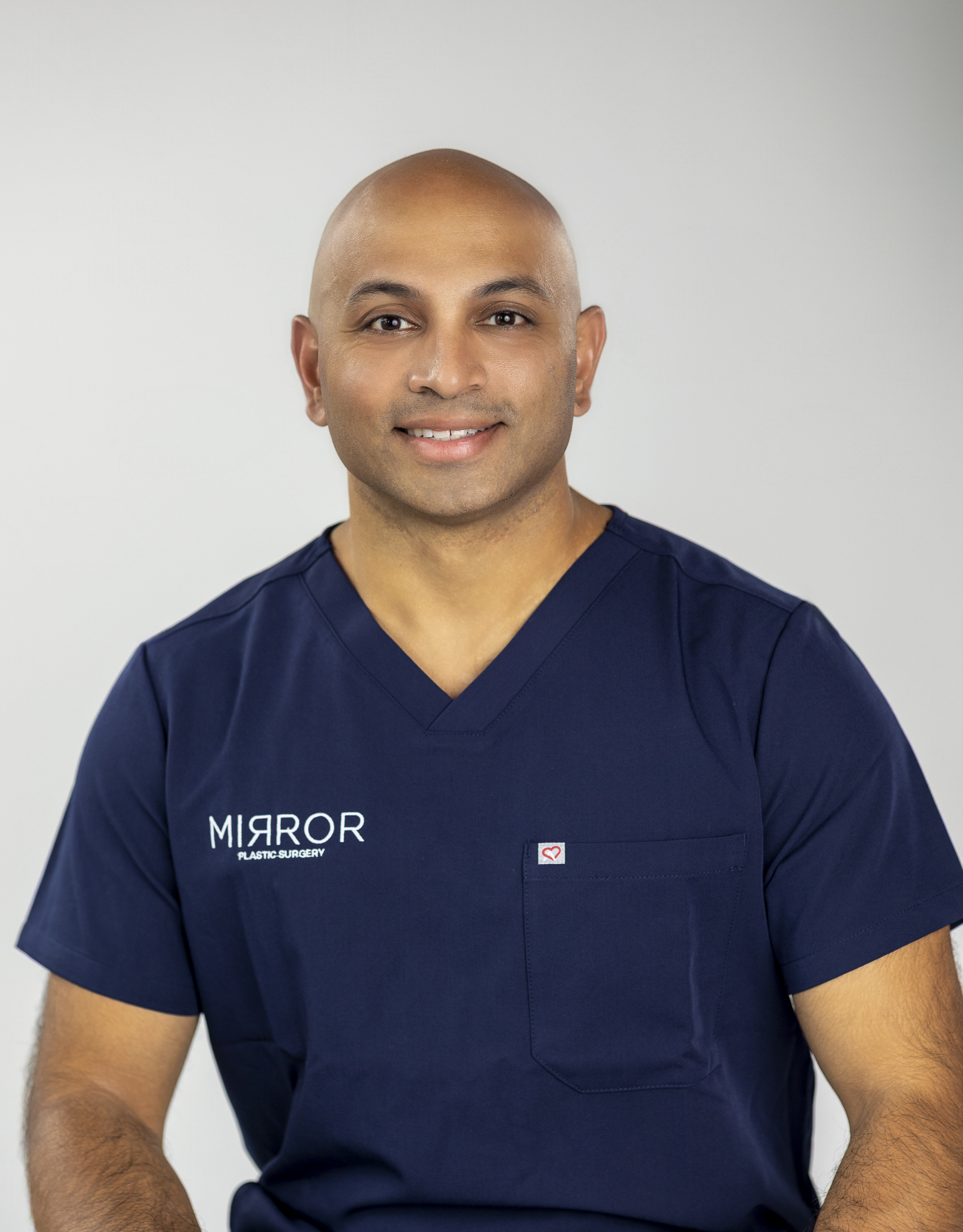
Dr. Akash has been named to Newsweek’s America’s Best Plastic Surgeons list two years in a row, including 2025. He serves on the editorial board of the Aesthetic Surgery Journal as a Next Generation Editor, has testified before the FDA on breast implant safety, and serves on advisory boards for companies developing technologies in breast augmentation, body contouring, and minimally invasive facial procedures.
Discuss your goals with a Harvard-trained, Johns Hopkins-residency-trained surgeon at Mirror Plastic Surgery’s St. Petersburg location.
Candidacy, Recovery, and Long-Term Results
Ideal BBL candidates have sufficient donor fat for harvest, realistic proportional goals, and stable body weight, which directly influence the procedure’s technical feasibility and outcome quality. Medical conditions that increase anesthetic or surgical risk must be absent or well controlled, because BBL requires extended operative time under anesthesia. A BMI under 30 is generally associated with better fat survival and lower complication rates, since excess adipose tissue can compromise blood supply to transferred fat.1 Patients who smoke, have uncontrolled metabolic conditions, or are planning significant weight changes after surgery are typically counseled to address those factors before proceeding.
Recovery milestones include avoiding direct pressure on the buttocks for the first several weeks, as newly injected fat remains malleable and unstable during this period and is vulnerable to migration from direct pressure. Most patients return to sedentary work within two to three weeks and resume full activity by six to eight weeks.1 Final results are typically assessed at six months, the point at which fat survival has stabilized as described earlier.1
Long-term durability is well documented when fat survives the initial healing phase. BBL results beyond ten years typically show sustained enhancement compared to pre-surgery when fat survives properly and weight remains stable, though natural aging produces gradual changes in skin elasticity and tissue position.1 Maintaining body weight within 10–15 pounds of post-procedure weight preserves volume and proportions, because significant weight loss reduces buttock volume while weight gain can alter distribution unpredictably.1
Anesthesia Choices and Facility Safety Standards
BBL procedures are performed under either general anesthesia or deep sedation, sometimes called an awake BBL. General anesthesia administered by a board-certified physician anesthesiologist in an accredited facility provides a highly controlled environment for a procedure of this complexity and duration. Awake or sedation-based approaches may reduce certain anesthetic risks but require careful patient selection and a surgeon experienced in managing patient movement and comfort during fat injection.
Regardless of anesthesia type, the facility must be accredited, equipped for emergency intervention, and staffed by personnel trained in advanced cardiac life support. Patients should confirm facility accreditation status directly and ask whether a board-certified physician anesthesiologist, not a nurse anesthetist operating independently, will be present throughout the procedure.
Frequently Asked Questions
How do I verify that a Tampa Bay BBL surgeon is board certified?
The American Board of Plastic Surgery maintains a free public verification tool at abplasticsurgery.org. Enter the surgeon’s name to confirm active certification status. Board certification in plastic surgery requires completion of an accredited residency and passage of both written and oral examinations, while certifications from non-ABPS cosmetic boards do not carry the same training requirements and are not equivalent.
What questions should I ask during a BBL consultation?
Ask whether the surgeon uses real-time ultrasound guidance during fat injection, how many BBL procedures they perform per day, whether the facility is accredited, and whether a board-certified physician anesthesiologist will be present. Request before-and-after photographs of patients with similar anatomy and goals. Ask about the surgeon’s protocol for managing complications and whether they hold hospital privileges.
How long does BBL recovery take, and when are final results visible?
Most patients avoid direct sitting pressure on the buttocks for two to six weeks after surgery by using a BBL pillow or modified positioning.1 Return to work and activity follows the timeline detailed in the recovery section above, with most patients resuming sedentary work within two to three weeks. Swelling resolves gradually over three to six months, and final results are assessed at the six-month mark once fat survival has stabilized.1
How long do BBL results last?
As noted in the longevity section, fat that survives the initial healing phase is considered permanent, though maintaining stable weight is essential for preserving results.1 Significant weight fluctuations cause transferred fat cells to expand or shrink proportionally, which alters contour. Natural aging affects skin elasticity over time but does not remove the structural enhancement created by the procedure.
What is a revision BBL, and how can it be avoided?
A revision BBL addresses volume loss, asymmetry, or contour irregularities from a prior procedure. Revision cases are more technically demanding than primary procedures because scar tissue from the initial surgery alters tissue planes and complicates both liposuction and fat injection. The most effective way to avoid revision is selecting a board-certified plastic surgeon with specialized body contouring training and a low-volume surgical model for the primary procedure.
Conclusion: Making a Safe BBL Choice in Tampa Bay
Selecting a BBL surgeon in Tampa Bay requires evaluating credentials, facility standards, surgical volume, and compliance with Florida’s 2026 ultrasound mandate, rather than comparing promotional pricing or booking speed. Board certification by the American Board of Plastic Surgery, active hospital privileges, an accredited facility, a board-certified anesthesiologist, real-time ultrasound guidance, and a low-volume surgical day form the non-negotiable criteria that define a safety-first practice.
Mirror Plastic Surgery limits its surgical schedule to one to two procedures per day, uses ultrasound in pre-operative assessment, and operates in accredited facilities with board-certified physician anesthesiologists. The practice is led by Dr. Akash, the Harvard-MIT and Johns Hopkins-trained plastic surgeon whose credentials are detailed above.
Begin your thorough, personalized evaluation at Mirror Plastic Surgery, located at 780 4th Ave S, St. Petersburg, FL 33701, or call 727-361-6515.
1 Results may vary from person to person. Editorial content, before and after images, and patient testimonials do not constitute a guarantee of specific results.