
Written by: Ellie Pranckevicius, FNP-BC, Aesthetic Nurse Practitioner & Aesthetic Injector | Facial Restoration & Regenerative Injectable Specialist, Mirror Plastic Surgery | Last updated: July 3, 2026
Key Takeaways
- Florida telehealth providers must establish a valid practitioner-patient relationship and document medical necessity before prescribing semaglutide.
- Baseline labs and a complete medical history review protect patient safety; skipping either step increases clinical and regulatory risk.
- Compounded semaglutide quality varies by pharmacy, so patients should look for cGMP-compliant facilities that perform third-party batch testing.
- Local concierge models in Florida often provide clearer licensing transparency, direct practitioner access, and structured follow-up than many national telehealth platforms.
- Patients ready for a supervised GLP-3R protocol can schedule a consultation at Mirror Plastic Surgery for personalized lab review and care.
Florida Telehealth Rules for Prescribing Semaglutide
Florida’s telehealth statute (F.S. 456.47) allows registered out-of-state practitioners to provide telehealth services, including prescribing, to Florida patients after completing an appropriate patient evaluation. These practitioners do not need an active Florida license, but they must still meet Florida’s standard of care. For controlled or higher-risk medications, documented medical necessity functions as a baseline requirement, not an optional extra.
By 2026, regulators have increased scrutiny of compounding pharmacies at both federal and state levels. The FDA has issued repeated warnings about outsourcing facilities that produce compounded semaglutide outside current good manufacturing practice (cGMP) standards. Florida telehealth practitioners are expected to honor these federal quality standards alongside state licensing rules. Prescribing without a careful history review or lab documentation exposes both provider and patient to avoidable legal and clinical risk.
Who May Not Qualify for Semaglutide
Clinicians determine semaglutide eligibility only after a detailed medical history review and, in most responsible protocols, laboratory analysis. Standard contraindications include:
- Personal or family history of medullary thyroid carcinoma (MTC)
- Multiple Endocrine Neoplasia syndrome type 2 (MEN 2)
- Active or prior pancreatitis
- Severe gastrointestinal disease
- Pregnancy or planned pregnancy
- Hypersensitivity to semaglutide or any formulation component
Required baseline labs typically include thyroid function, liver enzymes, kidney function markers, fasting glucose, HbA1c, and a lipid panel. Hormone panels may be added when the clinical picture suggests a hormonal contribution. Any telehealth provider that skips baseline labs before prescribing introduces meaningful patient risk.
To ensure your protocol starts with a complete baseline assessment, schedule a lab-focused consultation with Ellie and clarify whether semaglutide or a next-generation GLP-3R protocol better fits your profile.
Compounded vs. Brand-Name Semaglutide in Florida
Compounded semaglutide is not FDA-approved. Compounding pharmacies operate under a different regulatory framework than manufacturers of branded drugs, and quality standards vary widely between facilities. Documented concerns include:
- Inaccurate active ingredient concentration, with doses that may be higher or lower than labeled
- Sterility failures in facilities that do not follow cGMP standards
- Use of semaglutide salt forms, such as semaglutide sodium, that differ structurally from the base compound in FDA-approved products
- Lack of third-party batch testing in some supply chains
- Adverse event reports submitted to the FDA involving compounded versions, including hospitalizations
FDA-approved brand-name semaglutide products undergo strict manufacturing controls, clinical trial validation, and post-market surveillance. Patients often experience tradeoffs in access and cost. The clinical risk associated with compounded versions relates mainly to sourcing and oversight quality, not the molecule itself. A medically supervised protocol that uses verified, cGMP-compliant compounding pharmacies with documented batch testing can narrow this risk gap significantly.
How to Check a Telehealth Provider’s Oversight
Patients can protect themselves by confirming several oversight details before starting any telehealth semaglutide protocol:
- Florida license status: Confirm that the prescribing practitioner holds an active Florida license using the Florida Department of Health MQA portal.
- Lab review policy: Ask whether baseline and follow-up labs are required, strongly recommended, or treated as optional.
- Pharmacy sourcing: Confirm that the compounding pharmacy is FDA-registered as an outsourcing facility and performs batch testing.
- Follow-up frequency: Clarify whether check-ins occur on a set schedule or only when the patient initiates contact.
- Direct practitioner access: Determine whether you will communicate directly with the prescribing clinician or primarily with customer-service staff.
Provider Comparison: National Telehealth vs. Local Concierge Care
The following comparison highlights how national telehealth platforms and local concierge practices differ across oversight areas that strongly influence safety, personalization, and long-term outcomes.1
| Oversight Dimension | National Telehealth Models | Local Concierge Approach |
|---|---|---|
| Lab review frequency | Varies, and some platforms do not require baseline labs | Baseline labs reviewed before protocol initiation, with follow-up panels included in ongoing care |
| Ongoing support model | Often asynchronous messaging or scheduled video, with inconsistent direct practitioner access | Direct 24/7 text access to the prescribing practitioner and scheduled telemedicine follow-ups |
| Sourcing standards | Variable, and some platforms do not disclose pharmacy cGMP status or batch testing | Sourcing from reputable providers with documented batch testing and quality verification |
| Florida licensing status | Variable, and some national platforms may not use prescribers with active Florida licenses | Florida-licensed practitioner with in-state oversight and a physical location in St. Petersburg |
To see how this concierge model compares with your current options, request a one-on-one protocol comparison with Ellie.
Ellie’s Training and Clinical Background
Our lead practitioner, Ellie, holds a Bachelor’s in Health Science from Boston University on a premedical track, completed an aesthetics licensure program, and earned both her Bachelor’s and Master’s in Nursing from the University of South Florida. She then spent four years as a clinician in the Neuroscience ICU at Tampa General Hospital, managing complex patients and building deep expertise in physiology, metabolic health, and recovery.
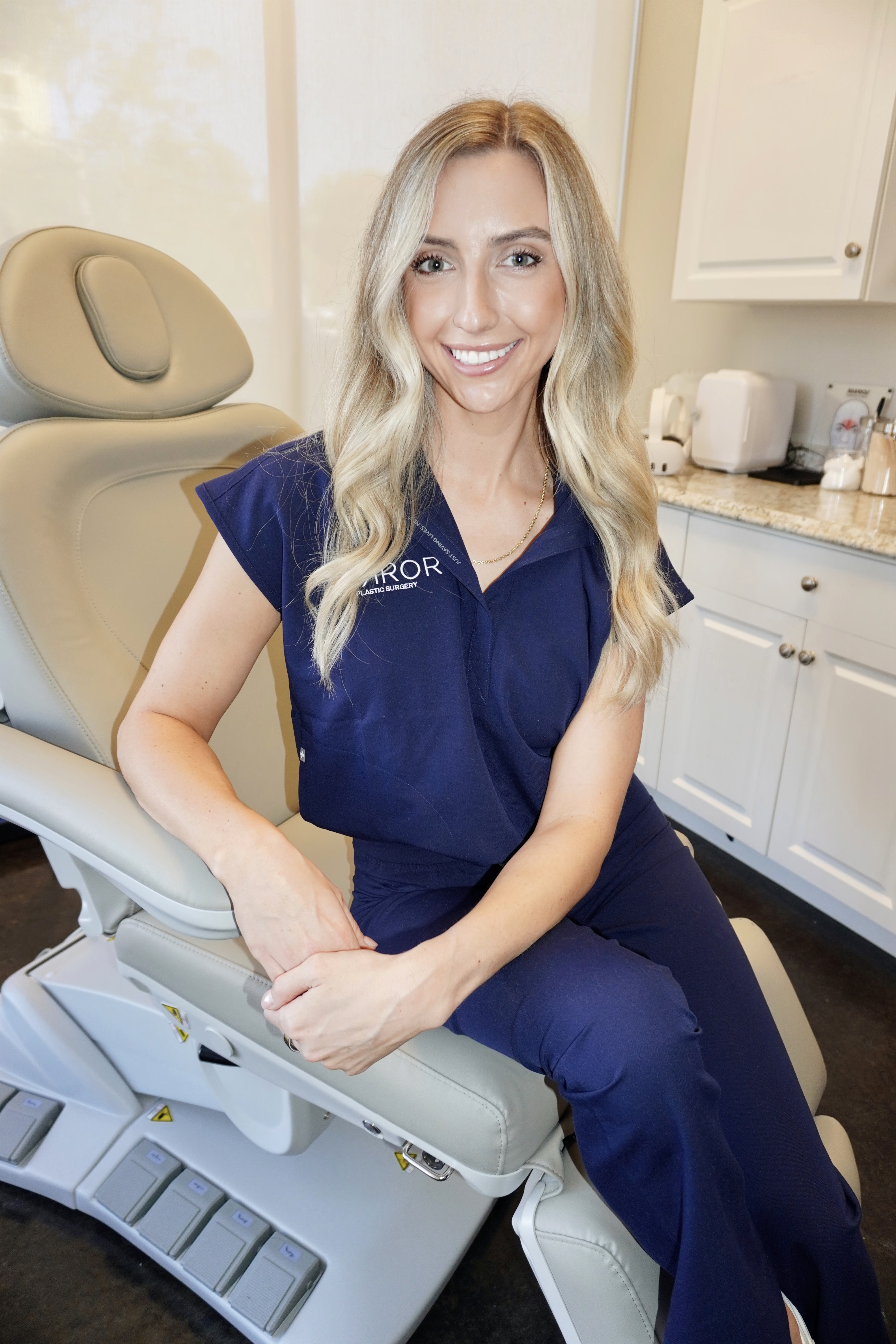
Ellie began her career at a high-end medical spa in Boston, which gave her a strong foundation in skin physiology and aesthetic assessment before she pursued nurse practitioner credentials. This combination of esthetician training and advanced clinical nursing remains uncommon in the telehealth weight-management space and shapes how she evaluates candidates for GLP-3R protocols.
Her approach centers on education and clear explanation. She breaks down the physiology behind each recommendation in plain language and often advises patients to delay or decline services that do not yet match their needs. When surgical support becomes appropriate, her work is complemented by a Harvard-educated, Johns Hopkins-trained plastic surgeon with fellowship training at Manhattan Eye Ear & Throat Hospital.
Semaglutide, GLP-3R, and Formulation Differences
Semaglutide is a GLP-1 receptor agonist first developed for type 2 diabetes and later approved for chronic weight management. It mimics the glucagon-like peptide-1 hormone, which reduces appetite and slows gastric emptying.
GLP-3R describes a newer-generation peptide formulation that builds on GLP-1 mechanisms while engaging additional metabolic pathways. Reported characteristics of GLP-3R formulations include a lower rate of gastrointestinal side effects compared with earlier GLP-1 agents, a reduced likelihood of lean muscle mass loss, and broader indications that span insulin resistance, cardiovascular risk factors, and weight management.1 Mirror Plastic Surgery’s concierge GLP-3R protocol applies this formulation within a supervised, lab-reviewed framework.
FDA-approved semaglutide products have undergone full clinical trial validation. Compounded versions have not, so their safety profile depends heavily on the compounding facility’s quality controls and the prescribing clinician’s oversight.
Step-by-Step Clinical Workflow at Mirror Plastic Surgery
- Initial consultation: A 30–60 minute session with Ellie covers medical history, current medications, health goals, and prior treatment history.
- Lab review: Existing panels are reviewed first. When recent results are unavailable, labs are ordered, including thyroid, liver, kidney, glucose, HbA1c, lipids, and hormones when indicated.
- Eligibility screening: Contraindications are assessed, and protocol selection is based on individual physiology rather than a preset template.
- Protocol initiation: A custom GLP-3R protocol is prescribed, and you receive reconstitution and self-administration instructions, including video demonstrations.
- Remote follow-up: You have direct text access to Ellie, scheduled telemedicine check-ins, and lab re-evaluation at clinically appropriate intervals.
Florida’s 2026 Telehealth and Semaglutide Environment
The 2026 regulatory environment reflects a national tightening around GLP-1 and compounded peptide prescribing. The FDA removed semaglutide from its drug shortage list on February 21, 2025, which triggered enforcement actions against compounding pharmacies that continued producing it outside shortage exemptions. Florida practitioners must navigate this landscape while following federal guidance, and patients who obtain compounded semaglutide from platforms that have not updated their supply chains face legal uncertainty and product-quality concerns.
Local, in-state oversight with a practitioner who tracks regulatory changes and adjusts sourcing accordingly offers a protective layer that national platforms operating across many states may not consistently match.
How to Weigh Your Semaglutide Telehealth Options
Patients can use four core criteria as a simple framework when comparing semaglutide telehealth providers: safety, personalization, long-term support, and outcome realism.
- Safety: A licensed Florida practitioner should review labs and history before prescribing.
- Personalization: The protocol should adjust based on your lab results and health history, not follow a one-size-fits-all template.
- Long-term support: Ongoing monitoring should be built into the model so you are not responsible for initiating every contact.
- Outcome variability: Expectations should reflect your individual physiology instead of promising identical results for every patient.
Risks, Limits, and Common Semaglutide Myths
Side-effect profile: GLP-1 class medications often cause nausea, vomiting, constipation, and fatigue, especially during dose escalation. Newer GLP-3R formulations are reported to reduce these effects, although individual responses still vary.1
Third-party testing gaps: Many compounding pharmacies do not publish batch-testing certificates of analysis. Patients should request this documentation before accepting any compounded formulation.
Supervision importance: Semaglutide and GLP-3R protocols require monitoring for thyroid changes, pancreatic enzyme levels, and kidney function over time. Unsupervised use removes the safety net that can catch early warning signs.
Misconception: “All telehealth options are equivalent”: Licensing status, lab requirements, sourcing standards, and follow-up models differ widely between platforms. Equal access does not guarantee equal oversight.
Misconception: “Semaglutide is only for weight loss”: GLP-1 and GLP-3R peptides are being studied and used for insulin resistance, cardiovascular risk reduction, and metabolic inflammation.1 Weight management represents one indication within a broader metabolic strategy.
To understand how these factors apply to your situation, request a personalized GLP-3R suitability review with Ellie based on your health profile and goals.
Frequently Asked Questions
Can I get semaglutide or GLP-3R prescribed via telehealth in Florida without an in-person visit?
Yes. Florida’s telehealth framework permits virtual prescribing when a valid patient-provider relationship exists and medical necessity is documented. Our team conducts the full consultation, lab review, and protocol initiation remotely for Florida residents and for patients in other eligible states.
What labs are required before starting a GLP-3R protocol?
A responsible protocol reviews the baseline labs described earlier in this article. Hormone panels are added based on individual presentation. When you do not have recent results, labs are ordered before any protocol begins.
Is compounded semaglutide legal in Florida in 2026?
The legal status of compounded semaglutide depends on the exact formulation, the pharmacy’s registration status, and whether a valid shortage exemption applies. Following the February 2025 shortage-list removal mentioned earlier, enforcement actions were triggered against certain compounding operations. Patients should confirm that any compounded product comes from an FDA-registered outsourcing facility with current cGMP compliance and batch testing documentation.
How is GLP-3R different from standard semaglutide?
GLP-3R is a newer-generation peptide formulation that targets overlapping but distinct metabolic pathways compared with GLP-1 receptor agonists such as semaglutide. Reported advantages include a reduced gastrointestinal side-effect burden, lower risk of lean muscle loss, and broader metabolic indications. Our GLP-3R protocol is individualized based on lab results and health history, not treated as a simple one-size-fits-all substitute for semaglutide.
What ongoing monitoring is included after starting a protocol?
Our concierge model includes direct 24/7 text access to the prescribing practitioner, scheduled telemedicine follow-ups, and repeat lab panels at clinically appropriate intervals. Patients are not left to self-manage between rare check-ins, and protocol adjustments are made based on lab trends and patient-reported response.
Conclusion: Choosing Safe, Local GLP-3R Care in Florida
Florida residents have real telehealth access to semaglutide and next-generation GLP-3R protocols, yet the quality of that access varies widely by provider. Licensing transparency, lab requirements, sourcing standards, and follow-up depth differ across the national telehealth market. Tampa and St. Petersburg residents who prefer locally supervised, lab-reviewed, concierge care can work with Mirror Plastic Surgery through a structured clinical pathway led by a practitioner with critical-care and metabolic experience.
Informed decisions begin with a thorough evaluation. Start with a complete medical history and lab review with Ellie, then move forward with a personalized protocol built around your physiology rather than a generic template.
1 Results may vary from person to person. Editorial content, before and after images, and patient testimonials do not constitute a guarantee of specific results.
Peptide therapy is intended for wellness and optimization purposes and is not prescribed to diagnose, treat, cure, or prevent disease unless specifically stated. Many peptides are not FDA-approved and may be used off-label. Some have limited long-term safety data, with a potential for unknown risks, complications, or desensitization with prolonged use.