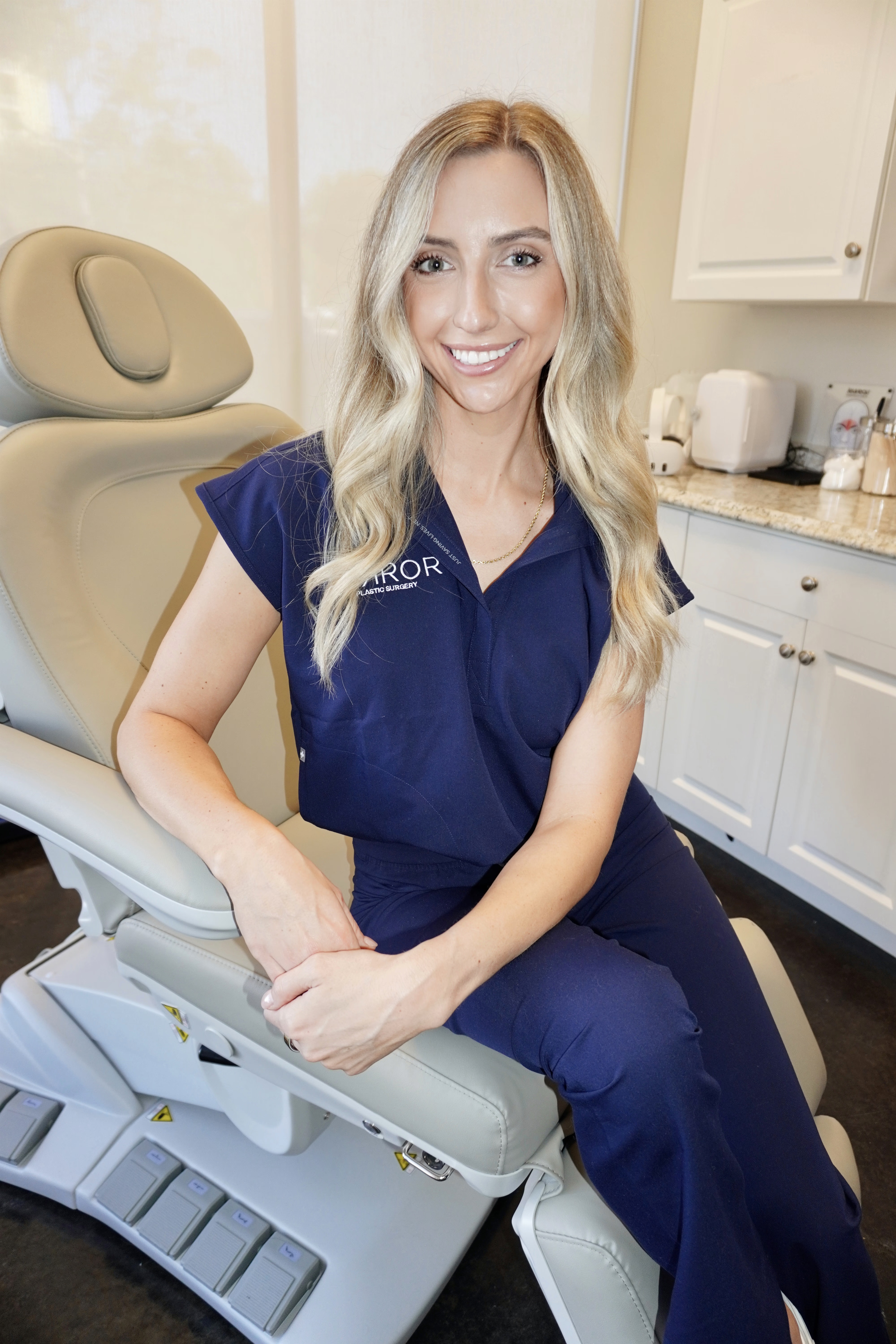
Written by: Ellie Pranckevicius, FNP-BC, Aesthetic Nurse Practitioner & Aesthetic Injector | Facial Restoration & Regenerative Injectable Specialist, Mirror Plastic Surgery
Key Takeaways
-
Hair growth peptides like GHK-Cu often reduce shedding within 4 to 8 weeks and improve visible density within 3 to 6 months.1
-
Peptides support follicle strength, collagen production, and inflammation control, addressing root causes more directly than minoxidil alone.
-
Consistency, age, and underlying health strongly influence results, while professional protocols can accelerate progress by roughly 20 to 30 percent.1
-
GHK-Cu clinical trials show 27 to 35 percent hair density increases over 6 months with minimal reported side effects.1
-
Experience safe, personalized peptide therapy at Mirror Plastic Surgery with a dedicated consultation tailored to your hair restoration goals.
Peptide Expertise at Mirror Plastic Surgery
Ellie Pranckevicius, FNP-BC, leads peptide therapies at Mirror Plastic Surgery. She holds a Master’s degree from the University of South Florida and has extensive Neuroscience ICU experience at Tampa General Hospital. Her blend of aesthetic training and advanced nursing expertise supports thorough evaluation of hair loss causes and precise treatment planning. Dr. Akash Chandawarkar, a Harvard-educated physician and Johns Hopkins-trained plastic surgeon, oversees all therapeutic protocols.
Core Hair Peptide Concepts and Terms
Hair growth peptides are short chains of amino acids that influence specific cellular processes within hair follicles. The most studied peptide, GHK-Cu (copper peptide), stimulates collagen production, calms inflammation, and extends the anagen, or growth, phase of the hair cycle. Unlike topical treatments that mainly improve blood flow, peptides can also support DHT modulation and follicle resilience.
These therapeutic compounds differ from conventional minoxidil by targeting systemic factors rather than only surface-level circulation. GHK-Cu exemplifies this systemic approach. It binds to copper ions and forms a complex that enhances cellular repair and promotes new blood vessel formation around hair follicles, which addresses root causes instead of only symptoms.
Explore tailored peptide stacks designed for your specific hair loss pattern and schedule your evaluation with Ellie for a customized protocol.
Typical Hair Growth Peptide Timeline
This timeline outlines what most patients can expect from consistent peptide use over the first several months.
Weeks 1 to 4: Peptides enter the bloodstream within the first hour after administration, yet visible changes remain subtle. Follicles begin shifting from resting phases into active growth phases during this period.
Weeks 4 to 8: Reduced hair shedding often becomes noticeable within 2 to 4 weeks of steady supplementation.1 Shedding usually decreases between weeks 4 and 6 as follicles strengthen and scalp inflammation improves.1
Months 2 to 4: Early regrowth appears as fine vellus or “baby” hairs between months 2 and 4.1 New visible growth commonly shows up between weeks 8 and 12 as circulation improves and collagen support around follicles increases.1
Months 3 to 6: Many patients see meaningful density changes between months 3 and 6.1 Reduced shedding, fuller coverage, and thicker strands typically appear after several months of consistent daily use.1
GHK-Cu Clinical Timeline Details
GHK-Cu is the most extensively studied hair growth peptide, so its specific timeline offers a useful benchmark. Clinical research on GHK-Cu demonstrates measurable results within 2 to 4 months.1 Lee et al.’s 2016 randomized, double-blind trial found that topical GHK peptide produced 52.6 ± 45.7 extra hairs per cm² in the high-dose group and 71.5 ± 44.9 extra hairs per cm² in the low-dose group after 6 months.1 GHK-Cu peptide resulted in a 27 percent hair density increase over 6 months, with some studies showing up to 35 percent increases in hair density and follicle size.1
Factors That Shape Your Hair Growth Timeline
Several variables significantly impact how quickly peptides produce visible results. The table below highlights three key factors that can speed up or slow down progress, along with how Mirror’s protocols address each one.
|
Factor |
Timeline Impact |
Mirror Optimization |
|---|---|---|
|
Consistency |
Accelerates results by 20-30%1 |
Custom protocols with 24/7 support |
|
Root Causes |
Hormonal/inflammatory issues delay progress |
Comprehensive lab analysis |
|
Age/Lifestyle |
Younger patients respond faster |
Personalized dosing adjustments |
Consistent daily use is essential for visible results and usually requires several months of adherence.1 Individual responses vary based on genetics, age, severity of hair loss, and underlying conditions. Some patients notice density gains within a few months, while others need six months or longer.1
Top Peptide Options for Hair Growth
GHK-Cu (Copper Peptide): This peptide is the most thoroughly researched option for hair restoration. GHK-Cu supports new blood vessel formation, regulates inflammatory markers, boosts collagen and elastin, and prolongs the anagen growth phase. Many patients see early changes within 2 to 4 months, along with potential softening of the gray hair appearance.1
Glow Stack (GHK-Cu + BPC-157 + TB500): This combination targets systemic inflammation while supporting collagen and tissue repair. BPC-157 effectiveness depends on addressing patient-specific issues such as poor circulation, chronic inflammation, or scalp conditions. Most patients require 3 to 6 months to appreciate full results from this stack.1
Peptides Compared With Minoxidil
Clinical data suggest that peptide combinations can produce hair growth improvements similar to minoxidil.1 Many users who combine GHK-Cu with minoxidil report 20 to 30 percent better density retention1, partly because peptides can reduce scalp irritation caused by minoxidil.
Peptides provide systemic benefits with fewer reported side effects than minoxidil’s localized approach. Minoxidil often requires indefinite use and may trigger initial shedding. Peptides instead focus on underlying inflammatory and hormonal drivers of hair loss, which can support more durable improvements while treatment continues.1
What Peptide Therapy Looks Like at Mirror
Mirror Plastic Surgery begins peptide care with a comprehensive 60-minute consultation with Ellie. This visit includes a detailed medical history review and laboratory testing when indicated. Custom peptide stacks are then formulated around your specific needs, with clear reconstitution instructions and ongoing support through 24/7 text communication.
The process unfolds in three stages. First comes the initial evaluation and lab review. Second is protocol development and education. Third is ongoing monitoring with dosage adjustments based on your response and goals.
Peptide Therapy Landscape in 2026
Recent advances in GHK-Cu formulations and compounding techniques have improved both delivery and stability. Supervised telehealth models have expanded as FDA scrutiny of unsupervised online peptide sales has increased. High-quality sourcing from batch-tested suppliers now represents the standard of care for medical practices offering peptide therapies.
Safety and Clinical Considerations
Safety remains the top priority with peptide therapy. Hair growth peptides are generally well-tolerated and carry a low risk of side effects because they mimic natural signaling molecules. Professional supervision supports appropriate screening for contraindications and careful cycling strategies.
Laboratory evaluation can uncover hormonal imbalances, thyroid dysfunction, or inflammatory markers that influence treatment success. Personalized protocols based on these findings improve both safety and clinical outcomes.
Risks, Limitations, and Treatment Challenges
Peptide therapy remains generally safe but still has limitations. Lee et al.’s 2016 trial reported zero adverse events across all 45 participants over 6 months. The study also showed high variability in results, with standard deviations of ±44.9 to ±45.7 hairs per cm².1
Results do not last permanently. Benefits usually fade when treatment stops, and hair density often returns toward baseline over time.1 Some patients experience mild injection site irritation with subcutaneous administration. Thorough screening helps identify contraindications and supports safe protocol design.
Common Misconceptions About Hair Peptides
Peptides do not work as instant solutions and usually require 3 to 6 months for visible improvements.1 Weight loss peptides may show faster changes, but hair growth peptides act more gradually through cellular-level changes in follicle function. Online peptide sources often lack quality control and medical oversight, which can compromise both safety and effectiveness.
Frequently Asked Questions
How long does GHK-Cu take to show results?
GHK-Cu typically produces noticeable improvements within 2 to 4 months of consistent use.1 Reduced shedding often appears first around 4 to 6 weeks, followed by visible density increases between 3 and 6 months.1 Age, genetics, and underlying health conditions all influence the pace of change.
Do peptides work better than minoxidil for hair growth?
Peptides offer efficacy comparable to minoxidil with potentially fewer side effects. Clinical studies show similar hair count improvements.1 Peptides also address systemic factors such as inflammation and hormonal imbalance rather than focusing only on surface circulation. Many patients combine both therapies for stronger overall results.
Is it safe to use peptides without medical supervision?
No. Unsupervised peptide use carries real risks, including contaminated products, incorrect dosing, and missed contraindications. Professional oversight ensures vetted sourcing, appropriate screening, and protocols tailored to your health profile and goals.
Are peptide results permanent?
Peptide benefits usually require ongoing maintenance. Stopping treatment often leads to a gradual return toward baseline hair density over several months.1 Long-term success depends on managing underlying causes and maintaining a consistent regimen.
Do I need lab work before starting peptides at Mirror?
Yes. Comprehensive laboratory analysis helps identify hormonal imbalances, thyroid issues, inflammatory markers, and other factors that affect hair growth. These results guide protocol design and support both safety and effectiveness.
Can I receive peptide therapy remotely?
Mirror Plastic Surgery offers nationwide remote consultations and peptide therapy with shipping to all 50 states. Virtual visits include the same detailed evaluation as in-person appointments, along with ongoing support through secure communication channels.
Conclusion
Hair growth peptides provide a promising, evidence-based option for patients seeking gradual but meaningful hair restoration. As outlined in the timeline above, peptide therapy requires patience and consistency, yet research supports real improvements for many patients.1
Mirror Plastic Surgery combines comprehensive evaluation, high-quality sourcing, and ongoing support to help patients get the most from peptide therapy. Located in St. Petersburg and serving the Tampa Bay area, the practice also offers remote consultations for patients across the United States.
Begin your personalized hair restoration journey with a consultation at Mirror Plastic Surgery. Contact the team at 727-361-6515 or hello@mirrorplasticsurgery.com.
1 Results may vary from person to person. Editorial content, before and after images, and patient testimonials do not constitute a guarantee of specific results.
Peptide therapy is intended for wellness and optimization purposes and is not prescribed to diagnose, treat, cure, or prevent disease unless specifically stated. Many peptides are not FDA-approved and may be used off-label. Some have limited long-term safety data, with a potential for unknown risks, complications, or desensitization with prolonged use.