
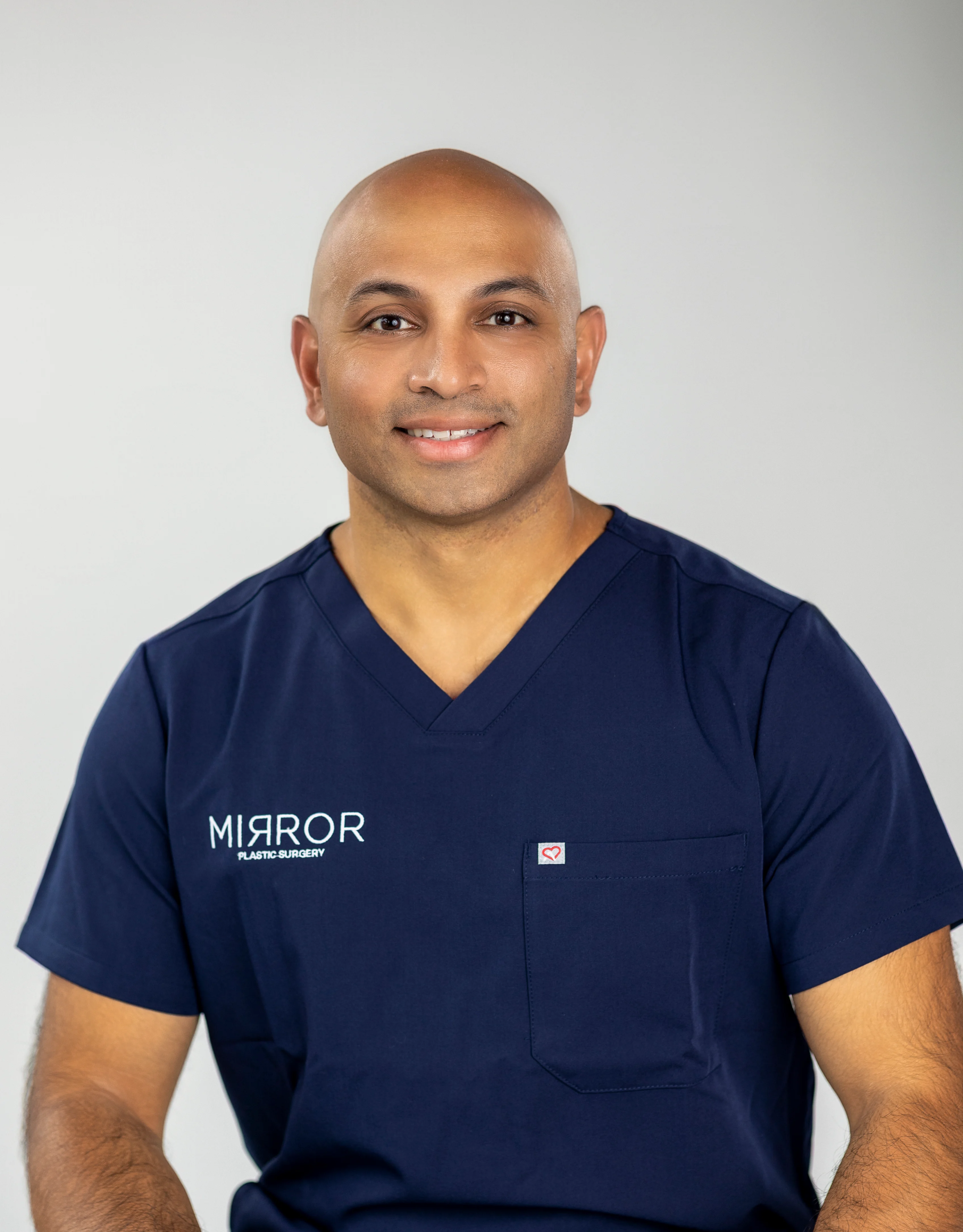
Written by: Dr. Akash Chandawarkar, Board Certified Plastic Surgeon, Mirror Plastic Surgery
Key Takeaways
- Peptide injections are not FDA-approved for cosmetic use and require careful provider vetting for safety and realistic results.
- A qualified provider clearly explains the specific peptide, its FDA status, the injector’s credentials, and the sourcing pharmacy with batch testing.
- Lab review before prescribing and ongoing physician monitoring are essential standards for safe peptide therapy.
- Benefits usually require maintenance, results vary by person, and improvements fade when treatment stops.1
- Mirror Plastic Surgery uses a physician-supervised, lab-driven model that follows every standard in this framework.
Talk With Dr. Akash About Your Peptide Options
Who Wrote This Framework
Dr. Akash Chandawarkar, MD, founded Mirror Plastic Surgery and personally designs and supervises every peptide protocol at the practice. He is board certified by the American Board of Plastic Surgery and trained at Harvard Medical School through the Harvard-MIT Division of Health Sciences and Technology. His clinical foundation includes a seven-year integrated plastic and reconstructive surgery residency at Johns Hopkins University and an aesthetic surgery fellowship at Manhattan Eye Ear & Throat Hospital (MEETH)/Lenox Hill. Every protocol at Mirror is tailored to each patient’s labs and physiology and medically supervised throughout. The framework below reflects the standard Dr. Akash applies to his own practice and the standard he believes every patient should expect from any provider.
The Background You Actually Need Before You Vet Anyone
Cosmetic peptide injections are injectable amino-acid-based therapies used for goals such as collagen and elastin production, skin, hair, and nail health, inflammation management, weight management, recovery, energy, and sexual wellness. The peptides you will encounter most often include GHK-Cu (copper peptide), BPC-157, TB-500, GLP-3R, NAD, KPV, sermorelin/ipamorelin, PT-141, and selank.
The regulatory picture is more complicated than most providers explain. The FDA’s Pharmacy Compounding Advisory Committee (PCAC) voted at its July 2026 meeting to recommend six peptides — BPC-157, KPV, TB-500, MOTS-c, Epitalon, and Semax — for the 503A Bulks List, which would allow compounding pharmacies to prepare them legally. However, PCAC votes are advisory only and are not binding on the FDA, and the agency must still complete formal rulemaking before any peptide is lawfully compoundable. Verify a provider’s claim that a peptide is “FDA-approved” or legally compoundable against the 503A Bulks List and final FDA rulemaking, not against marketing language.
This article focuses on how to vet providers and pharmacies, not on peptide biology, dosing instructions, or specific treatment protocols. Those details belong in a consultation. For a deeper look at what individual peptides do and how they work, Mirror Plastic Surgery’s existing peptide explainers cover that ground.
What You Should Ask Before Choosing A Peptide Injection Provider
Use these nine questions with every provider you consider. A qualified provider answers all nine clearly and without hesitation.
- Which specific peptide are you recommending, and why is this one appropriate for my goal?
- What is the FDA approval status of this peptide, and is it compounded?
- Who will actually inject me — an MD, DO, NP, or PA — and who supervises that person?
- Which pharmacy supplies the peptide, and is there third-party batch testing for purity and accurate dosing?
- Will you review labs (thyroid, liver, kidney, diabetes markers, hormone panels) before prescribing?
- How will I be monitored during treatment, and how do I reach you between visits?
- What results are realistic for my situation, and on what timeline?1
- What is the cost structure, and what does it include?
- What happens if I stop, and how quickly will benefits fade?
Answers That Should Disqualify A Provider
Walk away from any provider who gives you one or more of these responses:
- Cannot name the specific injector or their credentials
- Refuses to disclose the pharmacy name or sourcing information before payment
- Does not order or review lab work before prescribing
- Offers no monitoring plan or after-hours contact method
- Pressures you to book the same day
- Promises identical results for every patient1
- Claims a compounded peptide is “FDA-approved”
The FDA has issued warning letters to telehealth companies over false or misleading claims about compounded drugs, including claims that a compounded drug is sourced from an “FDA-approved” pharmacy, a designation that does not exist. Any provider using that language is either uninformed or misleading you.
Get These Nine Questions Answered By Dr. Akash
How To Compare In-Person Clinics, Telehealth, And Online Vendors
There is no peptide-specific prescribing law in the United States, and prescribing authority follows each state’s scope-of-practice rules for the clinician’s role. Nurse practitioners can prescribe independently in states with full practice authority, while NPs in other states require a collaborative or supervisory agreement with a physician. Physician associates face the same state-by-state variation, with many states still requiring a formal physician agreement. You can verify a clinician’s license through your state’s medical or nursing board website. Board certification for physicians is verifiable through the American Board of Medical Specialties.
The table below shows where the three access models diverge on the three attributes that determine safety: who holds clinical responsibility, whether labs are reviewed before prescribing, and how the peptide is sourced. In-person clinics and true telehealth practices can meet all three standards when they follow best practices. Direct-to-consumer vendors usually do not.
Mirror Plastic Surgery offers remote care across the United States, including Hawaii and Alaska, along with in-person care in St. Petersburg/Tampa. What makes remote care safe under a physician-supervised model is the same thing that makes in-person care safe. Lab review before prescribing, physician supervision throughout, batch-tested sourcing, and direct access to the physician between visits define the standard, and remote care can meet it.
The FDA states that compounded drugs do not undergo premarket review for safety, effectiveness, or quality, and a compounded peptide injection remains unapproved even when a facility cites USP <797> standards, accreditation, or third-party testing. USP <797> compliance is a sterile-compounding quality standard, not an FDA approval signal. Verify any pharmacy’s claims against its actual license, facility type, and FDA inspection record.
The Downsides And Limitations You Should Hear From Any Provider
A provider who does not volunteer the following information before you commit is not giving you complete care.
- Variable individual response. A 2026 review in the International Journal of Molecular Sciences (Int. J. Mol. Sci. 2026, 27(9), 3890) indicates that personalized patient analysis, including genomic and clinical data, along with lifestyle and protocol factors, influences therapeutic peptide outcomes, and results differ meaningfully between individuals.1
- Maintenance is required. Benefits from most peptide protocols diminish when treatment stops, similar to stopping any health regimen.1 A maintenance protocol is typically necessary to sustain results.
- No peptide acts exactly like Botox. Botulinum toxin works by temporarily blocking neuromuscular transmission to relax specific muscles. Peptides work through entirely different mechanisms, such as stimulating collagen production, modulating inflammation, or influencing receptor pathways. The comparison is mechanistically inaccurate and should not drive your decision.
- Human evidence is limited for many cosmetic peptides. As of September 2026, there is no published human study showing that subcutaneous injection of GHK-Cu is safe and effective for cosmetic use. The Center for Science in the Public Interest summarized the BPC-157 evidence gap: randomized trial evidence in humans is nowhere to be found. Physician supervision manages this gap responsibly but does not erase it.
- Sourcing risk is real. An expert cited in Vanity Fair estimated that approximately 30 percent of peptides tested for clients were contaminated or otherwise tainted.
How To Search Locally Without Getting Sold
Knowing the downsides is only half the work, and you still need a provider who will discuss them openly. Use this checklist before booking anything.
- Confirm the injector’s credentials and board certification through the relevant state board or ABMS
- Ask for the specific peptide name and its current FDA status
- Ask which pharmacy supplies the peptide and whether batch-specific certificates of analysis are available
- Ask whether labs are ordered and reviewed before prescribing, and which panels are included
- Ask how monitoring works during treatment and how to reach the provider between visits
- Ask what realistic results look like for your specific profile and timeline
- Ask what happens if you stop treatment
A thorough consultation includes a full medical history review, a goal discussion, lab review, and an honest conversation about risks and alternatives. State medical board actions against peptide prescribers typically involve documentation failures, such as lack of documented medical necessity, informed consent that does not cover non-FDA-approved use, and absence of a real evaluation with history, exam, baseline labs, and a monitoring plan. Those documentation requirements exist to protect you.
A rushed consultation is a red flag. If it skips labs, skips history, and ends with a same-day booking push, the clinic’s polished website does not change that. The opposite of that rush is a consultation long enough to review your history, order labs, and discuss risks honestly. Mirror Plastic Surgery’s concierge model dedicates up to an hour to exactly that, which is the benchmark to look for anywhere.
Schedule A Thorough Peptide Consultation With Dr. Akash
How Peptide Injections Fit Into Medically Supervised Wellness Care
Cosmetic peptide injections sit within a broader category of medically supervised wellness and longevity care. Depending on the protocol, peptides connect to inflammation management, weight management, post-surgical recovery, collagen and skin aging, energy, anxiety, and sexual wellness. At Mirror Plastic Surgery, peptides are sometimes used alongside surgical and non-surgical treatments, including post-operative recovery protocols, where their anti-inflammatory and tissue-repair properties can complement procedural outcomes.
After you choose a provider, the next step is personalizing your plan. That includes how peptide stacks are tailored to your labs and physiology, the practical difference between compounded and brand-name options, and what medically supervised peptide therapy looks like over a full treatment cycle. Those questions are best answered in a consultation, where your specific labs, history, and goals shape the plan.
Plan Your Personalized Peptide Protocol With Dr. Akash
Frequently Asked Questions
How Much Do Peptide Injections Usually Cost?
Peptide therapy pricing is individualized and quoted at consultation, because no two protocols are identical. Key cost drivers include the specific peptide or peptide stack prescribed, the length of the protocol, the lab panels required before and during treatment, the level of physician supervision, and whether care is delivered in person or remotely. A provider who quotes a flat price before reviewing your labs and history is not building a personalized protocol.
Who Has The Best Injectable Peptides?
The more useful question is which provider offers the best supervision. The peptide molecule matters far less than where it comes from, who prescribed it, and who is monitoring you while you use it. A vial from a licensed compounding pharmacy with a batch-specific certificate of analysis, prescribed by a board-certified physician who has reviewed your labs, is categorically different from the same peptide name purchased from an online vendor. Supervision, sourcing, and monitoring are the quality signals, not the label on the vial.
Where Can I Get Injectable Peptides In Person Or Online?
You can access peptides through an in-person clinic, a telehealth platform with genuine physician oversight, or a direct-to-consumer online vendor. As explained above, the first two pathways can be safe when the provider is licensed, the pharmacy is a registered 503A or 503B facility with batch testing, and labs are reviewed before prescribing. Direct-to-consumer vendors lack quality verification, dosing guidance, screening for pre-existing conditions or medication interactions, and clinical responsibility. Mirror Plastic Surgery offers both in-person care in St. Petersburg/Tampa and remote care across the United States, including Hawaii and Alaska, under the same physician-supervised, lab-driven model.
How Do I Find A Good Peptide Pharmacy Through My Provider?
The key task is verifying the pharmacy your provider uses. Ask for the pharmacy’s exact name, state license number, and facility type, such as 503A state-licensed pharmacy or 503B FDA-registered outsourcing facility. Ask whether the pharmacy holds accreditation from recognized organizations such as the Pharmacy Compounding Accreditation Board (PCAB), the Accreditation Commission for Health Care (ACHC), or the National Association of Boards of Pharmacy (NABP). Request a batch-specific certificate of analysis for the peptide you will receive. You can also check the FDA’s publicly available inspection database for the pharmacy’s inspection history. A provider who refuses to name the pharmacy before payment or cannot produce a certificate of analysis is a provider to avoid.
What Is The Downside Of Peptides?
The main downsides relate to variability, maintenance, evidence, and sourcing. As covered above, individual response varies significantly, and no provider can guarantee a specific outcome.1 Benefits fade when treatment stops, so maintenance is typically required.1 The human evidence base for many cosmetic peptides remains limited, with much of the data coming from animal studies or small, industry-funded trials. The non-FDA-approved status of most cosmetic peptides means that quality depends entirely on the provider’s diligence and pharmacy choice. Combining multiple peptides without physician oversight also creates unpredictable interactions that marketing materials do not fully address.
Do Any Peptides Act Like Botox?
No peptide acts like Botox, and the comparison is mechanistically misleading. Botulinum toxin works by temporarily blocking the release of acetylcholine at the neuromuscular junction, relaxing specific facial muscles and reducing dynamic wrinkles. Peptides work through different pathways, such as stimulating collagen and elastin synthesis, modulating inflammatory signaling, influencing receptor activity, or supporting cellular repair. Some peptides, particularly signal peptides like argireline, are marketed as “Botox alternatives.” They are claimed to influence muscle contraction at the cellular level by interfering with the SNARE complex. This marketing substantially overstates their clinical potency. Argireline works through reversible competitive interference rather than true neuromuscular blockade, and it is far weaker than injectable botulinum toxin. Clinical evidence for injectable cosmetic peptides producing Botox-equivalent results does not exist. A provider who positions any peptide as a direct Botox replacement is overstating the evidence.
Conclusion: Choose The Provider, Not Just The Peptide
The nine-question framework above applies to every provider you consider. Ask which peptide is being recommended and why. Verify its FDA and compounding status against the 503A Bulks List and final rulemaking, not against marketing language. Confirm the injector’s credentials and the pharmacy’s license, facility type, and batch-testing practices. Insist on lab review before prescribing and a clear monitoring plan throughout. Understand that benefits require maintenance and that no peptide replicates Botox. Choose a provider who will also tell you when a treatment is unnecessary for you right now.
Mirror Plastic Surgery’s physician-supervised, lab-driven, concierge peptide therapy, available in person in St. Petersburg/Tampa and remotely across the United States, is built around exactly these standards. Dr. Akash Chandawarkar reviews every patient’s labs, designs every protocol personally, and remains directly accessible throughout treatment. That is the standard to look for anywhere you go.
Start A Physician-Supervised Peptide Plan With Dr. Akash
Editorial and Compliance Note: Many peptides discussed in this article are not FDA-approved for cosmetic or aesthetic use, and individual results vary. The vetting framework above was authored by Dr. Akash Chandawarkar, MD, board certified by the American Board of Plastic Surgery, Harvard Medical School graduate (Harvard-MIT Division of Health Sciences and Technology), Johns Hopkins seven-year integrated plastic and reconstructive surgery residency, and aesthetic surgery fellowship at Manhattan Eye Ear & Throat Hospital (MEETH)/Lenox Hill. Treatment suitability is determined during a medical consultation; this article is educational and does not constitute medical advice. No competing local practitioner or clinic is named or implied. Pricing is not stated; all protocols are individually quoted at consultation.
1 Results may vary from person to person. Editorial content, before and after images, and patient testimonials do not constitute a guarantee of specific results.
Peptide therapy is intended for wellness and optimization purposes and is not prescribed to diagnose, treat, cure, or prevent disease unless specifically stated. Many peptides are not FDA-approved and may be used off-label. Some have limited long-term safety data, with a potential for unknown risks, complications, or desensitization with prolonged use.