
Written by: Dr. Akash Chandawarkar, Board Certified Plastic Surgeon, Mirror Plastic Surgery
Key Takeaways
- Peptide stacks combine multiple peptides like GHK-Cu, BPC-157, and TB-500 to target inflammation, collagen production, and tissue repair at the same time.
- GHK-Cu has the strongest human clinical evidence for topical skin use, while BPC-157 and TB-500 lack controlled human trials for skin indications, so injectable stacks rely mainly on mechanistic rationale.
- At Mirror Plastic Surgery, peptide therapy starts with a comprehensive medical evaluation, including lab work, so protocols match each patient’s goals, physiology, and safety profile.
- Visible skin improvements from peptide therapy usually appear at 6–8 weeks, with deeper benefits at 8–12 weeks, which reflects natural collagen turnover cycles rather than instant change.1
Schedule Your Consultation To Explore A Personalized Peptide Plan With Dr. Chandawarkar.
What Are Peptide Stacks For Skin? A Foundational Guide
Peptides are short chains of amino acids, the building blocks of proteins, that act as signaling molecules in the body. A single peptide usually targets one primary mechanism. A peptide stack combines multiple peptides to address several mechanisms in parallel. The rationale is that complementary pathways may produce broader or more durable outcomes than any single agent alone.
The distinction between topical peptide skincare and injectable or systemic peptide stacks is clinically significant because it determines both the evidence base and the safety profile. Topical formulations deliver peptides to the epidermis and superficial dermis through passive diffusion, a route with decades of human clinical trial data. Injectable or systemic stacks aim to deliver peptides systemically or to deeper tissue targets, a route with a substantially thinner human evidence base and a more complex regulatory and safety profile.
The “Glow Stack,” a term from biohacking communities rather than a medical designation, refers to the combination of three specific peptides:
- GHK-Cu (Copper Peptide): A naturally occurring tripeptide (glycyl-L-histidyl-L-lysine) bound to a copper ion. Plasma GHK levels decline roughly two-fold between the twenties and sixties, from approximately 200 ng/mL in young adults to about 80 ng/mL by age 60. This decline provides the biological rationale for replenishment-focused anti-aging interest. It is the best-evidenced of the three for skin outcomes, with multiple published human randomized controlled trials for topical use.
- BPC-157 (Body Protective Compound-157): A synthetic pentadecapeptide derived from gastric proteins, studied primarily in preclinical models for its angiogenic and anti-inflammatory properties. Human clinical evidence for skin outcomes is sparse.
- TB-500 (Thymosin Beta-4 Fragment): A peptide that promotes cell migration through actin regulation. No published human trials exist for injectable TB-500 in musculoskeletal or skin indications. It is used in veterinary medicine for equine tendon repair.
The table below summarizes how each peptide’s primary role and evidence level compare, which helps clarify why the Glow Stack rationale is mechanistic rather than clinical.
| Peptide | Primary Role | Evidence Level |
|---|---|---|
| GHK-Cu | Collagen and elastin synthesis, matrix remodeling, wound healing, anti-inflammatory and antioxidant gene modulation | Strong for topical skin use (multiple human RCTs); zero published human trials for injectable use |
| BPC-157 | Angiogenesis (VEGF pathway), systemic inflammation reduction, gut and soft-tissue repair signaling | 35 preclinical animal studies and one uncontrolled 16-patient chart review; no completed controlled human efficacy trials for skin |
| TB-500 | Cell migration via actin sequestration, re-epithelialization support, angiogenesis | Preclinical only for injectable use; Phase 3 RCT data exists for topical thymosin beta-4 in ophthalmic healing only |
How Peptide Stacking For Skin Works In A Clinical Setting
At Mirror Plastic Surgery, peptide therapy starts with a comprehensive 30–60 minute consultation with Dr. Akash Chandawarkar. This visit includes a full medical history review and a detailed discussion of specific skin and wellness goals. When clinically indicated, a lab panel covers thyroid, liver, kidney, diabetes markers, and hormone levels. The team designs no protocol until this evaluation is complete.
The clinical process follows a structured sequence:
- Eligibility Screening: The team identifies contraindications, current medications, and pre-existing conditions that affect peptide selection and dosing.
- Protocol Design: The physician determines whether a single peptide or a stack fits the patient’s goals, labs, and physiology, rather than applying a one-size-fits-all template.
- Administration Guidance: Patients receive detailed instructions for reconstitution and self-administration, often with video demonstrations, plus guidance on injection timing and site rotation.
- Monitoring And Follow-Up: Patients have ongoing direct access to Dr. Chandawarkar via text or telemedicine, and protocols are adjusted based on response.
Realistic timelines for skin-related outcomes reflect the biology of collagen turnover. Histological changes from GHK-Cu are detectable via biopsy as early as 4 weeks, but visible improvements in skin texture, elasticity, and wrinkle depth typically appear at the 6–8 week mark.1 This pattern reflects a natural collagen turnover cycle of 15–30 days per cycle. Deeper wrinkle reduction and elasticity gains take 8–12 weeks.1 Patients and physicians generally assess response over two to three cycles rather than within a single one.
The physician decides whether to stack peptides or use a single well-formulated peptide based on the clinical picture and not on marketing narratives about synergy. This clinical caution is especially important given the rapidly evolving regulatory and market landscape for peptides.
Start Your Physician-Led Peptide Evaluation
Regulatory And Safety Landscape For Peptide Stacks
Consumer interest in peptide stacks for skin has grown substantially alongside the broader GLP-1 market. The explosive growth of the GLP-1 market has fueled demand not only for weight-loss therapies but also for peptides marketed for wellness, fitness, and longevity purposes, driving growth in the gray market for peptide products.
The regulatory landscape shifted meaningfully in 2026. The FDA’s 503A bulk drug substances list, updated May 14, 2026, places GHK-Cu (except for injectable routes) in Category 1, under evaluation for permitted compounding use, with a PCAC review scheduled before the end of February 2027. In July 2026, the FDA’s Pharmacy Compounding Advisory Committee voted to recommend BPC-157 for ulcerative colitis and TB-500 for wound healing, despite FDA staff opposition citing insufficient human clinical data. A favorable PCAC recommendation does not immediately authorize compounding. Formal notice-and-comment rulemaking, which can take more than a year, is still required.
Sourcing quality remains the central safety issue in this market. Almost 30% of peptide samples analyzed through independent consumer testing were either mislabeled, underdosed, overdosed, or contaminated with toxins or bacteria. The Australian Therapeutic Goods Administration has identified serious adverse effects from unapproved peptide products, including liver damage, severe allergic reactions requiring hospitalization, and systemic inflammatory response syndrome. Mirror Plastic Surgery sources peptides exclusively from compounding pharmacies with rigorous batch testing and certificates of analysis, which provides meaningful quality assurance.
Is It Good To Stack Peptides For Skin? A Physician’s Perspective
No study has tested BPC-157 + TB-500 + GHK-Cu, or any two-compound subset involving GHK-Cu, in any model, preclinical or clinical, so the combination evidence base for the Glow Stack is nonexistent. The evidence does not show that stacking outperforms a single well-formulated peptide. The rationale for combining these three peptides is mechanistic. BPC-157 drives angiogenesis, TB-500 promotes cell migration, and GHK-Cu supports matrix remodeling, three phases of wound healing addressed in sequence. As one analysis describes it, this is “biological storytelling, not demonstrated pharmacology.”
Stacking can still be a rational choice in specific contexts. The decision requires a physician who can weigh mechanistic plausibility against evidence gaps, the patient’s goals, their labs, and their individual physiology. For a patient whose primary goal is facial anti-aging, a topical GHK-Cu product is often the evidence-based place to start. A more complex stack enters the discussion when goals are broader or topical results have plateaued.
What Should You Not Mix With Peptides?
This question always needs a physician’s input because the answer depends on the patient’s medications, conditions, and the specific peptides under consideration. General categories of concern include the following.
- Drug Interactions Involving Copper: Copper-chelating drugs such as penicillamine and trientine, used for Wilson’s disease, are relevant interaction contexts for systemic GHK-Cu use, and GHK-Cu is contraindicated in Wilson’s disease and other copper metabolism disorders.
- Therapies That Oppose Angiogenesis: Agents such as bevacizumab and VEGF-targeted tyrosine kinase inhibitors would be expected to oppose the angiogenic mechanisms of BPC-157, TB-500, and GHK-Cu.
- Medications Affecting Coagulation: Pharmacodynamic interactions with anticoagulants are theoretically possible given the angiogenic and vascular activity of these peptides.
- Physical Mixing Of Peptides: GHK-Cu should not be mixed with other peptides in the same vial or syringe because its copper moiety may catalyze oxidation of methionine, cysteine, tryptophan, or tyrosine residues in other peptides, producing degradation products with unknown activity.
- Topical Formulation Conflicts: High-concentration L-ascorbic acid, glycolic acid, and other strong acids can destabilize the copper-peptide complex when layered simultaneously in topical routines.
- Unverified Gray-Market Products: Combining a medically supervised peptide with an unverified product of unknown composition and purity introduces variables that no physician can screen for or manage.
Is There A Downside To Using Peptides? Risks And Limitations
The evidence for many skin-related benefits of injectable peptide stacks remains primarily preclinical. For GHK-Cu, the human evidence is strong for topical use and essentially absent for injectable use. As discussed, BPC-157 and TB-500 lack controlled human trials for skin.
Documented risks and limitations include:
- Inconsistent Response: Results vary significantly between individuals based on genetics, diet, lifestyle, and the specific protocol used.1
- Injection Site Reactions: Additive injection-site reactions such as erythema, swelling, and bruising are a concern when all three peptides are injected subcutaneously on the same day.
- Sourcing Contamination: Adverse events from unapproved peptide products include severe allergic reactions requiring hospitalization and systemic inflammatory response syndrome.
- Attribution Difficulty: With three compounds there are three suspects and six possible interaction pairs, so an adverse effect cannot be traced to a specific compound without discontinuing all three and reintroducing them individually.
- Copper Accumulation: Every dose of GHK-Cu delivers elemental copper; cycling protocols and dose restraint are standard practice for this reason.
People who should avoid stacking entirely include individuals with Wilson’s disease or other copper metabolism disorders, active malignancy, pregnancy or breastfeeding, known hypersensitivity to any component, significant liver disease, or active infection at the injection site. These exclusions require physician screening rather than self-assessment.
Find Out Whether Peptide Stacking Fits Your Health Profile
Common Misconceptions About Peptide Stacks For Skin
“Peptide stacks are Botox in a bottle.” No peptide stack replaces neuromodulators, dermal fillers, or surgery. Peptides work through collagen synthesis, matrix remodeling, and inflammation modulation, mechanisms that improve skin quality over weeks to months. Neuromodulators act on neuromuscular junctions within days. These tools solve different problems.
“More peptides in a stack means better results.” The Glow Stack delivers pro-angiogenic signaling from three distinct molecular pathways simultaneously,1 which intensifies cumulative angiogenesis concerns. Adding compounds multiplies interaction variables and attribution difficulty without any proven additive benefit in human trials.
“Buying the same named peptides online delivers the same result.” As noted earlier, nearly 30% of consumer-tested samples were mislabeled or contaminated. The name on a vial does not guarantee quality. Batch testing and certificates of analysis from a licensed compounding pharmacy form the minimum standard for safety.
“Peptides are only for weight loss.” The GLP-1 category dominates public awareness, but peptides address a wide range of mechanisms, including collagen synthesis, inflammation, wound healing, neurological function, and energy production. The Glow Stack specifically targets skin and connective tissue rather than metabolic weight management.
About Dr. Akash Chandawarkar
Dr. Akash Chandawarkar, MD, is the founder of Mirror Plastic Surgery and the lead physician for all peptide therapies at the practice. He is board certified by the American Board of Plastic Surgery. Dr. Chandawarkar studied neuroscience and nuclear engineering at MIT before graduating with Honors from Harvard Medical School through the Harvard-MIT Division of Health Sciences and Technology.
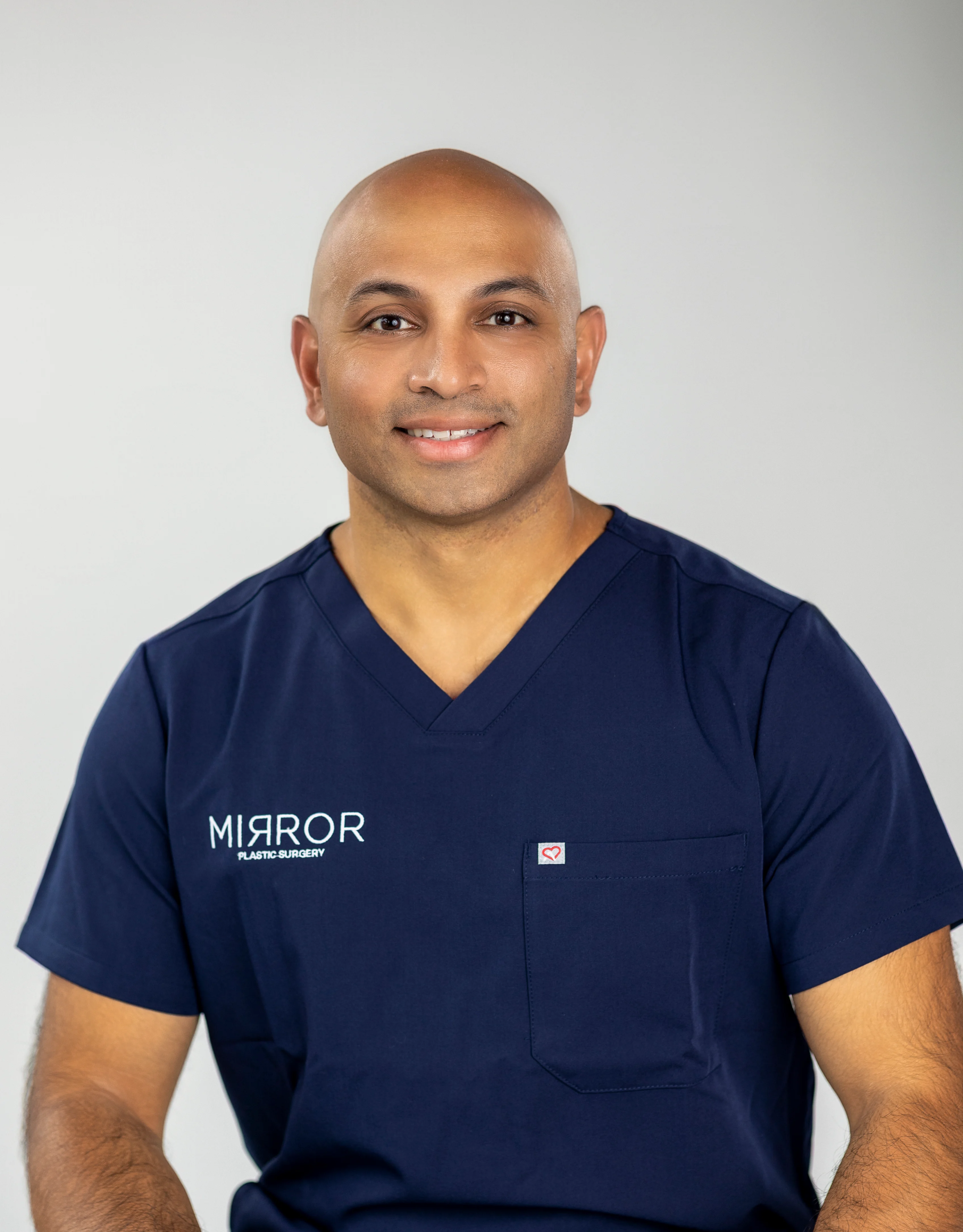
He completed a seven-year integrated plastic and reconstructive surgery residency at Johns Hopkins University and holds fellowship training in aesthetic surgery at the Manhattan Eye Ear & Throat Hospital/Lenox Hill Hospital. He paused his surgical residency to complete the Stanford University Biodesign Innovation Fellowship, a program that trains physician-innovators to identify unmet clinical needs and develop technological solutions. He serves on the advisory boards of several companies developing emerging technologies in the field.
Every peptide protocol at Mirror Plastic Surgery is designed by Dr. Chandawarkar around each patient’s labs and physiology and is medically supervised throughout. Patients have direct 24/7 access to Dr. Chandawarkar via text for ongoing support, questions, and protocol adjustments. The practice serves patients in St. Petersburg and Tampa, Florida, and remotely across the United States.
Frequently Asked Questions About Peptide Stacks For Skin
What Is The Best Peptide Stack For Skin?
No single peptide stack works best for every person. The optimal protocol depends on the individual’s goals, baseline labs, health history, and physiology. For patients whose primary goal is anti-aging and collagen support, GHK-Cu, particularly in topical form, has the strongest human clinical evidence base and often serves as the starting point.
For patients with broader goals involving systemic inflammation, wound healing, or post-surgical recovery, a physician may consider adding BPC-157 and TB-500, with the understanding that the combination evidence base is mechanistic rather than clinical. The decision follows a thorough evaluation rather than a generic protocol. At Mirror Plastic Surgery, Dr. Chandawarkar designs every stack based on the individual patient’s labs and clinical picture.
How Often Should You Inject Glow Stack Peptides?
Injection frequency varies by peptide and by the individual protocol. Community protocols commonly describe BPC-157 at 250–500 mcg once daily subcutaneously, TB-500 at 2–2.5 mg twice weekly, and GHK-Cu at 1–2 mg per day on a 30-days-on/30-days-off cycle to manage cumulative copper load. These are not standardized clinical doses because no published human trial has established optimal subcutaneous dosing for any of the three compounds.
A medically supervised protocol titrates doses based on the patient’s response, tolerance, and lab markers rather than applying community averages. Each peptide must be administered as a separate injection. They should never be mixed in the same vial or syringe.
Are Peptide Stacks For Skin Tightening Effective?
GHK-Cu has published human randomized controlled trial data showing improvements in dermal density, skin thickness, and elasticity with topical use over 8–12 weeks.1 These outcomes relate to skin tightening through improved structural integrity.1 Injectable peptide stacks for skin tightening have no controlled human trial evidence.
The mechanistic rationale, which includes collagen synthesis, matrix remodeling, and angiogenesis, is biologically plausible, but plausibility differs from demonstrated efficacy. Patients seeking skin tightening should view peptide stacks as a complementary approach rather than a replacement for procedural treatments, and they should expect gradual results with consistent protocols.
Can Peptide Stacks Be Used Before And After Procedures?
Peptides are used at Mirror Plastic Surgery as part of post-surgical recovery protocols, with the goal of reducing inflammation and supporting healing. BPC-157 and TB-500 have preclinical evidence for accelerating soft-tissue repair, and GHK-Cu has human data for wound healing after procedures such as CO2 laser resurfacing.
Pre-procedural use requires careful physician evaluation because the angiogenic activity of these peptides may interact with surgical planning. Post-procedural timing also matters. Starting BPC-157 too early (within the first 48–72 hours of acute inflammation) may amplify swelling via VEGF-mediated vascular permeability. All peri-procedural peptide use at Mirror Plastic Surgery is coordinated directly with Dr. Chandawarkar as part of the surgical plan.
Peptide Stack Vs. Single Peptide For Skin: Which Is Better?
The better choice depends on the patient’s goals and clinical picture. A single well-formulated peptide, particularly topical GHK-Cu, has a stronger human evidence base for skin outcomes than any injectable stack. Stacking has a mechanistic rationale, based on the idea that complementary mechanisms may address more dimensions of a complex problem at once.
For straightforward anti-aging goals, a single peptide is often the more evidence-supported choice. For complex presentations involving systemic inflammation, post-surgical recovery, or multiple tissue targets, a physician-designed stack may be reasonable. This determination relies on individual clinical judgment rather than a universal rule.
Conclusion: Making An Informed Decision About Peptide Stacks For Skin
Peptide stacks for skin offer real potential based on mechanistic rationale and, for topical GHK-Cu, on human clinical evidence. Their benefits are often overstated in injectable and combination form, where the evidence base remains primarily preclinical. Patients who understand the difference between these evidence tiers can make more informed choices about peptide therapy.
As the regulatory landscape continues to evolve, the key takeaway remains that medical supervision is essential for safe and effective peptide therapy. Medical oversight individualizes dosing, screens contraindications, verifies sourcing quality, and helps identify and manage adverse effects.
At Mirror Plastic Surgery, every peptide protocol rests on lab work, a thorough clinical evaluation, and ongoing physician oversight, which separates medically supervised peptide therapy from an unverified vial purchased online.
1 Results may vary from person to person. Editorial content, before and after images, and patient testimonials do not constitute a guarantee of specific results.
Peptide therapy is intended for wellness and optimization purposes and is not prescribed to diagnose, treat, cure, or prevent disease unless specifically stated. Many peptides are not FDA-approved and may be used off-label. Some have limited long-term safety data, with a potential for unknown risks, complications, or desensitization with prolonged use.