
Written by: Ellie Pranckevicius, FNP-BC, Aesthetic Nurse Practitioner & Aesthetic Injector | Facial Restoration & Regenerative Injectable Specialist, Mirror Plastic Surgery
Key Takeaways for Sensitive, Reactive Skin
- Laser hair removal usually causes less cumulative irritation for sensitive skin than waxing.1 It creates controlled heat inside the follicle without shearing the stratum corneum.
- Waxing mechanically disrupts the skin barrier with every session. This disruption triggers histamine release, transepidermal water loss, and a higher risk of ingrown hairs and post-inflammatory hyperpigmentation.
- Modern laser systems with appropriate wavelength selection, such as Nd:YAG for darker skin tones, plus integrated cooling, make treatment safer and more effective across many skin types.
- Active skin conditions, medication history, hair color, and Fitzpatrick skin type all need review before choosing either hair removal method.
- Book a consultation with Ellie at Mirror Plastic Surgery for a personalized assessment based on your skin type and hair removal goals.
How Waxing and Laser Affect Sensitive Skin
Waxing removes hair by forcibly extracting the shaft from the follicular bulb. Each strip pull causes mast cell degranulation, releasing histamine, bradykinin, and prostaglandins that induce localized vasodilation, increased capillary permeability, and nociceptor sensitization. At the same time, waxing strips away the stratum corneum lipid matrix, including cholesterol, free fatty acids, and ceramides. This loss elevates transepidermal water loss and prompts compensatory sebum production and faster keratin turnover that contribute to follicular congestion.
Soft wax increases barrier stress. Soft wax adheres to both hair and the stratum corneum, creating dual traction during strip removal that shears across the skin surface and lifts top skin cells, producing redness and a raw feeling, especially in thinner or more reactive skin. Sensitive areas such as the bikini, Brazilian, underarm, and facial zones have thinner epidermis and higher nerve density, so they react more strongly.
Ingrown hairs often follow this trauma. Follicular trauma from waxing activates cytokines including interleukin-1 alpha, interleukin-6, and tumor necrosis factor-alpha, which stimulate keratinocyte proliferation. In people prone to hyperkeratinization, excess keratin mixes with sebum to form micro-occlusive plugs that block regrowing hair shafts. Coarse or curly hair can then curl back into the follicular wall and trigger a foreign-body granulomatous reaction.
Laser hair removal uses a different pathway. A focused beam of light targets melanin pigment in the hair, converts light into heat, and damages hair follicles to slow future hair growth. This process creates controlled thermal injury rather than mechanical trauma. Because the stratum corneum stays intact, the skin barrier remains structurally preserved after each session. Laser hair removal targets the hair follicle without removing the outer skin layer and reduces hair density over multiple sessions, which suits people who experience chronic irritation or barrier disruption from physical methods such as waxing.
From Mechanism to Plan: How Treatment Scheduling Works
Understanding how each method affects your skin sets the stage for smart treatment planning. Translating that knowledge into a safe, effective plan requires careful scheduling and skin-tone assessment.
Laser hair removal works as a series of treatments, not a single appointment. After one laser hair removal treatment, patients can expect a 10% to 25% reduction in hair.1 Most require 2 to 6 treatments spaced 4 to 6 weeks apart to achieve results that last several months or years.1 More comprehensive protocols extend this range. Laser hair removal typically requires 6 to 10 sessions spaced 4 to 8 weeks apart for 85% to 95% permanent hair reduction in appropriate candidates, followed by one or two annual maintenance touch-ups.1
Waxing requires ongoing repetition without a true endpoint. Waxing usually means a visit every 2 to 6 weeks year-round, resulting in 8 to 15 or more appointments per year per treated area, compared with roughly 8 to 12 laser sessions including maintenance over a decade.
Skin-tone compatibility guides safe laser planning. Safer laser hair removal across diverse skin tones relies on appropriate wavelength selection, conservative fluence settings, test spots performed at least four weeks before treatment, and pre-treatment skin priming with agents such as azelaic acid or niacinamide. A top-to-bottom assessment, like the one Mirror Plastic Surgery provides in up to an hour, reviews Fitzpatrick skin type, active skin conditions, medication history, and follicle characteristics before any treatment.
Laser Technology Advances That Benefit Sensitive Skin
Wavelength selection now sits at the center of planning for sensitive and darker skin. For skin of color, Fitzpatrick Types IV to VI, the 1064 nm Nd:YAG laser is strongly preferred for hair removal because its long wavelength minimizes the risk of post-inflammatory hyperpigmentation while still targeting melanin in hair follicles. The long-pulsed 1064 nm Nd:YAG laser is often chosen for Fitzpatrick IV to VI skin because its wavelength can help reduce adverse effects such as hyperpigmentation.
For lighter skin tones, the alexandrite laser often performs well. The 755 nm Alexandrite laser can achieve significant axillary hair reduction after multiple sessions with high patient satisfaction that frequently persists at follow-up.
Safety improves further when devices deliver energy in short pulses equal to or shorter than the thermal relaxation time of the target chromophore. This timing allows tissue to cool between exposures and reduces adverse effects. These device-level controls represent a meaningful advancement over earlier laser generations and over the mechanical trauma that waxing always creates.
Medical and Medication Factors to Review First
Several conditions and medications need review before you choose either method. The following checklist highlights the most clinically significant factors for sensitive-skin patients.
Active skin conditions that may require postponement or modification:
- Active eczema or dermatitis in the treatment area: Clients with eczema can receive laser hair removal on areas where the skin is currently normal in appearance, but treatment is not performed on areas that are actively flared, irritated, or not at baseline.
- Active rosacea: Rosacea-prone skin can undergo laser hair removal when treatment avoids active flares, uses patch testing and gradual fluence increases, employs strong cooling and longer wavelengths, and either excludes visibly red or capillary-rich facial zones or schedules them separately.
- Active skin infection, open wounds, or severe psoriasis: Patients with uncontrolled eczema or dermatitis, active skin infection, open wounds, or recent isotretinoin use within 6 to 12 months should pause laser hair removal and obtain medical clearance first.
Medication and topical timing guidelines:
- Retinoids before waxing: Stopping topical retinoids, tretinoin, adapalene, or other exfoliating products in the treatment area one to two weeks before waxing is recommended, because retinoids thin the outer stratum corneum and increase risks of irritation, superficial skin lifting, wax burns, erosions, and post-inflammatory hyperpigmentation.
- Retinoids before laser: Discontinuing topical retinoids, AHAs, BHAs, and strong chemical peels 5 to 7 days before laser treatment is recommended for sensitive skin.
- Isotretinoin (Accutane): Individuals should not wax if they have taken isotretinoin within the preceding six months due to increased risk of complications. The same caution applies to laser.
Pre-treatment preparation for laser on sensitive skin follows a sequence designed to lower risk and support results:
- First, confirm safety: Patch test on the exact treatment area with planned settings, then wait 48 to 72 hours or up to two weeks before proceeding to confirm your skin tolerates the fluence.
- Protect pigment stability: Avoid sun exposure and tanning for at least two weeks before each session, because UV exposure increases epidermal melanin and raises the risk of burns or hyperpigmentation.
- Prepare the surface: Shave, and do not wax or pluck, 24 to 48 hours before the session so the laser can target melanin in the follicle without surface hair absorbing energy.
- Disclose risk factors: Tell your provider about all photosensitizing medications and any recent isotretinoin use, since these can amplify thermal injury.
- Support the barrier: Use gentle, fragrance-free moisturizers in the days before treatment to strengthen the skin barrier and reduce baseline inflammation.
Risks, Long-Term Tradeoffs, and Sensitive Skin
Both methods cause temporary post-procedure effects. After laser, laser hair removal triggers an expected inflammatory response that appears as clinical erythema and perifollicular papules, small raised bumps around follicles that resemble mild folliculitis. These changes are normal follicle-level responses to heat-affected tissue and typically resolve within 2 to 48 hours. After waxing, post-wax skin undergoes an acute inflammatory process involving micro-swelling, immune cell activity, and tissue rebuilding around disrupted follicle openings. This cycle typically completes in 48 to 72 hours.
Long-term risk diverges more clearly for sensitive skin. Chronic post-wax trauma from repeated irritation can produce post-inflammatory hyperpigmentation, scarring, or long-term skin barrier damage, particularly in individuals prone to keratosis pilaris or heightened immune responses. Laser, when performed with appropriate protocols, avoids this cumulative mechanical damage.
Laser still carries uncommon risks. Rare side effects of laser hair removal performed by or under the direct supervision of a dermatologist include blistering, herpes simplex outbreaks, infections, scarring, and skin lightening or darkening that may be permanent. These outcomes become far less likely when a qualified provider uses appropriate device settings and patient-specific protocols.
Laser also has a specific limitation. On rare occasions, laser hair removal may cause paradoxical hypertrichosis, in which hair grows thicker in the area surrounding the treated skin, especially when subtherapeutic fluences are used.
Common Misconceptions About Hair Removal and Sensitive Skin
“Waxing permanently thins hair over time.” This belief persists because people who wax for years often notice finer regrowth, yet that change usually reflects aging and hormonal shifts. Waxing does not make hair thinner over time or affect the hair bulb. Any perceived thinning comes from natural aging, not the waxing itself.
“Laser hair removal is always more painful than waxing.” Pain reports often favor laser. Most patients rate laser hair removal pain at 2 to 5 out of 10 on average across body areas and less painful than waxing, with discomfort that decreases with each subsequent session as hair thins and becomes less dense.
“Laser works on all hair colors.” Laser targets melanin, so pigment contrast matters. Laser hair removal is less effective on blonde, white, gray, or red hair due to lower pigment levels or different melanin types that do not absorb laser energy well. For very light hair, waxing may remain the more practical option even when skin is sensitive.
Laser vs Waxing Comparison for Sensitive Skin
| Factor | Laser Hair Removal | Waxing | Notes for Sensitive Skin |
|---|---|---|---|
| Pain level (Brazilian) | 3–4 out of 10; decreases over sessions | 6–7 out of 10; remains constant | Sensitive skin has more reactive nerve endings, so waxing’s sustained pulling often feels sharper and more prolonged than laser’s brief pulses. |
| Treatment frequency | 2–6 sessions, 4–6 weeks apart; then occasional maintenance | Every 2–6 weeks indefinitely; 8–15+ appointments per year | Fewer total sessions mean fewer barrier disruption events, which matters when your skin inflames easily. |
| Ingrown hair risk | Laser eliminates the follicle and thereby prevents ingrown hairs | Repeated waxing is the leading cause of ingrown hairs in bikini and underarm areas | Ingrown hairs on reactive skin can progress to painful folliculitis and post-inflammatory hyperpigmentation. |
| Post-procedure recovery | Mild redness lasting 1–24 hours | Mild redness lasting 1–2 hours to several days on sensitive skin | Sensitive skin often prolongs waxing recovery, while laser recovery tends to stay shorter and more predictable. |
Lifetime cost trajectories differ because the total number of sessions differs. Over several years, laser hair removal can become more cost-effective than ongoing waxing because it requires fewer treatments.
Real Patient Concerns
Forum posts that mention phrases like “waxing rips my skin” and “stubborn bumps after Brazilian” mirror the clinical picture described above. Sensitive skin has a lower inflammation threshold and often features thinner stratum corneum layers plus more reactive nerve endings, so redness, stinging, and swelling appear faster and last longer after waxing. Patients who describe waxing as “tearing” skin are feeling the dual-traction effect of soft wax on a compromised barrier. Those with “stubborn bumps” that recur in the same locations are often dealing with chronically inflamed ingrown hairs that may require professional extraction or topical antibiotics.
FAQ
Which is safer for sensitive skin: laser hair removal or waxing?
For most people with sensitive or reactive skin, laser hair removal produces less cumulative irritation over time.1 Waxing mechanically disrupts the stratum corneum with every session and triggers histamine release, transepidermal water loss, and follicular congestion that can progress to chronic barrier damage, post-inflammatory hyperpigmentation, and ingrown hairs. Laser creates a controlled thermal injury confined to the follicle without shearing the skin surface. When a qualified provider uses appropriate wavelength selection, cooling technology, and conservative fluence settings, laser avoids the repeated mechanical trauma that often makes waxing problematic for reactive skin. Individual factors, including active eczema, rosacea, medication use, and hair color, still affect candidacy for both methods and require a personalized consultation.
Can I get laser hair removal if I have rosacea or eczema?
Many patients with rosacea or eczema can receive laser hair removal with careful planning. For eczema, treatment is generally safe on areas where the skin is at its normal baseline, yet providers avoid actively flared, irritated, or broken skin. Once the area returns to baseline, treatment can resume. For rosacea-prone skin, laser hair removal remains possible when the provider avoids active flares, uses patch testing, employs strong cooling and longer wavelengths such as Nd:YAG, and either avoids visibly red or capillary-rich facial zones or treats them separately. Patients with uncontrolled eczema, active skin infections, or recent isotretinoin use should obtain medical clearance before proceeding. A thorough pre-treatment assessment is essential for anyone with these conditions.
What do dermatologists recommend for sensitive skin hair removal?
Dermatology experts consistently advise that people with very sensitive skin, eczema, psoriasis, active acne, or retinoid use proceed cautiously with waxing because they face higher risk of irritation, skin lifting, and post-inflammatory hyperpigmentation. For laser, dermatologists recommend choosing a board-certified provider experienced with diverse skin types, performing a test spot before full treatment, stopping retinoids and exfoliating acids before each session, and using strict sun protection before and after treatment. For darker skin tones, the Nd:YAG laser is generally preferred because its longer wavelength reduces the risk of pigment-related side effects. The combination of wavelength, pulse duration, and fluence determines whether laser treatment is safe and effective for a specific patient.
Is it normal to regret laser hair removal?
Regret remains uncommon among well-informed patients but can occur in specific scenarios. The most frequent concerns involve unrealistic expectations about permanence, because laser delivers permanent reduction rather than complete elimination, and hormonal changes such as pregnancy, menopause, PCOS, or thyroid conditions that can trigger new hair growth after a completed series. Patients with blonde, red, gray, or white hair who proceed despite low melanin contrast may also see limited results. Regret decreases when patients receive honest pre-treatment counseling about what laser can and cannot achieve, including the likelihood of occasional maintenance sessions. A provider who prioritizes transparent communication over sales volume plays a central role in long-term satisfaction.
How should I care for my skin after laser hair removal if I have reactive skin?
Post-treatment care for sensitive skin focuses on cooling, barrier support, and avoiding extra heat or friction. Immediately after treatment, apply cool compresses for 10 to 15 minutes and use fragrance-free, non-comedogenic moisturizers containing ceramides or glycerin. Avoid retinoids, glycolic acid, salicylic acid, and chemical exfoliants for at least 48 to 72 hours. Skip strenuous exercise, saunas, hot baths, and tight or synthetic clothing for 48 hours. Apply broad-spectrum SPF 30 or higher on exposed treated areas daily. Patients with Fitzpatrick skin types IV through VI should use SPF 50 and extend heat avoidance to 72 hours. Expected reactions, such as mild redness and small raised bumps around follicles, usually resolve within 24 to 48 hours and reflect normal follicle-level responses rather than complications.
Conclusion: Matching Hair Removal to Reactive Skin
Evidence consistently supports laser hair removal as the lower-irritation option for most people with sensitive or reactive skin.1 By avoiding mechanical shearing of the stratum corneum, laser sidesteps the histamine cascade, barrier disruption, and ingrown-hair cycle that make repeated waxing difficult for reactive skin types. Modern Nd:YAG and diode devices with integrated cooling and real-time monitoring have expanded safe treatment to a wider range of skin tones than earlier laser generations allowed.
Individual variability still matters. Hair color, Fitzpatrick skin type, active skin conditions, medication history, and hormonal factors all influence which method fits you and how treatment should be structured. Waxing remains a valid choice for people with light or unpigmented hair who are not laser candidates, and hard wax formulations reduce, though do not remove, the mechanical trauma associated with soft wax. The most reliable path to a good outcome is a personalized assessment that considers the full clinical picture before any treatment begins.
Why Tampa Bay Residents Trust Mirror Plastic Surgery for Sensitive-Skin Advice
Mirror Plastic Surgery follows a concierge medicine philosophy that differs from high-volume aesthetic clinics. Every new patient receives a top-to-bottom assessment that can last up to an hour, which allows time to understand your skin’s barrier status, medication history, hormonal factors, and long-term goals before any treatment recommendation. Ellie Pranckevicius, FNP-BC, combines esthetician training with advanced nursing expertise from her background at Tampa General Hospital’s Neuroscience ICU and years of medical spa practice. That dual foundation means she evaluates skin with a clinician’s eye, not only an aesthetic perspective.
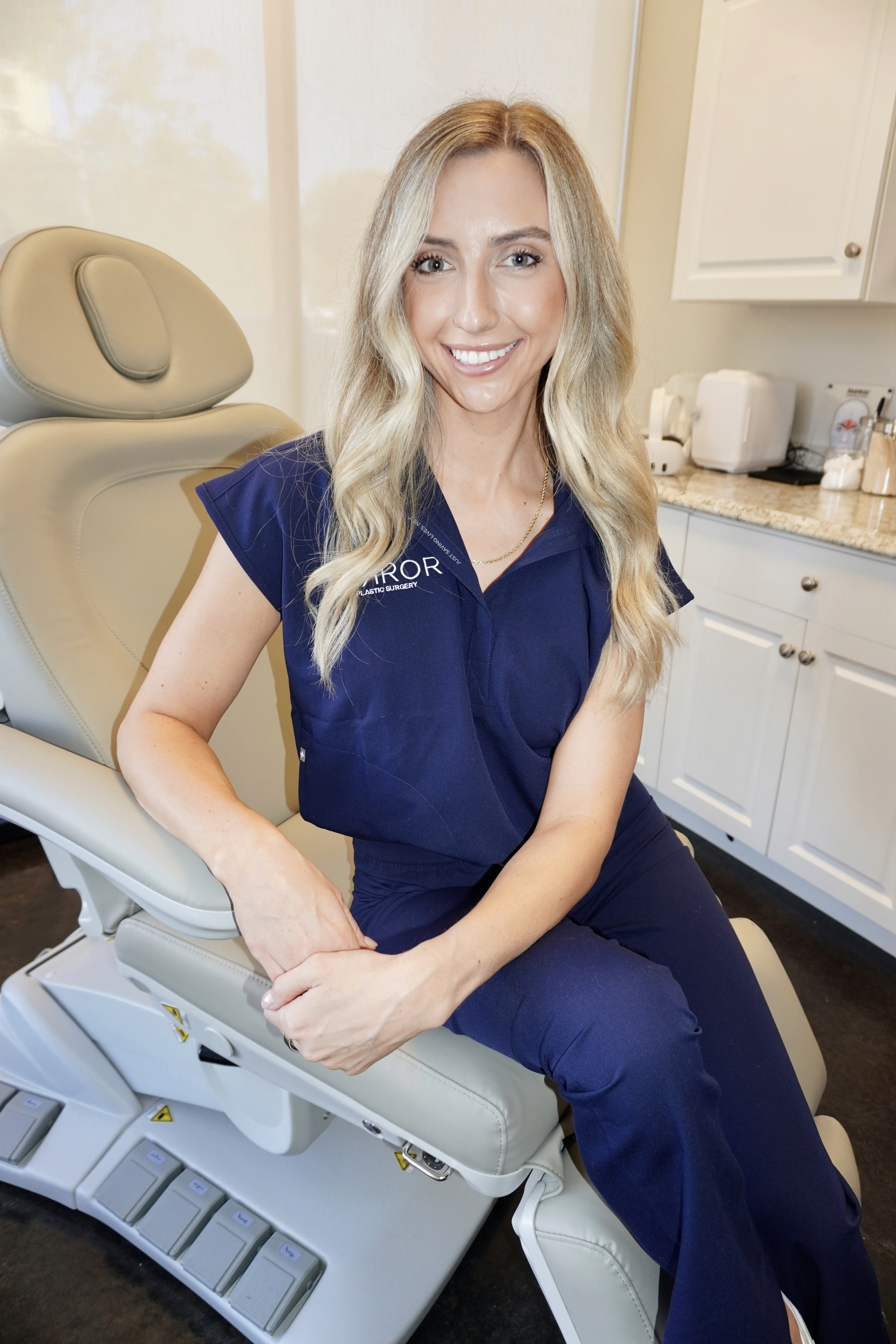
Mirror Plastic Surgery remains supplier-neutral, so recommendations reflect your anatomy and the evidence rather than product quotas or commission structures. If a treatment is not right for you yet, you will hear that clearly. That honesty forms the basis of every long-term patient relationship at the practice.
Mirror Plastic Surgery is located at 780 4th Ave S, St. Petersburg, FL 33701. Patients can call or text 727-361-6515 or email hello@mirrorplasticsurgery.com to schedule.
Disclaimer: Results may vary from person to person. Editorial content, before and after images, and patient testimonials do not constitute a guarantee of specific results.
1 Results may vary from person to person. Editorial content, before and after images, and patient testimonials do not constitute a guarantee of specific results.