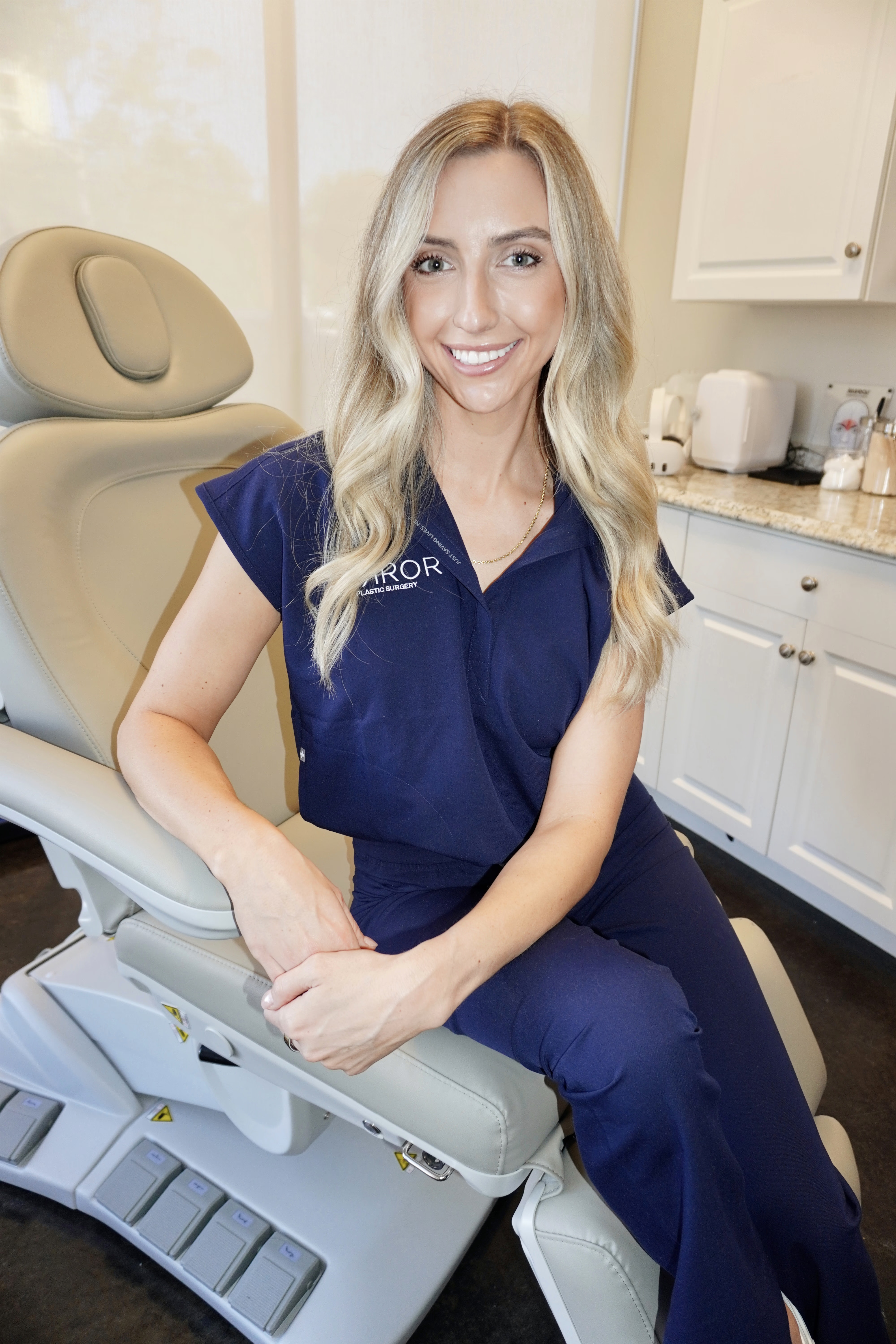
Written by: Ellie Pranckevicius, FNP-BC, Aesthetic Nurse Practitioner & Aesthetic Injector | Facial Restoration & Regenerative Injectable Specialist, Mirror Plastic Surgery
Key Takeaways
- Kim Kardashian has publicly confirmed using at-home IPL and diode devices, but no verified documentation exists for her professional laser protocol.
- IPL is not a true laser and is unsuitable for Fitzpatrick skin types V–VI because of high burn and hyperpigmentation risk.
- Diode (810 nm) works across most skin types I–V, while Nd:YAG (1064 nm) remains the gold standard for dark and tanned skin.
- At-home devices create slower, lower hair reduction than professional systems and are not appropriate for hormonally driven hair growth.1
- The right technology depends on wavelength, skin type, and clinical assessment, not celebrity endorsement. Book a consultation with Ellie at Mirror Plastic Surgery for an individualized, evidence-based evaluation.
Kim Kardashian’s Documented Hair Removal Devices
Kardashian’s confirmed public device mentions fall into two categories: at-home consumer devices and a single reference to a professional brand name. She has promoted the Ulike IPL handset on social media and has been associated with TRIA Beauty products. A New Beauty feature documented her use of the XERF laser for skin tightening, which is a different treatment than hair removal.
References to the Soprano diode platform appear in lifestyle media, yet no clinical record, treatment protocol, or verified provider statement confirms the specific device, fluence, or wavelength settings used in any professional session. Under CAP Code rule 3.47, marketers using testimonials must hold documentary evidence that the quote is genuine and accurately reflects the endorser’s statements. Most celebrity device mentions do not meet that standard. The FTC also requires clear disclosure of material connections, including free or discounted treatments, in any endorsement.
The practical conclusion is straightforward. Kardashian’s at-home use of IPL and consumer diode devices is documented. Her professional laser history is not.
Confirmed At-Home Devices: TRIA 4X and Ulike
The confirmed at-home devices in Kardashian’s public record include the Ulike IPL handset and the TRIA 4X diode laser. The TRIA 4X is the only true at-home diode laser in the consumer market and uses a single 810 nm wavelength comparable to in-office diode systems, although at much lower fluence. It suits light to medium skin tones. The Ulike is an IPL device rather than a single-wavelength laser and carries the same skin-tone limitations as other consumer IPL devices.
At-home devices can create hair reduction after consistent use over several months.1 Professional systems usually achieve greater reduction after a series of in-office sessions.1 Celebrity promotion does not change the underlying clinical specifications or safety profile of these devices.
Book a consultation with Ellie at Mirror Plastic Surgery to receive an individualized assessment of which technology fits your skin type, hair color, and treatment area before you invest in any device or professional series.
Who Is Not Suitable for IPL Hair Removal?
IPL devices emit broad-spectrum, non-coherent light rather than a single focused wavelength, so they are less follicle-selective than true lasers. This difference directly affects safety across skin tones and effectiveness across hair colors.
At-home IPL and diode devices have important contraindications, so users should review the device manual and speak with a healthcare provider if they have relevant medical conditions.
At-home IPL is also unsuitable for tattoos, moles, open wounds, sunburned skin, or patients taking photosensitizing medications such as isotretinoin unless they receive medical clearance first.
TRIA vs Soprano vs Ulike for Different Skin Tones
Given these safety constraints, device choice should match your skin tone and hair pattern rather than a celebrity mention. The table below summarizes how three commonly discussed devices perform across skin types.
| Device | Technology / Wavelength | Skin-Type Range | 2026 Performance Notes |
|---|---|---|---|
| TRIA 4X (at-home) | True diode, 810 nm; 1–10 J/cm² | Light to medium skin tones | FDA-cleared for hair reduction; requires multiple sessions and often plateaus below professional results |
| Ulike (at-home) | IPL, broad-spectrum 400–1200 nm range | Fitzpatrick I–IV; elevated burn and PIH risk on V–VI | FDA-cleared for hair reduction only; higher paradoxical hypertrichosis risk than true lasers, especially in skin type III |
| Soprano (professional diode) | 808–810 nm diode; 10–120 J/cm² with sapphire cooling | Fitzpatrick I–V; VI under low-fluence SHR protocols with specialist oversight | Delivers substantial lasting hair reduction over multiple sessions and outperforms at-home options for most patients1 |
IPL Safety on Darker Skin Tones
IPL systems are broader-spectrum and less follicle-selective than diode lasers and are generally limited to lighter skin (Fitzpatrick I–III) with high post-inflammatory hyperpigmentation risk on types IV–VI. The mechanism is simple. Broad-spectrum IPL cannot clearly distinguish melanin in the hair follicle from melanin in the surrounding epidermis.
In darker skin, the epidermis absorbs more of this energy, which raises the risk of burns, blistering, and permanent pigment changes. Most at-home IPL devices are FDA-cleared only for Fitzpatrick skin types I–IV. Some at-home devices that combine IPL with radiofrequency have clearance for Fitzpatrick I–VI, although their real-world outcomes still differ from professional systems.
For Fitzpatrick V–VI patients, Nd:YAG lasers typically emit at 1064 nm and remain the only consistently recommended first-line choice. The longer wavelength bypasses surface melanin and targets the follicle base more directly. A 2025 clinical study in Lasers in Medical Science examined an 808 nm diode laser using low-fluence, high-repetition protocols with integrated sapphire cooling in Sudanese women with Fitzpatrick IV–VI skin. The study reported safe use with only transient erythema and no permanent pigment changes, which confirms that diode can be used safely on darker skin under specialist protocols, while Nd:YAG remains the gold standard.
Common Laser Hair Removal Regrets
Forum discussions about laser hair removal regret often cluster around two themes. Patients describe unwanted outcomes in sensitive anatomical areas and report paradoxical hypertrichosis, which is a documented phenomenon where laser treatment stimulates rather than destroys hair growth.
IPL devices carry a higher risk of paradoxical hypertrichosis than true lasers, especially in skin type III. This effect appears most often when energy levels are too low to destroy follicles and instead stimulate them, a pattern that matches many at-home devices with limited fluence. Peer-reviewed literature confirms that significant adverse effects have been associated with laser treatment performed by untrained practitioners. Regret usually follows mismatched technology, inadequate cooling, or unsupervised use rather than the modality itself.
Cooling quality plays a separate and important role. Professional clinic diode lasers use active sapphire cooling to around 5°C. In contrast, at-home IPL devices rely on passive or mild air cooling, which limits safe fluence levels and raises the risk of thermal injury when users push settings beyond recommendations.
Alexandrite, Diode, and Nd:YAG for Body Hair
When a Professional Assessment Matters Most
Selecting a laser modality without a clinical skin-type assessment is a leading cause of poor outcomes and regret. Safe, effective treatment depends on several variables, including Fitzpatrick skin type, hair color and coarseness, hormonal history, anatomical treatment area, and medication use. A consumer device sensor or celebrity social media post cannot evaluate these factors accurately.
Mirror Plastic Surgery’s approach begins with a top-to-bottom anatomical assessment that reviews each of these factors before any technology recommendation. This assessment-first methodology reflects the practice’s safety-first philosophy, which prioritizes safety, then function, then aesthetics. As a result, no device or protocol is chosen because of trend or volume. Hormonally driven hair growth such as PCOS-related or postmenopausal regrowth usually requires the higher fluence and precise wavelength targeting of clinical systems1. At-home devices are not appropriate for these cases, and a concierge assessment identifies them before treatment begins.
Book a consultation with Ellie at Mirror Plastic Surgery in St. Petersburg to receive a personalized, evidence-based technology recommendation matched to your skin type, hair profile, and long-term goals.
2026 At-Home Device Snapshot
At-home IPL devices are FDA-cleared only for hair reduction, not permanent hair removal, and operate at 10–20 J/cm² compared with clinical systems at 20–120 J/cm². The TRIA 4X remains the only consumer diode laser for light to medium skin tones. Some at-home devices that combine IPL with radiofrequency have clearance for Fitzpatrick I–VI, although their results still differ from professional systems. The Epilaser 980 is a true 980 nm diode laser designed for Fitzpatrick V–VI skin, but current outcomes data remain limited compared with professional Nd:YAG systems.
At-home IPL devices are largely ineffective on blonde, gray, red, or fine light hair because low fluence cannot deliver enough energy to low-melanin follicles. Professional triple-wavelength diode systems address these hair types more effectively. Many users who purchase at-home IPL devices later seek professional treatment because home results are slower, partial, and require ongoing maintenance to sustain even modest reduction.
Limitations of Any Laser Hair Removal Plan
All laser hair removal outcomes, whether professional or at-home, vary meaningfully from person to person.1 Key factors include Fitzpatrick skin type and epidermal melanin, hair color and coarseness, hormonal status such as PCOS, pregnancy, and menopause, the anatomical treatment area and follicle density, and medications that affect photosensitivity. Geographic factors such as Tampa Bay’s high humidity and UV exposure increase the likelihood of post-treatment hyperpigmentation when sun protection is inconsistent.
No device or clinical system produces identical results across all patients. The figures cited in this article reflect study populations and may not match every individual’s anatomy or hair profile.
Frequently Asked Questions
Does Kim Kardashian’s device choice guarantee it will work for my skin?
No. Kardashian’s confirmed at-home devices, the TRIA 4X and Ulike IPL, suit light to medium skin tones and work best on dark hair against fair skin. Her skin tone and hair profile may differ significantly from yours. Device suitability depends on wavelength, your Fitzpatrick skin type, hair color, and coarseness, not on celebrity use. A clinical assessment remains the only reliable way to determine which technology fits your anatomy.
Is IPL the same as laser hair removal?
No. IPL uses broad-spectrum polychromatic light in the 400–1200 nm range rather than a single focused wavelength. True laser systems such as diode, Alexandrite, and Nd:YAG emit a single coherent wavelength that targets melanin in the hair follicle with greater precision. The FDA does not classify IPL as laser hair removal.
IPL is less follicle-selective, carries a higher risk of paradoxical hypertrichosis, and is not appropriate for Fitzpatrick skin types V–VI. Patients seeking permanent hair reduction should confirm that their provider uses a true laser system.
Which laser is safest for dark skin tones?
For Fitzpatrick skin types V–VI, Nd:YAG lasers typically emit at 1064 nm, which makes this technology the gold standard. The longer wavelength bypasses surface melanin and targets the follicle base, reducing the risk of epidermal burns and post-inflammatory hyperpigmentation. Diode lasers at 808–810 nm can be used safely on Fitzpatrick IV–V with low-fluence, high-repetition protocols and integrated sapphire cooling under specialist oversight. IPL and Alexandrite are generally not appropriate for Fitzpatrick V–VI skin.
Why do some people see more hair growth after laser treatment?
Paradoxical hypertrichosis, or increased hair growth after laser treatment, occurs most often when energy levels are too low to destroy follicles and instead stimulate them. This pattern appears more frequently with at-home IPL devices that operate at insufficient fluence and with IPL use on skin type III. It is also associated with treatment of fine, vellus facial hair.
Professional systems with calibrated fluence, appropriate wavelength selection, and clinical oversight greatly reduce this risk. Anyone who has experienced unexpected hair growth after a previous treatment should seek a clinical assessment before continuing with any energy-based hair removal.
How many sessions do professional lasers require compared with at-home devices?
Professional diode laser systems usually achieve substantial hair reduction over several sessions spaced 4–6 weeks apart. At-home IPL devices often require more sessions and tend to plateau at lower reduction levels, with hair returning once maintenance stops. At-home diode devices such as the TRIA 4X need regular sessions over an extended period and still deliver slower, less complete results than professional systems because of their much lower fluence.
Hormonal factors, hair color, and anatomical area influence the total number of sessions required, regardless of the modality used.
Final Takeaways and Next Steps
Kim Kardashian’s confirmed at-home device use, the TRIA 4X diode and Ulike IPL, is documented, while her professional laser protocol remains unverified. IPL is not a laser and is unsuitable for Fitzpatrick V–VI skin. Diode at 810 nm offers broad versatility across skin types I–V, and Nd:YAG at 1064 nm remains the gold standard for dark and tanned skin. At-home devices provide slower, lower reduction than professional systems.
The right technology depends on wavelength, skin type, and clinical assessment rather than celebrity endorsement. Mirror Plastic Surgery’s concierge, safety-first evaluation supports individualized, evidence-based selection for every patient.
Book a consultation with Ellie at Mirror Plastic Surgery, located at 780 4th Ave S, St. Petersburg, FL 33701, or call 727-361-6515 to begin your individualized laser assessment today.
Disclaimer: Results may vary from person to person. Editorial content, before and after images, and patient testimonials do not constitute a guarantee of specific results.
1 Results may vary from person to person. Editorial content, before and after images, and patient testimonials do not constitute a guarantee of specific results.