
Written by: Ellie Pranckevicius, FNP-BC, Aesthetic Nurse Practitioner & Aesthetic Injector | Facial Restoration & Regenerative Injectable Specialist, Mirror Plastic Surgery
Key Takeaways for Tampa and St. Petersburg Adults
- Dermal fillers can restore volume and soften lines with minimal downtime when an experienced injector evaluates your full facial anatomy and sets clear expectations.1
- Fillers are rarely worth it when chosen impulsively, performed in isolation, or repeated without reassessing total volume and anatomical fit.
- Poorly planned or excessive filler can migrate, create tissue memory, and compound unfavorably with natural aging, which drives many patients to seek reversal.
- Maintenance often ranges from $500–$6,000 per year depending on treatment areas, so you need a clear view of both cost and medical risk before starting.
- Schedule a consultation at Mirror Plastic Surgery for a full-face assessment and straightforward guidance on whether fillers match your goals.
Do Fillers Age You? How Long-Term Changes Really Work
Concerns that fillers might accelerate aging come partly from documented anatomical changes. Beverly Hills plastic surgeon Jason B. Diamond reports that commonly performed filler placement is not always anatomically appropriate and can migrate southward and downward, where it looks unnatural. The same source notes that filler can cause tissue to retain a memory of swelling even after partial metabolization, which creates ongoing puffiness when treatments are overdone.
Longevity data adds another layer. A 2024 MRI study of 33 patients found residual hyaluronic acid filler in every participant, with no complete dissipation over a 2-year period after injection. Filler placed today may still be present many years from now and will interact with natural aging in ways that are hard to predict.
ASPS Member Surgeon Omar Hussain, MD, notes that relying only on filler often leads to adding more volume over time, which pushes patients into an overfilled look that can appear less natural than the aging they hoped to soften. The face keeps aging during injectable use, which creates what ASPS Member Surgeon Karen Horton, MD, MSc, FACS, calls a “moving target.” Results shift with time even when the injector is highly skilled.
Fillers do not inherently age you. Poor planning, weak anatomical understanding, and frequent repeat sessions without full-face reassessment create results that can age poorly. A full-face evaluation at every visit, rather than simply topping off the same area, separates responsible care from volume-focused injection.
Schedule a full-face assessment with Ellie before you decide on any filler treatment.
Why Are People Stopping Fillers? Cultural Shifts and Regret
These anatomical concerns about migration and tissue memory help explain a measurable cultural shift now underway. Celebrities such as Simon Cowell, Blac Chyna, and Courteney Cox have publicly dissolved their fillers, with Cox saying “I messed up a lot” and Cowell stating “Enough was enough.” Their reversals mirror a broader pattern on forums and social media, where many people describe regret over cumulative volume, migration, and feeling that their face no longer looks like their own.
Reversal costs add financial stress. Patients often spend thousands of dollars on initial injections and then thousands more to dissolve filler when migration, overfilling, or an unnatural look appears. One Austin aesthetician who specializes in injectables reported paying $5,000 to remove all facial filler after complications from earlier treatments.
The trend away from fillers does not prove that fillers are universally harmful. Allergan Aesthetics research shows high satisfaction with HA fillers, while many patients still want a “natural” look. That gap points to execution and expectation management, not a flawed product. Social media and online videos supply much of the education around fillers, yet that information is often incomplete or misleading.
People usually stop fillers because the injector focused on volume instead of anatomy, treated single areas without considering the whole face, or failed to explain realistic long-term expectations from the beginning.
Start with an anatomy-first consult with Ellie to decide whether fillers truly fit your goals.
What Is the Downside of Dermal Fillers? Maintenance, Cost, and Risk
Dermal fillers carry three main downsides: ongoing maintenance, cumulative cost, and medical risk.
Maintenance frequency: Most hyaluronic acid fillers last six to eighteen months, with lips at the shorter end and deep cheek or jaw augmentation often lasting eighteen months or more.1 Longevity depends on placement, cross-linking of the product, your metabolism, exercise intensity, and sun exposure. High-intensity cardio can shorten duration.
Cumulative cost: Many patients need one to two touch-ups per year at $500–$2,000 per session, or about $500–$4,000 annually for moderate maintenance.1 Full-face maintenance at higher frequency can reach $3,500–$6,000 per year.
Medical risks: Common effects include bruising, swelling, and asymmetry. Rare but serious complications include vascular occlusion, tissue necrosis, and vision loss, which are covered in more detail in the vascular occlusion section below.
Karen Horton, MD, MSc, FACS, describes a “ceiling effect” for fillers, where additional product no longer improves results and instead creates heavy, distorted, or sagging skin. Knowing that ceiling before you begin helps you avoid the outcomes that often drive people to stop fillers.
Meet with Ellie to review maintenance demands and medical risks before you commit to filler.
Does Filler Change Your Face Shape Over Time? Migration and Tissue Memory
Filler can change your face shape over time through both anatomical and biological mechanisms. Hyaluronic acid filler integrates with tissue and resists natural breakdown because of chemical crosslinking and placement in protected tissue planes. Filler in the cheeks or temples rarely dissolves on a strict schedule. It persists, shifts, and interacts with ongoing volume loss and soft tissue descent.
Migration is the most visible shape change. The southward and downward shift that Diamond described is especially relevant in the midface. Repeated volumization there, without structural reassessment, can create a rounded, heavy look that no longer matches your natural facial geometry.
Tissue memory compounds this effect. Filler can cause tissue to retain a memory of swelling even after partial metabolization, which leads to lingering puffiness when treatments are aggressive. This tissue memory builds over time. Each session adds to your baseline, and if your provider does not reassess total volume at every visit, your face can drift into proportions that no longer reflect your original anatomy.
You do not need to avoid fillers entirely to prevent these issues. You need an injector who treats your face as a connected system instead of a set of isolated spots. At Mirror Plastic Surgery, Ellie Pranckevicius starts by restoring your inherent facial characteristics, then considers volume only when it supports that foundation. This order of operations helps prevent the shape distortions that accumulate over years.
Arrange a full-face evaluation with Ellie so any filler plan respects your existing structure.
Alternatives to Fillers: Other Ways to Address Aging Changes
Several non-surgical options address volume loss, laxity, and texture without the same migration or cumulative-volume concerns that come with repeated filler use. Each option has its own durability and risk profile.
- Neurotoxins (Botox, Dysport, Xeomin, Daxxify, Jeuveau): These treatments soften dynamic wrinkles and can create modest lifting by relaxing facial muscles, with results that last about 3–4 months.1 Common areas include crow’s feet, forehead lines, masseter slimming, and platysmal bands. Ellie treats the face, neck, masseters, and trapezius muscles with neurotoxins.
- RF Microneedling: This modality remodels collagen to improve jawline laxity, texture, and acne scars.1 Results appear over 6–12 weeks after a typical three-treatment series and often last about one year, with 1–3 days of downtime.
- Ultrasound Skin Tightening (HIFU/Sofwave): Focused ultrasound stimulates collagen and elastin for brow, lower face, neck, and under-chin tightening.1 Results build over 2–3 months and can last a year or longer after a single session, with no downtime.
- Thread Lifts (PDO/PLLA): Threads provide mechanical lifting for early jowls, cheek descent, and brow elevation.1 Lifting effects usually last 6–12 months.1 These treatments work best as a temporary bridge to surgery, not a substitute for significant laxity.
- Biostimulatory Fillers (Radiesse, Sculptra): These products stimulate collagen over about three months, with results that can last up to 24 months depending on product and area.1 They differ from HA fillers because hyaluronidase cannot reverse them, so precise placement by an experienced injector is critical.
- Surgical Options: Omar Hussain, MD, explains that surgery becomes appropriate when tissue descent reaches a point where repositioning, not volumizing, is required. Injectables can slow the appearance of aging but cannot reverse deeper mechanical changes. At Mirror Plastic Surgery, Dr. Akash Chandawarkar offers surgical consultations for patients whose anatomy has moved beyond what non-surgical options can address.
Explore non-filler options with Ellie to match your anatomy, goals, and budget.
Decision Tree: When to Skip Fillers and Choose Another Path
This framework helps you decide whether fillers should be your first step or whether another approach makes more sense.
- Identify your primary concern. If you mainly see dynamic wrinkles that appear with movement, start with neurotoxins. If you notice volume loss or contour changes, move to step 2 to see whether your skin can support filler. If sagging or laxity dominates, consider RF microneedling, ultrasound tightening, or a surgical consult before you think about filler.
- Assess your degree of laxity. This step matters because adding filler to loose skin often creates heaviness instead of lift. Mild laxity may respond well to energy-based treatments. Significant laxity with tissue descent usually responds better to surgery. Moderate laxity with volume loss often represents the clearest indication for filler.
- Clarify your five-year budget. If ongoing annual maintenance feels unrealistic, biostimulatory fillers or energy-based treatments with longer intervals may provide better long-term value than frequent HA filler sessions.
- Review your medical and risk tolerance. If you have vascular conditions, take anticoagulants, or have had filler complications before, you need a full medical review before any injection. Cannula technique and a provider with a documented complication-management protocol should be considered essential.
- Account for any prior filler. If residual filler remains from earlier treatments, adding more without first evaluating your baseline can worsen migration and shape distortion. Dissolving and then reassessing may be the safest first move.
If any step raises concern, your next move should be a detailed consultation, not an automatic treatment booking.
Work through this decision framework with Ellie and get clear guidance if fillers are not the right choice for you.
Realistic Lifetime Investment: Annual Filler Maintenance Ranges
The table below outlines estimated annual maintenance ranges for common filler areas, based on published longevity and cost data. Mirror Plastic Surgery does not quote specific prices here; your plan and pricing are discussed during consultation.
| Treatment Area | Typical Longevity | Estimated Sessions Per Year | Estimated Annual Cost Range (US) |
|---|---|---|---|
| Lips | 6–9 months | 1.5–2 sessions/year | $1,000–$4,000 |
| Cheeks / Chin / Jaw | 12–18 months | ~0.8 sessions/year | $500–$2,000 |
| Nasolabial Folds / Under-Eye | 9–12 months | ~1 session/year | $500–$2,000 |
| Full-Face Maintenance | Varies by area | 2 sessions/year | $3,500–$6,000 |
Note: long-term maintenance at experienced practices often involves conservative refinements that use only 10%–20% of the original volume, which can lower annual costs over a 3–7 year period. Premium, highly cross-linked products in structural areas can also reduce how often you need sessions compared with thinner gels.
Request a personalized treatment and cost plan with Ellie so you understand your long-term investment before you start.
Vascular Occlusion and Blindness Risks: How Ellie Reduces These Events
Vascular occlusion is the most serious acute complication of dermal filler. It occurs when filler enters or compresses a blood vessel and blocks blood flow to skin or, in severe cases, to the eye.
Observational studies and systematic reviews show a low overall incidence of cutaneous ischemic events from fillers, although reported ischemic injuries increased between 2000 and 2020. Vision loss remains rare but devastating. Retinal ischemia from filler embolism can cause permanent vision loss within minutes, and meaningful recovery usually occurs only when treatment begins within the first hour.
Prevention offers the most reliable protection. Key protocol elements include:
- Cannula over needle when appropriate: Studies report a significantly lower rate of ischemic events when cannulas are used instead of needles.
- Aspiration technique: Aspirating before injection in high-risk vascular zones lowers the chance of intravascular placement.
- Detailed anatomical knowledge: High-risk areas such as the glabella, nasolabial folds, nose, and periorbital region require precise understanding of vessel locations at each tissue plane.
- Hyaluronidase on hand: For HA fillers, immediate access to hyaluronidase and a written emergency protocol should be considered a basic safety standard.
- Low-volume, slow injection: Small, slow boluses reduce pressure that could push filler into vessels.
Ellie Pranckevicius’s four years in the Neuroscience ICU at Tampa General Hospital give her a level of emergency clinical judgment that is uncommon in aesthetics. Her advanced nursing training and deep understanding of subdermal anatomy shape both her injection style and her readiness to manage complications.
Discuss Ellie’s safety protocols in a consultation before you proceed with any injections.
Real Patient Regrets: Patterns Behind Filler Reversal
Patient forums and reversal consultations often describe a series of small decisions that eventually produced an outcome no single session seemed to cause.
- “I regret every milliliter I added after the first year.” Patients who continued maintenance without reviewing total volume often describe a face that no longer feels like theirs.
- “My cheeks look puffy even when the filler is supposed to be gone.” This matches the documented tissue memory effect, where filler causes tissue to retain a memory of swelling after partial metabolization.
- “I did not realize it was still there after five years.” This aligns with the 2024 MRI study that found persistent filler in one patient for 15 years.
- “My injector just kept adding more to the same spot every visit.” Isolated, single-area injections without full-face reassessment represent the most common procedural regret.
- “Getting it dissolved cost more than the original treatment.” Reversal can reach thousands of dollars on top of the initial investment.
These stories do not argue against fillers themselves. They argue against volume-driven, anatomy-agnostic practice. Patients who report the highest satisfaction usually work with providers who treat the full face as a system, explain cumulative effects clearly, and recommend less or nothing when the anatomy does not call for more.
Schedule a candid consult with Ellie; she will tell you directly when a treatment is unnecessary or premature.
How Mirror Plastic Surgery Approaches Fillers for Tampa Adults
At Mirror Plastic Surgery, non-surgical treatments are led by Ellie Pranckevicius, FNP-BC, an Aesthetic Nurse Practitioner with training in both esthetics and advanced nursing. Her background includes a Bachelor’s in Health Science from Boston University, 600 hours of hands-on aesthetics licensure training, and both a Bachelor’s and Master’s in Nursing from the University of South Florida. Before joining Mirror Plastic Surgery, she spent four years in the Neuroscience ICU at Tampa General Hospital, which directly informs her safety decisions and anatomical precision.
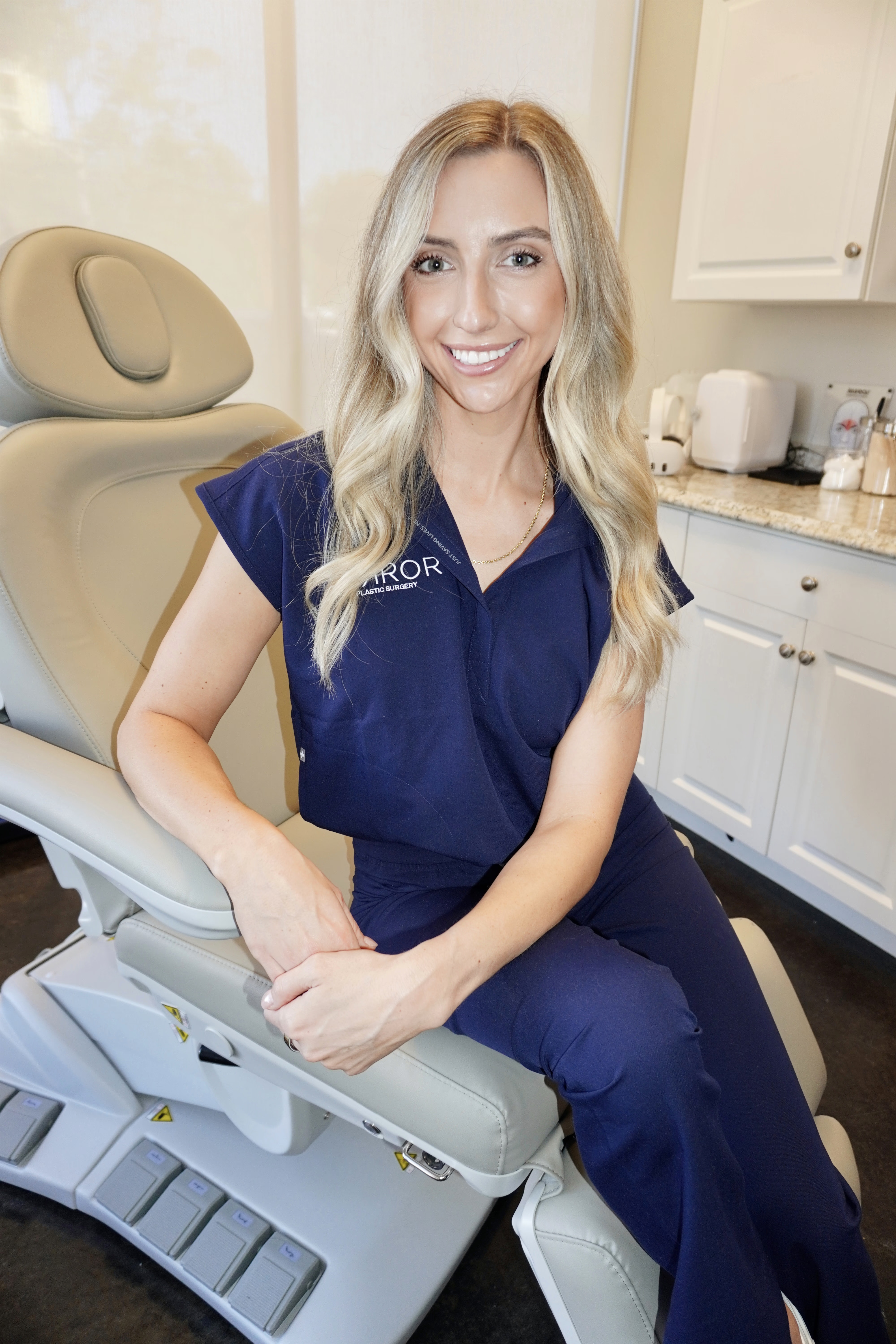
Ellie’s philosophy centers on a holistic, full-face approach. She first focuses on revitalizing your inherent facial characteristics. She considers volume augmentation only after that foundation is restored. This sequence helps prevent the “overdone” look and asymmetry that often follow isolated, single-area injections. She compares aesthetics to dentistry: professional treatments matter, but lasting results require understanding, consistent maintenance, and honest advice when an expensive service is not yet necessary.
Mirror Plastic Surgery remains supplier-neutral. Product choices depend on your anatomy, skin quality, and goals, not brand quotas or commissions. The practice uses a wide range of neuromodulator and filler brands, including Juvederm, RHA, Versa, Restylane, Radiesse, and Evolysse, and selects the formulation that best fits your needs.
Initial consultations can last up to an hour. That time allows for a thorough top-to-bottom assessment, a clear understanding of your emotional goals, and a plan that prioritizes safety first, function second, and aesthetics third. When surgery is appropriate, Ellie’s work pairs with that of Dr. Akash Chandawarkar, MD, a Harvard-educated, Johns Hopkins-trained, fellowship-trained aesthetic plastic surgeon at Manhattan Eye Ear & Throat Hospital.
Schedule a consultation with Ellie at Mirror Plastic Surgery’s St. Petersburg office to start with a full-face assessment that protects both your anatomy and your long-term well-being.
Conclusion and Medical Disclaimer
Dermal fillers are a clinically validated tool for facial rejuvenation. They can restore volume, soften lines, and refine contours with minimal downtime and, for HA products, the option of reversal. Fillers are worth considering when you work with a qualified injector who understands anatomy, evaluates your full face at every visit, explains cumulative volume and long-term cost, and maintains a clear protocol for rare but serious complications.
Fillers are rarely worth it when trend-driven, performed in isolation, or repeated without checking whether more volume still suits your anatomy. Patients who regret fillers usually regret choosing injectors who prioritized speed and volume over anatomy and honesty.
For adults in Tampa and St. Petersburg who want a transparent, evidence-based framework before committing to treatment, Mirror Plastic Surgery offers the level of concierge consultation that this decision deserves.
Arrange a consultation with Ellie at 780 4th Ave S, St. Petersburg, FL 33701, or contact the practice by phone or text at 727-361-6515.
*Disclaimer: Results vary from person to person. Editorial content, before and after images, and patient testimonials do not guarantee specific outcomes.
Frequently Asked Questions
How do I know if I need filler or a different treatment entirely?
Your answer depends on what actually drives your concern. Dynamic wrinkles that appear with movement respond best to neurotoxins, not fillers. Volume loss in the cheeks, temples, or jawline more often points toward filler or biostimulatory treatments. Skin laxity with tissue descent usually calls for energy-based tightening or, in advanced cases, surgery. Filler added to a face with significant laxity can create heaviness instead of lift. A thorough top-to-bottom assessment with an experienced injector offers the most reliable way to choose the right modality or combination. At Mirror Plastic Surgery, Ellie Pranckevicius spends up to an hour in consultation to answer this question before recommending any treatment.
Is it safe to dissolve filler if I change my mind?
Hyaluronic acid fillers can be dissolved with hyaluronidase, an enzyme that breaks down the filler material. The process is generally effective when performed by a skilled injector who understands the tissue planes where filler may sit or migrate. Dissolution does not always happen in a single session. Heavily treated areas may need multiple visits, and the cost can be substantial. Biostimulatory fillers such as Radiesse and Sculptra cannot be reversed with hyaluronidase, which makes precise initial placement even more important. Before starting any filler treatment, discuss the reversal process with your provider so you understand what happens if you dislike the outcome.
How often will I actually need to come back for maintenance?
Maintenance frequency depends on the treatment area, product choice, your metabolism, activity level, and sun exposure. Lips usually require the most frequent visits, often every six to nine months. Structural areas such as the cheeks and jawline, where firmer, more cross-linked gels sit over bone, can last twelve to eighteen months or longer. Long-term data suggests that with conservative, well-placed filler, touch-ups may require only a fraction of the original volume. The key is working with a provider who reassesses your full face at each visit instead of automatically re-treating the same spots. Ellie’s approach at Mirror Plastic Surgery is to evaluate what you truly need at every appointment and to say clearly when maintenance is not yet necessary.
What makes vascular occlusion more or less likely?
Vascular occlusion risk depends on injection technique, anatomical knowledge, treatment area, and tools. High-risk zones include the glabella, nasolabial folds, nose, and periorbital area, where vessels run close to the surface in predictable yet delicate planes. Cannula technique is associated with a lower rate of ischemic events than sharp needles. Slow, low-volume injection reduces pressure that can push filler into vessels. Aspiration before injection in high-risk zones adds another layer of protection. The most important factor is choosing an injector with deep anatomical expertise and a documented emergency protocol, including immediate access to hyaluronidase and the clinical judgment to recognize and treat early signs of occlusion.
1 Results may vary from person to person. Editorial content, before and after images, and patient testimonials do not constitute a guarantee of specific results.