Counterfeit botulinum toxin products have entered the U.S. market and now create real safety risks for Florida cosmetic patients.
Iatrogenic botulism can cause blurry vision, difficulty swallowing, and even respiratory failure, which requires immediate emergency care.
Only six FDA-approved cosmetic botulinum toxin products are legal in the United States as of 2026, and anything else is unapproved.
Authentic product verification depends on checking holograms, lot numbers, cold-chain documentation, and confirming direct purchase from authorized U.S. distributors.
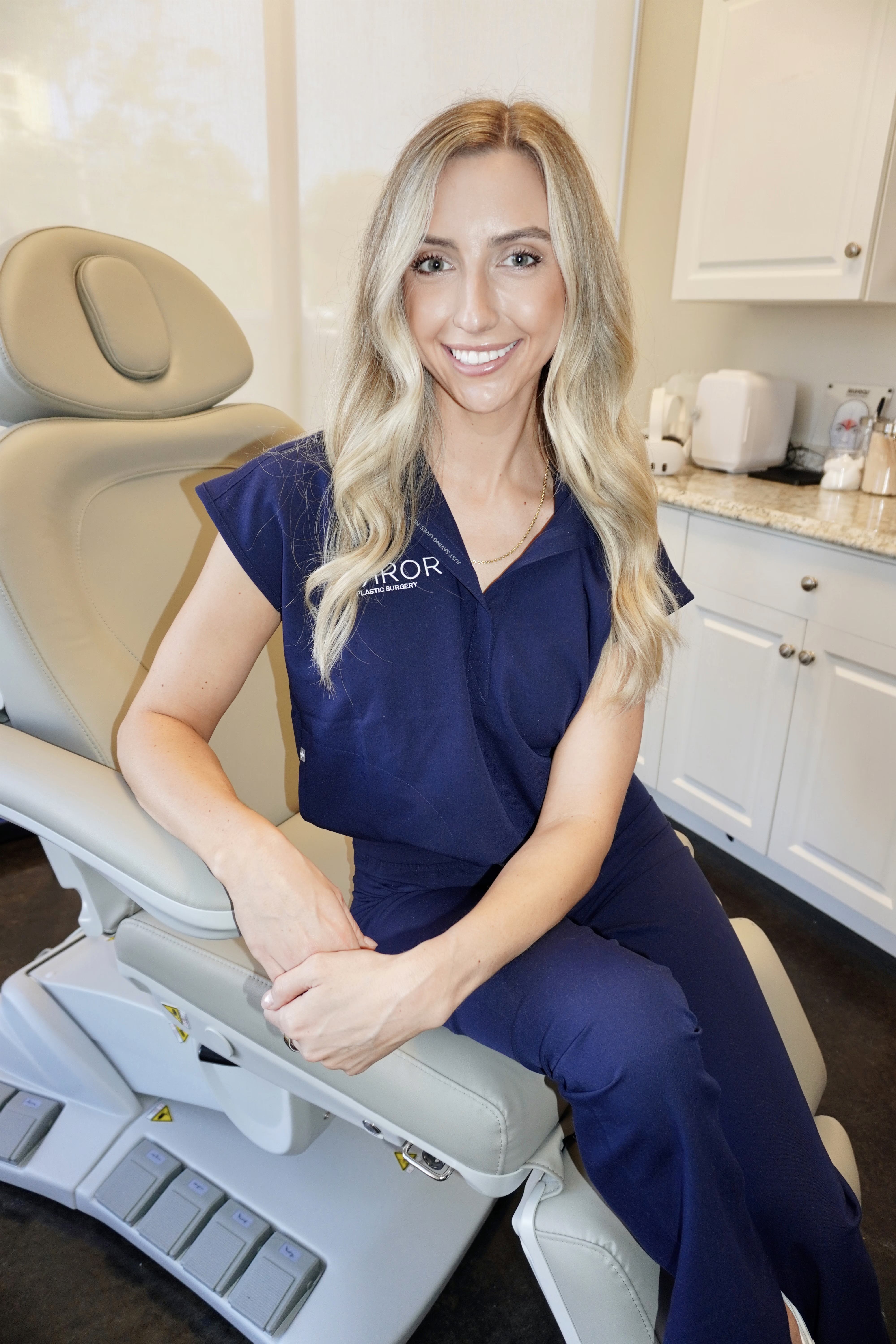
Patients lower their risk by choosing a licensed, board-certified provider such as those at Mirror Plastic Surgery who follow strict lot-verification and sourcing protocols.
How Iatrogenic Botulism Happens After Cosmetic Injections
Iatrogenic botulism occurs when botulism develops after a medical or cosmetic intervention instead of foodborne or wound exposure. Counterfeit, adulterated, or improperly dosed botulinum toxin can enter the body and block acetylcholine release at neuromuscular junctions. This process produces descending flaccid paralysis that can progress from localized muscle weakness to respiratory failure.
Botulism symptoms checklist: seek emergency care if you experience any of the following after an injection.
Spotting Fake Botox: Packaging and Lot-Number Checks
Packaging inspection gives you a practical first line of defense. These counterfeit products create risk precisely because they bypass the quality controls that govern legitimate manufacturing, and the verification checklist below addresses each failure point. Counterfeit manufacturers invest heavily in closely replicating authentic packaging, so you need a structured checklist instead of a quick glance.
“Every vial that enters this practice is cross-referenced against the manufacturer’s lot-number database before it is ever reconstituted. If the lot number does not return a verified result, the vial does not get used, full stop.” — Dr. Akash Chandawarkar, MD, Harvard-educated physician and Johns Hopkins-trained plastic surgeon, Mirror Plastic Surgery
“My neuroscience ICU background means I have seen firsthand what respiratory compromise looks like. That experience is exactly why I will not cut corners on product sourcing. Lot verification is non-negotiable in my practice.” — Ellie Pranckevicius, FNP-BC, Aesthetic Nurse Practitioner, Mirror Plastic Surgery
Verification checklist: how to confirm your Botox is authentic
Check the hologram seal. Authentic Botox vials carry a manufacturer hologram on the box. Tilt the packaging and watch for a genuine hologram that shifts color and pattern under light.
Inspect spelling and font consistency. Counterfeit labels frequently contain subtle misspellings, inconsistent font weights, or off-color ink. Compare the box and vial against the manufacturer’s official product imagery.
Verify the lot number. Allergan (Botox), Revance (Daxxify), Galderma (Dysport), Evolus (Jeuveau), and Merz (Xeomin) each maintain lot-number verification resources. Ask your provider to confirm that the lot number matches an active batch with no recalls.
Confirm the cold-chain documentation. Authentic botulinum toxin requires refrigerated storage. Request documentation that shows uninterrupted cold-chain handling from manufacturer to clinic.
Ask for the supplier invoice. A licensed practice purchases directly from the manufacturer or an authorized U.S. distributor. An unwillingness to share sourcing information should be treated as a red flag.
Confirm the product is unopened at time of reconstitution. You should see the vial opened in front of you or receive documented confirmation that this step occurred.
Unusually low per-unit pricing consistently signals compromised sourcing. Authentic FDA-approved neuromodulators carry fixed manufacturer costs. A provider who offers prices far below the going rate for licensed medical practices must recover that margin somewhere, most often through counterfeit or gray-market product acquisition.
High-volume mill practices that perform large numbers of injection appointments daily also present higher risk. Speed-focused environments reduce the time available for product verification, patient assessment, and complication monitoring. Mirror Plastic Surgery limits itself to one to two procedures per day so that every verification step and patient assessment receives full clinical attention.
Checking Botox Provider Credentials in Florida
Florida’s Department of Health maintains a public license verification portal where you can confirm any provider’s active license status. Verifying these credentials directly reduces your counterfeit exposure risk because licensed providers operate under regulatory oversight that unlicensed practitioners avoid. Before any injection appointment, verify the following:
Medical license status: Confirm that the physician or nurse practitioner holds an active, unrestricted Florida license.
Board certification: For plastic surgeons, confirm certification through the American Board of Plastic Surgery (ABPS) at abplsurg.org.
Nurse practitioner credentials: Confirm board certification (FNP-BC or equivalent) and verify the supervising physician relationship required under Florida law.
Injection-specific training: Ask directly about anatomy training, cadaveric dissection experience, and complication management protocols.
Dr. Akash Chandawarkar is a Harvard-educated physician and Johns Hopkins-trained plastic surgeon with fellowship training in aesthetic surgery at Manhattan Eye Ear & Throat Hospital/Lenox Hill Hospital and medical innovation training at Stanford University. Ellie Pranckevicius, FNP-BC, holds a Master’s in Nursing from the University of South Florida and spent four years in the Neuroscience ICU at Tampa General Hospital before specializing in aesthetic injections.
Mirror Plastic Surgery follows a defined lot-verification protocol for every neuromodulator used in the practice.
All neuromodulators are sourced exclusively from licensed U.S. distributors or directly from manufacturers, with no gray-market or online third-party suppliers.
Upon receipt, staff review and file each shipment’s cold-chain documentation.
Every lot number is cross-referenced against the manufacturer’s active lot database and any active FDA recall lists before use.
Vials are reconstituted in front of the patient or with documented chain-of-custody confirmation.
Product brand selection is based on patient anatomy and clinical indication, not supplier incentives, and the practice remains supplier-neutral.
Ellie conducts a comprehensive pre-injection assessment, and Dr. Chandawarkar is available for surgical-level consultation when needed.
Concierge Care vs. High Volume: Why Fewer Procedures Mean Lower Risk
A practice that performs ten or more injection appointments daily operates under very different incentives than a concierge practice. Quota-driven environments compress the time available for product verification, patient history review, and post-injection monitoring, and each of these steps reduces risk when done thoroughly.
Mirror Plastic Surgery’s concierge model limits daily procedures to one to two, allocates up to an hour for initial consultations, and includes a top-to-bottom anatomical assessment before any treatment recommendation. This structure functions as a clinical safety architecture rather than a marketing slogan. Without volume pressure, every verification step gets completed, every patient question receives a clear answer, and early complication signals are more likely to be caught.
Immediate Steps If You Suspect Botulism Exposure
If you develop symptoms consistent with botulism after any injection, act immediately and follow these steps.
Call 911 or go to the nearest emergency room. Do not wait to see whether symptoms improve.
Inform emergency staff that you received a botulinum toxin injection and provide the date, location, and product name if you know it.
Report the adverse event to the FDA via MedWatch and to the CDC.
Preserve any remaining product, packaging, or lot-number documentation for health authority investigation.
Contact your injection provider to report the reaction and obtain your treatment records.
Frequently Asked Questions
How common is iatrogenic botulism from cosmetic injections?
The CDC has documented reports of harmful reactions following botulinum toxin injections involving counterfeit or unlicensed products, with some cases serious enough to require hospitalization and antitoxin treatment. Most documented cases involved products sourced from unlicensed online suppliers or injections performed by providers without valid healthcare licenses. The true incidence is likely underreported because mild cases may be attributed to other causes. Choosing a licensed, board-certified provider who sources exclusively from authorized U.S. distributors remains the most reliable way to reduce personal risk.
How long after a Botox injection can botulism symptoms appear?
Symptoms of botulism following a botulinum toxin injection can begin anywhere from a few hours to several weeks after treatment. This wide window reflects variables such as dose, specific product, individual physiology, and whether the product was authentic and properly dosed. Early symptoms typically involve the cranial nerves, including blurry vision, drooping eyelids, and difficulty swallowing, before progressing to generalized muscle weakness. Any new neurological symptom following an injection requires immediate emergency evaluation rather than a wait-and-see approach.
What credentials should my Botox injector have in Florida?
In Florida, botulinum toxin injections must be performed by or under the supervision of a licensed medical professional. At minimum, confirm that your injector holds an active, unrestricted Florida license and has documented training in facial anatomy and injection technique. For nurse practitioners, confirm board certification (FNP-BC) and an active supervising physician relationship. For plastic surgeons, confirm American Board of Plastic Surgery certification. Ellie Pranckevicius at Mirror Plastic Surgery holds FNP-BC certification, a Master’s in Nursing from the University of South Florida, and four years of Neuroscience ICU experience at Tampa General Hospital. Dr. Akash Chandawarkar is a Johns Hopkins-trained, ABPS-eligible plastic surgeon with fellowship-level aesthetic training.
Is it safe to get Botox at a med spa or non-clinical setting in Florida?
Setting strongly influences safety. The CDC has documented harmful reactions occurring specifically in non-healthcare settings such as homes and spas, often involving unlicensed providers and unverified products. A licensed medical practice operating under physician oversight, with documented cold-chain sourcing and lot-number verification, provides structural safeguards that non-clinical settings cannot match. When evaluating any provider, ask where the product was sourced, whether lot numbers are verified against manufacturer databases, and what the complication management protocol includes. Unwillingness to answer these questions directly should be treated as a risk signal.
Conclusion: Building a Safer Botox Plan in Florida
Counterfeit botulinum toxin now represents a documented public health concern, with hospitalization and antitoxin use on record as of 2026. The verification framework outlined here, including packaging inspection, lot-number confirmation, cold-chain documentation, credential verification, and setting assessment, gives Florida patients a structured protocol for evaluating any injection provider.
Mirror Plastic Surgery’s concierge model, supplier-neutral sourcing, and the combined credentials of Dr. Akash Chandawarkar and Ellie Pranckevicius, FNP-BC, are designed to remove the variables that create counterfeit exposure risk. One to two procedures per day, up to an hour per consultation, and lot verification on every vial, with no volume quotas and no sourcing shortcuts.
Disclaimer: Results may vary from person to person. Editorial content, before and after images, and patient testimonials do not constitute a guarantee of specific results.