

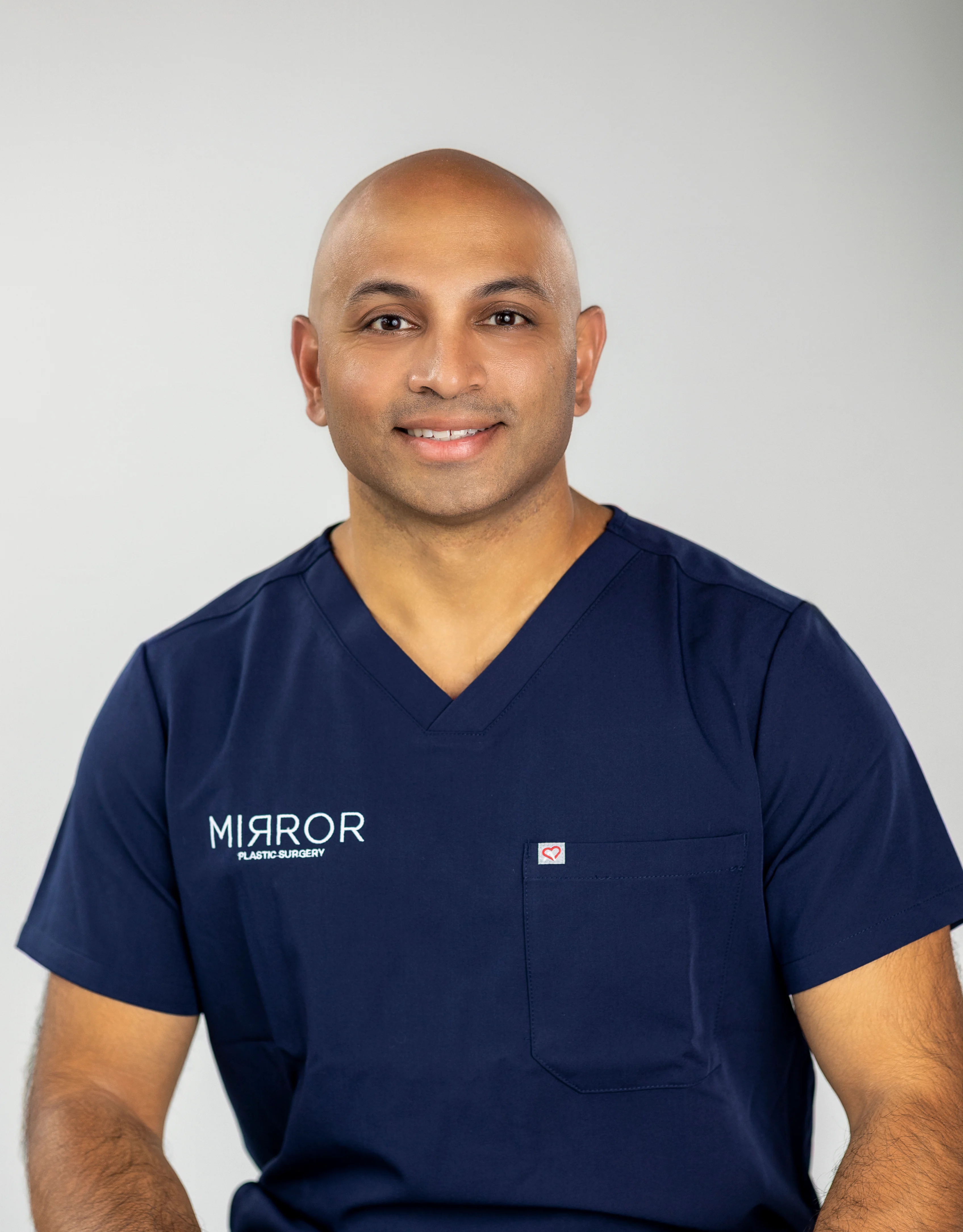
Written by: Dr. Akash Chandawarkar, Board Certified Plastic Surgeon, Mirror Plastic Surgery | Last updated: September 9, 2026
Lip enhancement can mean many different things, from a subtle boost in volume to a permanent change in lip shape. Lip augmentation describes the overall goal of enhancing volume, shape, or definition. Lip filler is one non-surgical way to reach that goal using injectable gel. Surgical options reshape the lips themselves and create longer-lasting change. This guide walks you through how each approach works, how they feel in daily life, and how to choose what fits your face and lifestyle.
Who Is Not A Candidate For Lip Fillers Or Lip Augmentation Surgery?
Some people are not good candidates for lip enhancement, and identifying this early protects your health, time, and budget. A thorough consultation screens for the following contraindications:
- Active infections or cold sores: Lip injection can reactivate the herpes simplex virus, and clinical guidance recommends antiviral prophylaxis for patients with a history of cold sores before treatment.
- Pregnancy or breastfeeding: Aesthetic lip procedures are generally postponed during these periods due to insufficient safety data.
- Bleeding disorders or anticoagulant use: These conditions raise bruising risk and complicate the management of vascular events such as occlusion.
- Active skin conditions: Active labial herpes simplex infection, significant perioral acne or dermatitis, and poor dental hygiene are potential contraindications specific to lip treatment with injectables.
- Unrealistic expectations: A defensible protocol empowers injectors to decline or defer treatment when a patient requests an outcome that is inadvisable or physically unachievable.
- Anatomical limitations: Very thin lips with minimal vermilion show may respond poorly to filler alone and could benefit from surgical approaches like vermilion advancement or lip lift instead.
- Surgical-specific contraindications: Active nicotine use is a significant contraindication for surgical lip lift because nicotine constricts blood vessels, compromising blood flow and potentially leading to poor wound healing, tissue death, and more prominent scarring.
Psychological readiness matters as much as physical health. Patients with body dysmorphic features or those seeking treatment to fix deeper self-image issues need careful screening. Mirror Plastic Surgery’s top-to-bottom assessment, which can extend up to an hour, is designed to understand both what you want and why you want it. This approach helps ensure that any treatment supports your overall well-being.
How Lip Augmentation Changes Daily Function, Kissing, And Sensation
Lip enhancement should look good and still feel like you. Many people worry about kissing, talking, and sensation after treatment, so it helps to know what to expect with each method.
With lip filler: Well-placed filler should not numb the lips or interfere with sensation when an expert injector respects nerve anatomy. The lip and perioral region are densely supplied by the superior and inferior labial arteries, branches of the facial artery, whose depth and path vary considerably between individuals and cannot be seen from the surface. A skilled injector places product more superficially to avoid these deeper structures. You may notice temporary swelling and tenderness for the first 24–72 hours, during which kissing and vigorous lip movement should be avoided. For the first 24–48 hours after lip filler, patients should avoid kissing, lip massage, heavy facial expressions, and very hot drinks. Once swelling settles, most patients report normal sensation and function.1
With surgical options: Full sensation in the upper lip can take up to six months to return after a lip lift.1 Recovery lasts longer, and the temporary impact on function is greater than with filler. Modern approaches increasingly combine lip lift, fillers, and fat grafting to create more natural results. Still, any surgical intervention requires a clear discussion of recovery expectations.
Mirror Plastic Surgery’s philosophy, safety first, function second, aesthetics third, keeps your ability to speak, smile, and kiss naturally at the center of every plan. Dr. Akash Chandawarkar’s surgical training supports precise injections that respect the complex muscular and vascular anatomy around the mouth.
Recovery And Downtime For Filler Vs Surgery
Clear expectations about recovery help you plan work, social events, and travel. Lip filler and surgical lip augmentation differ significantly in downtime and healing.
Lip Filler Recovery:
- Minimal downtime, with most patients returning to work or social activities the same day
- Swelling peaks within 24–72 hours and largely subsides within three to five days, with bruising common and lasting a week or more1
- Avoid strenuous exercise, heat, alcohol, and lip manipulation for 24–48 hours
- Most swelling after lip filler largely resolves by two weeks, though final results may take longer to fully manifest1
Surgical Lip Augmentation Recovery:
- Lip lift surgery requires 7–10 days off work and a 4–6 week full recovery period1
- Major swelling lasts 1–2 weeks, tissue stabilization takes 3–6 months, and scar maturation continues over 6–12 months1
- Strenuous activity is restricted for about two weeks, and full sensation may take up to six months to return1
Mirror Plastic Surgery limits surgeries to one or two per day, so your surgeon and team can focus on your procedure and aftercare. This low-volume model contrasts with high-volume practices that may perform many surgeries daily. Once you understand the recovery demands, you can weigh them against your goals and schedule.
Get a personalized recovery and treatment plan tailored to your anatomy and lifestyle.
How To Choose The Right Approach For Your Anatomy And Goals
Your lips, teeth, and surrounding features all influence which method will look most natural. A simple self-check before your consultation can clarify what you want and what you can realistically maintain.
- Current lip volume, shape, and symmetry: Study your lips in natural light. Lip augmentation should be selected according to the dominant anatomic problem — isolated thin lips may be suitable for filler-based augmentation when proportion and dental support are acceptable, but combined aging, lip lengthening, or commissure descent may require alternative or additional treatments.
- Temporary vs permanent change: Lip filler is a temporary, needle-based method that can be reversed with enzyme, while surgical lip enhancement reshapes the lip’s own tissue and lasts considerably longer but cannot be easily undone.
- Available downtime: Filler fits into a busy schedule with almost no time off. Surgery requires planning, healing time, and support at home.
- Subtle enhancement vs structural change: The biggest conceptual shift in lip enhancement is viewing lip enlargement less as a volume problem and more as a vermilion display problem, since many patients with thin lips lack visible vermilion exposure rather than volume.
During a consultation, a board-certified plastic surgeon evaluates these factors systematically. They assess the upper and lower lips, philtral height, dental support, and how your lips balance with the rest of your face. For many people, starting with reversible filler offers a low-commitment way to preview a fuller look. Patients with more significant structural issues, such as a long upper lip or very limited vermilion show, may benefit more from surgical options from the beginning.
Red Flags In Lip Providers And Products
Who treats you and what they use matter as much as the technique. Certain warning signs suggest you should pause or seek a second opinion.
- Providers without medical degrees: Aesthetic treatments are medical procedures that require anatomical expertise. Many non-medical injectors lack adequate training in anatomy and complication management, increasing the risk of serious complications.
- Poor vascular emergency preparedness: Vascular occlusion in the lip occurs when filler is injected into a labial artery or compresses one, interrupting blood flow, and a defensible practice keeps enzyme on site, in date, and in adequate quantity.
- High-volume “mill” practices: Rushed consultations and quota-driven upselling can compromise both safety and results.
- Pressure to upsell: Ethical providers recommend only what your anatomy and goals support.
- Unapproved or unspecified products: If a provider cannot name the specific filler brand they plan to use, explain its FDA labeling, and describe how they would handle a correction, that is a signal to ask more questions or seek a second opinion.
Mirror Plastic Surgery is supplier-neutral and uses evidence-based products matched to your anatomy instead of a limited in-house lineup. Dr. Akash Chandawarkar is a Harvard-educated, Johns Hopkins-trained, board-certified plastic surgeon with fellowship training in aesthetic surgery. His role on advisory boards for Merz Aesthetics and Tiger Aesthetics keeps him current on injectable advances while maintaining unbiased, patient-first recommendations.
Frequently Asked Questions About Lip Augmentation And Filler
What Is The Difference Between Lip Augmentation And Lip Filler?
Lip augmentation is the umbrella goal of enhancing lip volume, shape, or definition. Lip filler is one specific, non-surgical method to achieve that goal using injectable gel. Surgical options like lip lifts, fat transfer, or implants offer permanent or semi-permanent structural changes. The two terms describe different things: one is the outcome you want, and the other is a single technique for getting there.
Is Lip Filler Reversible?
Yes. Fillers can be dissolved with the enzyme hyaluronidase, typically within 24–48 hours. This reversibility helps first-time patients trial results before committing to longer-term options. Surgical augmentation methods, including lip lifts and implants, do not reverse in the same way, so they require more detailed planning and discussion.
Does Lip Augmentation Affect Kissing?
With well-placed filler, sensation and function should remain normal once swelling subsides, usually within a few days. Kissing and vigorous lip movement should be avoided for the first 24–48 hours after treatment, as described in the recovery guidelines above. Surgical options may cause temporary sensation changes during healing, and full sensation in the upper lip can take up to six months to return after a lip lift. An injector with deep anatomical knowledge places product superficially to avoid the sensory nerve supply of the lips.
Do Lips Go Saggy After Lip Fillers Are Dissolved?
There is no established clinical evidence that appropriately dosed filler causes permanent skin laxity after dissolving.1 However, very high volumes injected repeatedly over many years can stretch lip tissue over time.1 Conservative, anatomy-based treatment plans with documented cumulative volume and clear thresholds for dissolving before adding more help protect tissue quality. Treating dissolving as a normal clinical option, rather than a failure, is a hallmark of responsible practice.
Who Is A Good Candidate For Lip Augmentation?
Healthy adults with realistic expectations who want to address volume loss, asymmetry, or definition are often good candidates. Ideal candidates understand the difference between temporary and permanent options, have no active infections or uncontrolled medical conditions, and are not pregnant or breastfeeding. Anatomical factors such as philtral height, vermilion show, dental support, and overall facial proportions guide which method fits best. A board-certified plastic surgeon who performs both surgical and non-surgical procedures can make that determination without bias toward one approach.
Making The Right Choice For Your Face
The core lip augmentation vs lip filler difference is simple: augmentation is the destination, and filler is one reversible vehicle to reach it. The right path depends on your anatomy, your goals, and a careful professional assessment by someone with surgical expertise who understands both surface aesthetics and deeper structures. Reversible vs permanent lip enhancement depends on your specific face, your timeline, and your comfort with downtime and commitment.
Long-lasting, natural results come from choosing a provider who prioritizes your safety, your function, and your long-term satisfaction over trends or volume alone.
Your Next Step: Schedule An Anatomy-First Consultation
The decision between lip filler and surgical lip augmentation should come from a personalized, anatomy-based evaluation, not from a single article. You deserve guidance from a board-certified plastic surgeon who offers both options and has no incentive to push one approach.
At Mirror Plastic Surgery in St. Petersburg, Dr. Akash Chandawarkar offers concierge-level consultations that can extend up to an hour. You will receive honest, unbiased advice about whether filler, surgery, or no treatment best suits your face. With only one to two surgeries scheduled per day, your care receives focused attention from the entire team.
Schedule your anatomy-first consultation with Ellie today.
Disclaimer: Results may vary from person to person. Editorial content, before and after images, and patient testimonials do not constitute a guarantee of specific results.
1 Results may vary from person to person. Editorial content, before and after images, and patient testimonials do not constitute a guarantee of specific results.


