
Written by: Ellie Pranckevicius, FNP-BC, Aesthetic Nurse Practitioner & Aesthetic Injector | Facial Restoration & Regenerative Injectable Specialist, Mirror Plastic Surgery | Last updated: September 3, 2026
Key Takeaways
- MORE is an eight-week, evidence-based program that blends mindfulness, cognitive reappraisal, and savoring to address addiction, chronic pain, and emotional distress at their roots.
- Clinical trials show MORE reduces opioid misuse by 45%, cuts pain severity, and maintains benefits at nine months, nearly tripling standard group therapy results.1
- The three core skills in MORE restore healthy reward processing and reduce craving and anhedonia by retraining attention, emotion, and pleasure responses.
- MORE is highly cost-effective, delivering $12 in savings for every dollar spent, and is now available via telehealth and through more than 1,200 trained clinicians worldwide.
- For a holistic recovery plan that combines therapies like MORE with personalized wellness strategies, book a consultation with Mirror Plastic Surgery.
How MORE Supports Recovery From the Inside Out
Mindfulness-Oriented Recovery Enhancement (MORE) is a structured behavioral intervention developed by Eric Garland. It combines mindfulness training, cognitive reappraisal, and savoring in a step-by-step protocol that targets dysregulated reward processing in the brain.
The program usually runs for eight weeks in a group format with guided home practice between sessions. Each week builds on the last, helping patients gradually shift how they relate to pain, craving, stress, and everyday pleasure.
MORE draws primarily from affective neuroscience and integrates third-wave cognitive-behavioral and positive-psychology methods. Its central focus is hedonic dysregulation, which means the brain struggles to value rewards in a healthy way. This pattern links addiction, chronic pain, and psychiatric distress.
Clinical trials began around 2010, and MORE has since become a recognized framework within integrative medicine and pain management.
The Three Core Components of MORE
Mindfulness: Creating Space Between Trigger and Response
In MORE, mindfulness trains patients to notice thoughts, body sensations, pain, stress, and craving without immediately reacting. This awareness creates a pause, which opens room for healthier choices.
This meta-awareness interrupts automatic addictive patterns. Behaviors that once felt reflexive become visible, understandable, and more manageable.
The STOP technique (Stop, Take mindful breaths, Observe, Proceed) gives patients a simple tool to pause before acting on urges. For pain, MORE adds a “zooming in and zooming out” practice that shifts how the brain processes discomfort.
Zooming out redirects attention away from pain to reduce emotional reactivity. Zooming in focuses on the raw sensory details of pain, breaking it into smaller sensations that the mind can reappraise more easily.
On average, this zooming technique can reduce pain in the moment by about 30%, similar to five milligrams of oxycodone.1
Cognitive Reappraisal: Changing the Story Around Pain and Craving
Cognitive reappraisal in MORE teaches patients to reinterpret stressful or craving-related events in more helpful ways. This shift lowers emotional intensity and supports clearer decision-making.
The method draws from Stoic philosophy and cognitive behavioral therapy. Patients learn to slow down their thinking and examine the beliefs that fuel distress.
The A-B-C-D framework (Activating event, Beliefs, Consequences, Dispute) guides this process. Patients identify what happened, what they told themselves, how they felt or acted, and then actively challenge unhelpful beliefs.
Reappraisal training can reduce skin conductance responses, a marker of sympathetic nervous system arousal. Lower arousal supports relapse prevention by making urges feel less overwhelming.
Savoring: Restoring the Brain’s Capacity for Healthy Pleasure
Savoring in MORE directs attention toward pleasant sensory and emotional experiences. This practice rebuilds responsiveness to natural rewards and helps counter reward deprivation.
Anhedonia, or difficulty feeling pleasure, often shows up in addiction and chronic pain. Savoring directly targets this pattern by strengthening the brain’s response to everyday positive experiences.
The restructuring reward hypothesis proposes that enhancing responses to healthy rewards reduces the pull of drug-related rewards. As natural pleasure becomes more vivid, craving and addictive behavior tend to decrease.
Savoring functions as a clinical tool, not just a feel-good exercise. Repeated practice over eight weeks helps rewire reward circuitry in a deliberate, measurable way.
Book an appointment with Ellie to explore how personalized wellness strategies, including peptide therapy, can complement evidence-based recovery approaches like MORE within a comprehensive plan.
Evidence Behind MORE: What Studies Show
In the largest randomized controlled trial of MORE to date, Garland et al. (2022) found a 45% reduction in opioid misuse among chronic pain patients.1 MORE nearly tripled the impact of standard group therapy and also reduced pain severity and pain-related interference at nine months.
A 2025 JAMA Psychiatry secondary analysis found that patients with opioid use disorder had major deficits in voluntarily increasing positive emotion. After eight weeks of MORE, their neural responses during savoring normalized to levels seen in people without opioid use disorder. Supportive group therapy did not produce this change.
A 2026 economic evaluation from UC San Diego School of Medicine, published in Value in Health, reported that MORE yields $12 in cost savings for every dollar spent.1 Lifetime savings reached $324,489 per patient, reflecting reduced health care use, criminal justice involvement, lost productivity, and overdose mortality.
Conditions Where MORE Shows Strong Benefits
MORE has been tested across multiple overlapping conditions, which makes it especially helpful for people dealing with more than one challenge at a time.
- Substance use disorders: MORE has been developed and tested for opioid use disorder, broader addiction, and relapse prevention, with the developer reporting a 42% reduction in drug relapse.1
- Chronic pain: MORE has been applied to opioid-treated chronic pain, lumbosacral radicular pain (sciatica), and musculoskeletal pain. Chronic pain affects about 20% of adults in the United States.
- Emotional distress: MORE addresses depression, anxiety, and PTSD, with meta-analytic data showing moderate effects on psychiatric symptoms (SMC = −0.34).
How MORE Compares to Other Recovery Approaches
MORE and Cognitive Behavioral Therapy (CBT)
CBT focuses on changing unhelpful beliefs, increasing healthy behaviors, and improving coping strategies. MORE combines mindfulness, cognitive reappraisal, and positive emotion training to shift how attention and reward systems respond to pain and craving.
CBT offers a broad, modular toolkit that works well for patients who want practical coping skills and structured relapse-prevention planning. MORE fits best when pain and opioid misuse are tightly linked and reward dysregulation plays a central role.
MORE and Dialectical Behavior Therapy (DBT)
DBT is a third-wave CBT approach originally created for suicidal behaviors and later adapted for borderline personality disorder. It blends CBT with acceptance strategies and mindfulness across four skills modules: mindfulness, distress tolerance, emotion regulation, and interpersonal effectiveness.
DBT tends to work best for patients with severe emotional dysregulation, self-harm risk, or borderline personality traits. MORE focuses more narrowly on craving, pain, and reward processing, which makes it a strong fit when those mechanisms drive the main symptoms.
MORE and 12-Step Programs
Twelve-step programs emphasize peer support, accountability, spiritual growth, and long-term community involvement. They do not center on therapist-delivered cognitive or mindfulness training.
A 2026 review found that combining mindfulness programming with 12-step facilitation improved mindful responding, thriving, and craving reduction. Many patients benefit from blending internal skill-building through MORE with the external support of a recovery community.
How to Find and Start MORE Treatment
MORE is a clinician-delivered treatment, not a self-guided app or workbook. Patients work directly with trained professionals who follow a structured protocol.
- Licensed mental health professionals and trained clinicians, such as social workers, psychologists, and counselors, typically deliver MORE.
- Patients can locate providers through professional directories, university-affiliated clinics at UC San Diego and the University of Utah, and telehealth platforms.
- Garland’s 2024 Guilford Press manual, “Mindfulness-Oriented Recovery Enhancement: An Evidence-Based Treatment for Chronic Pain and Opioid Use,” serves as the primary written reference.
- More than 1,200 clinicians in the United States and internationally have completed MORE training across medical centers, military systems, and community clinics.
- Certification requires basic and advanced training plus demonstrated competence on the MORE Fidelity Measure.
- Recent trials have successfully delivered MORE via telehealth videoconferencing, which expands access for patients who cannot attend in person.
Pairing MORE With Physical Wellness and Peptide Therapy
MORE builds a strong psychological foundation for recovery, and long-term wellness improves further when the physical body receives focused support. Many patients benefit from coordinated attention to nutrition, movement, sleep, stress, and targeted medical therapies.
How Peptide Therapies May Support Recovery
Regenerative peptide therapies now play a growing role in chronic pain management. Peptides such as BPC-157, TB-500, and GHK-Cu are under study for tissue repair, inflammation reduction, and cellular restoration.
Chronic pain affects about 20% of adults in the United States, and inflammation frequently underlies both pain and recovery challenges.
Peptide therapies do not replace evidence-based psychological treatments like MORE. They function as one part of a broader wellness plan that supports physical healing and resilience.
Mirror Plastic Surgery offers personalized peptide protocols under medical supervision. Options include BPC-157 for systemic inflammation and tissue repair, TB-500 for soft tissue healing, and GHK-Cu for collagen support and inflammation reduction. Each plan includes in-depth lab analysis and concierge-level support led by Ellie Pranckevicius, FNP-BC.
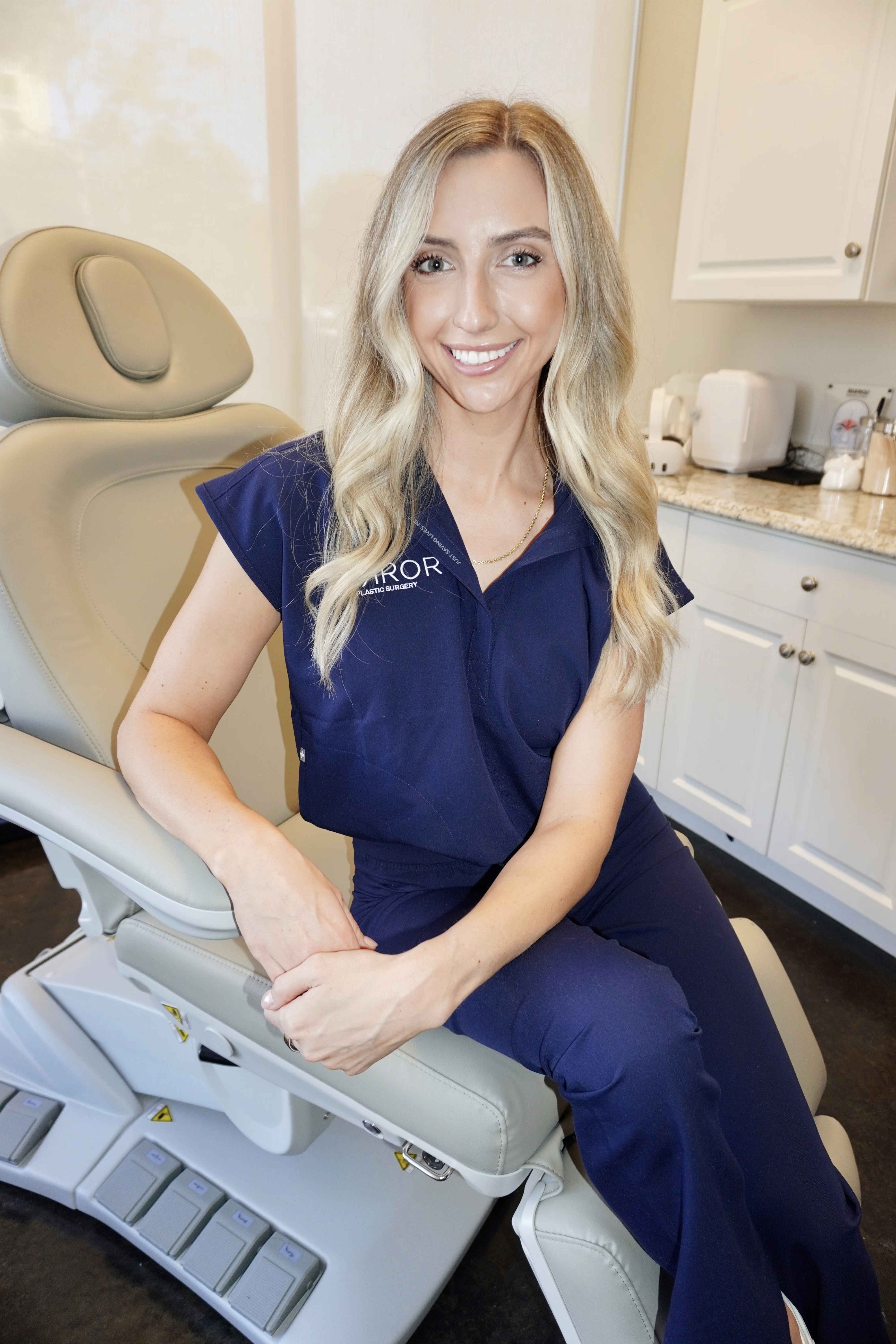
Book an appointment with Ellie to discuss how a tailored peptide protocol may support your physical recovery within a comprehensive wellness strategy.
Recovery Principles That Align With MORE
Several simple frameworks from the recovery field complement the skills taught in MORE and help patients stay consistent over time.
- The 7 R’s of recovery (Recognize, Responsibility, Restore, Reconcile, Release, Rebuild, Resilience) mirror MORE’s progression from awareness to adaptive coping and long-term well-being.
- The five rules of recovery (Honesty, Open-mindedness, Willingness, Action, Maintenance) support the steady practice that MORE’s skill-building model requires.
- The three P’s of sobriety (Patience, Persistence, Positive attitude) reflect the mindset shifts that savoring and reappraisal are designed to strengthen.
Frequently Asked Questions
Is MORE effective for opioid addiction?
MORE has strong evidence for opioid addiction. The largest randomized controlled trial showed a 45% reduction in opioid misuse among chronic pain patients and nearly tripled the effect of standard group therapy, with benefits lasting at least nine months.
A 2025 JAMA Psychiatry secondary analysis found that MORE normalized neural responses during savoring in patients with opioid use disorder. This change corrected a core deficit in positive emotion regulation that supportive therapy did not address.
How long does MORE treatment take?
Most MORE programs run for eight weeks with weekly group sessions and structured home practice. Trial data indicate that improvements in opioid misuse, pain, and craving continue for at least nine months after the program ends, suggesting durable benefit.
Can MORE be done online?
Telehealth delivery of MORE is now available. Recent clinical trials have successfully used videoconferencing, including a 2026 study that paired telehealth-delivered MORE with ketamine-assisted psychotherapy for opioid use disorder.
Online delivery expands access for patients who live far from MORE-trained providers or have mobility or scheduling limitations.
Is MORE covered by insurance?
Insurance coverage for MORE is expanding. At least one health system began offering MORE as a reimbursable service in 2021.
A 2026 economic evaluation showing $12 in savings for every dollar spent is likely to encourage broader adoption. Patients should confirm current coverage directly with their health plan and provider network.
What is the difference between MORE and mindfulness-based stress reduction (MBSR)?
MBSR focuses on reducing stress through mindfulness meditation. MORE combines mindfulness with cognitive reappraisal and savoring to actively reshape reward processing.
MORE is grounded in affective neuroscience and aims to change how the brain values rewards, not only to create calm or reduce stress reactivity.
Next Steps: Building Your Recovery Enhancement Plan
Mindfulness-Oriented Recovery Enhancement stands out as a rigorously validated behavioral treatment for addiction, chronic pain, and emotional distress. Its three integrated components work together to shift the neurobiological patterns that keep these conditions in place, with benefits that extend beyond the eight-week program.
Recovery works best when it supports the whole person. MORE offers powerful psychological tools, and complementary physical wellness strategies can help the body heal alongside the mind.
Mirror Plastic Surgery provides personalized peptide therapy consultations led by Ellie Pranckevicius, FNP-BC. Services include detailed lab analysis, custom peptide protocols, and concierge-level support designed to fit into your broader recovery and wellness plan.
To explore whether peptide therapy aligns with your goals, contact Mirror Plastic Surgery at 727-361-6515, email hello@mirrorplasticsurgery.com, or visit 780 4th Ave S, St. Petersburg, FL 33701.
Book an appointment with Ellie and take the next step toward a comprehensive, personalized recovery enhancement plan.
Disclaimer: Results may vary from person to person. Editorial content and patient testimonials do not constitute a guarantee of specific results.
Disclaimer: Peptide therapy is intended for wellness and optimization purposes and is not prescribed to diagnose, treat, cure, or prevent disease unless specifically stated. Many peptides are not FDA-approved and may be used off-label. Some have limited long-term safety data, with a potential for unknown risks, complications, or desensitization with prolonged use.
1 Results may vary from person to person. Editorial content, before and after images, and patient testimonials do not constitute a guarantee of specific results.
Peptide therapy is intended for wellness and optimization purposes and is not prescribed to diagnose, treat, cure, or prevent disease unless specifically stated. Many peptides are not FDA-approved and may be used off-label. Some have limited long-term safety data, with a potential for unknown risks, complications, or desensitization with prolonged use.