

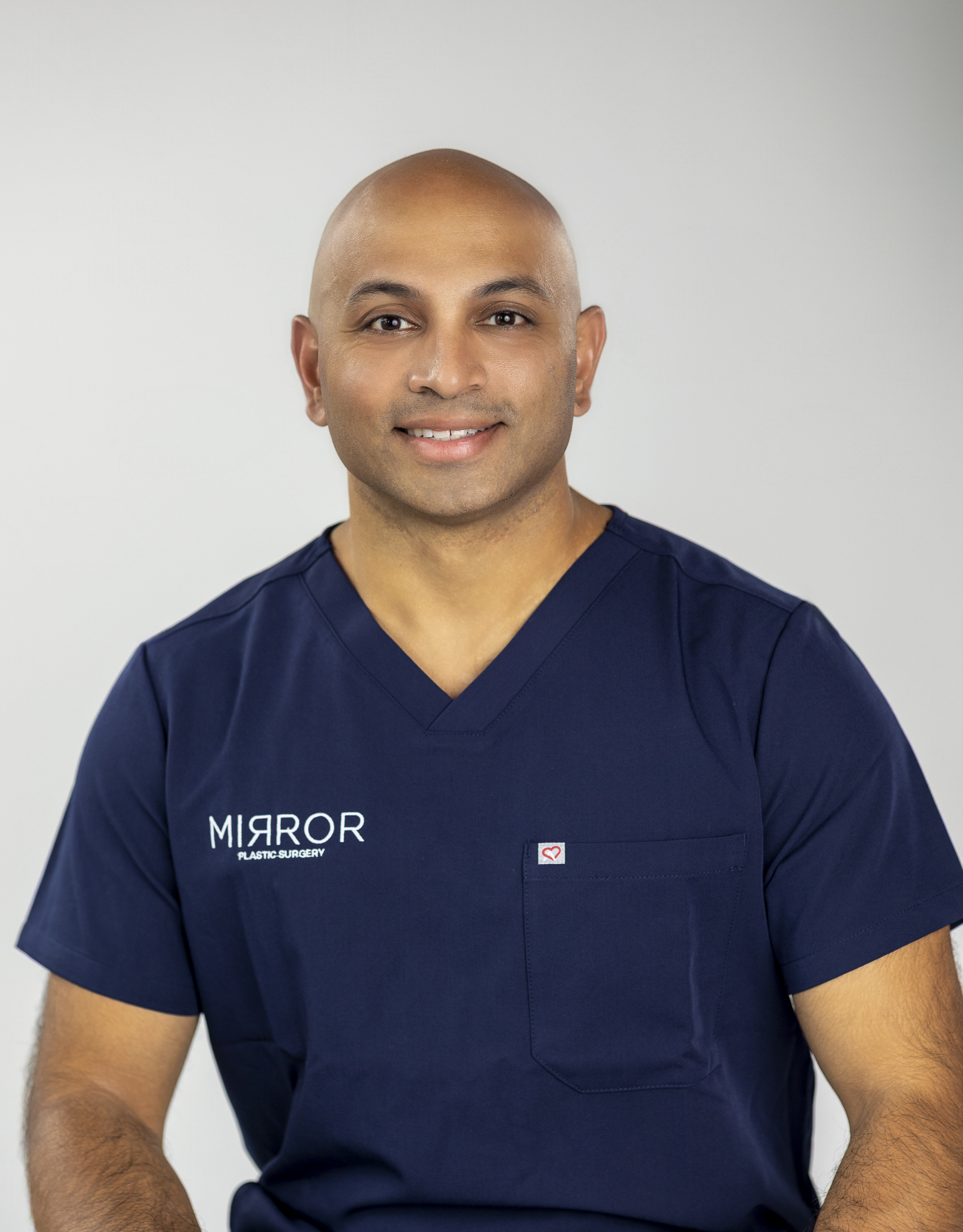
Written by: Dr. Akash Chandawarkar, Board Certified Plastic Surgeon, Mirror Plastic Surgery | Last updated: June 15, 2026
Key Takeaways
-
Buttock augmentation implants provide a structural, fat-independent option for patients seeking projection and shape when donor fat is insufficient.
-
Modern dual-plane and submuscular placement techniques, along with cohesive gel devices, improve coverage, stability, and long-term comfort compared with older methods.1
-
Recovery is demanding. Patients must avoid sitting for the first two weeks, sleep on their stomach, and follow a six-week gradual return to activity.1
-
Implants are durable but not lifetime devices. Revision may be needed due to complications or changing goals, so surgeon expertise and patient compliance are essential.1
-
Schedule your personalized consultation at Mirror Plastic Surgery to determine whether gluteal implants align with your anatomy and goals.
How Submuscular Gluteal Implants Are Placed
Gluteal implants can be positioned in three anatomical planes: intramuscular (within the gluteus maximus fibers), submuscular (beneath the muscle), or subfascial (beneath the fascial layer above the muscle). Each plane presents a distinct tradeoff between coverage, stability, and functional load on surrounding tissue.
Intramuscular placement positions the implant between muscle fibers, concealing edges and reducing displacement risk because the muscle holds the device firmly. However, fully intramuscular placement subjects the implant to the full contractile force of the gluteus maximus. Over time this force can contribute to displacement, discomfort, and asymmetry.
The dual-plane gluteal implant pocket technique represents a more recent evolution. This approach divides the pocket into a superior submuscular component and an inferior subfascial component. The design reduces muscle load on the implant, improves lower-pole definition, and creates more natural transitions compared with fully intramuscular placement. A 2025 outcome analysis published in Plastic and Reconstructive Surgery Global Open (2025;13(12):e7350) examined cohesive gel implants placed with this technique in primary augmentation cases and reported improved coverage, mechanical behavior under load, and symmetry.
Implant materials have also advanced. Devices have shifted from traditional solid silicone to semi-solid cohesive gel versions that feel softer yet remain durable enough to withstand daily sitting and movement. This change provides a meaningful improvement in long-term patient comfort.1
Complication data for implant-based augmentation deserves transparent review. No 2023 systematic review in the Aesthetic Surgery Journal of 2,312 silicone gluteal implant procedures reporting a 25% complication rate appears in the evidence. The nearest publication is a 2017 comprehensive literature review in the same journal. A 2024 PubMed study of implant-based gluteal augmentation reported wound dehiscence, excessive implant palpability, and seroma. These complications underscore why surgeon selection, placement technique, and anatomical candidacy assessment are not secondary considerations. They are the primary determinants of outcome.
At Mirror Plastic Surgery, Dr. Akash, named to Newsweek’s America’s Best Plastic Surgeons list two years in a row, applies his Johns Hopkins residency training and MEETH aesthetic fellowship expertise to individualized anatomical assessment before any implant recommendation is made.
Schedule your anatomical assessment to determine which placement technique is right for your case.
How Long Buttock Implants Typically Last
Gluteal implants are not classified as lifetime devices, yet they are not placed on a routine 10-year replacement schedule associated with some older breast implant generations. Modern cohesive gel gluteal implants are designed for long-term durability, and many patients do not require revision unless a complication arises or aesthetic goals change.
Several factors influence how long implants remain stable and satisfactory:
-
Placement plane: Dual-plane and submuscular placements reduce chronic mechanical stress on the implant compared with fully intramuscular positioning. This reduction can extend stable outcomes.
-
Implant material: Semi-solid cohesive gel devices resist deformation better than earlier solid silicone generations under the repetitive compressive loads of sitting.
-
Patient anatomy: Patients with adequate soft-tissue coverage experience lower rates of palpability and edge visibility over time.
-
Weight fluctuation: Significant changes in body weight alter the soft-tissue envelope around the implant and can affect contour symmetry.
-
Surgical technique: Precise pocket dissection and meticulous closure reduce early complications, including seroma and wound dehiscence, which are common drivers of unplanned revision.
-
Post-operative compliance: Adherence to activity restrictions during the healing window directly affects implant positioning and capsule formation.
Patients should plan for the possibility of revision surgery at some point over a decade or more. This plan reflects realistic long-term maintenance within Mirror Plastic Surgery’s Safety-Function-Aesthetics framework, not a guaranteed need for replacement.
Comfort Levels With Buttock Implants
Recovery after butt implant surgery typically involves swelling, tightness, and moderate discomfort during the first one to two weeks. Soreness while sitting or moving is common because the implant sits within or near the gluteal muscle. Patients frequently describe the sensation as a deep pressure or tightness rather than sharp pain, especially when transitioning from lying to standing.
The first two weeks usually feel the most difficult. Moderate to severe pain and tightness are most pronounced during this period. Ice applied around the clock for the first 7–10 days, combined with prescribed anti-inflammatory and pain medications, forms the standard protocol for managing this phase.
Compared with subfascial placement, submuscular and dual-plane techniques involve greater initial muscle disruption. This disruption explains the higher early discomfort level. Most patients accept this tradeoff because deeper placement provides superior long-term coverage and reduces the risk of visible or palpable implant edges, a known complication of implant-based augmentation.
What Buttock Implant Recovery Looks Like Week by Week
Recovery from buttock augmentation implants is logistically demanding, and patients benefit from understanding this before surgery. The restrictions protect implant position during the critical early healing window rather than serving as arbitrary rules.
|
Milestone |
Activity Status |
Sitting |
Sleep Position |
|---|---|---|---|
|
Days 1–14 |
Light walking only, no stairs, no bending |
Restroom use only |
Stomach only |
|
Weeks 2–3 |
Light daily activity, return to desk work possible |
20–30 minutes at a time |
Stomach, side sleeping still restricted |
|
Week 4 |
Light to moderate activity |
Up to 1 hour at a time |
Stomach preferred |
|
Week 6+ |
All restrictions lifted, squats and lunges at low intensity |
Unlimited as tolerated |
Unrestricted |
Patients consistently report several key recovery realities:
-
Weeks 1–2: No sitting except for restroom use. Sleeping on the stomach is mandatory. Most patients find this the most psychologically and physically challenging phase. Ice and medication management are central to comfort.
-
Weeks 2–3: Sitting resumes in short increments. Most patients return to non-strenuous work during this window, often with a standing desk or modified seating arrangement.
-
Weeks 4–6: Swelling remains present but manageable. Full swelling resolution takes two to three months as tissues adapt to the implant.
Compression garments, as directed by your surgeon, form a standard component of post-operative care and support tissue adaptation throughout recovery.
What to Expect 10 Years After Buttock Implant Surgery
Long-term outcomes for gluteal implants reflect the same variables that govern early results: placement technique, implant quality, patient anatomy, and lifestyle. Patients who maintain stable body weight, follow post-operative protocols, and attend periodic follow-up assessments generally report sustained satisfaction with projection and contour.1
Over a decade, the most common reasons for revision include capsular contracture, implant malposition, or a change in aesthetic goals rather than implant failure itself. The shift to cohesive gel devices and dual-plane techniques has improved the mechanical durability profile compared with earlier generations. Long-term population-level data specific to these newer techniques is still accumulating.
Mirror Plastic Surgery’s Safety-Function-Aesthetics hierarchy applies directly to the 10-year horizon. Safety means selecting the correct implant size and plane for the patient’s anatomy. Oversizing increases capsular contracture and displacement risk over time. Function means preserving gluteal muscle integrity so that normal movement, exercise, and daily activity remain unaffected. Aesthetics, achieved through the first two priorities, means results that age proportionally with the patient rather than becoming incongruous with natural body changes.
Who Typically Benefits From Buttock Augmentation Implants
Candidacy for gluteal implants depends on anatomy rather than preference alone. Implants may be the only option for patients who lack sufficient donor fat for a meaningful BBL result. Beyond donor fat availability, the following criteria support implant candidacy:
-
Adequate gluteal soft-tissue coverage to conceal implant edges
-
Realistic goals focused on projection and structural shape rather than volume diffusion
-
Willingness to comply with the recovery restrictions outlined above
-
Stable body weight and good general health
-
No active infection or skin compromise in the surgical area
Implants are less suited to patients seeking a very soft, diffuse volume increase across the hip and buttock region, an outcome fat transfer achieves more naturally. They also present a more complex choice for very lean patients where soft-tissue coverage is minimal and palpability risk is higher.
Hybrid augmentation, which combines a structural implant with targeted fat grafting to smooth transitions and refine hip contours, is particularly beneficial for patients with limited but usable donor fat.
Buttock Augmentation Implants vs Fat Transfer: Key Differences
|
Factor |
Buttock Implants |
Fat Transfer (BBL) |
|---|---|---|
|
Safety profile |
No 2023 systematic review reporting a 25% overall complication rate identified (nearest is a 2017 literature review). Risks include malposition, capsular contracture, seroma, and wound dehiscence. |
A systematic review and meta-analysis of gluteal fat grafting reported a pooled minor-complication rate of 3.58%. Risks include fat necrosis, asymmetry, and embolic events if protocols are not followed. Major complications have decreased with current ASPS/Aesthetic Society task force protocols. |
|
Longevity |
Device-dependent, with no routine replacement schedule. Revision is usually driven by complication or goal change. |
Graft survival rates of 60–80%.1 Final volume is established at 3–6 months post-procedure and remains stable thereafter in most patients. |
|
Recovery |
No sitting for 2 weeks. Full restrictions lift at 6 weeks. Swelling resolves over 2–3 months. |
No sitting on buttocks for 2–6 weeks depending on protocol. Compression garment required. Swelling resolves over a similar timeframe. |
|
Maintenance |
Periodic follow-up. Revision is possible for capsular contracture or malposition. No absorption variable. |
No device to monitor. Volume may shift with significant weight change. Touch-up grafting is possible if needed. |
Frequently Asked Questions
How should I prepare for buttock implant surgery?
Preparation starts with a comprehensive anatomical assessment to confirm candidacy and select the appropriate implant size and placement plane for your specific tissue characteristics. In the weeks before surgery, patients are typically advised to stop smoking, discontinue blood-thinning medications and supplements, arrange for a responsible adult to assist during the first week of recovery, and set up a recovery space that accommodates stomach sleeping and minimizes the need for sitting. Because the no-sitting restriction is among the most logistically demanding aspects of recovery, planning your home and work environment in advance significantly reduces post-operative stress.
What are the most serious risks I should know about?
The most clinically significant risks for gluteal implants include wound dehiscence, seroma, infection, capsular contracture, and implant malposition. Studies of implant-based gluteal augmentation have reported wound dehiscence and seroma. Capsular contracture, the formation of scar tissue that tightens around the implant, can alter shape and cause discomfort and may require revision surgery. Implant palpability or visible edges are more likely in patients with thin soft-tissue coverage. Selecting a board-certified plastic surgeon with specific experience in gluteal anatomy and current placement techniques is the most direct way to reduce these risks.
Will buttock implants affect my ability to exercise long-term?
Most patients resume normal exercise fully by six weeks post-operatively, including squats and lunges at progressively increasing intensity.1 The gluteus maximus remains functional after submuscular or dual-plane placement, and most patients report no long-term restriction on athletic activity. The key variable is the healing period. Strenuous activity before the six-week clearance can displace the implant or compromise wound closure. Patients who are competitive athletes or engage in high-volume lower-body training should discuss their specific activity profile during consultation so that implant size, placement, and pocket design can be tailored accordingly.
Is there a difference between buttock implants and a Brazilian Butt Lift?
Buttock implants and Brazilian Butt Lift procedures differ in technique, feel, risk profile, recovery logistics, and candidacy requirements. Buttock implants use a solid or semi-solid silicone device placed surgically within or beneath the gluteal musculature. A Brazilian Butt Lift (BBL) uses the patient’s own fat, harvested via liposuction from donor areas and transferred to the subcutaneous layer of the buttocks. Implants provide structural projection independent of body fat availability. Fat transfer produces a softer result but depends on adequate donor fat and is subject to partial resorption. Some patients are candidates for a hybrid approach that combines both. The right choice depends on anatomy rather than preference alone.
How do I know if I need a revision after buttock implant surgery?
Revision becomes appropriate when a complication arises, such as capsular contracture, malposition, or persistent wound issues, or when a patient’s aesthetic goals change significantly over time. Routine follow-up appointments allow your surgeon to monitor implant position, tissue response, and overall contour as swelling resolves over the first several months. Patients should contact their surgeon promptly if they notice asymmetry, firmness, pain, or skin changes that were not present during normal healing. Not all changes require revision, and many resolve with conservative management. The decision to revise always rests on individualized assessment rather than a fixed timeline.
Making an Informed Choice About Buttock Implants
Buttock augmentation implants offer a reliable, anatomy-independent path to structural projection for patients who are not candidates for fat transfer or who prefer a device-based outcome. The procedure requires honest candidacy assessment, a surgeon with deep anatomical knowledge of gluteal planes, and a patient prepared for the logistical realities of a six-week recovery arc.
At Mirror Plastic Surgery, every buttock augmentation evaluation follows the Safety-Function-Aesthetics hierarchy. Dr. Akash, a Harvard Medical School graduate, Johns Hopkins-trained plastic surgeon, MEETH aesthetic surgery fellow, and two-time Newsweek America’s Best Plastic Surgeons honoree, dedicates up to an hour per consultation to anatomical assessment, transparent complication discussion, and individualized procedure planning. The practice performs one to two surgeries per day, which supports focused, unhurried care at every stage.
Patients who are evaluating buttock augmentation implants and want a thorough, evidence-based assessment of candidacy, placement options, and realistic outcomes benefit from a direct conversation with a surgeon whose training and philosophy center on long-term well-being.
1 Results may vary from person to person. Editorial content, before and after images, and patient testimonials do not constitute a guarantee of specific results.



