
Written by: Ellie Pranckevicius, FNP-BC, Aesthetic Nurse Practitioner & Aesthetic Injector | Facial Restoration & Regenerative Injectable Specialist, Mirror Plastic Surgery | Last updated: June 15, 2026
Key Takeaways for Choosing a Peptide Provider in Florida
-
Peptide therapy requires more than a basic license. Practitioners need clinical depth, lab interpretation skills, and documented good-faith exams before prescribing.
-
Verify state licensure, collaborative agreements, and USP <797> compounding standards to confirm patient-specific prescriptions and sterile sourcing.
-
Prioritize practitioners with critical-care or hospital experience, board certification, and a track record of adjusting protocols based on labs and patient response.
-
Avoid high-volume med-spa or telehealth models that skip exams, lab reviews, or follow-up. These patterns raise safety and compliance concerns under 2026 Florida regulations.
-
Schedule a personalized consultation at Mirror Plastic Surgery to review your labs and receive a concierge-level peptide protocol tailored to your health goals.
Florida License Checks and Good-Faith Exam Basics
Confirming a practitioner’s legal authority to prescribe peptides is the first step. In Florida, the Board of Medicine and the Department of Health regulate prescribing practices with requirements for patient evaluation and documentation. Nurse practitioners in Florida generally must have a supervisory protocol with a physician to prescribe medications.
-
Search the practitioner’s license on the Florida Department of Health MQA portal and confirm active, unrestricted status.
-
Ask whether a physician collaborative agreement is on file. Florida is a reduced practice state where most non-physician prescribing operates under a written supervisory protocol with a physician, though an autonomous practice pathway is available for eligible NPs.
-
Request confirmation that a good-faith examination will be completed and documented before any prescription is issued.
-
Verify that the prescription will be patient-specific, not issued under a generic standing order.
What is a good-faith exam for peptides? A good-faith examination is a documented clinical evaluation completed before a prescription is written. For compounded peptides, chart documentation of clinical need must precede the prescription; a generic note such as “patient prefers compounded” is inadequate under Florida enforcement standards. A defensible exam documents relevant history, comorbidities, contraindications, required labs, and a specific titration and follow-up plan signed by the prescriber.
Clinical Background That Supports Safe Peptide Therapy
A valid license establishes legal authority. Clinical background determines whether a practitioner can safely interpret labs, recognize adverse reactions, and adjust protocols. Injectable peptides should be administered only by a licensed medical professional with advanced medical training and hands-on experience. Relevant background includes:
-
Critical-care or hospital experience: ICU clinicians develop fluency in metabolic physiology, drug interactions, and adverse-event escalation, skills directly applicable to peptide monitoring.
-
Lab interpretation: Prescription injectable peptides require routine bloodwork and individualized tailoring to the patient’s biology. A practitioner who cannot read a thyroid, metabolic, or hormone panel cannot safely customize a protocol.
-
Aesthetics training: Knowledge of skin physiology and client assessment adds precision when peptides target collagen production or anti-aging outcomes.1
-
Board certification: FNP-BC or equivalent credentialing signals completion of a standardized competency examination beyond entry-level licensure.
These credentials translate into real-world capability at the bedside and in the clinic. Ellie Pranckevicius, FNP-BC, the lead peptide practitioner at Mirror Plastic Surgery, illustrates what this combination looks like in practice. She holds a Bachelor’s in Health Science from Boston University on the premedical track, completed an aesthetics licensure program, and earned both her BSN and MSN from the University of South Florida.
Four years in the Neuroscience ICU at Tampa General Hospital built her foundation in complex physiology and metabolic health. Her dual background in esthetics and advanced nursing informs both the clinical and aesthetic dimensions of every protocol she designs.
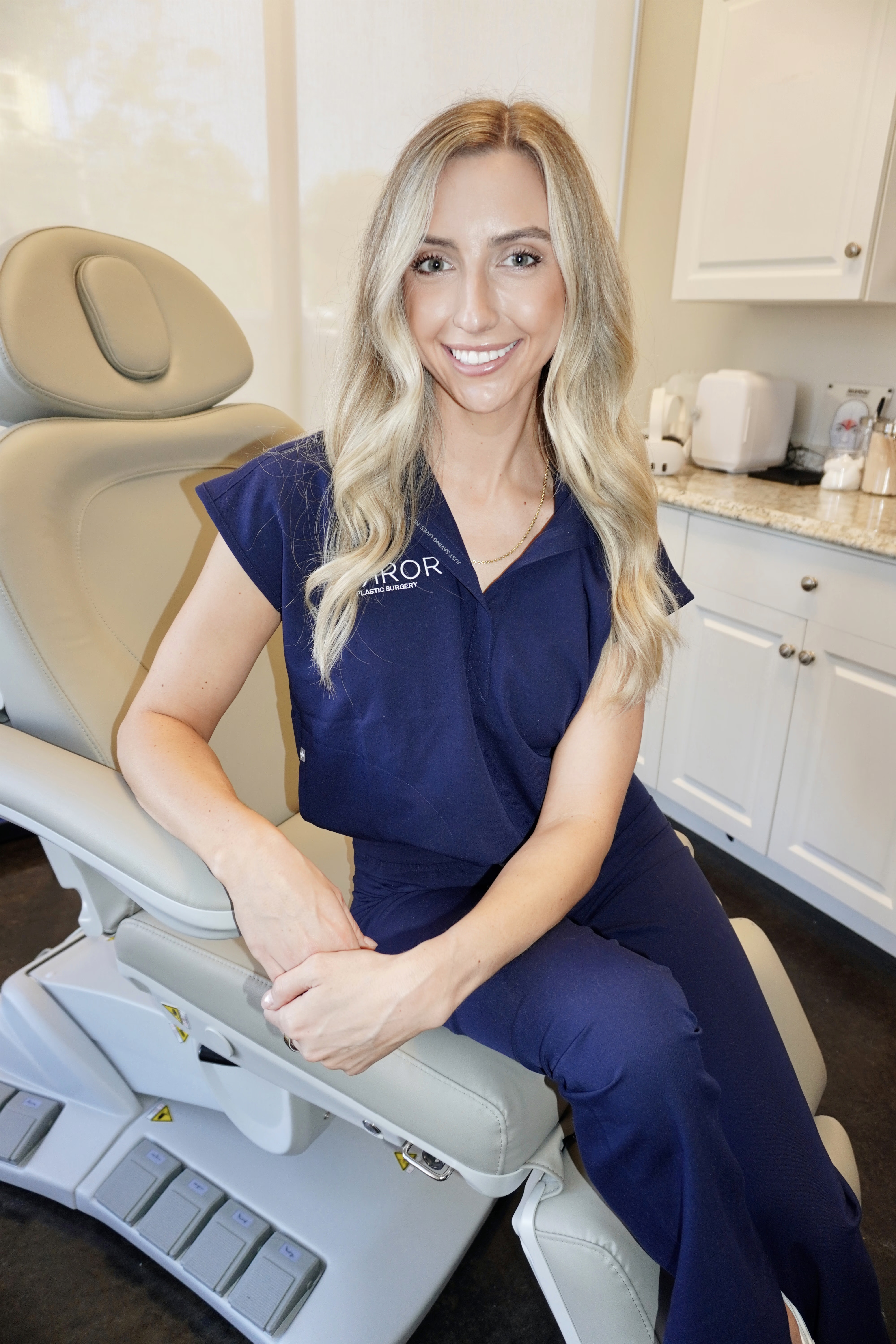
Book an appointment with Ellie to review your labs and discuss a protocol built around your specific health profile.
Peptide Sourcing, Testing, and Pharmacy Standards
Research-grade peptides obtainable without a prescription often have purity levels as low as 60% and carry greater potential for toxicity and life-threatening adverse effects compared to pharmaceutical-grade versions. Sourcing verification is non-negotiable. Use the following four-step checklist to confirm your practitioner sources from a compliant pharmacy.
-
Ask whether the compounding pharmacy holds a current state license and whether it compounds under USP General Chapter <797>, which became the first enforceable standard for sterile compounding effective January 1, 2004, with a major revision becoming official on June 1, 2008. This step confirms that sterile medications are prepared under enforceable safety standards.
-
Next, request a certificate of analysis (COA) confirming third-party batch testing for identity, potency, and sterility. The COA proves that the specific batch you receive has been independently verified.
-
Then confirm the peptide is not on the FDA’s “Do Not Compound” list and that the pharmacy operates under 503A or 503B compounding rules with a valid patient-specific prescription. This step helps ensure the prescription is legally defensible.
-
Finally, verify the pharmacy’s accreditation status through the NABP accreditation database. Accreditation adds a further layer of third-party oversight beyond state licensing alone.
What makes a peptide vendor reputable? A reputable vendor supplies compounded peptides to licensed practitioners only, provides batch-specific COAs from an independent laboratory, compounds under USP <797> for sterile preparations, and operates under a state pharmacy license. Practitioners who cannot produce sourcing documentation on request should be disqualified.
What Concierge-Level Supervision Looks Like
Telehealth platforms prescribing peptides typically rely on brief questionnaires and remote consultations with clinicians patients may never see again, creating a pathway that lacks continuity of care. Supervision quality is evaluated by structure, not by the presence of a physician name on a website.
Use the points below as a quick screen for ongoing supervision and support.
-
Collaborative agreement on file: Confirm the NP’s supervising physician is identified and the agreement is current.
-
Defined follow-up cadence: The follow-up cadence described earlier, with adverse-event screening, vitals, and repeat labs, must be documented at each refill decision.
-
Direct practitioner access: Patients should have a clear channel to reach the prescribing clinician, not a general intake line, between appointments.
-
Protocol adjustment capability: The practitioner should be able to modify dosing, swap peptides, or pause therapy based on lab changes or symptom reports, not simply reissue the same order.
Red Flags That Signal Higher Peptide Risk
A 2020 survey cited in an AMA report found that 61% to 100% of complications from cosmetic procedures addressed by dermatologists originated from procedures performed in medical spa settings. The following patterns indicate elevated risk:
-
No good-faith examination or documentation of clinical rationale before prescribing
-
Peptides dispensed without a patient-specific prescription
-
No lab review required prior to initiating therapy
-
Inability to produce a COA or name the compounding pharmacy
-
Refills issued without any follow-up contact or status documentation
-
Telehealth models relying on short intake-form-only encounters without follow-up, the enforcement priority noted earlier
-
No disclosed collaborative physician agreement in a restrictive NP state such as Florida
-
Peptides sold directly online with no clinical interaction required
Florida Rule Changes and Where to Check Them
Florida’s regulatory environment for compounded peptides tightened after 2025. Florida legislators have proposed bills (SB 966 and SB 860) that would require outsourcing facilities to obtain permits from the Department of Health and Board of Pharmacy and restrict distribution of compounded weight-loss medications outside patient-specific prescriptions. Patients and practitioners can use the following resources to stay current:
-
Florida Board of Medicine, for license verification, disciplinary history, and prescribing standards
-
Florida Department of Health, for off-label prescribing standards and enforcement actions
-
Florida Board of Pharmacy, for 503A and 503B compounding pharmacy licensing and compliance
-
FDA compounding guidance and the current “Do Not Compound” list and outsourcing facility rules
Post-2025 updates of note include Florida’s office-based facility registration rules, which apply only to liposuction exceeding 1,000 cc and Level II or Level III office surgeries and do not impose requirements on GLP-1 prescribing or administration. NP collaborative agreement requirements remain in force and are actively enforced. The table below contrasts documentation and follow-up practices between high-volume med spas and concierge practices, showing how the concierge model reduces compliance risk.
|
Oversight Model |
Documentation Requirements |
Patient Follow-Up |
|---|---|---|
|
High-Volume Med Spa |
Protocol-driven standardized check-ins, with common deficiencies such as refills without current patient status documentation and inadequate contraindication screening |
Brief questionnaire-based intake with clinicians patients may never see again, which undermines continuity of care |
|
Concierge Practice |
Defensible good-faith exam documenting BMI, comorbidities, weight history, medication review, contraindications screen, required pre-treatment labs, and a specific titration plan signed by the prescriber |
Active, patient-specific monitoring with a defined follow-up cadence, adverse-event screening, vital signs, and repeat labs when clinically indicated, plus protocol adjustments at each stage |
Experience the concierge standard with a personalized consultation, including comprehensive labs, a documented good-faith exam, and direct access throughout your protocol.
Frequently Asked Questions About Peptides in Florida
Can a nurse practitioner order peptides in Florida?
Yes, a board-certified nurse practitioner in Florida can prescribe compounded peptides, but only under a written collaborative or supervisory agreement with a licensed physician. The NP must perform and document a good-faith examination, write a patient-specific prescription, and ensure the compounding pharmacy is licensed and operating under applicable state and federal standards. A generic standing order or intake form does not satisfy Florida’s documentation requirements.
What is the difference between a med-spa peptide consult and a concierge peptide consult?
A med-spa consult is typically protocol-driven, with a standardized intake, a brief clinical interaction, and a pre-set order. A concierge consult involves a 30–60 minute one-on-one evaluation, review of existing labs or ordering of new ones, a custom peptide stack built around the patient’s specific physiology and goals, and a defined follow-up plan. The prescribing practitioner remains directly accessible between appointments for dosing questions, adverse-event concerns, and protocol adjustments.
Are peptides FDA-approved?
Most peptides used in wellness and anti-aging contexts are not FDA-approved for those indications, though some, such as established GLP-1 receptor agonists, carry FDA approval for specific conditions. Compounded peptides are prepared by licensed pharmacies under 503A or 503B rules and require a valid patient-specific prescription. The primary safety risk is not the peptide class itself but obtaining peptides from unregulated online sources that lack third-party batch testing, accurate dosing, or sterility verification.
What labs should be ordered before starting peptide therapy?
The appropriate panel depends on the peptide and the patient’s health goals. Weight-management protocols typically require HbA1c, a lipid panel, a comprehensive metabolic panel, TSH, and a pregnancy test where applicable. Anti-aging or inflammation protocols may include hormone panels, inflammatory markers, and kidney and liver function. A qualified practitioner reviews existing results or orders new ones before writing any prescription, not after.
What happens if I stop peptide therapy?
Benefits from peptide therapy are generally sustained only with continued use.1 Inflammation that was being managed will likely return to its prior state once the peptide is discontinued.1 Weight-management gains may diminish without a maintenance protocol.1 Collagen-stimulating peptides require ongoing use to sustain skin, hair, and nail improvements.1 A qualified practitioner will discuss realistic maintenance expectations during the initial consultation and adjust protocols over time based on lab results and patient response.
Get your questions answered in a clinical consultation with the same directness and depth that defines every Mirror Plastic Surgery appointment.
Verifying peptide therapy practitioner qualifications beyond typical med spas works best with a structured review of state licensure, collaborative agreements, good-faith exam documentation, clinical background, sourcing standards, and follow-up protocols. No single credential is sufficient on its own. Patients who apply the framework above, checking Florida board records, requesting COAs, confirming lab-based intake, and evaluating direct practitioner access, are positioned to make an informed decision about where and with whom to pursue peptide therapy.
1 Results may vary from person to person. Editorial content, before and after images, and patient testimonials do not constitute a guarantee of specific results.
Peptide therapy is intended for wellness and optimization purposes and is not prescribed to diagnose, treat, cure, or prevent disease unless specifically stated. Many peptides are not FDA-approved and may be used off-label. Some have limited long-term safety data, with a potential for unknown risks, complications, or desensitization with prolonged use.