
Written by: Ellie Pranckevicius, FNP-BC, Aesthetic Nurse Practitioner & Aesthetic Injector | Facial Restoration & Regenerative Injectable Specialist, Mirror Plastic Surgery | Last updated: July 11, 2026
Key Takeaways
- Hip dip fillers are temporary. Longevity ranges from 12 months to 5 years, depending on product choice and collagen response.1
- Results depend on accurate anatomical assessment, skin elasticity, and completing the full recommended treatment plan.1
- Biostimulatory fillers like Sculptra and Radiesse are non-reversible, so provider expertise and realistic expectations matter.
- Non-surgical options can soften and improve contour but rarely erase severe hip dips caused by bone structure.1
- Schedule a personalized assessment at Mirror Plastic Surgery to match your anatomy and goals with the right approach.
Why Hip Dips Form and How Fillers Address Them
Hip dips are a fixed orthopedic feature determined by the width and shape of the pelvis, the attachment points of the gluteus medius and minimus muscles, and the distribution of subcutaneous fat between the iliac crest and the greater trochanter of the femur. Because the depression sits where skin and subcutaneous tissue lie directly over bone with minimal fat pad, diet and exercise rarely change their appearance in a meaningful way.
Non-surgical correction adds soft-tissue volume to that depression. The two clinically established injectable options for this area are biostimulatory fillers, Sculptra (poly-L-lactic acid) and Radiesse (calcium hydroxylapatite), and allograft adipose matrix (AlloClae). Each category differs in mechanism, longevity, reversibility, and candidacy requirements, which makes product selection a critical step in planning.
How Mirror Plastic Surgery Plans Hip Dip Treatment
Ellie Pranckevicius, FNP-BC, leads all non-surgical body contouring at Mirror Plastic Surgery, including non-surgical BBL and hip dip correction. Her dual background in esthetics and advanced nursing, supported by four years in the Neuroscience ICU at Tampa General Hospital, provides clinical depth that extends beyond surface-level injection technique.
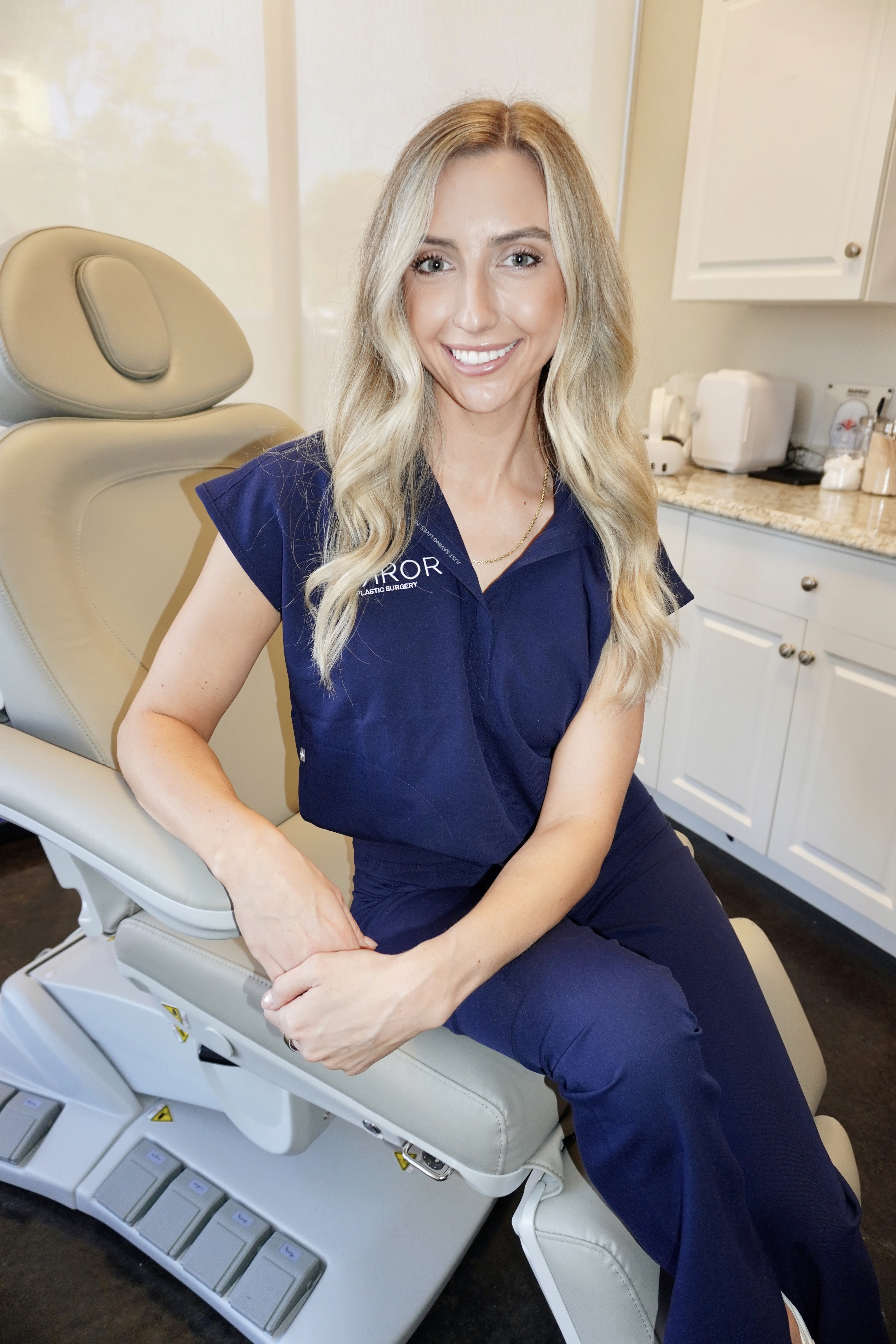
Every new patient receives a top-to-bottom assessment that can last up to an hour. During that session, Ellie evaluates hip dip depth, skin thickness and elasticity, gluteal contour, pelvic width, symmetry, and long-term goals before selecting any product or volume. Because Mirror Plastic Surgery is supplier-neutral, product recommendations follow anatomy and evidence, not brand quotas or commissions. Book a consultation with Ellie to begin that assessment.
How Long Hip Dip Fillers Typically Last
Longevity data varies by product class. The table below summarizes reported durations, maintenance intervals, and key clinical notes for the options Mirror Plastic Surgery evaluates.
| Filler Type | Reported Duration | Maintenance Interval | Notes |
|---|---|---|---|
| Sculptra (PLLA) | 2–5 years | Every 18–24 months | Non-reversible, collagen builds over 3–6 months; delayed-onset nodules occur in an estimated 3–5% of Sculptra cases in some series |
| Radiesse (CaHA) — hyperdilute body use | 12–24 months | Every 12–24 months | Immediate visible fill plus collagen response; non-reversible |
| AlloClae (allograft adipose matrix) | Long lasting | Repeatable as needed | FDA-regulated human tissue product, favorable retention, no liposuction required |
Sculptra stimulates gradual collagen production over 3–6 months, so results appear slowly rather than all at once.1 Radiesse delivers immediate volume plus a collagen response, with full skin-quality changes developing within 2–3 months.1 AlloClae provides immediate visible contour improvement with continued integration over weeks as the patient’s own cells inhabit the adipose scaffold.1
Who Tends to Do Well With Hip Dip Fillers
Hip dip fillers work best for patients whose health, anatomy, and expectations align with how these products behave over time.
- Generally healthy non-smokers who are not pregnant or breastfeeding
- Adults with noticeable hip dips and good skin elasticity
- Patients with stable body weight before treatment, since significant post-treatment weight loss can shift overall contour and reduce predictability
- Individuals who understand that full correction with Sculptra typically requires 2–4 sessions spaced 4–6 weeks apart
- Patients who accept a maintenance commitment measured in years rather than months
Patients reporting the highest long-term satisfaction entered treatment with a multi-year budget already understood and accepted. Ellie’s hour-long assessment focuses on that kind of expectation alignment before any treatment begins. Book a consultation with Ellie to see whether your anatomy and goals make you a strong candidate.
Risks, Limits, and When to Skip Treatment
Biostimulatory fillers used for hip dip correction carry specific risks that patients should understand clearly before proceeding.
- Non-reversibility: As noted earlier, Sculptra and Radiesse cannot be enzymatically reversed. Misplacement cannot be corrected with a dissolving agent, so prevention matters more than repair.
- Nodule formation: The nodule risk noted in the table above, occurring in 3–5% of cases, is most often linked to superficial injection into the dermis rather than proper deep subcutaneous placement.
- Asymmetry: Sculptra hip dip correction carries documented risks of nodule formation and asymmetry that require formal informed consent.
- Migration potential: Injection precision in the deep subcutaneous layer, with proper dilution and dosing, is essential because the product stimulates collagen over several weeks and cannot be reversed if misplaced.
- Severe hip dip limitations: Severe hip dips treated with biostimulatory fillers can reduce indentation depth but rarely achieve complete elimination due to pronounced skeletal geometry.1
Some situations make hip dip fillers a poor choice.
- Patients with allergies to lidocaine or PLLA, a history of keloid scarring, or active skin infection at the injection site
- Patients with very loose skin, who may need surgical alternatives
- Very lean patients (for example, BMI 19) who often see less dramatic improvement due to skeletal structure and limited tissue
- Patients unwilling or unable to complete the full recommended session protocol, since clients who complete the full protocol achieve measurably superior outcomes compared to those who stop early
Unlicensed, black-market buttock injections using industrial-grade silicone or hydrogels represent a completely different and dangerous risk class. These substances can migrate, cause chronic inflammation, severe infections, permanent disfigurement, and life-threatening embolisms, and are nearly impossible to fully remove. Mirror Plastic Surgery uses only FDA-regulated products administered under clinical protocols.
Common Misconceptions About Hip Dip Fillers
Misconception: Exercise can eliminate hip dips. Gluteal strengthening exercises can increase muscle bulk in the gluteus medius and minimus but cannot change genetically determined fat distribution or pelvic bone spacing that creates hip dips. Exercise can complement treatment by adding underlying muscle volume, but it does not replace filler or fat grafting.
Misconception: One session produces permanent results. All currently available non-surgical options are biodegradable. Even the longest-lasting biostimulatory fillers require maintenance. Across a 10-year horizon, the cumulative cost of non-surgical hip dip maintenance with biostimulators can approach or exceed the upfront cost of surgical fat grafting.
Misconception: More filler always means better results. A gradual, step-by-step approach, assessing how the shape settles after an initial session before adding more volume, produces safer and more symmetrical results than injecting large amounts in a single visit.
Comparing Non-Surgical and Surgical Hip Dip Options
Sculptra remains the longest-lasting biostimulatory option for hip dip correction, with the 2–5 year duration noted above varying based on the patient’s natural collagen production rates. Its gradual mechanism helps the final contour blend naturally with surrounding tissue, although patients need to accept a 4–6 month timeline before seeing full results.
Radiesse in hyperdilute body formulation offers immediate visible volume alongside a collagen-stimulating effect. It suits patients who want earlier visible feedback while still benefiting from biostimulation.
For patients seeking an alternative to synthetic biostimulators, AlloClae, the first FDA-regulated injectable allograft adipose matrix, represents a meaningful advancement for those who lack sufficient donor fat for surgical grafting. Early clinical results show favorable retention compared to traditional fat grafting. Mirror Plastic Surgery offers AlloClae as part of its non-surgical body contouring portfolio.
Surgical fat grafting (BBL) remains the most volumetrically significant option, with average fat graft survival of 60–80% when performed with modern technique. It also requires general anesthesia, liposuction from donor sites, and 6–8 weeks of downtime for most daily activities, with complete healing taking up to six months. For patients who prefer to avoid surgery, non-surgical options at Mirror Plastic Surgery offer a clinically sound alternative when expectations are set clearly.
Frequently Asked Questions
Do hip dip fillers migrate?
Migration is a documented risk, not an automatic outcome, and its likelihood relates directly to injection technique and product placement. Biostimulatory fillers such as Sculptra must be placed in the deep subcutaneous layer at the correct dilution and depth. When injected too superficially or without precise anatomical mapping, the product can shift before collagen encapsulates it, which can lead to uneven results or nodules. Because these fillers are non-reversible, provider expertise becomes the primary safeguard against migration. At Mirror Plastic Surgery, Ellie’s dual background in esthetics and advanced nursing, combined with a thorough pre-treatment anatomical assessment, directly addresses this risk.
What is the longest-lasting hip dip filler?
Among currently available non-surgical options, Sculptra (poly-L-lactic acid) produces the longest-documented results, with longevity reported between 2 and 5 years depending on collagen production rate, number of sessions completed, and lifestyle factors such as weight stability and sleep. Radiesse in hyperdilute body formulation follows closely. AlloClae, as an allograft adipose matrix, offers long-lasting results with favorable retention rates. No non-surgical option is permanent, so all require periodic maintenance to sustain results.
Are hip dip fillers worth it for severe indentations?
For pronounced hip dips caused by wide pelvic spacing and minimal overlying soft tissue, non-surgical fillers can reduce indentation depth and improve the waist-to-thigh transition, but they rarely achieve complete elimination of the depression.1 Patients with severe structural dips should expect meaningful improvement rather than full smoothness. In those cases, a thorough consultation, such as the hour-long assessment Ellie conducts at Mirror Plastic Surgery, may conclude that surgical fat grafting offers a more appropriate long-term solution. That kind of honest guidance counts as a successful outcome even when treatment does not proceed.
How many sessions are required for hip dip filler correction?
Session requirements vary by product and by the depth of correction needed. As mentioned in the candidacy section, Sculptra-based correction follows a 2–4 session protocol, typically spaced 4–6 weeks apart, with 8–10 vials per session for moderate cases. Radiesse-based correction generally requires 2–3 sessions. AlloClae treatments to the same area are spaced about three months apart to allow integration. Patients who complete the full recommended protocol consistently achieve better outcomes than those who treat sessions as optional.1 Ellie’s initial assessment establishes a realistic session roadmap before any treatment begins, so patients understand the full commitment upfront.
Can hip dip fillers be dissolved if I am unhappy with the results?
This depends entirely on the product used. Biostimulatory fillers, Sculptra and Radiesse, are non-reversible and cannot be dissolved with an enzyme. AlloClae, a tissue-based product, integrates with the body’s own cells and is also not reversible in the traditional sense. This irreversibility is one of the strongest reasons to choose a provider with deep anatomical knowledge and a conservative, evidence-based approach. At Mirror Plastic Surgery, product selection and volume decisions follow a comprehensive assessment that aims to minimize the chance of outcomes that would require correction.
Deciding Whether Hip Dip Fillers Are Worth It
Hip dip filler results tend to feel worth it when the right product is matched to the right anatomy by a provider who prioritizes honest communication over volume-driven treatment. Biostimulatory fillers and allograft options can provide longevity measured in years rather than months, but only when candidacy is assessed carefully, session protocols are completed, and maintenance is planned from the start.
Mirror Plastic Surgery’s concierge model, led by Ellie Pranckevicius, centers on that standard of care. The hour-long top-to-bottom assessment, supplier-neutral product selection, and commitment to transparent long-term planning give Tampa Bay patients the information they need to make a genuinely informed decision, including the decision not to proceed if the timing or anatomy is not right.
Book a consultation with Ellie at Mirror Plastic Surgery in St. Petersburg, FL, and receive the evidence-based, personalized assessment your decision deserves.
Disclaimer: Results may vary from person to person. Editorial content, before and after images, and patient testimonials do not constitute a guarantee of specific results.
1 Results may vary from person to person. Editorial content, before and after images, and patient testimonials do not constitute a guarantee of specific results.