
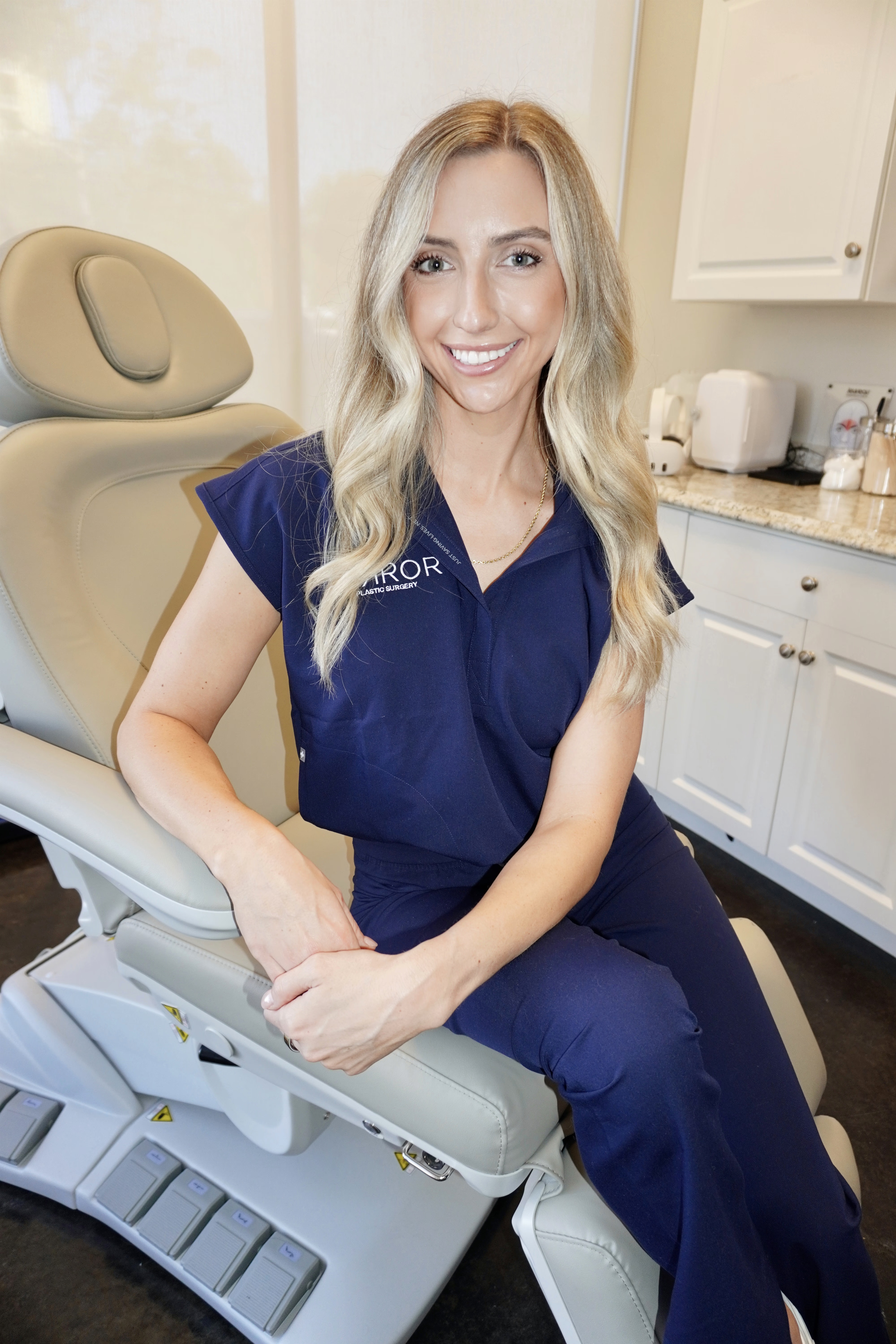
Written by: Ellie Pranckevicius, FNP-BC, Aesthetic Nurse Practitioner & Aesthetic Injector | Facial Restoration & Regenerative Injectable Specialist, Mirror Plastic Surgery | Last updated: June 24, 2026
Key Takeaways
-
A natural-looking BBL prioritizes proportional enhancement over maximum volume, using precise placement and thorough anatomical assessment instead of preset targets.
-
Proportion-first planning evaluates hip-to-waist ratio, skin quality, fat availability, and symmetry before choosing surgical or non-surgical options.
-
The skinny BBL technique uses layered subcutaneous fat placement, strict no-sit protocols, and conservative volume goals to shape lean frames safely.
-
Non-surgical BBL with biostimulatory fillers like Radiesse and AlloClae offers subtle refinement, hip-dip correction, and cellulite smoothing without surgery or general anesthesia.
-
At Mirror Plastic Surgery, a personalized proportion assessment aligns every recommendation with your anatomy and goals, so you can book a consultation with confidence.
Proportion-First Planning for Natural BBL Results
Proportion-first planning keeps your overall shape in balance before any surgical or non-surgical pathway is selected. This checklist focuses on how your anatomy can support a natural, safe result.
-
Gluteal width vs. hip-to-waist ratio: Enhancement should widen the apparent hip shelf only as much as it harmonizes with the natural waist and thigh transition.
-
Skin quality and laxity: Skin with reduced elasticity may not handle large-volume augmentation gracefully. Biostimulatory options that also improve skin texture can be a better fit.
-
Fat availability (surgical pathway): Candidates with limited donor fat are often better served by the skinny BBL technique or a non-surgical alternative instead of aggressive liposuction harvest.
-
Conservative volume goals: Incremental augmentation preserves the option to refine over time and significantly lowers the risk of an unnatural appearance.
-
Symmetry and hip-dip correction: Asymmetry and hip dips are often the main concern. Targeted correction of these areas frequently delivers more satisfaction than global volume addition.
At Mirror Plastic Surgery, consultations include a detailed assessment before any treatment plan is proposed. This evaluation ensures that proportion, not volume, guides every recommendation.
Schedule your proportion assessment with Ellie before committing to any pathway.
Choosing the Pathway for the Most Natural Look
Selecting the right pathway for your anatomy has the greatest impact on how natural your BBL looks. Two primary options exist: surgical fat transfer, including the skinny BBL technique, and non-surgical biostimulatory injectables.
Neither pathway works better for everyone. The correct choice depends on donor fat availability, skin quality, downtime tolerance, and how much enhancement you want.
Use this simple decision framework as a starting point:
-
Surgical pathway fits when you want a moderate-to-significant volume increase, have adequate donor fat, and can follow a strict postoperative protocol.
-
Non-surgical pathway fits when subtle shape refinement, hip-dip correction, cellulite smoothing, or asymmetry correction is the main goal, and you prefer to avoid general anesthesia and extended downtime.
Regardless of which pathway your anatomy supports, both require an experienced, anatomy-literate provider. Technique matters as much as the product or procedure itself.
Skinny BBL Technique for Lean Frames
The skinny BBL is a surgical fat transfer approach tailored to patients with a lean body composition and limited donor fat. Instead of chasing large volumes, the technique focuses on precise, layered placement of a smaller, highly purified fat graft to create shape rather than bulk.
Key technical principles include:
-
Subcutaneous plane placement only: Fat is deposited exclusively in the subcutaneous layer, never in the deep muscle. Intramuscular injection carries a significantly elevated risk of fat embolism, which is among the most serious complications associated with BBL procedures. Subcutaneous placement now represents a recommended safety standard for BBL procedures.
-
Layered micro-injection: Fat is deposited in small aliquots across multiple passes to maximize contact with vascularized tissue, which supports graft survival.
-
Strict three-week no-sit protocol: Direct pressure on the grafted area compresses newly placed fat cells before vascularization develops. Patients use a BBL pillow or prone positioning for about three weeks after surgery.
-
Lymphatic drainage support: Manual lymphatic drainage in the early postoperative period reduces swelling, supports circulation, and can improve the quality of the final contour.
-
Proportion over volume: The skinny BBL accepts that a smaller final volume is the correct outcome for a lean frame because the body cannot safely vascularize excess graft tissue. Attempting to overcorrect with more fat than the anatomy supports increases complication risk and reduces the likelihood of a natural result precisely because the excess fat lacks adequate blood supply to survive.
At Mirror Plastic Surgery, surgical procedures are performed by Dr. Akash Chandawarkar, a Johns Hopkins-trained, fellowship-trained aesthetic surgeon. The practice performs one to two surgeries per day, a deliberate limit that ensures undivided attention at every stage of care.
Natural-Looking BBL Without Surgery
Patients who want shape refinement without surgery can consider non-surgical BBL injectables using biostimulatory fillers. At Mirror Plastic Surgery, Ellie Pranckevicius uses products such as Radiesse and AlloClae to achieve subtle volumization, cellulite smoothing, stretch mark reduction, and symmetry correction in the gluteal region.
Biostimulatory fillers stimulate the body’s own collagen production over time. Results develop gradually and look more natural than an abrupt, immediate change.1 This mechanism aligns well with the proportion-first philosophy, since results build incrementally and can be refined across sessions. At Mirror Plastic Surgery, Ellie Pranckevicius applies this incremental approach through a structured protocol.
Ellie’s non-surgical BBL approach includes:
-
A comprehensive anatomical evaluation before any product is selected or placed
-
Targeted correction of hip dips and asymmetry without general anesthesia
-
Regenerative product selection based on individual skin quality, tissue depth, and aesthetic goals
-
Direct guidance on whether a non-surgical approach will meet your goals, or whether a surgical consultation with Dr. Akash offers a better path
Ellie’s background spans esthetics licensure, four years in a Neuroscience ICU, and advanced nursing training. This combination gives her a deep understanding of both surface anatomy and systemic physiology, which shapes product selection and the safety margins she applies to every treatment.
Find out whether non-surgical BBL is right for you and discuss how it fits your anatomy and goals.
Long-Term Maintenance for Lasting Results
Results from either pathway need active maintenance to preserve their quality over time.1
-
Weight stability: Fat grafts and biostimulatory filler results are both sensitive to significant weight fluctuations.1 Gaining or losing more than 10–15 pounds can alter the distribution and appearance of augmented tissue, which is why crash dieting or rapid weight gain after a BBL, surgical or non-surgical, is among the most common reasons patients feel dissatisfied with long-term outcomes.
-
Periodic touch-up planning: Non-surgical results from biostimulatory fillers typically require maintenance sessions as collagen remodeling continues. Surgical fat grafts are permanent in structure but respond to metabolic changes just like native fat tissue. Planning for periodic reassessment, instead of treating either pathway as a one-time event, produces the most consistent long-term outcomes.
Key Decision Factors for Your BBL Plan
The following variables should be evaluated objectively before selecting a pathway. Each factor affects both safety and aesthetic outcome, and the right choice comes from the complete picture rather than a single variable.
-
Skin elasticity: Higher elasticity supports both pathways. Reduced elasticity may favor biostimulatory injectables that also improve skin quality.
-
Donor fat availability: Insufficient donor fat makes surgical BBL technically challenging. Non-surgical injectables have no donor-site requirement.
-
Downtime tolerance: Surgical BBL requires a minimum three-week activity restriction and several months of full recovery. Non-surgical BBL involves minimal downtime.
-
Degree of enhancement desired: Significant volume increase requires surgery. Subtle refinement, hip-dip correction, and cellulite smoothing fall well within the scope of non-surgical options.
-
Anesthesia preference: General anesthesia carries inherent risks that some patients prefer to avoid. Non-surgical BBL is performed without it.
-
Budget and timeline: Non-surgical options may require multiple sessions over time. Surgical BBL is a single procedure with a longer initial recovery.
Safety and Common Misconceptions
Several persistent misconceptions can make BBL decisions more confusing than they need to be.
-
More volume equals better results: Overfilling increases complication risk in both pathways and often causes unnatural-looking outcomes. Conservative, anatomy-guided volume targets consistently produce more balanced results.
-
Non-surgical BBL is risk-free: Injectable treatments in the gluteal region carry their own risk profile, including infection, product migration, and vascular complications with inexperienced providers. Biostimulatory fillers such as Radiesse and AlloClae have established safety profiles when placed correctly, but provider expertise and anatomical knowledge remain essential.
-
Results are guaranteed: Individual anatomy, skin quality, metabolic factors, and postoperative behavior all influence outcomes.1 No provider can guarantee a specific result, and any practice that does so should be approached with caution.
-
All BBL techniques are equivalent: As noted in the skinny BBL section, subcutaneous-only placement is now the safety standard across surgical fat transfer approaches. Technique selection is a safety issue, not just a stylistic preference, and any provider still using intramuscular injection should be avoided.
Practical Takeaways Before You Decide
-
Natural-looking BBL results depend on moderate volume, precise placement, and proportion-first planning rather than maximum augmentation.
-
The skinny BBL technique uses layered subcutaneous fat placement, strict postoperative positioning, and conservative volume goals to shape lean frames.
-
Non-surgical BBL with biostimulatory fillers (Radiesse, AlloClae) offers a clinically sound option for subtle enhancement, hip-dip correction, and cellulite smoothing without surgery or general anesthesia.
-
Provider expertise and anatomical knowledge are the most important variables in both pathways.
-
Weight stability and periodic reassessment are essential for preserving results over time.
-
A thorough initial assessment before any treatment is non-negotiable for safe, proportional outcomes.
Ready to start? Schedule your comprehensive assessment with Ellie at Mirror Plastic Surgery in St. Petersburg, FL, and receive a personalized plan built around your goals, your frame, and your long-term well-being.
Frequently Asked Questions
What is the difference between a standard BBL and a skinny BBL?
A standard BBL harvests fat from multiple donor sites and transfers larger volumes to the gluteal region to achieve significant augmentation. A skinny BBL is designed for patients with a lean body composition who have limited donor fat available. The technique prioritizes precise, layered placement of a smaller, highly purified fat graft to create shape and projection rather than bulk. Both approaches use subcutaneous-only placement as the current safety standard. The skinny BBL accepts that a proportionally smaller result is the anatomically correct outcome for a lean frame instead of attempting to overcorrect with volume the body cannot safely support.
How long do non-surgical BBL results last?
Non-surgical BBL results using biostimulatory fillers like Radiesse and AlloClae are not permanent.1 These products stimulate the body’s own collagen production, so results develop gradually and continue to improve over several months after treatment. Longevity varies based on individual metabolism, skin quality, lifestyle factors, and the specific products used.1 Most patients benefit from periodic maintenance sessions to sustain and refine their results over time.1 During your consultation at Mirror Plastic Surgery, Ellie will outline a realistic timeline and maintenance plan based on your anatomy and goals.
Am I a candidate for non-surgical BBL if I want significant volume increase?
Non-surgical BBL injectables work best for patients seeking subtle shape refinement, hip-dip correction, asymmetry correction, cellulite smoothing, or modest volumization. If your primary goal is a significant increase in overall gluteal volume, surgical fat transfer is likely the more appropriate pathway. One of the core values at Mirror Plastic Surgery is honest, unbiased guidance. Ellie will tell you directly during your consultation whether a non-surgical approach can realistically meet your goals or whether a surgical consultation with Dr. Akash Chandawarkar offers a better starting point. No treatment will be recommended if it does not align with your anatomy and realistic expectations.
What makes Mirror Plastic Surgery’s approach to BBL different from high-volume clinics?
Mirror Plastic Surgery operates on a concierge medicine model that differs from high-volume aesthetic clinics. The practice limits itself to one to two surgical procedures per day and dedicates up to one hour per consultation for a comprehensive assessment. Every treatment recommendation follows a safety-first, function-second, aesthetics-third framework. Ellie Pranckevicius brings a dual background in esthetics and advanced nursing, including four years in a Neuroscience ICU, to every non-surgical BBL consultation. The practice is supplier-neutral, so product selection is driven entirely by what fits the individual patient rather than by brand quotas or commissions.
What should I do to maintain my BBL results long-term?
Long-term maintenance centers on the weight stability principles discussed earlier, including avoiding significant fluctuations of more than 10–15 pounds and planning for periodic reassessment rather than treating either pathway as a one-time event. For non-surgical results, touch-up sessions with biostimulatory fillers help sustain collagen remodeling and volume over time. For surgical results, the fat graft is permanent in structure but responds to metabolic changes just like native fat tissue. Scheduling periodic reassessments with your provider allows for early, conservative corrections before any changes become pronounced.
Disclaimer: Results may vary from person to person. Editorial content, before and after images, and patient testimonials do not constitute a guarantee of specific results.
1 Results may vary from person to person. Editorial content, before and after images, and patient testimonials do not constitute a guarantee of specific results.