
Written by: Dr. Akash Chandawarkar, Board Certified Plastic Surgeon, Mirror Plastic Surgery | Last updated: July 5, 2026
Key Safety Checks Before Choosing Your Surgeon
- Hospital privileges give you an independent review of a surgeon’s training and competency, beyond marketing or self-reported claims.
- Florida patients can confirm privileges through the state MQA portal, hospital medical staff offices, ABPS certification checks, AHCA facility registration, and accreditation directories.
- Red flags include no active hospital privileges, no ABPS board certification, unaccredited facilities, or surgeons who discourage direct verification.
- ABPS certification, accredited facilities, and board-certified anesthesiologists are consistently associated with safer breast augmentation outcomes in Florida.1
- Verify these credentials yourself during a consultation at Mirror Plastic Surgery, where Dr. Akash’s hospital privileges and certifications are available for direct review.
7-Step Checklist to Verify a Florida Surgeon’s Hospital Privileges
Use this Florida-specific checklist before you commit to any breast augmentation surgeon. Work through each step and confirm every item.
- Verify Florida medical licensure via the MQA portal. Search the surgeon’s name at the Florida Department of Health Medical Quality Assurance (MQA) Search Services portal. The practitioner’s official MQA profile publicly displays current staff privileges at specific Florida hospitals, medical centers, and ambulatory surgery centers. Confirm the license status reads “Active” and the specialty is plastic surgery.
- Confirm ABPS board certification. Visit the American Board of Plastic Surgery (ABPS) verification page and search the surgeon’s name. The ABPS requires board-certified plastic surgeons to have admitting privileges at a hospital in their specialty and to perform surgery only in accredited surgery centers. A surgeon listed on the ABPS directory has met this requirement.
- Contact the hospital medical staff office directly. Call the medical staff office of the hospital the surgeon lists as an affiliation and ask: “Does [surgeon’s full name, MD] hold active, unrestricted plastic surgery privileges at this facility?” Florida hospitals do not have to share clinical details, but most will confirm or deny active privilege status. For UF Health Shands Hospital, call (352) 265-0301. For UF Health Flagler Hospital, call (904) 819-4497. Use the same script at any Tampa Bay area hospital.
- Check AHCA office-surgery facility registration. Florida’s Agency for Health Care Administration (AHCA) registers and inspects office surgery suites operating at Level II and Level III. Confirm the surgeon’s operating facility appears in the AHCA facility search as a currently registered and inspected site. Treat an unregistered facility as a disqualifying red flag.
- Confirm a board-certified physician anesthesiologist. Ask the practice directly whether a physician anesthesiologist, not a nurse anesthetist operating independently, will manage anesthesia. Mirror Plastic Surgery employs board-certified physician anesthesiologists for every surgical procedure. This distinction matters because physician anesthesiologists meet higher training standards and align with the safety expectations described in the facility accreditation step below.
- Verify surgical facility accreditation. ASPS guidance recommends that breast augmentation surgery be performed in accredited, state-licensed, or Medicare-certified facilities. Ask the practice for its accreditation certificate number and cross-reference it on the accrediting body’s public directory (AAAASF, AAAHC, or The Joint Commission). A surgeon operating in an unaccredited facility may have had hospital or surgery center privileges restricted.
- Run a disciplinary and malpractice cross-check. Return to the Florida MQA portal and review the surgeon’s full profile for any disciplinary actions, license restrictions, or formal complaints. Supplement this with a search on the National Practitioner Data Bank (NPDB) Public Data, which records malpractice payments and adverse actions reported by hospitals and state boards.
Clear Warning Signs of a Risky Plastic Surgeon
- The surgeon cannot confirm unrestricted plastic surgery hospital privileges, or a hospital has denied them such privileges, which signals that the institution considered them too high a risk.
- The surgeon lacks ABPS board certification and instead holds certification only from a non-ABMS board, which frequently results in denial of plastic surgery hospital privileges.
- The surgical facility is not registered with AHCA or accredited by a recognized body such as AAAASF, AAAHC, or The Joint Commission.
- The surgeon discourages direct contact with the hospital medical staff office or deflects questions about privileges.
- The consultation feels rushed, anatomy-specific questions go unanswered, and no written treatment plan is provided.
- The MQA profile shows disciplinary actions, license restrictions, or a pattern of formal complaints.
- The practice has rebranded after a documented incident, which often indicates an attempt to distance the surgeon from adverse outcomes.
Checklist for Confirming a Legitimate Plastic Surgeon
- Active, unrestricted Florida medical license confirmed on the Florida DOH MQA portal with plastic surgery as the listed specialty.
- ABPS board certification verified directly on the ABPS website, confirming the surgeon meets the privilege and accreditation standards described in Step 2.
- Hospital staff privileges confirmed verbally by the hospital’s medical staff office using the direct phone script in Step 3 above.
- Privilege verification for UF Health Shands practitioners is also available online at the UF Health credentialing portal.
- Surgical facility accreditation certificate number verifiable through the accrediting body’s public directory.
- AHCA facility registration confirmed for any office-based surgical suite where procedures are performed.
Request a credential review session with Dr. Akash to walk through each verification step in person and discuss how it applies to your surgery.
How to Interpret a Surgeon’s Success and Safety Record
- Florida does not maintain a publicly searchable surgeon-specific complication or success-rate database, and no single registry lists procedure-level outcome data for individual plastic surgeons.
- The NPDB Public Data file records malpractice payments and adverse privilege actions but does not report complication rates or surgical volume.
- The Florida MQA portal records disciplinary actions and license restrictions, which can signal serious adverse outcomes but do not quantify success rates.
- Research has associated ABPS board certification, active hospital privileges, and use of an accredited surgical facility with acceptable safety outcomes for breast augmentation.1
- Peer-reviewed publications authored by a surgeon, presentations at national meetings such as The Aesthetic Meeting, and editorial roles at journals like the Aesthetic Surgery Journal are verifiable signs of engagement with evidence-based outcomes research.
- Ask a surgeon directly for their personal complication rate and how they manage complications, since this is a legitimate and recommended consultation question.
The following credentials show how a fully verified surgeon’s profile looks when you complete the seven-step checklist above.
Expert Context: Dr. Akash’s Credentials
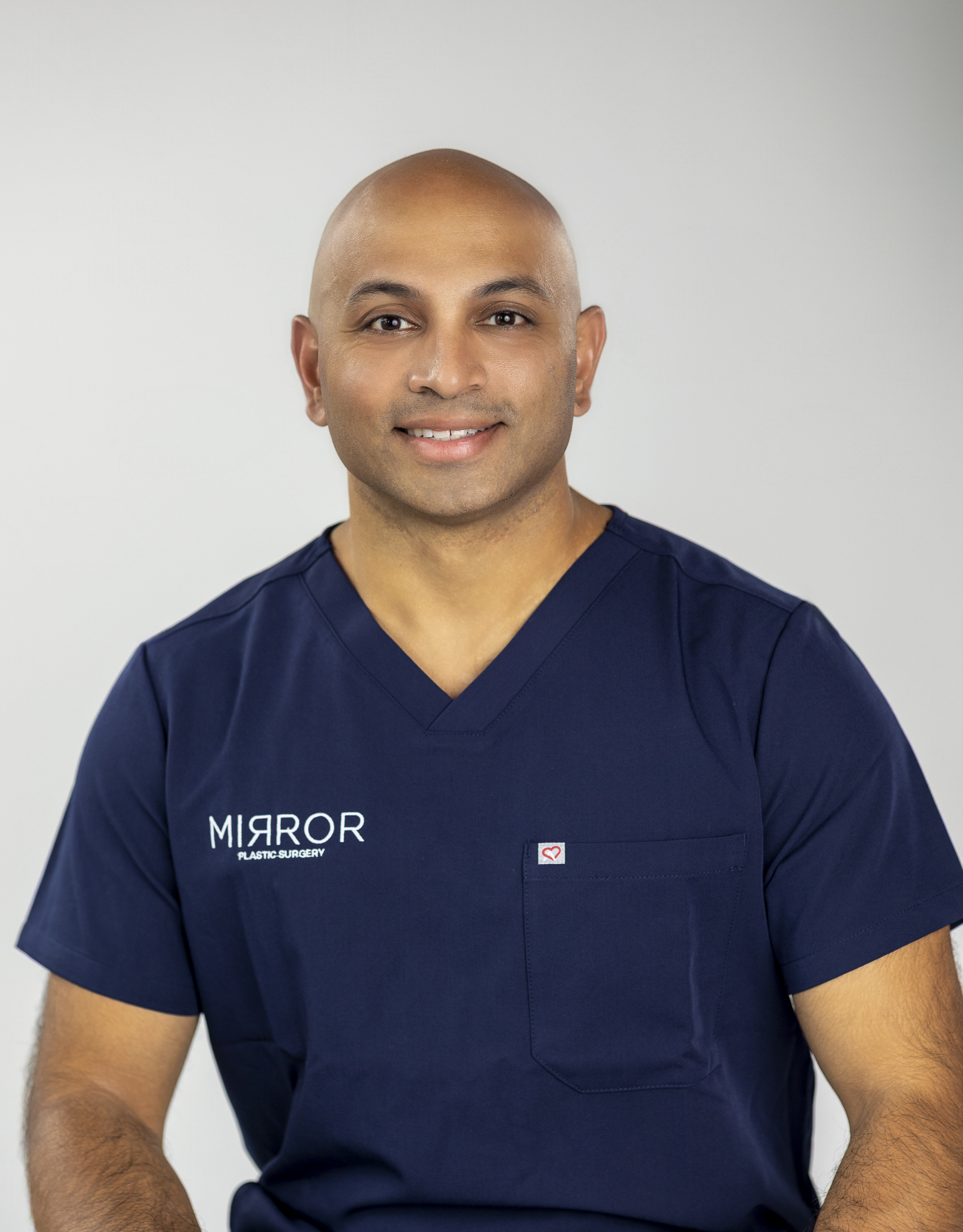
Dr. Akash completed his medical degree through the Harvard-MIT Division of Health Sciences and Technology and graduated from Harvard Medical School with Honors. He then finished a seven-year integrated plastic and reconstructive surgery residency at Johns Hopkins University. After residency, he completed an aesthetic surgery fellowship at the Manhattan Eye, Ear and Throat Hospital (MEETH), one of the most competitive programs in the country for advanced breast, facial, and body contouring training.
Dr. Akash holds active ABPS board certification and operates exclusively in an accredited surgical facility with board-certified physician anesthesiologists. He has been named to Newsweek’s “America’s Best Plastic Surgeons” list two years in a row, including 2025. He also testified before the U.S. Food and Drug Administration on breast implant safety, which reflects his standing as a national authority on the subject.
Printable Verification Checklist
Florida Breast Augmentation Surgeon Verification — 7-Step Checklist
- ☐ Florida MQA License Check — Confirm active plastic surgery license and review listed hospital privileges at mqa-internet.doh.state.fl.us
- ☐ ABPS Board Certification — Verify certification at abplasticsurgery.org
- ☐ Hospital Medical Staff Office Call — Ask: “Does [surgeon name] hold active, unrestricted plastic surgery privileges at this facility?”
- ☐ AHCA Facility Registration — Confirm office surgery suite registration at ahca.myflorida.com
- ☐ Board-Certified Physician Anesthesiologist — Confirm directly with the practice
- ☐ Facility Accreditation — Verify AAAASF, AAAHC, or Joint Commission certificate number
- ☐ Disciplinary Cross-Check — Review MQA profile and NPDB Public Data
Conclusion and Next Steps
Verified hospital privileges, active ABPS board certification, AHCA-registered facilities, and board-certified physician anesthesiologists form the core safety standards for breast augmentation in Florida. These checks provide more protection than marketing language or before-and-after galleries, because they rely on independent institutional review. The seven steps in this guide give you clear tools to complete that verification before you schedule surgery.
Mirror Plastic Surgery in St. Petersburg follows this safety-first standard. Dr. Akash’s credentials are verifiable through every channel described here. The practice’s concierge model, limited to one to two surgeries per day, keeps the full attention of a Harvard-MIT and Johns Hopkins-trained, ABPS board-certified surgeon on your safety, function, and outcome from the first consultation through recovery.1
Start your verified, safety-first breast augmentation journey by scheduling a consultation with Dr. Akash at Mirror Plastic Surgery, 780 4th Ave S, St. Petersburg, FL 33701, or call 727-361-6515.
Frequently Asked Questions
Why hospital privileges matter for breast augmentation in Florida
Hospital privileges are formal permissions granted by a hospital’s credentialing committee that authorize a specific physician to admit patients and perform defined procedures at that institution. The hospital independently verifies a surgeon’s training, licensure, malpractice history, and demonstrated competency, separate from any self-reported biography or marketing claim. For breast augmentation patients in Florida, this matters because most procedures take place in office-based or ambulatory surgery settings rather than hospitals.
If a complication arises in that setting, a surgeon with active hospital privileges can transfer you to a hospital and continue managing your care directly. A surgeon without those privileges cannot follow you into the hospital, which creates a dangerous gap in continuity of care. The American Board of Plastic Surgery requires its certified surgeons to maintain active hospital privileges as a condition of certification, so privilege verification becomes one of the most reliable safety checks available to patients.
Florida law and hospital privileges for office-based breast augmentation
Florida Statute 458.328 governs office-based surgery at Levels I, II, and III but does not explicitly require hospital privilege verification before a surgeon performs breast augmentation in an office setting. The most recent legislative update, effective July 1, 2026 under HB 1175, addressed building and fire code standards for office surgery suites and did not add any hospital privilege verification requirements.
This legal standard sits below the professional standard set by the American Board of Plastic Surgery and the American Society of Plastic Surgeons, which both require active hospital privileges. Patients should not treat state registration alone as proof of a surgeon’s qualifications. Completing the seven-step verification checklist, including direct contact with a hospital medical staff office and a search of the Florida MQA portal, provides the independent confirmation that Florida law does not automatically require.
How to use the Florida MQA portal to check hospital privileges
Go to the Florida Department of Health Medical Quality Assurance Search Services portal at mqa-internet.doh.state.fl.us/MQASearchServices/HealthCareProviders. Enter the surgeon’s first and last name and select “Medical Doctor” as the license type. Open the practitioner’s full profile. The profile displays the surgeon’s current license status, any disciplinary actions or restrictions, and a list of hospitals, medical centers, and ambulatory surgery centers in Florida where the surgeon holds active staff privileges.
Confirm that the listed specialty is plastic surgery and that the license status reads “Active.” If no hospital privileges appear in the profile, or if the listed privileges are in a specialty other than plastic surgery, treat this as a significant red flag. Follow up with a direct call to the hospital’s medical staff office before you move forward.
Key safety questions to ask during a breast augmentation consultation
Four targeted questions cover the most critical safety checkpoints. First, ask: “Are you board certified by the American Board of Plastic Surgery, and can I verify that directly on the ABPS website?” A legitimate surgeon will give you their full name exactly as it appears in the ABPS directory. Second, ask: “Do you hold active, unrestricted plastic surgery privileges at a hospital near this facility, and which hospital?” Then call that hospital’s medical staff office to confirm.
Third, ask: “Is this surgical facility accredited, and by which organization? Can I have the accreditation certificate number?” Cross-reference the number on the accrediting body’s public directory. Fourth, ask: “Who manages anesthesia, and are they a board-certified physician anesthesiologist?” These four questions, combined with the seven-step checklist, give you a complete, independently verifiable picture of the surgeon’s qualifications before you pay a deposit or schedule surgery.
How Mirror Plastic Surgery’s low-volume schedule supports safety
Mirror Plastic Surgery limits its surgical schedule to one to two procedures per day as a direct expression of its safety-first philosophy. High-volume practices that perform five to ten surgeries daily divide the surgical team’s attention across multiple patients at once, which compresses pre-operative assessment time, intraoperative focus, and immediate post-operative monitoring.
At Mirror Plastic Surgery, every team member, including Dr. Akash, the board-certified physician anesthesiologist, and the nursing staff, focuses on one patient at a time. This model supports thorough pre-operative evaluation, precise intraoperative technique, and attentive recovery monitoring for complex procedures like breast augmentation. It also reflects the practice’s concierge medicine approach, which includes an hour-long initial consultation, a personalized treatment plan based on anatomical assessment, and direct access to Dr. Akash throughout your care.
1 Results may vary from person to person. Editorial content, before and after images, and patient testimonials do not constitute a guarantee of specific results.