
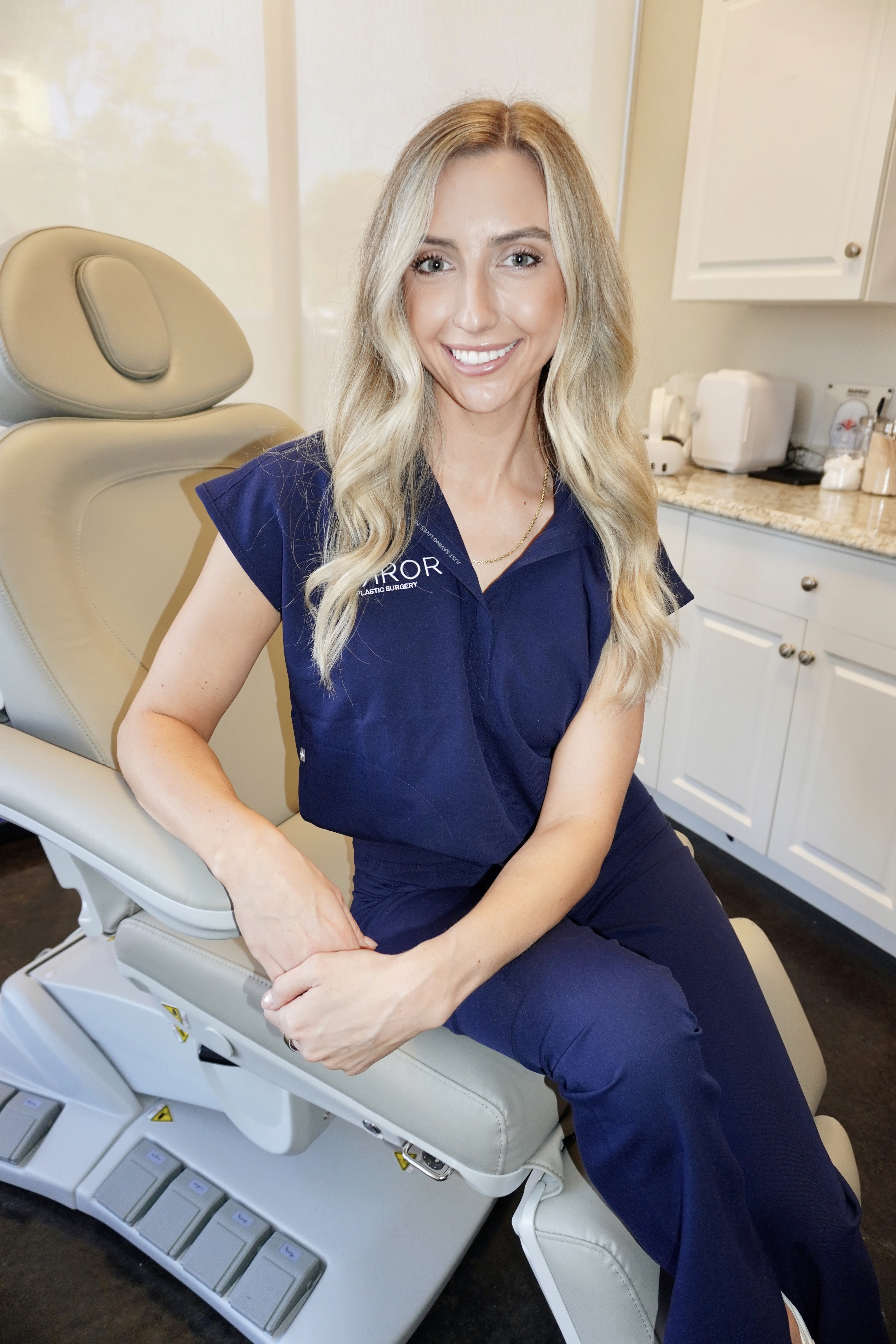
Written by: Ellie Pranckevicius, FNP-BC, Aesthetic Nurse Practitioner & Aesthetic Injector | Facial Restoration & Regenerative Injectable Specialist, Mirror Plastic Surgery | Last updated: July 13, 2026
Key Takeaways for Hip Dip Fillers
- Hip dip fillers offer moderate improvement for mild-to-moderate concavities but cannot change the bone structure that creates the dip.1
- Biostimulatory fillers like PLLA often require 20–30 vials across several sessions, with full results building over 3–6 months.1
- Results can last 2–5 years with maintenance, although most patients need yearly touch-ups to support the collagen framework.1
- Injector expertise in lateral hip anatomy and deep cannula technique is the key factor for safety and natural-looking results.
- Book a consultation with Ellie at Mirror Plastic Surgery for an anatomy-first evaluation of your candidacy for non-surgical hip contouring.
How Much Filler Different Hip Dips Usually Need
The hip area requires far more filler than the face, and volume needs rise with dip severity. For biostimulatory PLLA, most patients receive 8–10 vials per session and complete 2–4 sessions spaced 4–6 weeks apart. This schedule usually totals 20–30 vials for full correction, with deeper or more structurally driven dips falling near the higher end of that range.1
Biostimulatory fillers do not create instant volume. Collagen stimulation starts around 2–3 weeks after treatment, with visible fullness appearing at 6–12 weeks and peak results at 3–6 months.1 This gradual timeline reflects how the product works rather than a drawback. New collagen slowly integrates into the tissue, which helps the area look and feel like natural soft tissue instead of a pocket of gel.
Hip dips come mainly from skeletal structure, not from fat percentage or muscle tone. Injectable treatments can add soft tissue volume and soften the curve, but they cannot erase the dip or reshape bone. Patients with mild-to-moderate soft tissue deficits usually see the most noticeable change.1 When dips are almost entirely skeletal, even well-planned filler sessions may create only subtle improvement, and a transparent consultation should explain that clearly.1
How Long Hip Dip Filler Results Last
Filler longevity in the hip varies by product type. PLLA biostimulators such as Sculptra can maintain results for 2 years or longer because they stimulate the body’s own Type I collagen, which forms a lasting framework instead of a temporary gel pocket.1 Radiesse (CaHA), another biostimulatory choice, generally lasts between 12 and 24 months for hip dip correction.1
Most patients benefit from yearly PLLA touch-ups after the initial series to support the collagen network and preserve their results. Planning for this maintenance phase from the beginning prevents surprise costs and sets realistic expectations. When dips remain pronounced despite multiple injectable sessions, surgical options such as fat transfer or a traditional Brazilian Butt Lift usually offer a more appropriate and predictable solution.
Safety Risks, Migration, and Blood Vessels in the Lateral Hip
The lateral hip is a higher-risk injection area. Larger blood vessels run through this region, and incorrect placement that is too superficial, too deep, or too forceful can cause vascular compromise, nodules, and visible asymmetry. Skill with facial filler does not automatically translate to safe hip dip treatment because the hip and gluteal region involve deeper planes and larger vessels.
Technique strongly influences risk. A qualified provider uses a blunt cannula instead of a sharp needle for gluteal injections, which lowers the chance of piercing a blood vessel. The subcutaneous fat layer is the preferred injection plane, and a blunt cannula allows the injector to move through this layer while reducing puncture risk.
Product choice also affects migration risk. Biostimulatory PLLA integrates through collagen formation and tends to migrate less than gel-based fillers, which remain as free-flowing deposits that respond to gravity and motion. Sculptra particles trigger a collagen matrix that helps hold them in place within the hip dip. Nodule formation after PLLA usually relates to shallow placement or poor post-treatment massage, which are both technique and aftercare issues.
Choosing the Right Filler for Hip Dip Correction
Only certain fillers work well and safely in the lateral hip. Current evidence-based practice supports the following options:
- Sculptra (PLLA): This biostimulator prompts the body to build its own collagen over time instead of giving instant gel volume. Results develop over 3–6 months and can last 2–5 years.1 Collagen integration lowers migration risk. Use for body contouring is off-label but widely adopted by experienced injectors.
- Radiesse (CaHA): This biostimulatory filler can be diluted in different ways to target cellulite, laxity, or volume in specific layers. Results usually last 12–18 months.1 When placed correctly, it is considered a safe and effective body contouring option.
- Hyaluronic acid (HA) fillers: These products are not ideal for large-volume body areas like the hips. Large HA volumes in the buttock region carry documented vascular risks because of nearby major vessels. For this reason, HA fillers are not used for hip dip correction at Mirror Plastic Surgery.
Mirror Plastic Surgery’s non-surgical BBL service uses biostimulatory fillers chosen for each patient’s anatomy, goals, and tissue quality, rather than a single standard formula.
How to Vet Your Hip Dip Filler Injector
Injector selection has the greatest impact on both safety and outcome. Butt filler procedures carry documented risks of infection, major asymmetry, nodules, prolonged swelling, migration, tissue irritation, and vascular events when performed by unqualified providers. The checklist below offers a practical way to evaluate your options.
- Credentials specific to body contouring: Ask about dedicated body contouring training, not just overall years in aesthetics. Board certification, advanced nursing licensure, and documented education in gluteal anatomy should form the baseline.
- Hands-on anatomical assessment at consultation: A proper hip dip consultation includes a physical exam of the area to determine volume needs and a realistic plan. Without assessing tissue thickness, skin elasticity, and dip depth in person, no provider can estimate vial counts accurately, so quoting numbers without an exam signals an incomplete assessment.
- Cannula technique: Confirm that the provider uses a blunt cannula for gluteal injections. Board-certified plastic surgeons or highly trained aesthetic nurse specialists working under direct medical supervision are the safest choices for non-surgical hip augmentation because they understand and manage risks such as vascular occlusion, nodules, and asymmetry.
- Honest candidacy assessment: A qualified injector explains when fillers are not the right choice. Hip dip fillers suit patients with mild contour concerns and realistic expectations more than those seeking dramatic, surgery-level reshaping.
- Post-treatment protocol including the 5-5-5 rule: After PLLA injections, patients should follow the 5-5-5 massage protocol described in the FAQ section to help prevent nodules. An injector who does not clearly review this step is a concern.
- Consultation length and communication style: Rushed visits that skip anatomical evaluation or gloss over timelines and limitations are warning signs. Ellie Pranckevicius’s four years in the Neuroscience ICU at Tampa General Hospital, combined with advanced nursing and esthetics training, support a consultation style grounded in physiology, clinical judgment, and clear expectation-setting.
Book a consultation with Ellie at Mirror Plastic Surgery to experience an anatomy-first, unhurried assessment.
Frequently Asked Questions
Are hip dip fillers worth it?
Hip dip fillers can be worthwhile for the right candidate with realistic expectations.1 They work best for mild-to-moderate soft tissue deficits and for patients who want a softer contour rather than a dramatic structural change.1 As discussed earlier, the skeletal foundation that creates hip dips limits what injectables can achieve, so fillers soften the contour instead of eliminating it.1 Patients who accept a gradual, multi-session process usually report strong satisfaction.1 Those expecting instant, surgery-like results often feel disappointed. A thorough consultation that reviews tissue thickness, skin quality, dip depth, and skeletal influence offers the clearest picture of what fillers can achieve for you.
Does hip dip filler migrate?
Migration risk depends on both product and technique. As noted in the migration discussion above, PLLA’s collagen integration mechanism makes migration less likely when placed correctly in the deep subcutaneous layer.1 Gel-based fillers remain as mobile deposits and respond more to gravity and movement, which is one reason they are not used for this area at Mirror Plastic Surgery. Regardless of product, shallow placement and poor massage increase the chance of nodules and uneven distribution. Deep cannula technique by an injector with specific body contouring training remains the most reliable safeguard.
What is the 5-5-5 rule after Sculptra?
The 5-5-5 rule describes the standard massage protocol after PLLA injections. Patients massage the treated area for 5 minutes, 5 times per day, for 5 consecutive days after each session. This routine spreads PLLA particles evenly through the tissue before collagen forms around them. Uneven distribution is the main cause of nodules and relates closely to technique and aftercare. Following the 5-5-5 rule is a clinical requirement, not an optional suggestion, and any provider who skips this explanation is not offering complete care.
When should patients consider surgical alternatives?
Surgery becomes the better option in several situations. Patients whose dips stem mostly from bone structure often see only subtle change from injectables, even after multiple sessions. Patients who want dramatic, long-lasting structural reshaping also align better with surgical solutions. Fat transfer and traditional Brazilian Butt Lift procedures can deliver larger, more permanent volume changes than fillers. At Mirror Plastic Surgery, Ellie’s non-surgical work pairs with the surgical expertise of Dr. Akash Chandawarkar, MD, a Harvard-educated and Johns Hopkins-trained plastic surgeon, so patients receive unbiased guidance based on anatomy and goals rather than a push toward one method.
Next Steps for Hip Dip Filler at Mirror Plastic Surgery
Hip dip fillers can create real, but limited, improvement. Biostimulatory fillers placed with deep cannula technique can soften mild-to-moderate trochanteric depressions, and results can last several years with maintenance. Research and clinical experience both show that injector expertise matters more than product choice. Lateral hip anatomy is complex, nearby vessels are significant, and the difference between a smooth result and a complication often comes down to anatomical knowledge, precise technique, and honest patient selection.
Mirror Plastic Surgery’s non-surgical BBL approach follows a concierge-style model: up to an hour for consultation, a detailed hands-on exam, a candid discussion of candidacy, and a plan tailored to your tissue rather than a preset package. Ellie Pranckevicius combines Neuroscience ICU experience, advanced nursing training, and esthetics expertise in every non-surgical body contouring case.
Book a consultation with Ellie at Mirror Plastic Surgery, located at 780 4th Ave S, St. Petersburg, FL 33701. Call or text 727-361-6515, or email hello@mirrorplasticsurgery.com.
Disclaimer: Results may vary from person to person. Editorial content, before and after images, and patient testimonials do not constitute a guarantee of specific results.
1 Results may vary from person to person. Editorial content, before and after images, and patient testimonials do not constitute a guarantee of specific results.