
Written by: Dr. Akash Chandawarkar, Board Certified Plastic Surgeon, Mirror Plastic Surgery
Key Takeaways
- Hair transplantation provides the only permanent restoration of lost hair, while native, non-transplanted hair still requires medical protection.1
- FUE and FUT each offer specific advantages, and the right choice depends on your pattern of loss, donor supply, lifestyle, and long-term goals.
- Robotic systems like ARTAS assist with harvesting, and outcomes still depend heavily on the surgeon’s skill in planning, site creation, and hairline design.
- Patients should verify board certification, facility accreditation, and who performs each critical step, because any licensed physician can legally offer hair transplants.
Schedule a consultation at Mirror Plastic Surgery to receive an evidence-based assessment and personalized plan from a board-certified plastic surgeon.
What Makes Hair Transplantation The Only Permanent Treatment?
Hair transplantation offers permanent restoration in treated areas, while medications help manage ongoing loss in untreated regions.1 The procedure relocates healthy, DHT-resistant follicles from a stable donor zone to thinning or balding areas. These follicles keep growing naturally for life in their new location.1 Medications require ongoing use to maintain their effect, while transplanted hair does not depend on continued treatment to survive. Medical therapy still matters because it protects the native, non-transplanted hair that remains vulnerable to thinning.
The term “permanent” in hair restoration refers specifically to moving follicles that are genetically resistant to dihydrotestosterone (DHT), the primary driver of androgenetic alopecia. Non-surgical options such as minoxidil, finasteride, platelet-rich plasma (PRP), and low-level laser therapy can slow or partially reverse loss. Their benefits last only while treatment continues. Stopping these medications usually leads to a gradual return to the previous pattern of loss within months.
The table below summarizes how common treatments compare on permanence and maintenance.
| Treatment Type | Mechanism | Permanence | Maintenance Required |
|---|---|---|---|
| Hair Transplant (FUE/FUT) | Relocates DHT-resistant follicles to thinning areas | Permanent for transplanted hair; native hair may continue to thin | Medical therapy often recommended to protect native hair |
| Finasteride | Inhibits type II 5-alpha-reductase; lowers scalp DHT | Not permanent; benefit reverses on discontinuation | Indefinite daily use required |
| Minoxidil (topical/oral) | Vasodilation; prolongs anagen growth phase | Not permanent; native hair supported by minoxidil may gradually thin after stopping | Indefinite use required |
| PRP / Laser Therapy | Growth factor stimulation; follicular support | Not permanent; evidence supports adjunct role, not standalone permanence | Ongoing sessions required |
Once you understand that transplantation is the only permanent option, the next step is choosing the surgical technique that fits your pattern and goals.
FUE Vs. FUT: Choosing Your Surgical Technique
Hair transplantation uses two primary techniques: Follicular Unit Extraction (FUE) and Follicular Unit Transplantation (FUT). Each method has clear trade-offs, and the ideal choice depends on your hair loss pattern, donor supply, hairstyle preferences, and long-term plan.
FUE removes individual follicular units directly from the scalp with a small punch tool. This approach leaves tiny dot scars rather than a linear incision. It is the dominant technique globally, holding approximately 58–60% of the hair restoration market, and works well for patients who wear their hair short. FUT removes a strip of scalp from the donor area, and the team dissects follicular units under microscopy. This method produces a permanent linear scar but can yield a higher graft count in a single session, which benefits patients with advanced loss who need maximum coverage.
The table below contrasts scarring, recovery, and graft yield to help you weigh the trade-offs.
| Technique | Scarring | Recovery Time (Donor Area) | Grafts Per Session |
|---|---|---|---|
| FUE | Tiny dot scars; generally less visible than FUT | 7–10 days | 1,500–3,500 standard |
| FUT | Permanent linear scar; 1–5 mm width (single session) | 10–14 days; suture removal at day 10 | 2,500–4,000+ per session |
Surgeon skill influences results more than technique choice. FUT transection rates range from 2–5% in expert teams versus 8–15% in less skilled settings. This difference reflects the team’s experience rather than the method itself. Patients who undergo FUT also face a permanent limitation, because FUE extraction cannot be performed within or adjacent to FUT scar tissue, which reduces total lifetime graft yield. This factor matters for long-term planning.
Robotic Systems: ARTAS Vs. NeoGraft In Real Practice
Robotic-assisted FUE systems act as technological aids that support, rather than replace, surgical expertise. Clear expectations about their capabilities help you evaluate any clinic that markets them heavily.
ARTAS iXi is the current iteration of the ARTAS platform. The original ARTAS received FDA clearance in 2011 as the world’s first robotic hair transplant system. ARTAS iXi uses a seven-axis robotic arm and a 44-micron resolution stereoscopic vision system to automate the follicle harvesting phase. ARTAS automates only harvesting. Recipient site creation and graft implantation still rely on the surgeon’s skill and artistry.
A 2024 peer-reviewed, randomized, split-scalp controlled trial by Zhu et al. at Huashan Hospital, Fudan University found that ARTAS robotic extraction and expert manual FUE achieved statistically equivalent transection rates and patient satisfaction in ideal candidates. However, ARTAS produced a significantly higher discard rate (10.71% vs. 5.46% for manual FUE). Surgeons must therefore target more donor follicles to reach the same final implanted count.
The table below summarizes FDA status, limitations, and ideal candidates for each system.
| System | FDA Status | Key Limitation | Best Candidate |
|---|---|---|---|
| ARTAS iXi (Robotic FUE) | FDA-cleared for men with black or brown straight hair with androgenic alopecia only | Cannot harvest body hair; excludes women, curly/wavy/light hair types | Larger cases (1,500+ grafts); men with dark, straight hair; Norwood II–V |
| NeoGraft (Motorized FUE) | FDA-cleared as a motorized FUE device; not a robotic AI system | Outcome depends heavily on operator skill; not AI-guided | Patients seeking FUE without a full robotic system; broader hair type applicability |
| Manual FUE | Standard of care; no device-specific FDA clearance required | Outcome highly dependent on individual surgeon experience | Hairline work, small sessions, facial hair, curly/wavy/Afro-textured hair, body hair harvesting |
Mirror Plastic Surgery evaluates all technologies based on clinical evidence and patient needs. The team selects the tool that best serves each patient’s anatomy, hair type, and goals.
Get an evidence-based assessment of your hair restoration options and learn which approach fits your case.
How To Evaluate A Hair Restoration Surgeon In Tampa Bay
In the United States, any licensed physician can legally perform hair transplant surgery. No specialized training is required by law. This reality places the responsibility for credential checks on the patient. A structured approach helps you vet any provider more confidently.
To verify a hair restoration surgeon’s qualifications, start by confirming board certification through an official registry, not just a website badge. Then confirm that the surgical facility is accredited and uses board-certified physician anesthesiologists. Ask who personally performs extraction, recipient site creation, and hairline design, because delegating these critical steps to unlicensed technicians raises serious safety concerns. Request before-and-after photos of patients with similar patterns, taken at the 12-month mark. Finally, ask how many surgeries the surgeon performs per day and how they handle complications and revisions.
- Confirm board certification through the American Board of Plastic Surgery (ABPS) or American Board of Hair Restoration Surgery (ABHRS) registry.
- Verify that the surgical facility is accredited and staffed by board-certified physician anesthesiologists.
- Clarify who performs extraction, site creation, and hairline design, and whether technicians handle any of these steps.
- Request 12-month before-and-after photos that match your hair type and pattern.
- Ask how many surgeries the surgeon performs per day and how they manage complications and revisions.
- Note that 59.4% of ISHRS member surgeons reported black-market hair transplant clinics in their cities as of 2025, which makes credential verification a key safety step.
Dr. Akash At A Glance
- Board-certified by the American Board of Plastic Surgery
- M.D. from Harvard Medical School, graduated with Honors
- Seven-year integrated plastic and reconstructive surgery residency at Johns Hopkins University
- Aesthetic surgery fellowship at Manhattan Eye, Ear and Throat Hospital (MEETH)
- Biodesign Innovation Fellowship at Stanford University
- Named in Newsweek’s America’s Best Plastic Surgeons 2025 for two consecutive years
- Mirror Plastic Surgery performs 1–2 surgeries per day, allowing focused attention on each patient
The Role Of Medical Management In Protecting Your Results
A hair transplant permanently relocates DHT-resistant follicles, yet it does not change the behavior of native follicles that remain in place. Native hair can continue to miniaturize and thin after surgery, so surgery alone cannot provide complete long-term control.
The 2023 international expert consensus by Vañó-Galván et al., involving 38 experts from 17 countries, recommends medical therapy such as finasteride or dutasteride and minoxidil for transplant patients with androgenetic alopecia. This approach prevents deterioration of non-transplanted hair and reflects the current standard of care.
Without medical management, progressive native hair loss can create the “island effect.” A dense transplanted hairline can become isolated by thinning behind it, which looks unnatural. A surgeon who discusses lifetime graft budgeting and medical therapy during the consultation shows a focus on long-term results and patient advocacy.
- Do I Have To Take Finasteride Forever? Benefits last only while treatment continues, and stopping usually leads to a gradual return to the previous pattern.
- What Are The Side Effects? Possible effects include sexual symptoms, breast tenderness, and mood changes, which your physician should review during informed consent.
- Is Finasteride Appropriate For Women? Finasteride is not used in women of childbearing potential due to teratogenic risk. Alternative options exist and require discussion with a qualified physician.
Realistic Expectations For Timeline, Graft Counts, And Results
Clear expectations about the growth timeline prevent unnecessary worry after surgery. Transplanted hair usually sheds in the first 2–4 weeks after the procedure, which is normal. New growth typically begins at 3–4 months. Noticeable improvement appears at 6–9 months, and full results develop over 12–18 months.1 As noted in the surgeon evaluation guidance, always review before-and-after photos at the 12-month mark.
The average FUE case in 2024 involved 2,262 grafts, according to the ISHRS 2025 Practice Census. Graft count alone does not determine outcome. Placement angle, density distribution, and hairline design carry equal importance. Only 40–50% of original density is needed to create the visual appearance of fullness because of light scattering and layering of hair. Overpacking grafts beyond this level can compromise blood supply and reduce graft survival.
Approximately 42.7% of patients require more than one procedure, especially as native hair loss progresses. A reputable surgeon will discuss staged planning and lifetime graft budgeting from the first consultation.
Questions To Ask In Your Consultation
A thorough consultation gives you the clearest picture of your options. To ensure you cover the essentials, bring the questions below to any provider you consider.
- Are you board-certified by the American Board of Plastic Surgery or the American Board of Hair Restoration Surgery?
- What technique do you recommend for my specific case, and why?
- Who personally performs the extraction, recipient site creation, and hairline design?
- How do you handle complications, and do you have hospital privileges if needed?
- What is your approach to preserving native hair long-term, including medical management?
- Can I see before-and-after photos of patients with similar hair loss patterns at the 12-month mark?
- What is your policy on revision procedures?
- How many surgeries do you perform per day?
Schedule your personalized consultation with Dr. Akash to review your anatomy, goals, and long-term plan in detail.
Why Mirror Plastic Surgery Stands Out In Tampa Bay
Mirror Plastic Surgery offers a safety-first, evidence-based approach for patients seeking permanent hair restoration in Tampa Bay. The practice emphasizes education, realistic expectations, and durable outcomes.
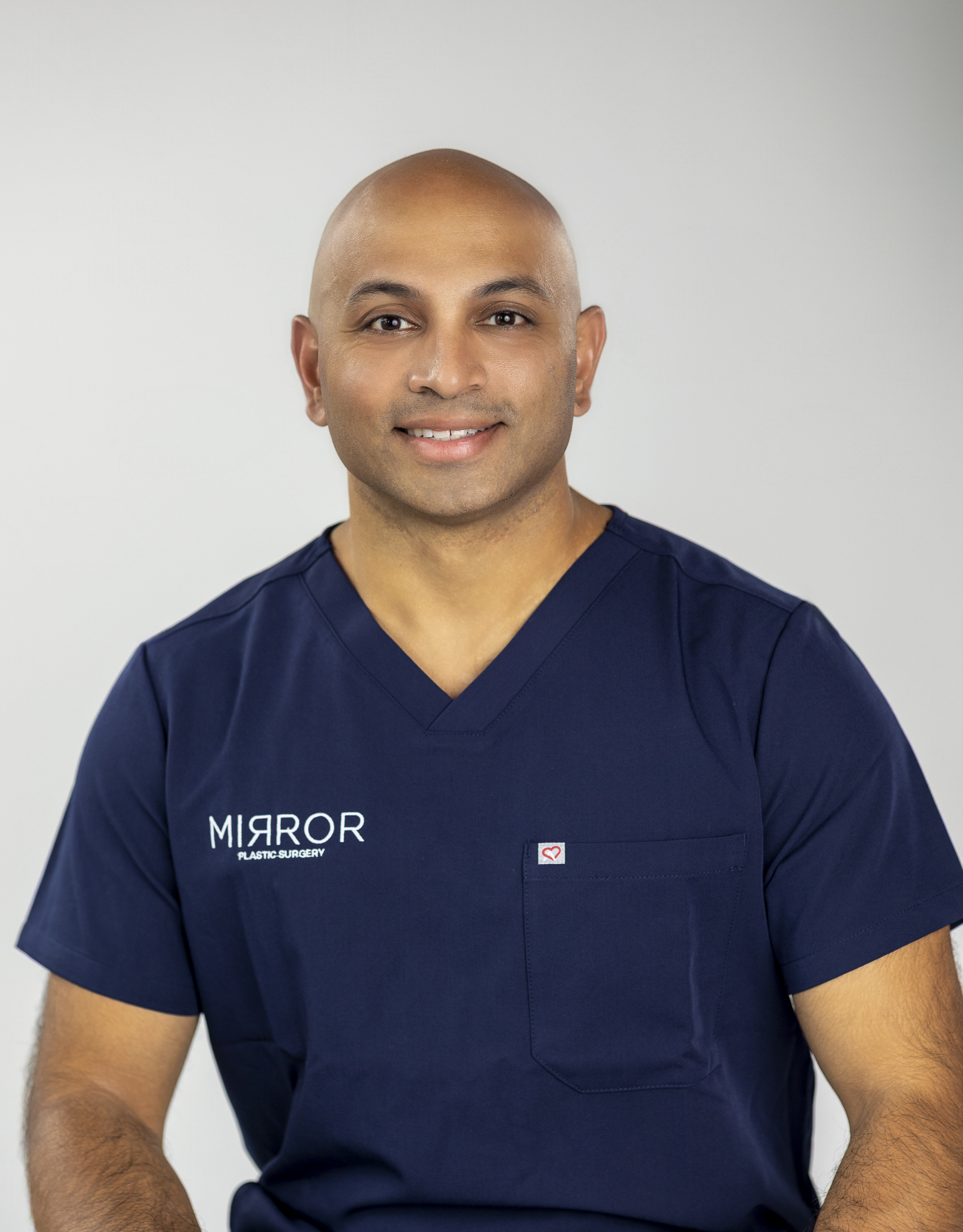
Dr. Akash, a Harvard-educated, Johns Hopkins-trained, and MEETH fellowship-trained plastic surgeon, applies the same guiding philosophy to every hair restoration case: safety first, function second, aesthetics third. Named in Newsweek’s America’s Best Plastic Surgeons 2025 for two consecutive years, he brings elite academic training and supplier-neutral recommendations to each consultation.
Mirror Plastic Surgery limits its schedule to one or two surgeries per day. This deliberate choice keeps the entire clinical team focused on each patient before, during, and after the procedure. Consultations often run up to an hour and cover anatomy, technique options, medical management, and long-term planning.
Discuss your hair restoration goals with Dr. Akash and receive a personalized, evidence-based treatment plan.
Frequently Asked Questions
Here are answers to common questions about hair transplant surgery and recovery.
Is Hair Transplant Surgery Painful?
Hair transplant surgery uses local anesthesia, so patients feel minimal discomfort during the procedure. Some soreness, swelling, and tightness in the donor and recipient areas are common in the days that follow and usually resolve within one to two weeks. Most patients describe the experience as manageable and return to light daily activities within a few days.
How Long Do Hair Transplant Results Last?
Transplanted hair lasts because the follicles come from a donor zone that is genetically resistant to DHT, the hormone responsible for androgenetic alopecia.1 These follicles retain their genetic characteristics in their new location, a principle known as donor dominance, and continue to grow for life. Native non-transplanted hair may keep thinning over time, so many patients use finasteride or minoxidil alongside surgery to protect surrounding hair and preserve the overall result.
Can Women Get Hair Transplants?
Women can be candidates for hair transplantation, although evaluation is more selective. Female pattern hair loss often appears diffuse and can affect areas that serve as donor sites in men, which makes a stable donor zone less certain. A thorough diagnostic assessment that reviews hair loss pattern, donor density, and underlying causes is essential before recommending surgery. Female hair restoration surgical patients increased by 16.5% from 2021 to 2024, reflecting growing demand. Women should seek a surgeon experienced in female hair restoration who can discuss all options clearly.
What Is The Recovery Time After A Hair Transplant?
Recovery timelines differ slightly by technique. FUE donor area recovery typically takes 7–10 days. FUT donor area recovery usually takes 10–14 days, with suture removal around day 10. Recipient area recovery is similar for both methods. Most patients return to desk work within a few days, while strenuous activity, direct sun exposure, and swimming should be avoided for several weeks. Transplanted hairs shed in the first 2–4 weeks as part of the normal cycle. New growth begins around 3–4 months, and full results appear at 12–18 months.1
Are There Non-Surgical Permanent Options For Hair Loss?
As of 2026, transplantation remains the only option that permanently restores hair in treated areas. It does not cure the underlying genetic condition or prevent continued thinning in untreated regions. Non-surgical treatments such as finasteride, minoxidil, PRP, low-level laser therapy, and emerging regenerative therapies like exosomes can slow or partially reverse loss while treatment continues. Hair cloning and stem cell therapies remain in research phases and are not yet available at scale. A qualified surgeon will review all options and help you choose the combination of surgical and medical approaches that fits your situation.
1 Results may vary from person to person. Editorial content, before and after images, and patient testimonials do not constitute a guarantee of specific results.