
Written by: Ellie Pranckevicius, FNP-BC, Aesthetic Nurse Practitioner & Aesthetic Injector | Facial Restoration & Regenerative Injectable Specialist, Mirror Plastic Surgery
Key Takeaways
- Injector experience has a greater impact on safe, natural-looking lip filler results than the specific filler brand.1
- Verify credentials, case volume, and before-and-after photos to confirm specialized training and consistent outcomes.1
- Watch for red flags such as vague credentials, rushed consultations, pressure tactics, or missing complication protocols.
- Prepare targeted consultation questions about board certification, lip-specific volume, complication management, and realistic outcomes.1
- Schedule a consultation with Ellie at Mirror Plastic Surgery to receive expert, anatomy-driven care in Tampa Bay.
Step 1: See How Injector Experience Shapes Your Results
Lip filler outcomes, both aesthetic and safety-related, directly reflect injector skill.1 An experienced, licensed provider who understands facial anatomy consistently delivers more natural, better-proportioned results than someone with minimal training.1
A 2026 systematic review in Aesthetic Plastic Surgery identifies injector experience as a key factor in complication risk. The review notes that underqualified providers, non-physicians, and some med spa operators offering fillers can put patients at risk. Intra-arterial injection with subsequent necrosis occurs in 0.1–0.3% of filler procedures, more commonly in the lip, forehead, and nasolabial fold. Poor injection technique or inappropriate filler choice can increase that risk.
An experienced injector understands facial proportions, how lips move during speech and smiling, and how to select the right product for each patient’s unique anatomy, rather than defaulting to a single brand.1 A highly trained injector evaluates anatomy, blood supply, muscle movement, asymmetry, skin quality, and risk zones, which changes both technique and outcomes.
Step 2: Verify Credentials With Clear Standards
As of 2026, the United States has no unified national standards for training or board certification in aesthetic medicine. Patients should confirm the exact board name and specialty when a provider claims to be board-certified. The checklist below focuses on what truly matters.
Licensure And Specialty Certification
The table below compares credential elements across provider types. Every data point comes from published sources.
| Credential Element | Physician (MD/DO) | Nurse Practitioner (NP/APRN) | Registered Nurse (RN) |
|---|---|---|---|
| Core Training | 4 years medical school + 3–7 years residency | 4–6 years nursing education (BSN + MSN/DNP) | 2–4 years nursing education (ADN/BSN) |
| Board Certification | ABMS-recognized (e.g., American Board of Plastic Surgery) | ANCC or AANP certification in nursing specialty | None required beyond licensure |
| Aesthetic Training | Fellowship or residency training in aesthetic procedures | Formal injectable certification programs, mentored hours | Typically weekend courses or on-the-job training |
| Supervision Required (Florida) | Independent practice | Physician delegation required | Physician supervision required |
For nurse injectors, the Certified Aesthetic Nurse Specialist (CANS) credential sets a clear specialty standard. CANS certification requires an unrestricted RN or nurse practitioner license, two years of core aesthetic specialty experience within the previous three years, 1,000 hours of aesthetic practice within the last two years, and a sponsorship letter from a board-certified physician in plastic or aesthetic surgery, ophthalmology, dermatology, cosmetic medicine, or facial plastic surgery.
Specialized Training And Portfolio
Beyond licensure, the depth of specialized training and the consistency of practice separate average injectors from true experts. These elements help you gauge that depth.
- Fellowship training in aesthetic surgery or formal injectable certification programs with documented hands-on hours
- Case volume, including how many lip filler procedures are performed monthly. Providers doing fewer than 10 injectable cases per month have limited repetition for developing consistent technique.
- Before-and-after photos of actual patients with consistent lighting and healed results, rather than day-of swelling photos
- Familiarity with multiple filler brands and techniques, which shows versatility instead of reliance on a single product
- Active membership in organizations such as the American Society of Plastic Surgeons (ASPS)
Step 3: Spot Red Flags Early
Red flags often appear before a needle ever touches your skin. Common warning signs include pressure to book immediately, vague credentials, a menu-first approach before medical assessment, no discussion of complications, and heavy discounting on high-skill procedures.
A more complete list of warning signs:
- Vague credentials or inability to name specific board certification
- No before-and-after photos, or refusal to show them
- Consultations under five minutes, or quoting a package price before assessment
- High-volume “mill” practices that prioritize speed over personalized care
- Price-driven promotions or heavy upselling of additional treatments at the first visit
- Inability to explain the procedure, risks, or aftercare clearly
- No discussion of complications or emergency protocols
- Pressure to pay a deposit before your questions are answered
- Unrealistic promises or guarantees of specific outcomes.1
- Treatment in a non-medical setting such as a home, salon, or pop-up event
- Inability to confirm hyaluronidase is stocked on-site for emergencies
- Filler decanted into an unlabelled syringe, or an injector who cannot name the exact product used
Step 4: Use Targeted Questions In Your Consultation
A well-structured consultation gives you the clearest view of injector experience. Bring this list to any appointment, in Tampa Bay or elsewhere.
- What are your medical credentials, and are you board-certified? Is your board certification ABMS-recognized, or is it a separate aesthetic certification?
- How many lip filler procedures do you perform each month specifically?
- Can I see before-and-after photos of your lip filler patients, especially patients with lips similar to mine in shape, size, and starting volume?
- What filler brands do you use, and why do you recommend a specific product for my lips and goals?
- How do you handle complications such as vascular occlusion, and is hyaluronidase available on-site?
- What is your approach to achieving natural-looking results, and how do you assess the whole face, not just the lips?1
- Which results are not possible for my anatomy, and what are my limitations?1
- How long will my results last, and what maintenance will I need?1
- What is your follow-up policy if I have concerns after treatment?
Quality providers welcome thorough questioning. Providers who seem annoyed, dismissive, or evasive often lack the expertise, transparency, or patient-centered philosophy patients deserve.
Step 5: Review Product Knowledge And Aesthetic Philosophy
FDA-approved fillers for lip augmentation include Restylane-L, Restylane Kysse, Juvéderm Ultra XC, and Juvéderm Volbella XC. Juvéderm uses Vycross crosslinking technology, which produces smoother, more cohesive gels. Restylane uses NASHA and XpresHAn platforms, and XpresHAn products such as Kysse feel softer and more flexible. These differences affect how each filler integrates into lip tissue.
An experienced injector:
- Matches the product to the patient’s goals, lip anatomy, tissue thickness, and how the lips move during speech and smiling
- Recognizes that softer fillers are generally preferred for lips because they integrate better with movement and feel more natural
- Assesses the whole face, not just the lips, to maintain proportion across facial thirds
- Explains realistic outcomes and clarifies what the treatment will not achieve.1
- Starts conservatively. A half-syringe (0.5 ml) at the first session usually provides a safe starting point and allows evaluation of the settled result.1
Mirror Plastic Surgery operates as a supplier-neutral practice and uses a range of filler brands, including Juvéderm, RHA, Versa, Restylane, and Evolysse. This approach keeps recommendations focused on patient anatomy and goals instead of product quotas.
Step 6: Choose An Experienced Lip Filler Injector In Tampa Bay
Tampa Bay and St. Petersburg residents can apply this same framework locally. Mirror Plastic Surgery reflects the standards described throughout this guide.
Non-surgical injectable treatments are led by Ellie Pranckevicius, FNP-BC, an Aesthetic Nurse Practitioner with a rare dual background. She completed 600 hours of hands-on esthetics training, earned a Bachelor’s and Master’s in Nursing from the University of South Florida, and spent four years in the Neuroscience ICU at Tampa General Hospital. That ICU experience sharpened her clinical judgment, time management, and deep understanding of human physiology, which forms the foundation of a skilled injector. Her career began in 2019 at a high-end medical spa in Boston, where she advanced from esthetician to medical esthetician before transitioning into advanced nursing practice.
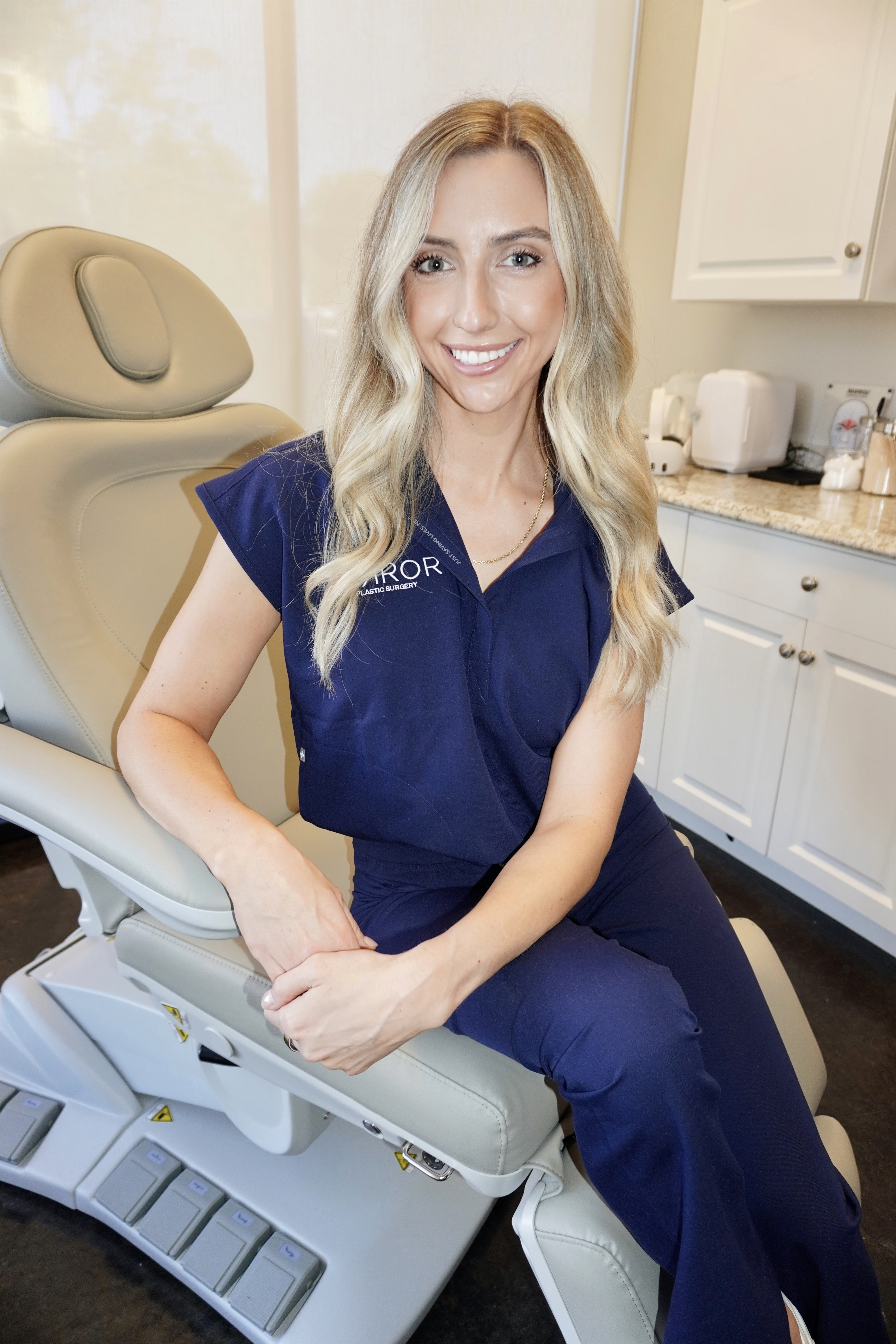
Ellie’s injectable work is supported by Dr. Akash Chandawarkar, MD, founder of Mirror Plastic Surgery. He is a Harvard-educated physician, a Johns Hopkins-trained plastic surgeon, and a fellowship-trained aesthetic surgeon at Manhattan Eye Ear & Throat Hospital (MEETH)/Lenox Hill Hospital, with additional medical innovation training at Stanford University.
Mirror Plastic Surgery’s approach directly addresses common patient concerns.
- Hour-long consultations with a top-to-bottom assessment, instead of rushed five-minute sales pitches
- Supplier-neutral practice with product selection that supports unbiased, anatomy-driven recommendations
- Hyaluronidase on-site with clear complication management protocols
- Concierge medicine philosophy that prioritizes safety first, function second, and aesthetics third
- Honest, transparent communication, including clear guidance when a procedure does not suit a patient’s anatomy or timing
To address common concerns, the following section answers frequently asked questions about lip filler safety and results.
Frequently Asked Questions
What Is The Best Filler For Lip Augmentation?
There is no single best filler for every patient. The right product depends on your anatomy, tissue thickness, lip movement, and aesthetic goals. As noted earlier, several FDA-approved fillers are designed for lips, including Restylane Kysse and Juvéderm Volbella XC. Softer, more flexible formulations are generally preferred because they integrate naturally with movement. An experienced injector evaluates lip shape, symmetry, cupid’s bow, vermilion border, and dynamic movement before recommending a product. Mirror Plastic Surgery uses a range of filler brands and selects based on individual needs.
How Do You Prevent “Duck Lips”?
“Duck lips” usually result from overfilling, using overly stiff products designed for structural areas, or poor injection technique such as border injection without body support. An experienced injector starts conservatively, often with 0.5 ml for a first session, respects your natural anatomy, and builds volume gradually across sessions. They assess the lower-to-upper lip ratio, since the lower lip should carry slightly more volume than the upper. They also distribute filler at multiple depths through the lip body and select a product with appropriate flexibility for lip movement. Duck lips reflect technique, not an inevitable outcome of lip filler.1
How Can I Verify An Injector’s Credentials In Florida?
Use the Florida Department of Health’s online license verification portal to confirm active license status and check for disciplinary history. For physicians, confirm that board certification is ABMS-recognized and in a relevant specialty such as plastic surgery or dermatology, rather than a non-ABMS aesthetic certification. For nurse practitioners, verify an active APRN license and ask about aesthetic-specific training, supervised clinical hours, and case volume. In Florida, NPs performing aesthetic injectables require physician delegation, so ask about the supervisory structure and whether a physician is accessible. A practical script is, “Please tell me your main specialty board, plus any additional aesthetic certification and what it required.”
What Should I Do If I Am Unhappy With My Lip Filler Results?
Most lip fillers can be dissolved with hyaluronidase, an enzyme that breaks down the filler quickly. Wait at least two weeks for swelling to fully resolve before evaluating your results, since up to 80% of day-one volume is temporary swelling.1 Many patients who request early dissolution would have been satisfied with the settled result. If you remain unhappy after swelling subsides, seek a qualified provider for assessment and possible dissolution. Avoid returning to an injector whose work consistently disappoints you. Seeking a second opinion is a sound clinical strategy.
How Many Lip Filler Procedures Should My Injector Perform Each Month?
Case volume offers a useful proxy for skill development. As mentioned earlier, low case volume, under 10 injectable cases per month, can limit technique development. A mid-volume injector places 20–50 syringes per month, while high-volume injectors place 50 or more. Volume alone does not tell the full story, so ask specifically about lip filler cases, since general injectable experience does not guarantee lip expertise. Pair volume data with a review of before-and-after photos showing healed results at two to four weeks, consistent lighting, and patients with anatomy similar to yours.
Your Next Step Toward Safe, Natural Results
Choosing the right injector is the most consequential decision you will make, more than the product or the price. By applying the steps in this guide, you can prioritize safety, realistic expectations, and natural-looking results.1
If you live in Tampa Bay or St. Petersburg, Mirror Plastic Surgery offers dual esthetics and advanced nursing expertise, surgical oversight from a fellowship-trained plastic surgeon, supplier-neutral product selection, and a concierge philosophy focused on long-term outcomes.
Disclaimer: Results may vary from person to person. Editorial content, before and after images, and patient testimonials do not constitute a guarantee of specific results.
1 Results may vary from person to person. Editorial content, before and after images, and patient testimonials do not constitute a guarantee of specific results.