
Written by: Ellie Pranckevicius, FNP-BC, Aesthetic Nurse Practitioner & Aesthetic Injector | Facial Restoration & Regenerative Injectable Specialist, Mirror Plastic Surgery
Key Takeaways
- Consultations under five minutes function as sales encounters, not clinical assessments, and raise the risk of unnatural or imbalanced results.
- Expert injectors combine advanced credentials, hands-on CME training, and complication-management protocols that most high-volume providers do not maintain.
- Red flags such as upselling without assessment, missing reversal agents, or skipping full-face evaluations signal quota-driven rather than patient-centered care.
- A structured eight-step consultation checklist that covers medical history, full-face evaluation at rest and in animation, anatomy-based explanations, and phased planning helps patients identify qualified providers.
- Book a consultation with Ellie at Mirror Plastic Surgery to experience a thorough, anatomy-first injectable evaluation tailored to your goals.
How Rushed Consultations Undermine Injectable Results
A consultation that lasts under five minutes functions as a transaction, not a clinical assessment. A consultation under 5 minutes or one that turns into a hard sell for multiple treatments indicates a sales-driven rather than clinically driven process. When a provider skips a full-face evaluation, they treat isolated features without understanding how those features interact. The forehead, midface, and lower face function as a single structural system. Treating one zone without accounting for the others often produces the “overdone” look that patients want to avoid.
The HARMONY study found that a sequenced, panfacial, multimodal treatment approach significantly increases client satisfaction with facial appearance.1 This research aligns with what experienced injectors observe in practice. Patients who receive a full-face evaluation before any product is selected consistently report more natural, balanced outcomes.1
Google reviews measure patient satisfaction in the moment, but satisfaction immediately after treatment does not predict long-term outcomes. What reviews cannot measure, such as anatomical knowledge, complication-management capability, and assessment quality, determines long-term safety and aesthetics. These variables decide whether your results look natural two years from now or require correction.1
Ellie’s Training and What Defines an Expert Injector
In Florida, ARNPs generally perform aesthetic procedures under a written collaborative agreement or physician protocol, with limited autonomous practice options, and medical spas are not universally required to maintain a medical director. Holding a license sets the minimum bar. Expert injectors distinguish themselves through the depth and recency of training layered on top of that license.
Quality Botox and filler training programs include hands-on instruction with live patient models. These programs cover facial anatomy, dosing and injection techniques, patient consultation and assessment, and complication recognition and management. Reputable courses award CME credits from recognized bodies and require periodic recertification to keep skills current.
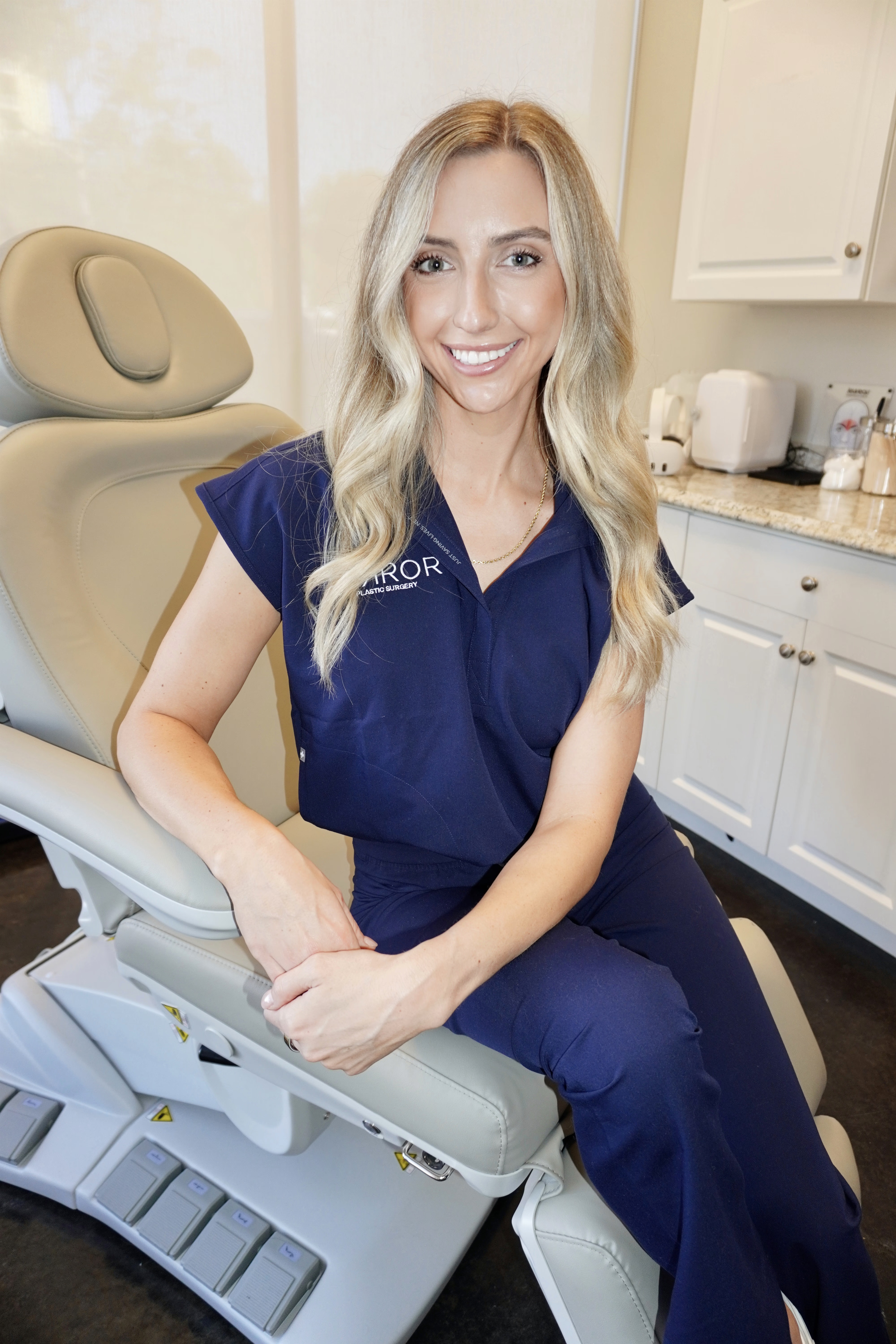
Ellie Pranckevicius, FNP-BC, serves as Mirror Plastic Surgery’s Aesthetic Nurse Practitioner for injectables. She holds a Bachelor’s in Health Science from Boston University, completed a 600-hour hands-on aesthetics licensure program, and earned both her Bachelor’s and Master’s in Nursing from the University of South Florida. Before joining Mirror Plastic Surgery, she spent four years in the Neuroscience ICU at Tampa General Hospital, an environment that demands precise anatomical knowledge, rapid clinical judgment, and real-time management of high-stakes complications. Her career began in 2019 at a high-end medical spa on Newberry Street in Boston, where she advanced from esthetician to medical esthetician. This dual background in esthetics and advanced nursing gives Ellie a layered understanding of skin physiology and subdermal anatomy that most injectors in Tampa do not possess.
When complex cases benefit from surgical perspective, Ellie’s work is supported by Dr. Akash Chandawarkar, MD, a Harvard-educated physician, Johns Hopkins-trained plastic surgeon, and fellowship-trained aesthetic surgeon at Manhattan Eye Ear & Throat Hospital (MEETH)/Lenox Hill Hospital, with additional medical innovation training at Stanford University.
Red Flags That Signal Quota-Driven Care
Now that you have a picture of expert-level training, you can contrast it with signs of volume-focused practices. The following warning signs indicate that a provider is operating a quota-driven model rather than a clinically grounded one:
- Consultations lasting fewer than 10 minutes with no structured facial assessment
- Upselling multiple treatments at the first visit without a phased, anatomy-based plan
- Quoting a package price before examining the patient
- Inability to explain which product is being used and why it suits the patient’s specific anatomy
- No documented protocol for managing vascular occlusion
- Absence of reversal agent on site, which disqualifies the practice for safe management of time-sensitive vascular occlusion that risks skin necrosis or blindness
- Agreement with every treatment request without clinical pushback or explanation of what would not be appropriate for the patient’s anatomy
- No review of prior injectable, laser, or surgical history before planning treatment
Across all adverse event categories for non-surgical facial aesthetics, the dominant determinants of harm are operator training, regulatory environment, and clinic-level protocol rather than product brand or patient demographics. In other words, the provider’s process, not the filler brand or your age, is the safety variable that matters most.
Eight-Step Consultation Checklist for Evaluating Injectors
Use this checklist when evaluating any injectable provider in Tampa before committing to treatment:
- Medical history review: The provider asks about medications, autoimmune conditions, prior fillers, neuromodulators, biostimulators, lasers, and surgeries. Each of these factors influences current treatment planning.
- Full-face evaluation at rest: The provider assesses all three facial thirds, upper, middle, and lower, at the same time rather than focusing only on the area you mentioned.
- Full-face evaluation in animation: Effective full-face assessment includes viewing the patient at rest and in animation from frontal, oblique, lateral, and profile angles.
- Anatomy-based explanation: The provider explains the anatomical reason behind each recommendation and clearly states what they would not recommend and why.
- Risk discussion: Complications including bruising, vascular occlusion, and delayed nodules are discussed openly. The provider describes their management protocol for each scenario.
- Product transparency: Qualified injectors specify the exact product, such as Botox versus Dysport or Restylane versus Juvéderm, and allow patients to view the sealed box before opening.
- Phased treatment plan: The provider presents a sequenced plan rather than recommending maximum volume at the first appointment. Conservative use of the minimum effective amount of filler, combined with staged appointments, supports natural-looking results and allows reassessment after swelling resolves.1
- Long-term maintenance discussion: The provider outlines realistic timelines for retreatment and explains how results will evolve. Aesthetics is framed as an ongoing relationship rather than a one-time procedure.
Mirror Plastic Surgery’s initial consultations routinely extend up to an hour and follow these eight steps in a structured way. Book a consultation with Ellie to walk through this process for your own anatomy and goals.
When Injectables Benefit from Surgical Oversight
Some patients present with concerns that sit at the intersection of non-surgical and surgical planning, such as significant volume loss, structural asymmetry, or prior filler complications that require a more comprehensive evaluation. In these cases, Ellie’s injectable work can be complemented by Dr. Akash Chandawarkar’s surgical perspective. This integration of non-surgical and surgical expertise within a single practice ensures that treatment planning accounts for the full spectrum of options. Patients are not steered toward a procedure simply because it is the only one available in-house.
The practice maintains a supplier-neutral stance for these decisions as well. The recommendation focuses on the most appropriate intervention for the patient’s anatomy, not the most profitable one.
Five Safety Questions to Ask Before You Book
Before scheduling an injectable appointment with any provider in Tampa, ask these five questions directly:
- What is your training background, and what hands-on CME have you completed in the past 12 months?
- Do you stock reversal agent on site, and can you describe your vascular occlusion protocol?
- Will you conduct a full-face assessment before recommending any treatment?
- Can you explain which product you plan to use and why it suits my specific anatomy?
- Who is your supervising or collaborating physician, and are they available if a complication arises?
A provider who cannot answer these questions clearly and without hesitation is not operating at the standard that your safety and results require.
Frequently Asked Questions
What professional credentials should an injector hold in Florida in 2026?
In Florida, aesthetic injectable procedures such as Botox and dermal fillers may be performed by licensed physicians (MD or DO), nurse practitioners, physician assistants, registered nurses, and dentists, each operating within their respective scope of practice. Florida’s regulatory framework allows ARNPs to perform injectables under physician collaboration, as discussed earlier. Beyond the base license, expert-level injectors complete hands-on CME-accredited training that covers facial anatomy, vascular danger zones, complication recognition, and emergency protocols. A certificate of completion from a training course does not itself confer legal authority to inject, because that authority derives from the provider’s professional license. Ellie Pranckevicius holds a Master’s in Nursing from USF, a 600-hour aesthetics licensure, and board certification as a Family Nurse Practitioner (FNP-BC), practicing under the medical directorship of Dr. Akash Chandawarkar at Mirror Plastic Surgery.
How common are vascular complications from dermal fillers?
Vascular complications from dermal fillers are rare but serious. Studies report that such events occur infrequently, yet they carry significant risk. The risk is highest in anatomically sensitive regions, including the glabella, forehead, nasal dorsum, and periorbital area, where facial vessels communicate directly with the ophthalmic artery. Severe outcomes including tissue necrosis and, in rare cases, vision loss have been documented in the literature.
Risk factors include high-volume bolus injections, elevated injection pressure, sharp needle use in vascular regions, and limited anatomical awareness on the part of the injector. Observational data consistently show that longer, more structured injector training is associated with lower rates of significant adverse events and faster real-time recognition of complications. At Mirror Plastic Surgery, reversal agent is stocked on site and a vascular occlusion protocol is in place for every filler appointment.
Why does a full-face assessment produce more natural results than treating one area?
The face functions as a structural system, not a collection of independent features. Volume loss in the temples affects the appearance of the brows, and midface deflation changes how the nasolabial folds look. Treating the lips without addressing the chin can create disproportionate results that draw attention rather than harmonize.
A full-face assessment evaluates all three facial thirds, upper, middle, and lower, at rest and in animation from multiple angles before any product is selected. This approach allows the injector to sequence treatment from structural foundations outward. That strategy typically requires less product and produces results that look like a refreshed version of the patient rather than an obvious correction.1 Ellie’s philosophy at Mirror Plastic Surgery prioritizes foundational restoration before volume augmentation, so each treatment builds on a coherent whole-face plan rather than addressing isolated concerns alone.
How can patients verify product authenticity and supplier neutrality?
Counterfeit Botox and dermal fillers have been documented in FDA and CDC multi-state alerts as recently as 2024–2025. Patients can verify product authenticity by asking the injector to show the sealed box before opening and to confirm the brand name and lot number. Authorized products are purchased directly from manufacturers or licensed distributors, and a reputable provider can state this clearly.
Supplier neutrality means the practice is not financially incentivized to use one brand over another. Recommendations are based on which product best suits the patient’s anatomy, skin quality, and treatment goals. Mirror Plastic Surgery maintains a supplier-neutral position across its injectable portfolio, which includes neuromodulators such as Botox, Dysport, Xeomin, Daxxify, and Jeuveau, and dermal fillers including Juvederm, RHA, Versa, Restylane, Radiesse, and Evolysse. The right product for your anatomy is selected at consultation, not predetermined by a supplier agreement.
Conclusion
Selecting a medical spa in Tampa for injectables and fillers deserves the same rigor you would apply to any significant medical decision. Star ratings and promotional pricing do not measure anatomical knowledge, assessment depth, or complication-management capability. The framework outlined here, including verifiable credentials, a structured full-face evaluation, product transparency, a hyaluronidase protocol, and a phased treatment plan, gives you a repeatable standard to apply to any provider you consider.
At Mirror Plastic Surgery, Ellie Pranckevicius brings a combination of 600-hour aesthetics training, a Master’s in Nursing from USF, and four years of Neuroscience ICU experience at Tampa General Hospital to every injectable consultation. The practice’s concierge model means your appointment is not scheduled between nine others. Your visit receives the team’s full attention from assessment through long-term follow-up.
Book a consultation with Ellie at Mirror Plastic Surgery, located at 780 4th Ave S, St. Petersburg, FL 33701. You can also reach the practice by phone or text at 727-361-6515, or by email at hello@mirrorplasticsurgery.com.
Disclaimer: Results may vary from person to person. Editorial content, before and after images, and patient testimonials do not constitute a guarantee of specific results.
1 Results may vary from person to person. Editorial content, before and after images, and patient testimonials do not constitute a guarantee of specific results.