
Written by: Dr. Akash Chandawarkar, Board Certified Plastic Surgeon, Mirror Plastic Surgery
Key Takeaways
- Rhinoplasty is one of the most technically demanding plastic surgery procedures and must balance aesthetic refinement with healthy breathing.
- Choosing among rhinoplasty plastic surgeons in the St. Petersburg Tampa area means looking closely at board certification, fellowship training, surgical volume, and safety philosophy.
- Revision rhinoplasty is significantly more complex than primary procedures, with revision rates ranging from 5% to 15% depending on surgeon experience and technique.1
- Functional and cosmetic goals often overlap, so many patients benefit from combined septorhinoplasty to improve both breathing and appearance.
- Ready to evaluate your options in person? Schedule a one-on-one consultation with Dr. Akash at Mirror Plastic Surgery to experience a safety-first, evidence-based approach firsthand.
What to Look for in a Rhinoplasty Surgeon in Tampa Bay
The most qualified rhinoplasty plastic surgeons in the St. Petersburg Tampa area share four traits: they are board-certified by the American Board of Plastic Surgery, they have completed specialized fellowship training in aesthetic or facial plastic surgery, they perform a high volume of rhinoplasty procedures, and they prioritize safety and natural results over aggressive reshaping. Each factor directly affects your outcome, so it helps to understand them clearly.
Board Certification. American Board of Plastic Surgery (ABPS) certification signals rigorous training, ongoing education, and adherence to patient safety standards. Some surgeons hold dual certification, such as ABPS plus the American Board of Otolaryngology. This combination is particularly valuable for functional rhinoplasty or complex revision cases because the otolaryngology background provides deep training in nasal airway mechanics.
Fellowship Training. A general plastic surgery residency covers the full body over six or more years. A specialized fellowship in aesthetic surgery or facial plastic surgery adds one to two dedicated years focused on nasal anatomy, advanced grafting techniques, and facial rejuvenation. Fellowship-trained surgeons have refined skills in nasal anatomy and airway function that extend beyond what residency alone provides. That added depth matters most in complex primary cases and revision surgery.
Surgical Volume and Specialization. A surgeon who performs 50 or more rhinoplasties per year develops a different level of refined skill than one who performs the procedure occasionally. Higher volume supports better pattern recognition, more adaptable decision-making in the operating room, and lower revision rates.1 Revision rhinoplasty requires even deeper expertise because scar tissue, altered anatomy, and potential cartilage depletion make every case structurally unpredictable.
Safety Philosophy. A high-standard practice has non-negotiable markers: accredited surgical facilities, board-certified anesthesiologists, and a surgeon who evaluates safety and function before aesthetics. The European Academy of Facial Plastic Surgery recommends that rhinoplasty surgeons be board-certified, experienced with cartilage grafting, trained to address functional concerns, and transparent about realistic outcomes.
When you feel ready to compare surgeons in person, arrange a consultation with Dr. Akash at Mirror Plastic Surgery to see this safety-first, evidence-based approach in action.
The Shortlist: Top Rhinoplasty Surgeons in St. Petersburg and Tampa
The following table compares surgeons who meet the objective criteria above. As you review it, you will see that Dr. Akash’s board certification, fellowship training, and national recognition place him among the most credentialed rhinoplasty surgeons in the Tampa Bay area. Competing surgeons are described by credentials only, without names, to keep this a fair comparison guide.
| Surgeon | Board Certification | Fellowship Training | Notable Recognition |
|---|---|---|---|
| Dr. Akash (Mirror Plastic Surgery) | American Board of Plastic Surgery | Aesthetic Surgery Fellowship, Manhattan Eye Ear & Throat Hospital (MEETH); Stanford Biodesign Innovation Fellowship | Newsweek “America’s Best Plastic Surgeons 2025” — named two consecutive years; Next Generation Editor, Aesthetic Surgery Journal; FDA testimony on breast implant safety |
| Leading double board-certified facial plastic surgeon (St. Petersburg area) | American Board of Plastic Surgery + American Board of Otolaryngology | Facial plastic and reconstructive surgery fellowship | RealSelf Top Doctor; guest faculty at nationally recognized cosmetic surgery symposiums |
| Board-certified plastic surgeon (Tampa area) | American Board of Plastic Surgery | Aesthetic surgery fellowship | Published peer-reviewed research; PhD in Biomedical Engineering |
| Double board-certified facial plastic surgeon (Tampa area) | American Board of Facial Plastic and Reconstructive Surgery + American Board of Otolaryngology | Facial plastic and reconstructive surgery fellowship | Guest faculty at national plastic surgery symposiums; specializes in complex revision cases |
Dr. Akash at Mirror Plastic Surgery. Dr. Akash’s academic path began at MIT, where he studied neuroscience and nuclear engineering, before he entered the Harvard-MIT Division of Health Sciences and Technology and graduated from Harvard Medical School with Honors. His surgical training took place during a seven-year integrated plastic and reconstructive surgery residency at Johns Hopkins University, with rotations at the R Adams Cowley Shock Trauma Center and the Curtis National Hand Center. He then completed an aesthetic surgery fellowship at MEETH, one of the most competitive programs in the country for advanced facial rejuvenation and rhinoplasty. He also completed the Stanford University Biodesign Innovation Fellowship, which trained him to evaluate emerging surgical technologies with the same rigor applied to clinical outcomes. He has been named to Newsweek’s “America’s Best Plastic Surgeons” list two consecutive years and serves as a leading researcher on artificial intelligence applications in rhinoplasty outcome analysis.
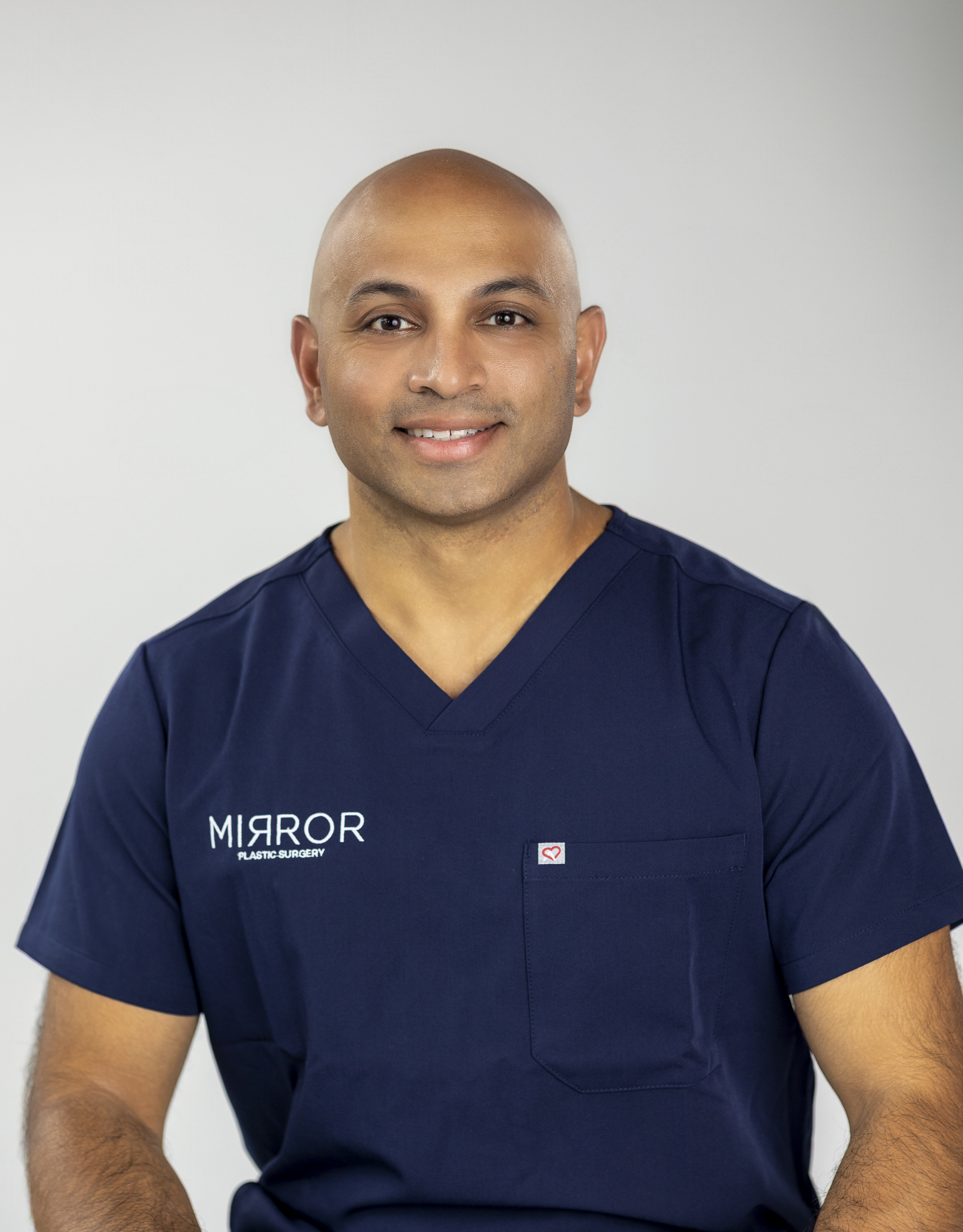
Mirror Plastic Surgery limits itself to one to two surgeries per day, a deliberate contrast to high-volume practices performing five to ten daily. Consultations run up to an hour, and every treatment plan follows the practice’s guiding hierarchy: safety first, function second, aesthetics third.
Other leading options in the Tampa Bay market include a double board-certified facial plastic surgeon with fellowship training in rhinoplasty and complex revision cases, a board-certified plastic surgeon with an aesthetic surgery fellowship and published peer-reviewed research, and a double board-certified facial plastic and reconstructive surgeon who serves as guest faculty at national symposiums. Each brings strong credentials. The main differences involve surgical volume, practice philosophy, and the depth of the consultation experience.
Primary vs. Revision Rhinoplasty: Matching the Procedure to Your Needs
Primary rhinoplasty is a first-time surgical procedure to reshape the nose for cosmetic reasons, functional reasons, or both. Revision rhinoplasty is a secondary procedure performed to correct or improve results from a prior surgery.
Published peer-reviewed data indicate that revision surgery is required in 5% to 15% of primary rhinoplasty cases, with a widely cited figure of 9% to 10% across large surgical series. Revision cases are significantly more complex. Scar tissue makes dissection less predictable, tissue planes are altered, and cartilage that was used or removed during the primary procedure may need to be replaced with grafts harvested from the ear or rib.
Patients undergoing revision septorhinoplasty show smaller improvements in health-related quality of life compared to primary surgery patients and are more likely to require additional surgeries.1 This pattern reinforces the importance of choosing the right surgeon the first time.
Dr. Akash’s fellowship training at MEETH included advanced revision cases alongside primary aesthetic rhinoplasty, positioning Mirror Plastic Surgery to serve both patient populations with the same evidence-based, safety-first approach.
Just as primary and revision procedures differ, the goals of functional and cosmetic rhinoplasty also differ, and many patients need elements of both.
Functional Rhinoplasty vs. Cosmetic: How They Work Together
Functional rhinoplasty addresses breathing problems caused by structural issues inside the nose, such as a deviated septum, nasal valve collapse, or chronic nasal obstruction, while cosmetic rhinoplasty focuses on reshaping the nose’s external appearance for improved facial balance.
Many patients benefit from a combined approach. A nose that looks better and breathes better is achievable in a single combined procedure called septorhinoplasty, which addresses the internal septum and external nasal structure simultaneously. The International Society of Aesthetic Plastic Surgery confirms that rhinoplasty may include septoplasty, turbinate reduction, valve support, and grafting when clinically indicated to improve airway function alongside aesthetic balance.
Dr. Akash’s philosophy of safety, function, and aesthetics, in that order, aligns with this integrated approach. Cosmetic improvements at Mirror Plastic Surgery always protect airway function.
How Much Does a Nose Job Cost in Tampa Bay?
Rhinoplasty costs in Tampa Bay vary based on surgeon credentials, procedure complexity, surgical facility type, and anesthesia. Each patient at Mirror Plastic Surgery receives a personalized quote after consultation because every nose and every surgical plan is unique.
Key cost factors include:
- Surgeon’s experience and fellowship credentials
- Primary versus revision procedure complexity
- Functional versus cosmetic scope, as combined septorhinoplasty may allow the functional component to be billed to insurance when medically documented
- Surgical facility type, since accredited outpatient surgery centers typically cost less than hospital operating rooms
- Anesthesia fees and pre-operative testing
Extremely low quotes in Tampa almost always reflect trade-offs in surgeon credentials or facility standards. Choosing a surgeon based on the lowest quote is one of the most reliable predictors of needing costly revision surgery later.
What Is the Regret Rate for Nose Surgery?
Traditional structural rhinoplasty is associated with revision rates commonly cited as 5% to 15%, and in some reports up to 20% to 25%, depending on patient population, technique, and surgeon experience.1 Preservation rhinoplasty techniques, by contrast, have demonstrated revision rates ranging from 0% to 7.9% in a 2026 systematic review of 855 patients.1
Postoperative nasal obstruction and asymmetry are key factors that reduce patient satisfaction after rhinoplasty and drive revision surgery. This finding underscores why functional evaluation must accompany every cosmetic plan.
On the satisfaction side, a retrospective study of 200 rhinoplasty and rhinoseptoplasty patients reported a global postoperative satisfaction rate above 84%1 when surgery was performed by a qualified surgeon with realistic expectations established in advance. Patient satisfaction after rhinoplasty depends not only on surgical skill but also on timing, communication, and psychological management, and patients who viewed results at two weeks rather than one week reported significantly higher satisfaction at three months post-operatively.1
Choosing a surgeon who prioritizes honest communication, natural results, and thorough pre-operative counseling, as Dr. Akash does at Mirror Plastic Surgery, directly reduces the risk of dissatisfaction and revision.
How to Choose: 5 Questions to Ask in Consultation
These questions help you evaluate any rhinoplasty surgeon during your consultation:
- Are you board-certified by the American Board of Plastic Surgery or the American Board of Facial Plastic and Reconstructive Surgery?
- How many rhinoplasties do you perform per year, and what is your revision rate?
- Can I see before-and-after photos of patients with similar nasal anatomy to mine?
- How do you approach functional concerns, such as breathing, alongside cosmetic goals?
- What is your philosophy on safety, and what accreditation does your surgical facility hold?
Red flags to watch for during consultations include:
- Rushed consultations under 15 minutes with no anatomical discussion
- High-volume practices performing five or more surgeries daily
- Pressure to book immediately or accept a package deal
- Inability or unwillingness to provide before-and-after photos of comparable cases
- Vague or evasive answers about revision rates and facility accreditation
Meet with Dr. Akash to experience an hour-long, anatomy-driven evaluation that is pressure-free and thorough.
Long-Term Results and Maintenance After Rhinoplasty
Rhinoplasty results are permanent, but the nose continues to evolve with age as skin loses elasticity and cartilage shifts.1 The final appearance of the nose is expected at approximately one year post-surgery, with subtle swelling persisting especially at the tip through the early months.1
The final result of any rhinoplasty cannot be fully assessed for at least twelve months post-surgery, and in revision cases even longer, as swelling can mask the true outcome for a significant period.1 Surgeons who plan for long-term structural integrity, using techniques that preserve cartilage support and avoid over-resection, produce results that age more gracefully and require fewer secondary interventions.1
Dr. Akash’s approach at Mirror Plastic Surgery focuses on natural, lasting outcomes that preserve the patient’s identity while improving proportion. This low surgical volume also means that post-operative follow-up receives the same focused attention as the procedure itself.
Conclusion: Your Next Step Toward a Confident Decision
Selecting among the best rhinoplasty plastic surgeons in the St. Petersburg Tampa area requires evaluating board certification, fellowship training, surgical volume, safety philosophy, and the quality of the consultation experience. The combination of elite training, honest communication, and a safety-first practice model separates surgeons who consistently deliver lasting, natural results from those who do not.
Schedule consultations with multiple surgeons, including Dr. Akash at Mirror Plastic Surgery, to compare approaches firsthand. The right surgeon will take time to understand your goals, explain your options clearly, and prioritize your safety above all else.
Ready to Take the Next Step?
Schedule your rhinoplasty consultation with Dr. Akash at Mirror Plastic Surgery and experience a concierge-level evaluation built on Harvard-MIT education, Johns Hopkins surgical training, and a philosophy that puts safety and function before aesthetics.
Mirror Plastic Surgery | 780 4th Ave S, St. Petersburg, FL 33701 | 727-361-6515 | hello@mirrorplasticsurgery.com
Frequently Asked Questions
What is the difference between a facial plastic surgeon and a plastic surgeon for rhinoplasty?
Both can perform excellent rhinoplasty, but their training paths differ. A board-certified plastic surgeon completes a six-or-more-year general residency covering the full body and is certified by the American Board of Plastic Surgery. A facial plastic surgeon completes a five-year otolaryngology residency followed by a one-to-two-year fellowship in facial plastic and reconstructive surgery, earning dual certification from the American Board of Otolaryngology and the American Board of Facial Plastic and Reconstructive Surgery. Because of their otolaryngology background, facial plastic surgeons typically have the deepest training in nasal airway anatomy, which can be advantageous for functional rhinoplasty or complex revision cases. However, the most important factor for any patient is the individual surgeon’s rhinoplasty volume, outcomes, and ability to address both cosmetic and functional concerns. That is why Dr. Akash at Mirror Plastic Surgery holds ABPS certification and completed a dedicated aesthetic surgery fellowship at MEETH, providing advanced training in both nasal anatomy and facial rejuvenation techniques.
How long does it take to see the final results of rhinoplasty?
Most visible swelling and bruising resolve within seven to fourteen days, and the majority of patients return to work within two to three weeks. Subtle swelling, particularly at the nasal tip, can persist for several months. The final appearance of the nose is generally not fully established until approximately twelve months after surgery, and in revision cases or patients with thicker skin, the timeline can extend further.
Surgeons and professional organizations recommend waiting a full year before evaluating whether revision surgery is needed. Patients who assess their results too early, especially in the first one to two weeks when swelling and bruising peak, are more likely to experience unnecessary anxiety and premature dissatisfaction. Structured post-operative communication and realistic expectation-setting before surgery, both hallmarks of the Mirror Plastic Surgery approach, significantly improve long-term satisfaction outcomes.
Can rhinoplasty improve breathing and appearance at the same time?
Yes. A combined procedure called septorhinoplasty addresses the internal nasal septum for functional improvement and reshapes the external nose for aesthetic balance in a single operation. This approach is appropriate when both functional and cosmetic concerns exist simultaneously, such as a patient with a deviated septum who also wants to reduce a dorsal hump or refine the nasal tip. The functional component of a combined procedure may be partially covered by insurance when medical necessity is documented, while the cosmetic portion is paid out of pocket.
At Mirror Plastic Surgery, Dr. Akash evaluates both the internal airway and external nasal structure during consultation. He follows the practice’s core philosophy: function must be assessed and protected before any cosmetic modification is planned. A nose that looks better but breathes worse does not represent a successful outcome.
What are the most common reasons patients need revision rhinoplasty?
Revision rhinoplasty is sought for two broad categories of concern: cosmetic dissatisfaction and functional problems, which frequently overlap. Common cosmetic reasons include residual or worsened asymmetry, over-resection leading to a pinched tip or collapsed lateral walls, under-correction of a dorsal hump, and unsatisfactory nasal tip definition, projection, or rotation. Functional reasons include worsened or new breathing difficulties, nasal valve collapse, and structural changes during healing that compromise airflow.
A retrospective study of 369 consecutive rhinoplasties found an overall revision rate of 9.8%, with dissatisfaction occurring in 15.4% of patients even when the surgeon considered the anatomical correction successful. This finding highlights the importance of thorough pre-operative communication about realistic outcomes. Choosing a surgeon with high rhinoplasty volume, fellowship training in advanced techniques, and a philosophy that prioritizes honest communication significantly reduces the likelihood of needing revision surgery.
Is rhinoplasty covered by insurance in Florida?
Purely cosmetic rhinoplasty is not covered by Medicare or private insurance in Florida or anywhere in the United States. However, the functional component of a combined septorhinoplasty procedure, specifically septoplasty for a documented deviated septum causing breathing obstruction, may be partially covered when medical necessity is established and prior authorization requirements are met.
Insurance plans typically require documented evidence of nasal airway obstruction, proof that conservative treatments have been attempted, and confirmation of structural abnormalities through clinical examination or nasal endoscopy. The cosmetic portion of any combined procedure remains the patient’s financial responsibility regardless of insurance coverage. Patients who want to understand how their specific insurance plan applies to a functional rhinoplasty component should discuss this during their consultation, where the clinical findings can be reviewed and documented appropriately.
1 Results may vary from person to person. Editorial content, before and after images, and patient testimonials do not constitute a guarantee of specific results.