
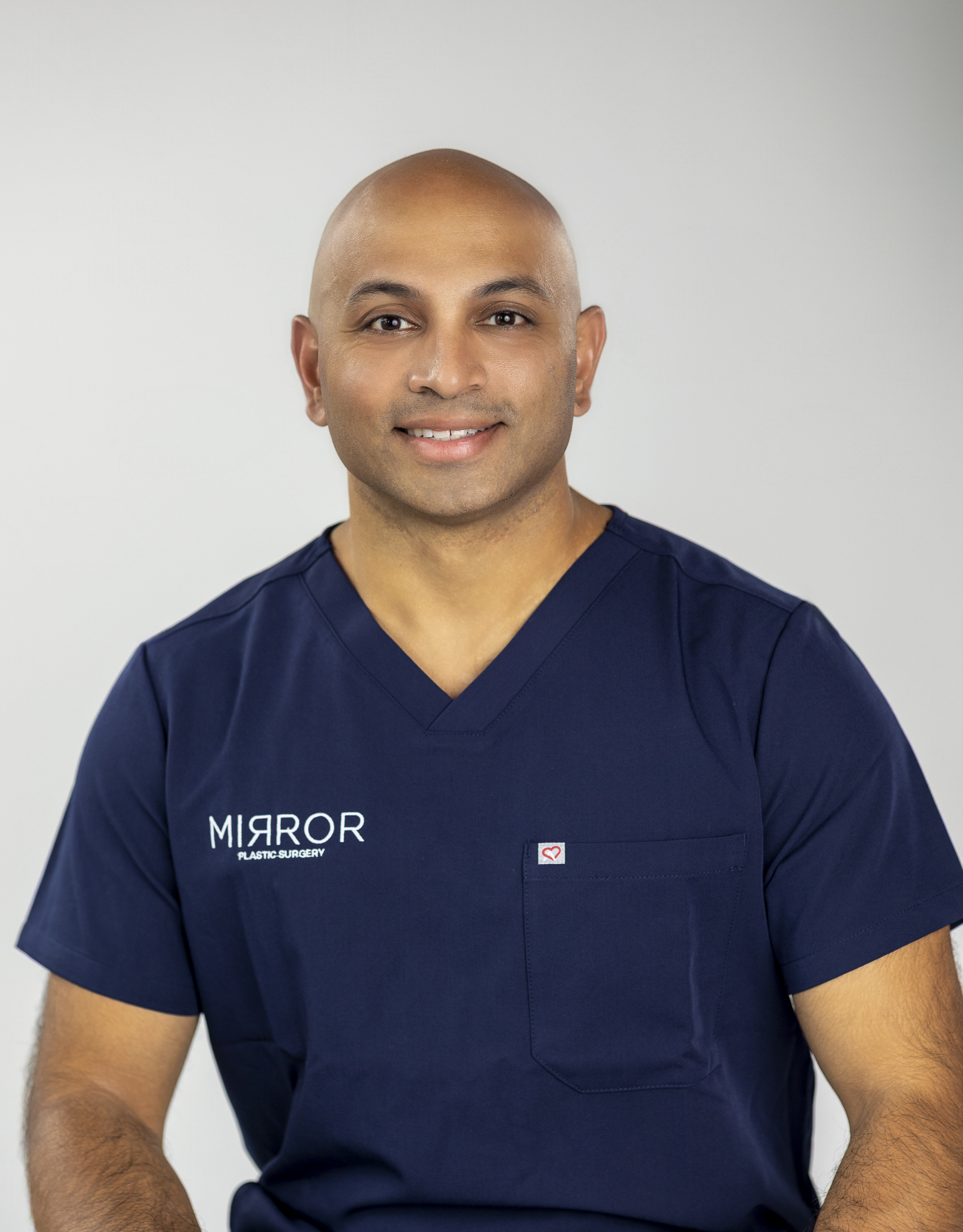
Written by: Dr. Akash Chandawarkar, Board Certified Plastic Surgeon, Mirror Plastic Surgery
Key Takeaways
- The consultation, not the surgery day, determines candidacy, graft strategy, hairline design, and long-term safety.
- Physician-led evaluations that include trichoscopy and density measurement consistently outperform sales-driven sessions that skip anatomical assessment.
- Patients should confirm who performs every surgical step, the surgeon’s credentials, and whether a lifetime graft budget is discussed upfront.
- Quality consultations address future hair-loss progression, donor supply limits, and medical therapies that protect results over decades.
- Request your 60-minute evaluation with Dr. Akash to receive a physician-led, anatomy-driven consultation at Mirror Plastic Surgery.
What to Ask During a Hair Transplant Consultation
The questions you bring to a hair transplant consultation help reveal how thorough and safe the evaluation truly is. Physician-led consultations are clinically superior to sales coordinator-led sessions because only a physician can accurately assess donor density, identify contraindications, diagnose hair loss patterns, and make evidence-based candidacy determinations.
The following questions benchmark any consultation against a physician-led standard:
- Who personally examines my scalp, designs my hairline, and creates recipient-site incisions, and what are their credentials?
- What is my current Norwood or Ludwig stage, and what stage does my family history suggest I will reach?
- What is my donor density in follicular units per square centimeter, and how many grafts remain in my lifetime budget?
- Which technique, FUE or FUT, is recommended for my anatomy, and why?
- What medical therapies such as finasteride or minoxidil are appropriate before or after surgery?
- What does the full recovery timeline look like, and what follow-up cadence does the practice maintain?
Red flags include receiving a graft count before any close scalp examination, immediate focus on discounts or deadlines, overpromising density beyond donor supply limits, or proposing hairlines that are too low, straight, or aggressive for the patient’s age and pattern.
At Mirror Plastic Surgery, Dr. Akash begins by reviewing medical and hair-loss history to establish baseline health and identify contraindications. He then assesses donor density with in-office diagnostic tools including ultrasound, which informs how he stages the loss pattern. After understanding current anatomy and projected progression, he designs a conservative, age-appropriate hairline before any technique or graft count is discussed.
Cost Considerations for a Hair Transplant in Tampa
Hair transplant cost depends on your specific pattern of loss and the level of medical involvement. Key drivers include Norwood or Ludwig stage, total graft requirement, technique selected, the surgeon’s training and direct participation, facility accreditation, and the depth of pre- and post-operative care.
A quote generated without a scalp examination functions as a marketing figure, not a medical estimate. The donor zone holds a finite lifetime graft budget of approximately 4,000 to 8,000 grafts across a patient’s lifetime, so the first consultation should plan for the entire future hair loss trajectory rather than only the current presentation. A thorough consultation that accounts for this budget protects your investment across multiple decades, not just the first session.
Mirror Plastic Surgery provides personalized quotes only after Dr. Akash completes a full anatomical assessment. Each quote reflects the specific plan developed for that patient’s anatomy, goals, and long-term trajectory.
Who Performs the Grafts: Doctor or Technician?
Clarifying who performs each surgical step protects both safety and results. High-volume clinics often blur this line. The ISHRS has issued consumer alerts stating that donor harvesting, hairline design, channel creation, and graft placement should be performed or directly supervised by a qualified medical professional rather than delegated entirely to unlicensed technicians.
The ISHRS states that preoperative diagnostic evaluation, surgery planning, donor hair harvesting, hairline design, and recipient site creation must only be performed by properly trained and licensed physicians and are non-delegable surgical acts. A reassuring response is one where the surgeon personally performs donor harvesting, hairline design, and recipient-site incisions, with supporting staff limited to graft placement after sites are created by the physician.
At Mirror Plastic Surgery, Dr. Akash is responsible for all non-delegable surgical acts. The practice performs one to two procedures per day, so the entire clinical team focuses on a single patient throughout the procedure.
Downsides and Regret Risks of Hair Transplants
According to ISHRS 2024 census data, 6.9% of all hair transplants performed were repair or revision procedures, up from 5.4% in 2021, and 10% of all repair cases were attributed to previous black-market hair transplants. These figures reflect structural problems in how many procedures are planned and executed, not isolated technical failures.
Peer-reviewed literature classifies unfavorable outcomes into two root-cause categories: errors of judgment before surgery and errors of technique during surgery. Errors of judgment include transplanting patients too young, ignoring progressive hair loss trajectory, designing overly aggressive hairlines, and failing to account for long-term donor supply. Errors of technique include improper graft angulation, poor graft handling, excessive ischemia time, and donor-site mismanagement.
Mirror Plastic Surgery’s consultation model directly addresses both error categories. Dr. Akash’s anatomical training, developed through a seven-year Johns Hopkins plastic surgery residency, supports conservative hairline design, precise graft planning, and a multi-session lifetime strategy that preserves donor supply for future needs.
Hair Transplant Recovery Timeline
A practical week-by-week framework helps patients navigate the process without alarm:
- Days 1–3: The first 72 hours are the most critical, as grafts are fragile and require careful protection from touching, sunlight, and strenuous activity.
- Week 1: Scabbing forms around recipient sites, and most patients return to desk work within 5 to 7 days.1
- Weeks 2–6: Transplanted hairs shed as follicles enter the resting (telogen) phase, and the scalp may temporarily resemble its pre-procedure appearance before new growth starts around month 3.
- Months 3–4: Early regrowth begins, and some patients experience temporary shock loss of native hair near the recipient or donor area, which usually regrows within a few months.
- Month 6: Approximately 50–60% of final density is visible.
- Month 9: Approximately 70–80% of final density is visible.
- Months 12–18: Final result matures, and crown cases sometimes require 18–20 months for full maturation.
Mirror Plastic Surgery maintains a structured post-operative follow-up cadence so Dr. Akash can monitor graft maturation, manage any shock loss, and adjust medical therapy as needed throughout the recovery window.
Long-Term Outcomes After Hair Transplant
Hair transplant results can last many years and often remain permanent for the transplanted follicles, which are taken from genetically resistant donor areas, though natural hair around the transplant site can continue to thin over time.1 This distinction matters because the transplant redistributes existing hair but does not halt androgenetic alopecia in surrounding native hair.
Many patients need a second hair transplant in their lifetime, meaning multi-session planning is a normal part of the hair restoration journey1, not a sign of failure. Quality clinics discuss this explicitly with younger patients during the initial consultation.
Pairing surgical hair restoration with ongoing medical treatments such as minoxidil or finasteride protects non-transplanted hair and produces better long-term outcomes than surgery alone. Many surgeons recommend finasteride to appropriate male patients before and after a transplant.
Mirror Plastic Surgery’s concierge model includes ongoing medical management as a standard component of the long-term plan, not an afterthought. Dr. Akash evaluates each patient’s candidacy for adjunct therapies, including hair restoration with Acorn Biolabs Secretome, as part of a comprehensive, safety-first approach.
Key Factors to Compare: 7 Consultation Quality Markers
Understanding recovery timelines and long-term outcomes sets expectations, and you also need clear criteria to judge the consultation itself. Beyond asking the right questions, use these markers to compare any consultation against physician-led standards before committing to a procedure:
- Physician-led assessment: The named surgeon personally examines the scalp, reviews medical history, and develops the surgical plan, not a coordinator or sales representative.
- Anatomical mapping with diagnostic tools: Donor density is measured in follicular units per square centimeter using trichoscopy, dermoscopy, or ultrasound. A density below approximately 40 follicular units per cm² may limit surgical options.
- Graft-count transparency: The estimated graft count is tied to a documented scalp examination, Norwood or Ludwig staging, and a written treatment plan, not a per-graft marketing rate.
- Future hair-loss planning: The consultation explicitly addresses projected progression, family history, and lifetime graft budget across multiple potential sessions.
- Facility accreditation: Surgery takes place in an accredited facility with board-certified physician anesthesiologists, not in an unregistered clinic or medical tourism setting.
- Anesthesia safety: A board-certified physician anesthesiologist manages sedation, and local anesthetic dosing is calibrated to body weight and procedure duration to avoid cumulative toxicity thresholds.
- Post-operative follow-up cadence: The practice schedules structured follow-up appointments through the 12–18 month maturation window, not just a single post-op check.
Common Misconceptions About Hair Transplant Consultations
Two persistent misconceptions often steer patients toward poor outcomes.
The first misconception claims that free consultations equal physician-led evaluations. A proper hair transplant consultation must include direct evaluation by the treating physician rather than consultants, coordinators, or sales representatives, ensuring the surgeon who will perform the procedure has sufficient opportunity to assess the patient. A free session conducted by a non-physician provides general information and promotional framing, not a medical diagnosis or candidacy determination.
The second misconception suggests that technician involvement in extraction is standard and acceptable. While supporting staff may assist with graft placement after recipient sites are created by the physician, the ISHRS consumer alert identifies the bait-and-switch ghost surgeon model, where unlicensed technicians perform extractions and incisions, as a dangerous practice that places patients at serious risk and violates ABHRS non-delegable acts standards. Many surgeons have reported black-market hair transplant clinics operating in their cities.
Practical Reader Checklist
To avoid these misconceptions and recognize high-quality consultations, use this two-part checklist during your evaluation process:
Questions to ask at any hair transplant consultation:
- What is the surgeon’s board certification, and are they an ISHRS member?
- Who personally performs hairline design, donor extraction, and recipient-site incisions?
- What is my Norwood or Ludwig stage, and what stage does my family history project?
- What is my measured donor density, and how many grafts remain in my lifetime budget?
- Is FUE or FUT recommended for my anatomy, and why?
- What is the surgeon’s documented transection rate, and what graft storage protocol is used?
- What follow-up appointments are included through 18 months?
Red flags to walk away from:
- A graft count or price quoted before any scalp examination
- Pressure to book immediately or accept a limited-time discount
- Vague answers about who performs each surgical step
- Promises of “guaranteed results,” “scarless surgery,” or “unlimited grafts”
- A portfolio showing only fresh post-operative photos with no 12-month-plus outcomes
- Consultation conducted entirely by a non-physician coordinator
How Hair Restoration Fits Into Broader Aesthetic Planning
Hair restoration works best when it fits into your overall aesthetic and wellness plan. For patients managing multiple concerns, the sequence and combination of procedures directly affect safety and outcomes. Mirror Plastic Surgery’s safety-first philosophy, expressed as safety, then function, then aesthetics, applies to hair restoration as much as to facial surgery, breast procedures, and body contouring.
Dr. Akash’s training spans neuroscience, reconstructive surgery, and aesthetic fellowship at the Manhattan Eye, Ear and Throat Hospital. This background gives him a comprehensive view of how hair density interacts with facial proportions, hairline framing, and overall appearance. For patients considering hair restoration alongside other procedures, the 60-minute consultation addresses sequencing, recovery overlap, and anesthesia safety so no single session exceeds safe physiologic thresholds.
Mirror Plastic Surgery also offers non-surgical hair restoration with Acorn Biolabs Secretome as part of a continuum of care. These options support patients who are not yet surgical candidates or who want to complement a transplant with ongoing medical management.
Frequently Asked Questions
Who is a good candidate for a hair transplant?
Candidacy requires adequate donor density, a stable or predictable hair loss pattern for at least 6 to 12 months, realistic expectations, and good overall health with no active contraindications such as uncontrolled hypertension, bleeding disorders, or active scalp disease. Conditions including diffuse unpatterned alopecia, active scarring alopecias, and unstable hair loss are contraindications to surgery. Only 2 to 5% of women with hair loss are true surgical candidates, so a physician-led evaluation is essential for female patients. Younger patients with rapidly progressing loss are often advised to stabilize their pattern with medical therapy before pursuing surgery. Dr. Akash determines candidacy only after a complete in-person scalp examination and medical history review.
What is realistic downtime after a hair transplant?
Most patients return to desk work within 5 to 7 days and resume exercise after 3 to 4 weeks.1 Visible scabbing usually resolves within 7 to 14 days. Transplanted hairs shed between weeks 2 and 6, which represents a normal biological phase rather than a sign of failure, and new growth typically begins around months 3 to 4. Most patients notice steady improvement through month 9, with final maturation between 12 and 18 months and crown cases sometimes extending to 20 months. Graft survival rates above 90% are achievable when patients follow post-operative protocols, while smoking, picking scabs, heavy sweating in week one, or direct trauma can reduce survival and are largely within patient control.1
How do I know if a clinic is operating safely?
A safe clinic names the responsible surgeon before any deposit is required, performs surgery in an accredited facility with a board-certified physician anesthesiologist, limits daily case volume to allow full surgeon involvement, and provides a written treatment plan without same-day booking pressure. The surgeon should be able to disclose their average transection rate, graft storage method, and out-of-body time protocol. Clinics that use vague team references, promise unlimited grafts for a flat fee, or conduct consultations entirely through non-physician coordinators present measurable safety risks. Verifying board certification through the American Board of Plastic Surgery and ISHRS membership are baseline steps before any commitment.
Will I need more than one hair transplant procedure?
Many patients require a second procedure in their lifetime, most often because androgenetic alopecia continues to thin surrounding native hair after the first transplant rather than because the first procedure failed.1 A responsible consultation discusses this explicitly, designs the first session conservatively to preserve donor supply, and maps a multi-session lifetime strategy. Safe single-session graft limits are typically 3,500 to 5,000 grafts, and patients with advanced hair loss patterns often require 4,000 to 8,000 grafts total across staged sessions depending on individual donor capacity. Patients who maintain consistent finasteride and minoxidil use after a first procedure frequently delay or avoid the need for a second transplant by slowing androgenetic progression.
What are the most common reasons hair transplants fail or require revision?
Revision procedures account for a growing share of all hair transplants performed, with recent data approaching 7% as noted earlier. The most common causes are poor graft handling including desiccation or excessive time outside the body, incorrect graft angle and direction, overharvesting that depletes the donor zone, unnatural hairline design placed too low or too straight, and failure to account for future hair loss progression. These errors occur most frequently in high-volume practices where technicians rather than physicians perform non-delegable surgical acts. Revision procedures are more complex because of limited remaining donor hair, so they require careful redistribution, hairline softening, and scar camouflage, which underscores why the quality of the first consultation and procedure determines long-term outcomes.
Making an Informed Decision
The best hair transplant consultation in the Tampa Bay area is defined by physician involvement, anatomical rigor, transparent planning, and a long-term strategy that protects donor supply across decades, not by price, graft count, or promotional packaging.
Every element of Mirror Plastic Surgery’s model, including 60-minute evaluations, one to two procedures per day, Dr. Akash’s direct involvement in all non-delegable surgical acts, accredited facility standards, and board-certified physician anesthesiology, supports that standard. Dr. Akash, named to Newsweek’s America’s Best Plastic Surgeons list two years running, brings Harvard Medical School, Johns Hopkins, and Manhattan Eye Ear and Throat Hospital training to every consultation.
Patients in the St. Petersburg and Tampa Bay area can text or call Mirror Plastic Surgery at 727-361-6515, or visit the practice at 780 4th Ave S, St. Petersburg, FL 33701, to schedule their evaluation.
1 Results may vary from person to person. Editorial content, before and after images, and patient testimonials do not constitute a guarantee of specific results.