
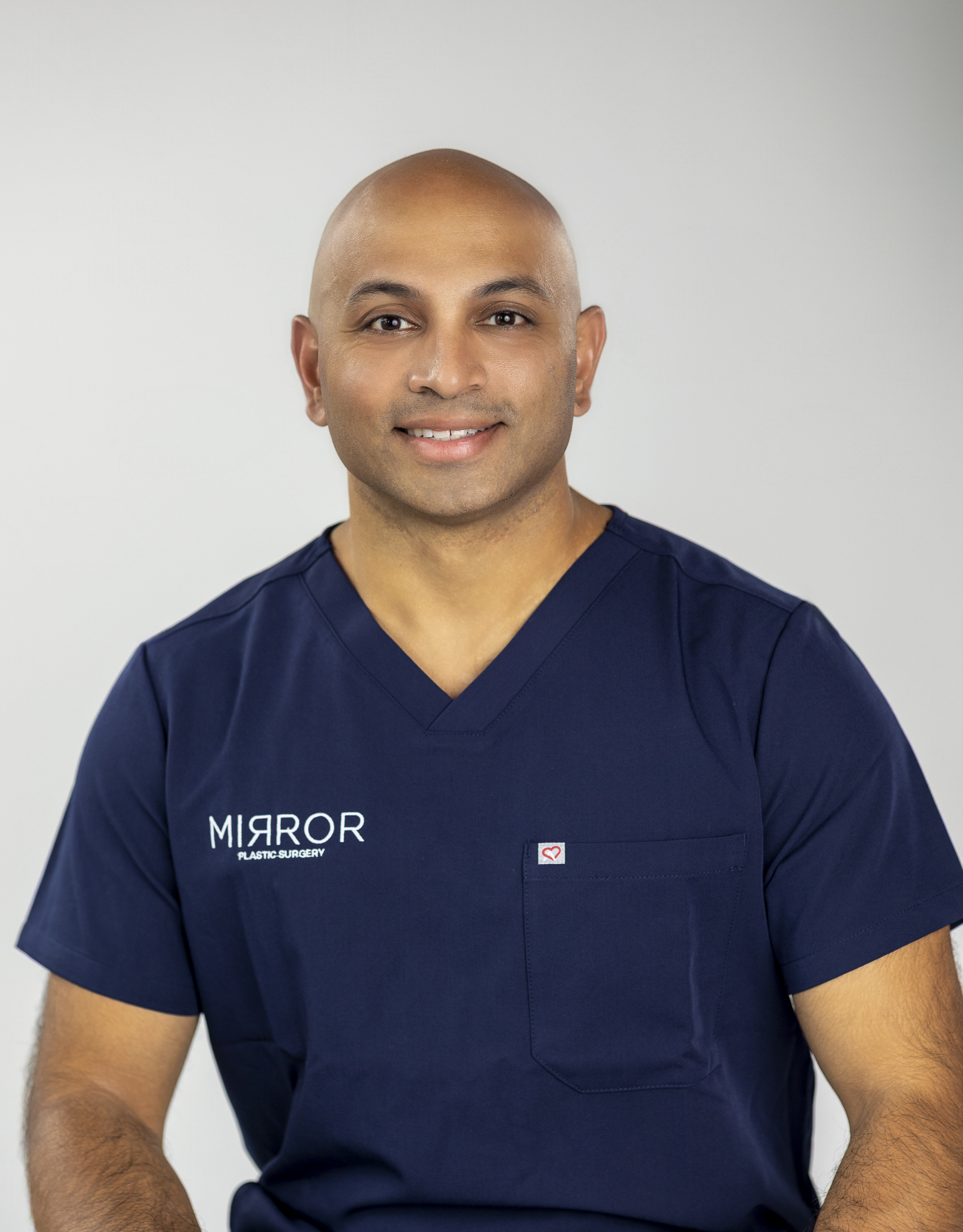
Written by: Dr. Akash Chandawarkar, Board Certified Plastic Surgeon, Mirror Plastic Surgery
Key Takeaways for Men Considering Buttock Augmentation
- Male buttock augmentation includes three main options: fat transfer (BBL), gluteal implants, and injectable fillers, each with different invasiveness, recovery, and longevity.
- Most men want a squared, athletic gluteal shape with upper-pole fullness and lateral definition, not the rounded projection many women request.
- Fat transfer with AlloClae is the preferred first-line option at Mirror Plastic Surgery when donor fat is sufficient, providing permanent, natural results with a favorable safety profile.1
- Gluteal implants create the greatest projection for lean men but carry higher long-term complication rates, while injectable fillers offer the lowest-risk, lowest-downtime option for subtle enhancement.
- Schedule your personalized consultation at Mirror Plastic Surgery for an evidence-based, male-specific treatment plan tailored to your anatomy and goals.
How Male Aesthetic Goals Differ From Female BBL Goals
Men seeking gluteal enhancement pursue a fundamentally different aesthetic than female patients. A 2023 Plastic and Reconstructive Surgery study of more than 2,000 people found that the ideal male buttocks are moderately enhanced and well-proportioned, with a characteristic lateral dimple and emphasis on horizontal width instead of a rounded “peach” shape. The preferred silhouette is squared and athletic, with upper-pole fullness and strong lateral definition rather than the rounder, heart-shaped projection many women prefer.
Anatomy drives these differences. Men have narrower android pelvises and distinct fat deposition patterns compared with women, so surgical plans must respect this skeletal foundation. Men also have denser muscle mass and firmer soft tissue, which lowers the recipient site’s capacity to accept large fat grafts and increases the risk of irregularities or reabsorption when overfilled. Surgeons preserve slight lateral concavity at the sides of the hips instead of filling this area, which would create a more feminine rounded hip profile. High-definition liposuction of the flanks and lower back is often combined with gluteal work to enhance visual projection without adding extra width.
At Mirror Plastic Surgery, Dr. Akash, a two-time Newsweek America’s Best Plastic Surgeons honoree, applies his Johns Hopkins-trained anatomical expertise to every male gluteal consultation. He evaluates the android pelvis, existing gluteal muscle mass, and the patient’s athletic goals before finalizing any aesthetic plan.
Book a consultation with Dr. Akash to receive a male-specific anatomical assessment and a personalized treatment plan.
Fat Transfer (BBL) for Men Seeking Athletic Projection
Male BBL removes fat from the abdomen, flanks, or lower back with liposuction, processes it, and injects it into the subcutaneous plane of the upper and central gluteal zones. This approach typically achieves 60–80% long-term fat survival and includes concurrent torso liposuction to create a tapered V-shaped upper body.1 Fat that successfully integrates behaves like native tissue, expanding with weight gain and shrinking with weight loss.1
Candidacy hinges on adequate donor fat availability. Men typically need 10–15 or more pounds of excess body fat, roughly 15–20% body fat, to provide enough donor material for meaningful enhancement. This requirement explains why very lean men under 10–12% body fat often lack sufficient donor fat, so implants become a more practical option.
Safety has improved substantially. The mortality rate for gluteal fat grafting improved to approximately 1 in 14,921 after surgeons adopted subcutaneous-only injection techniques, compared with earlier estimates of roughly 1 in 2,500–3,000. At Mirror Plastic Surgery, Dr. Akash uses real-time ultrasound guidance to confirm that the cannula remains entirely within the subcutaneous plane, in line with current multi-society guidelines.
AlloClae, a technology whose advisory board includes Dr. Akash through Tiger Aesthetics, advances fat transfer outcomes. AlloClae provides structural scaffolding that supports fat integration and helps maintain volume more consistently than traditional fat transfer alone. For men who want natural, athletic gluteal projection with simultaneous torso contouring, fat transfer with AlloClae is the preferred first-line surgical option at Mirror Plastic Surgery when donor fat is sufficient.
Gluteal Implants for Lean Men Needing Maximum Projection
Gluteal implants use solid silicone elastomer devices placed intramuscularly or subfascially through a 5–6 cm incision hidden in the buttock crease. They serve as the primary option for lean men who lack enough donor fat for BBL. Implants can create a 40–50% or greater augmentation, compared with the 20–30% volume increase typical of fat transfer, so they remain the only option capable of dramatic projection in very lean physiques.1
The long-term complication profile requires careful attention. Complication rates for gluteal implants are higher than for fat transfer, with wound dehiscence as the most frequent issue. Some patients need revision surgery, and infection can require implant removal, while capsular contracture remains a known risk. Surgical technique significantly modifies these risks. Use of paramedian incisions reduces wound dehiscence from 30% to approximately 5% and improves overall wound stability.
Men aged 30–45 who prioritize long-term function often weigh these risks carefully. Mirror Plastic Surgery follows a safety-first philosophy, so Dr. Akash reviews implant data in detail during consultation instead of minimizing the complication burden.
Injectable Fillers for Subtle Male Gluteal Refinement
Injectable fillers provide the least invasive entry point for gluteal enhancement. The main options include Sculptra (poly-L-lactic acid), Radiesse (calcium hydroxylapatite), and hyaluronic acid (HA) body fillers such as HYAcorp.
Sculptra BBL carries lower procedural risk, with no fat-transfer mortality risk and only 2–3 days of social downtime. Results are subtle, usually a 10–20% improvement in shape and projection, and require 2–3 sessions spaced 4–6 weeks apart.1 Full collagen response develops over 3–6 months, and results last 2–3 years.1 Radiesse results last 12–18 months, while HA fillers typically last 6–12 months.
A 2024 retrospective observational study of nonsurgical gluteal augmentation with HYAcorp biphasic HA fillers reported no serious adverse events and a low rate of moderate adverse events.
Fillers suit men who want subtle shape refinement, hip-dip correction, or a low-commitment introduction to gluteal enhancement. They cannot replace surgical options when a major increase in projection is the goal. The FDA recommends against using dermal fillers for body contouring such as buttock augmentation and classifies large-volume use as off-label, with risks that include vascular occlusion and embolism. As a Merz Aesthetics advisory board member, Dr. Akash brings direct clinical expertise in biostimulatory fillers such as Radiesse to every nonsurgical consultation.
Side-by-Side Comparison of Male Buttock Augmentation Options
| Criterion | Fat Transfer (BBL) | Gluteal Implants | Injectable Fillers |
|---|---|---|---|
| Invasiveness | Moderate, general or IV sedation, liposuction plus grafting | High, general anesthesia, incision and pocket dissection | Low, topical or local anesthetic, no incisions |
| Donor Fat Required | Yes, about 15–20% body fat and 10–15+ lbs excess fat | No | No |
| Volume Increase | About 20–30% | About 40–50% or more | About 10–20% with Sculptra |
| Fat Survival / Longevity | 60–80% fat survival, permanent after 90 days | Permanent unless revised, revisions sometimes required | Sculptra 18 months–2 years, Radiesse 12–18 months, HA 6–12 months |
| Sitting Protocol | No direct sitting weeks 0–2, BBL pillow weeks 2–6, normal sitting around weeks 6–8 | No direct sitting weeks 0–4, cushion weeks 2–8, normal sitting around weeks 6–8 | 0–2 days downtime, no sitting restriction |
| Return to Work (desk) | 10–14 days with BBL pillow | 2–3 weeks with cushion | Same day or next day |
| Return to Full Training | 10–12 weeks | 10–12 weeks | 24–48 hours |
| Long-Term Complication Rate | About 7–10% overall, serious complications under 1% | Approximately 15–30%, technique-dependent | Under 5% moderate events, 0% serious events reported in recent HA studies |
| Ongoing Maintenance | None after fat integration, stable weight recommended | None unless revision required | Touch-ups every 1–2 years |
Male-Specific Recovery Timeline and Sitting Protocols
Recovery milestones vary by procedure. This timeline applies to surgical options such as fat transfer and implants, while filler patients usually return to normal activity within 24–48 hours.
- Days 1–3: Pain typically peaks at 6–8 out of 10 because of liposuction trauma and swelling for BBL patients, mainly at donor sites. Short assisted walks begin to reduce clot risk. Avoid direct sitting or lying on the buttocks. Sleep on your stomach or side. Implant patients stand, walk, or lie on the stomach only.
- Weeks 1–2: Limit unavoidable sitting to 10 minutes at a time and walk every 2–3 hours while awake. Wear the compression garment continuously. Begin lymphatic massage 24–36 hours after BBL, as recommended. Avoid lifting over 5 pounds, bending, or strenuous activity.
- Weeks 2–4: BBL patients may return to desk work using a BBL pillow. Implant patients may sit briefly with a special cushion that avoids direct implant pressure. Increase light walking to 10–20 minutes. Gentle upper-body mobility stretches are allowed.
- Weeks 4–6: Low-impact activities such as treadmill walking and light elliptical use are usually permitted. Heavy squats, lunges, deadlifts, and jumping remain off-limits. Most patients receive clearance to drive between weeks 4 and 6 with surgeon approval.
- Weeks 6–8: Surgeons typically clear normal sitting without a pillow between weeks 6 and 8. Upper-body resistance training resumes. Compression garment use usually ends during this period.
- Weeks 8–12: Full gym workouts, including lower-body resistance training, return between weeks 10 and 12. Glute-focused training, squats, and cardiovascular exercise reenter the program gradually.
- Months 3–6: Transferred fat that survives has stabilized by about 90 days after BBL. Final implant settling and aesthetic results appear between 3 and 6 months for both surgical options.
Patients who wear compression garments as prescribed and attend all follow-up appointments often receive earlier exercise clearance than those who do not. Consistent compliance remains the most controllable factor in the recovery timeline.
Common Misconceptions About Male Buttock Augmentation
- “BBL is only for women.” Male gluteal augmentation accounts for an estimated 5–10% of all gluteal augmentation procedures in the United States and continues to grow. Male BBL uses different fat placement zones, aesthetic targets, and anatomical priorities than female BBL.
- “Injectable fillers are permanent.” HA fillers dissolve within 6–12 months. Sculptra usually lasts 18 months to 2 years, and Radiesse lasts 12–18 months. All filler options require maintenance sessions to sustain results, while fat transfer and implants provide long-term or permanent outcomes.
- “Gluteal implants always look unnatural.” Outcome quality depends on surgeon experience, implant selection, and pocket placement technique. Newer intramuscular placement methods show lower complication rates than older approaches, so surgeon technique plays a critical role. When sized and positioned correctly for the android pelvis, implants can create a natural, athletic contour.
- “BBL is too dangerous to consider.” Modern gluteal fat grafting that uses subcutaneous-only protocols, real-time ultrasound guidance, and accredited facilities with board-certified surgeons is significantly safer than earlier intramuscular techniques. Mortality rates now align more closely with other common cosmetic procedures when these updated protocols are followed.
How to Choose the Right Option: A Decision Framework
Mirror Plastic Surgery uses a safety-function-aesthetics hierarchy to guide every male gluteal augmentation decision. This hierarchy prioritizes patient safety first, functional outcomes second, and aesthetic goals third. The framework translates into treatment selection based on three primary variables: donor-fat availability, desired projection magnitude, and tolerance for surgical risk and recovery duration.
- Sufficient donor fat and moderate projection goal: Fat transfer with AlloClae is the first-line recommendation because it uses the patient’s own tissue, avoids implant-related complications, contours the torso at the same time, and delivers permanent results with an overall complication rate of about 7–10%.
- Lean physique and significant projection goal: Gluteal implants are the primary surgical option for men under roughly 10–12% body fat. Candidates must understand the long-term complication profile and commit to strict post-operative protocols. A hybrid approach that combines a smaller implant with fat transfer to surrounding zones can reduce implant size and risk while improving shape.
- Insufficient donor fat, subtle enhancement, and minimal downtime: Injectable fillers such as Sculptra or Radiesse suit men who want shape refinement, hip-dip correction, or a way to test their aesthetic direction before surgery. Results are temporary and require ongoing maintenance.
- Borderline BBL candidate: Some patients who sit about 10 pounds below target weight can gain 8–12 pounds under supervision before surgery to reach the donor fat threshold discussed earlier and support meaningful fat transfer.
Every candidate at Mirror Plastic Surgery receives a comprehensive anatomical assessment lasting up to one hour before any recommendation. Dr. Akash performs only one to two surgeries per day so the entire clinical team can focus fully on each patient before, during, and after the procedure.
Book a consultation with Dr. Akash to receive an evidence-based, male-specific treatment plan built around your anatomy, donor-fat availability, and athletic goals.
Frequently Asked Questions
Am I a candidate for male BBL if I am very lean and athletic?
Lean men with body fat below about 10–12% usually lack enough donor fat for meaningful gluteal fat transfer. BBL candidacy generally requires the donor fat threshold discussed earlier, with sufficient harvestable tissue across multiple zones such as the abdomen, flanks, and lower back to create visible projection. Men who fall below this range often move toward gluteal implants or, for subtle goals, injectable biostimulatory fillers. In some cases, a supervised pre-surgical weight gain of 8–12 pounds can shift a borderline candidate into a viable range for fat transfer. During consultation, Dr. Akash evaluates body composition, skin elasticity, and skeletal anatomy to determine the most appropriate path.
How long does male buttock augmentation recovery take before I can train again?
For both fat transfer and gluteal implants, most men return to full lower-body resistance training, including squats, deadlifts, and glute-focused exercises, between weeks 10 and 12 if healing progresses normally. The first two weeks require strict avoidance of direct sitting on the buttocks, although light walking usually resumes between days one and three. Low-impact cardio such as treadmill walking or light elliptical use is generally allowed around weeks four to six. Upper-body resistance training often resumes between weeks six and eight. Final aesthetic results stabilize between three and six months as swelling resolves and, for fat transfer, surviving fat cells complete integration. Injectable filler patients usually face no meaningful activity restriction and return to full training within 24–48 hours.
What is the long-term complication rate for gluteal implants in men, and how does it compare to BBL?
Gluteal implants carry a substantially higher long-term complication burden than fat transfer. Complication rates for implants are significant, with wound dehiscence as the most common issue and some patients requiring revision surgery. Capsular contracture affects a subset of implant patients. Surgical technique modifies this risk profile, and modern incision strategies have reduced wound problems markedly compared with older methods. By contrast, fat transfer carries an overall complication rate of about 7–10%, with serious complications in fewer than 1% of cases. Mirror Plastic Surgery presents this data transparently during every implant consultation in line with its safety-first philosophy.
Are injectable fillers like Sculptra a safe and effective option for male gluteal enhancement?
Sculptra and Radiesse work well for men who want subtle shape refinement, hip-dip correction, or a nonsurgical introduction to gluteal enhancement. These fillers carry the lowest procedural risk of the three options, require no general anesthesia or incisions, and allow same-day return to normal activities. Results are temporary, with Sculptra lasting about two years and Radiesse lasting 12–18 months, so maintenance sessions are needed. Fillers cannot match the projection achievable with fat transfer or implants and are not recommended as the primary strategy when major augmentation is the goal. The FDA classifies large-volume filler use for body contouring as off-label, so treatment should be performed only by a board-certified physician with direct experience in biostimulatory injectables. As a Merz Aesthetics advisory board member, Dr. Akash brings specialized expertise in Radiesse and related agents to every nonsurgical consultation.
How does Mirror Plastic Surgery’s approach to male buttock augmentation differ from high-volume practices?
Mirror Plastic Surgery limits surgical volume to one to two procedures per day, while some high-volume practices perform five to ten surgeries daily. This lower volume allows Dr. Akash and the clinical team to maintain undivided focus on each patient before, during, and after surgery. Every male gluteal augmentation patient receives a comprehensive consultation of up to one hour that includes a full anatomical assessment, a transparent review of complication data for each option, and a personalized plan aligned with body composition, skeletal anatomy, and athletic goals. Dr. Akash, a Harvard Medical School graduate and Johns Hopkins-trained plastic surgeon, applies evidence-based protocols such as real-time ultrasound guidance and AlloClae fat integration technology to support both safety and long-term outcomes.
Conclusion: Choosing the Right Male Buttock Augmentation Path
Male buttock augmentation in 2026 rests on a clear evidence base. Fat transfer with AlloClae offers permanent, natural-feeling results with a favorable complication profile for men who have adequate donor fat. Gluteal implants deliver the greatest projection for lean physiques but carry higher long-term complication rates that require careful patient selection and experienced technique. Injectable fillers provide the lowest-risk, lowest-downtime route for subtle enhancement, with results that usually last one to two years. The right choice depends on donor-fat availability, desired projection, and tolerance for surgical recovery, which all require a thorough, male-specific anatomical evaluation.
Dr. Akash at Mirror Plastic Surgery combines Harvard Medical School training, a Johns Hopkins plastic surgery residency, and specialized fellowship experience in male aesthetics during every gluteal augmentation consultation. The practice’s safety-first, concierge-style model keeps each recommendation grounded in anatomy, evidence, and long-term well-being rather than surgical volume. Book a consultation with Dr. Akash at Mirror Plastic Surgery in St. Petersburg, Florida, and take the first step toward a male-specific gluteal enhancement plan built around your anatomy and athletic goals.
1 Results may vary from person to person. Editorial content, before and after images, and patient testimonials do not constitute a guarantee of specific results.