
Written by: Dr. Akash Chandawarkar, Board Certified Plastic Surgeon, Mirror Plastic Surgery
Key Takeaways
-
BBL surgery has shifted from one of the riskiest elective procedures to a significantly safer operation when surgeons follow modern evidence-based protocols with ultrasound guidance.
-
Florida’s HB 1471 law mandates real-time ultrasound guidance for all BBL procedures, creating a minimum legal safety standard that most other states do not yet provide.
-
Current 2024–2025 data show no mortalities or major fat emboli events when surgeons inject fat only in the subcutaneous plane above the muscle under ultrasound visualization.1
-
Trends in 2025 favor conservative volumes, patient-specific planning, and approaches such as the Skinny BBL or Country Club BBL that focus on natural proportions instead of maximum projection.
-
Patients who want the safest BBL should confirm board certification, facility accreditation, and ultrasound guidance, then schedule a personalized consultation at Mirror Plastic Surgery to review goals and candidacy.
Why BBL Safety Protocols Have Evolved
The historical risk profile of BBL surgery connects directly to injection technique. Early methods often placed fat into or near the gluteal muscles, where large blood vessels create pathways for fat emboli to enter the circulatory system. Before modern safety protocols, mortality rates reached approximately 1 in 3,000 procedures.
A critical University of Miami study analyzing 11 post-BBL autopsies showed a consistent pattern. Surgeons overestimated their ability to judge injection depth by tactile feedback alone. Fat grafts were found in the gluteal muscles even when operative notes documented subcutaneous-only injection. This evidence accelerated the move toward real-time imaging guidance as a standard of care instead of an optional enhancement.
Florida responded with legislation. HB 1471, effective 2023, became the first U.S. law that mandates ultrasound guidance for all BBL procedures performed in the state. This regulatory baseline gives Florida patients a statutory minimum standard of care that most other states still lack.
Which BBL Is the Safest? Current Standards and 2025 Data
The legislative shift toward mandatory ultrasound guidance reflects a broader evidence base that supports subcutaneous ultrasound-guided fat grafting as substantially safer than historical methods. A 2024 retrospective study in the Aesthetic Surgery Journal on ultrasound-guided gluteal fat grafting reported no mortalities and no macroscopic fat emboli events.1 The study documented a low rate of complications, and those issues were minor and not life-threatening.1
Population-level data support these findings. A 2024 ABCS survey found that mortality dropped when surgeons injected fat exclusively above the muscle.1 This reduction aligns with the earlier mortality concerns linked to intramuscular injection.
The mechanism is straightforward. Ultrasound-guided BBL uses real-time imaging to confirm that fat enters only the subcutaneous space above the muscle. Surgeons can visualize cannula placement throughout the procedure. As the Aesthetic Surgery Journal noted in 2023, “real-time intraoperative ultrasound allows the surgeon to confirm a subcutaneous-only fat graft injection, target specific gluteal subcutaneous compartments, and take advantage of the unique architecture of the deep subcutaneous space to create gluteal projection.”
What Is the BBL Trend in 2025? Volume and Aesthetic Shifts
BBL aesthetics in 2025 emphasize conservative volumes and proportional, natural-looking results. High-volume BBL, which historically focused on maximum projection regardless of body frame, now gives way to patient-specific planning that considers existing hip anatomy, skin laxity, and long-term fat retention.
Two procedure categories illustrate this shift. The “Skinny BBL” serves patients with limited donor fat who want subtle enhancement. The “Country Club BBL” targets a refined, athletic silhouette instead of dramatic augmentation. Both approaches rely on precise subcutaneous placement and micro-droplet layering techniques that support fat survival and reduce contour irregularities.
Long-term fat survival rates for BBL typically range from 50–80% and vary by technique and patient factors.1 Conservative volume planning accounts for this retention variability and lowers the risk of over-correction.
Successful outcomes also depend on thorough pre-operative screening across several key dimensions:
|
Screening Factor |
Consideration |
Clinical Relevance |
|---|---|---|
|
Donor fat availability |
Sufficient subcutaneous fat at harvest sites |
Determines volume achievable, influences candidacy for Skinny BBL variants |
|
BMI and weight stability |
Stable weight for at least 3–6 months pre-operatively |
Weight fluctuation after surgery alters fat graft retention and contour |
|
Skin quality and laxity |
Adequate skin elasticity at recipient site |
Poor laxity may require a staged approach or adjunct skin tightening |
|
Medical history |
Absence of coagulopathy, active infection, or uncontrolled systemic disease |
Directly affects anesthesia risk and healing capacity |
How Safe Is BBL in 2025? Patient Decision Factors
BBL safety in 2025 reflects a combination of surgeon technique, facility accreditation, anesthesia management, patient selection, and post-operative compliance. Patients who evaluate providers carefully should confirm each of these elements separately.
Accredited surgical facilities with board-certified physician anesthesiologists form a non-negotiable baseline. Staged approaches, which separate liposuction harvesting from grafting in patients with elevated risk profiles, can reduce operative time and anesthesia exposure. Post-operative positioning compliance, usually avoiding direct sitting pressure on the buttocks for several weeks, directly affects fat survival rates.
Understanding the recovery timeline helps patients plan for these positioning requirements and other restrictions:
|
Recovery Phase |
Approximate Timeline |
Key Requirement |
|---|---|---|
|
Immediate post-operative |
Days 1–3 |
Compression garment, avoid direct buttock pressure |
|
Early recovery |
Weeks 1–3 |
Limited sitting, use of BBL pillow when seated |
|
Intermediate recovery |
Weeks 4–6 |
Gradual return to light activity, continued compression |
|
Final result assessment |
Months 3–6 |
Fat retention stabilizes, final contour visible |
Comparing Modern BBL Technique Categories
Four primary technique categories define the current BBL landscape, and each carries a distinct risk profile and intended outcome.
|
Technique |
Injection Plane |
Guidance Method |
Risk Profile |
|---|---|---|---|
|
Traditional high-volume BBL |
Intramuscular or mixed |
Tactile only |
Higher, associated with historical mortality data |
|
Subcutaneous ultrasound-guided BBL |
Subcutaneous only |
Real-time intraoperative ultrasound |
Significantly reduced, with recent studies showing no mortalities in large patient cohorts |
|
VASER/PAL-assisted with micro-droplet layering |
Subcutaneous only |
Ultrasound-assisted harvesting plus real-time guidance |
Low, with refined fat quality that may improve retention |
|
AlloClae structural alternative |
Non-autologous, structural scaffold |
Guided placement |
Distinct risk profile, suitable for patients with insufficient donor fat |
Key BBL Safety Terms Explained
Subcutaneous plane: The tissue layer between skin and muscle. Injection into this plane, instead of into the muscle itself, represents the central safety advancement in modern BBL.
Ultrasound-guided injection: Real-time imaging that confirms cannula position during fat transfer and removes reliance on tactile estimation alone.
VASER-assisted harvesting: Ultrasound energy applied during liposuction to emulsify fat cells before extraction, which may improve graft viability.
Micro-droplet layering: A technique that distributes fat in small aliquots across multiple tissue planes to maximize surface contact and support long-term retention.
Skinny BBL / Country Club BBL: Colloquial terms for conservative-volume approaches that target subtle enhancement or athletic proportionality instead of maximum projection.
Common Misconceptions About BBL Safety
Larger volumes do not create safer or more durable results. Higher volumes increase operative time, anesthesia exposure, and mechanical pressure on grafted fat, which all harm outcomes. The belief that intramuscular injection produces better projection conflicts with outcome data and University of Miami autopsy findings that show surgeons cannot reliably judge injection depth without imaging. BBL risk also varies across providers, since technique, facility, and patient selection account for most outcome differences.
Meet Dr. Akash: Credentials and Recognition
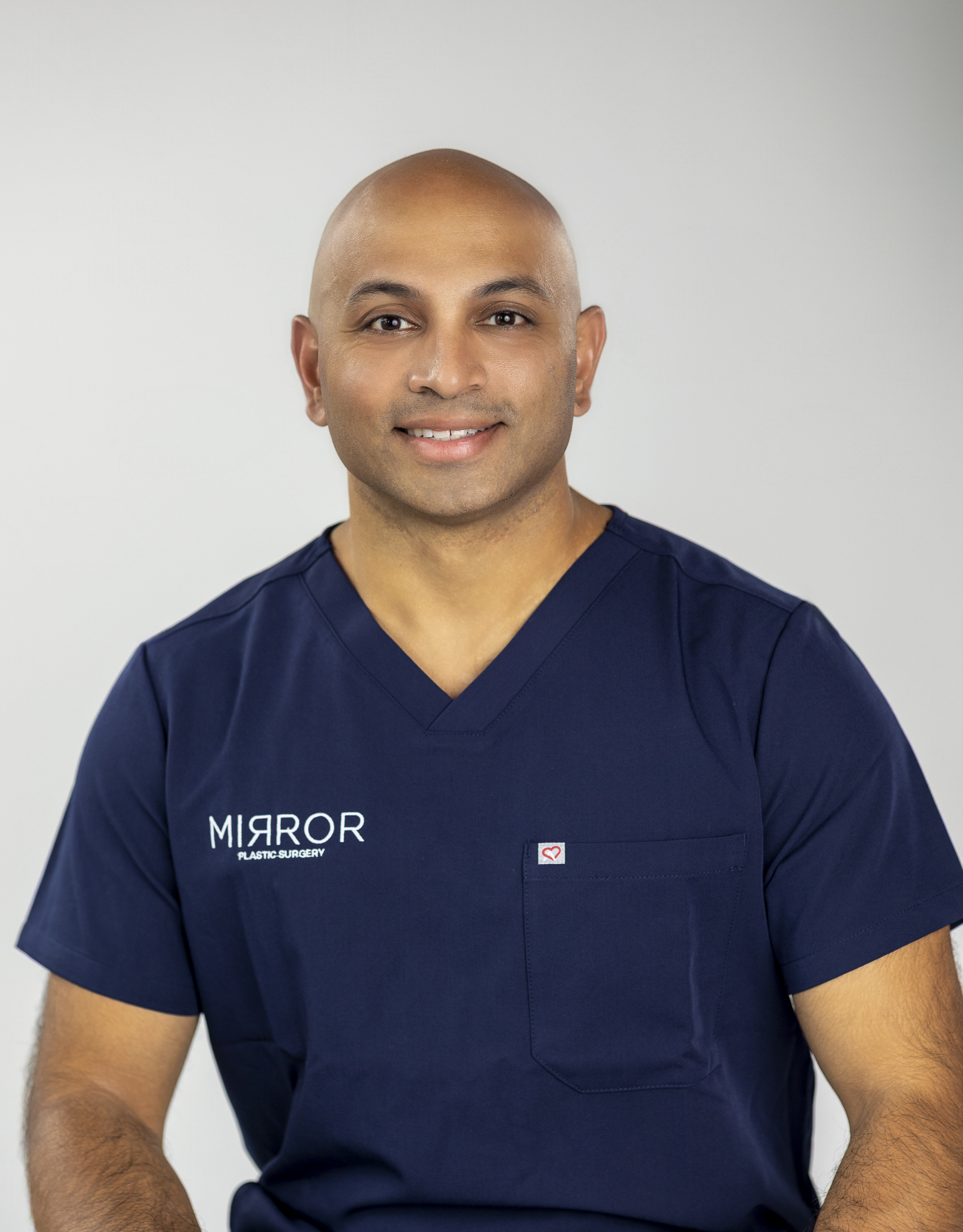
Dr. Akash completed his medical degree through the Harvard-MIT Division of Health Sciences and Technology and graduated from Harvard Medical School with Honors. His seven-year integrated plastic and reconstructive surgery residency at Johns Hopkins University included rotations at the Johns Hopkins Hospital, the R Adams Cowley Shock Trauma Center, and the Curtis National Hand Center. He then completed an aesthetic surgery fellowship at the Manhattan Eye, Ear and Throat Hospital (MEETH) and a Biodesign Innovation Fellowship at Stanford University.
Dr. Akash serves as Next Generation Editor for the Aesthetic Surgery Journal and has testified before the U.S. Food and Drug Administration on breast implant safety. He has appeared on Newsweek’s America’s Best Plastic Surgeons list for two consecutive years, including 2025. He also holds advisory board positions with companies developing technologies such as AlloClae (Tiger Aesthetics), which Mirror Plastic Surgery offers as a structural alternative for patients with insufficient donor fat.
Evaluating Providers for Advanced BBL Techniques
Informed provider evaluation starts with verifying board certification with the American Board of Plastic Surgery, which confirms formal surgical training. Next, patients should confirm the facility’s accreditation status, since accreditation shows that emergency protocols and equipment meet national safety benchmarks. Beyond credentials and facility, patients should ask whether intraoperative ultrasound guidance is used for every case, as required by Florida law discussed earlier, because this safeguard protects against fat embolism. Finally, patients should understand the surgeon’s approach to patient screening and volume planning, which determines whether the procedure fits individual anatomy or follows a one-size-fits-all protocol.
Mirror Plastic Surgery performs one to two surgeries per day to preserve focus and individualized care. Each patient receives an hour-long initial consultation with Dr. Akash that covers anatomy, candidacy, technique selection, and realistic outcome expectations. The practice uses in-office ultrasound for pre-operative assessment and operates only in accredited surgical facilities with board-certified physician anesthesiologists.
Frequently Asked Questions
How do I verify that a BBL surgeon is using the safest current techniques?
Patients can verify safety practices by confirming that the surgeon is board certified by the American Board of Plastic Surgery and that the procedure will take place in an accredited surgical facility. They should also confirm that real-time intraoperative ultrasound guidance will be used for fat injection. In Florida, ultrasound guidance is legally required for all BBL procedures under HB 1471. Patients should ask whether fat will be placed exclusively in the subcutaneous plane and how the surgeon confirms injection depth during the procedure. A surgeon who cannot answer these questions clearly and technically warrants further scrutiny.
Am I a good candidate for a BBL in 2025?
Candidacy depends on several factors that a surgeon evaluates during a thorough pre-operative consultation. Sufficient donor fat at harvest sites is necessary for autologous fat transfer. Weight should remain stable for at least three to six months before surgery, because post-operative weight changes alter fat retention and final contour. Skin quality at the recipient site, overall medical history, and realistic aesthetic goals all influence the evaluation. Patients with insufficient donor fat may qualify for structural alternatives such as AlloClae. A comprehensive anatomical assessment provides the only reliable way to determine candidacy.
What is the difference between a Skinny BBL and a traditional BBL?
A traditional BBL historically referred to high-volume fat transfer aimed at maximum projection, often without strict attention to injection plane. A Skinny BBL uses a conservative-volume approach for patients with limited donor fat who want subtle, proportional enhancement instead of dramatic augmentation. Modern variants, including the Country Club BBL that targets an athletic silhouette, use subcutaneous-only injection with ultrasound guidance. The main differences involve the volume transferred, the aesthetic goal, and the patient’s baseline anatomy.
How long do BBL results last?
BBL results can last for many years when patients maintain a stable weight.1 The fat that survives the initial three-to-six-month consolidation period behaves like native fat tissue and responds to weight changes accordingly.1 Stable weight after surgery remains the most significant patient-controlled factor that affects long-term durability.
What makes Mirror Plastic Surgery’s approach to BBL different from high-volume practices?
Mirror Plastic Surgery limits its surgical schedule to one to two procedures per day so that Dr. Akash and the clinical team can focus fully on each patient before, during, and after surgery. Each patient receives an hour-long initial consultation that covers anatomy, technique rationale, and realistic outcomes. Dr. Akash uses in-office ultrasound for pre-operative assessment and follows a safety-first, function-second, aesthetics-third philosophy that prioritizes long-term well-being over volume-driven throughput. High-volume practices that perform five to ten surgeries daily often compress pre-operative assessment and intraoperative focus, which can affect both safety and results.
1 Results may vary from person to person. Editorial content, before and after images, and patient testimonials do not constitute a guarantee of specific results.