
Written by: Dr. Akash Chandawarkar, Board Certified Plastic Surgeon, Mirror Plastic Surgery
Key Takeaways for Tampa Bay Hair Restoration Patients
- Physician-led hair restoration means a board-certified surgeon personally performs every critical step, from evaluation through graft implantation, instead of handing work to unlicensed technicians.
- Choosing a qualified surgeon with board certification, accredited facilities, and hospital privileges lowers the risk of graft failure, unnatural results, and expensive corrective surgery.
- Facial plastic surgery training improves hair restoration by refining hairline design, angle control, and long-term harmony with your facial features.
- Long-term success depends on realistic planning that protects the donor zone, designs an age-appropriate hairline, and includes medical therapy for future thinning.
- Mirror Plastic Surgery provides physician-led, anatomically precise hair restoration with Dr. Akash; schedule your consultation today to begin a personalized treatment plan.
The Current Landscape of Hair Restoration Options in Tampa Bay
As of 2026, Tampa Bay patients can choose from a wide range of hair restoration providers and treatments. Surgical options include Follicular Unit Excision (FUE) and Follicular Unit Transplantation (FUT), with FUE now the dominant technique after its broad adoption post-2010. Non-surgical options, including topical and injectable biologics, help patients in early hair loss stages who are not yet ready for surgery.
The regional market reflects this national divide between physician-led and technician-delegated models. The 2025 ISHRS Practice Census found that 10% of repair cases in 2024 were due to previous procedures performed by unqualified technicians, up from 6% in 2021, which highlights the real-world consequences of provider selection. Patients evaluating Tampa hair restoration surgeons gain a clearer picture when they first determine which model a practice follows.
Mirror Plastic Surgery operates exclusively as a physician-led practice. Dr. Akash performs one to two procedures per day, a deliberate limit that keeps his attention on each patient from start to finish and contrasts sharply with high-volume clinics that may perform five to ten procedures daily.
Experience the difference of a low-volume, high-attention practice and schedule your evaluation with Dr. Akash to discuss whether you are a candidate for physician-led hair restoration.
Key Decision Factors for Evaluating Tampa Hair Restoration Surgeons
Several objective criteria help patients separate qualified physician-led practices from technician-driven alternatives.
Board certification. Board certification in plastic surgery requires at least six years of surgical training after medical school and builds the anatomical knowledge and aesthetic judgment needed for hair restoration. For hair restoration specifically, the American Board of Hair Restoration Surgery (ABHRS), organized in 1996, is the only certifying board specific to hair restoration surgery, with 270 surgeons worldwide holding Diplomate status. However, even this specialized certification is not enough by itself, and the ISHRS emphasizes that documented clinical experience in hair restoration remains essential for consistent outcomes.
Who performs extractions and placements. To verify the physician-led model described earlier, ask directly whether the attending physician or technicians perform follicular extraction and recipient-site creation. ISHRS survey data show that many clinics rely on technicians for extractions and that complication rates in technician-performed procedures can exceed those in surgeon-performed cases.
Facility accreditation. Accredited surgical centers follow standardized sterilization protocols, maintain emergency equipment, verify staff credentials, and undergo regular regulatory oversight. These safeguards materially reduce complication risks during multi-hour procedures. Mirror Plastic Surgery operates in an accredited facility staffed by board-certified physician anesthesiologists.
Complication management protocols. A board-certified plastic surgeon holds hospital privileges, which provide a critical safety backstop if a rare surgical complication occurs. Technician-led clinics cannot offer this level of protection.
How Facial Plastic Surgery Training Elevates Hair Restoration Results
Among the decision factors above, the surgeon’s training background deserves closer attention. Facial plastic surgery training builds a detailed understanding of facial and scalp anatomy, blood supply, and aesthetic proportions. This foundation directly improves hairline design, angle precision, and long-term visual integration.
Hairline design functions as a custom, not a template. A natural hairline follows irregular, zone-specific patterns, including a soft, uneven front edge, age- and sex-appropriate temporal recession, and density gradients that shift from single-hair units at the front to multi-hair units behind. Board certification in facial plastic surgery provides the anatomical foundation for safe, precise hair restoration because the same principles that guide facelift, brow lift, and rhinoplasty procedures, such as facial harmony and tissue-layer awareness, also guide hairline construction.
Angle precision during recipient-site creation determines whether transplanted hair lies flat and natural or sticks out unnaturally. Frontal hairline follicles require placement at approximately 15° to 20° forward, while temporal areas require downward orientation. Errors in either region can produce cosmetically unsatisfactory results even when grafts survive. A surgeon trained in facial anatomy applies the same level of precision used for rhinoplasty osteotomies or blepharoplasty incisions to these angles.
Risks and Limitations of Technician-Driven or High-Volume Clinics
The performance gap between physician-led and technician-delegated procedures is measurable. Surgeon-led procedures achieve higher graft survival and lower transection rates than technician-led cases.1 Elite specialists also report lower transection rates than the worldwide clinic average, which translates directly into better density.1
Beyond graft survival, technician-performed procedures carry structural risks that stem from inadequate training and supervision. Common intraoperative errors include follicle transection, dehydration damage during storage, depth errors during implantation, and angle errors that create an unnatural “doll hair” look or cause ingrown hairs and cysts. Perhaps most consequential, donor-zone overharvesting in volume-driven practices, where technicians extract grafts without real-time physician oversight, permanently depletes the limited donor supply that patients may need for future procedures. Most patients have a finite number of grafts that can be safely harvested over a lifetime, so overharvesting creates an irreversible problem.
Corrective surgery often costs thousands of dollars and is not always possible. Some outcomes, including severe donor overharvesting, deep scarring, and nerve damage, cannot be fully repaired. These repair cases, referenced earlier in the ISHRS data, represent real patients facing lengthy, expensive attempts to salvage prior work.
10-Year Outcome Planning for Hair Transplants
Even when you choose a qualified, physician-led practice and avoid the risks above, long-term success still depends on realistic planning from the start. Transplanted follicles taken from the permanent donor zone retain resistance to androgenetic alopecia through donor dominance, a principle established in Dr. Norman Orentreich’s 1959 autograft research. When performed correctly, transplanted hair usually lasts a lifetime.1 Native hair around the grafts, however, continues to thin based on genetics, which can change the overall appearance over time.
Approximately 33% of hair transplant patients undergo two procedures across their lifetime, and 9.6% need three. Age-appropriate hairline design, placed conservatively enough to remain natural as the patient ages and native hair recedes, becomes a core surgical planning decision rather than a simple style preference.
Medical maintenance significantly improves long-term outcomes. One 2024 Aesthetic Plastic Surgery study examined hair transplant surgery combined with medical therapy and reported a 34% hair-density difference at 18 months.1 Studies show that finasteride use before and after transplant can visibly increase scalp hair compared with placebo.1 Thoughtful long-term planning therefore combines surgical and non-surgical maintenance from the beginning.
Meet Dr. Akash: Training and Experience Behind Mirror Plastic Surgery
Dr. Akash offers a credential profile that is rare in any surgical field, including hair restoration. He completed undergraduate studies at MIT in neuroscience and nuclear engineering, then entered the Harvard-MIT Division of Health Sciences and Technology, one of the most selective physician-scientist programs worldwide. He graduated from Harvard Medical School with Honors.
He then completed a seven-year integrated plastic and reconstructive surgery residency at Johns Hopkins University. His training included complex cancer and trauma reconstruction, emergency procedures at the R Adams Cowley Shock Trauma Center, and microsurgical work at the Curtis National Hand Center. He later completed an aesthetic surgery fellowship at the Manhattan Eye, Ear and Throat Hospital (MEETH), one of the most competitive aesthetic fellowships in the country, with advanced training in facial rejuvenation and the precise anatomical techniques that apply directly to hairline design and scalp surgery.
Dr. Akash also completed the Stanford University Biodesign Innovation Fellowship, which trained him to evaluate and adopt emerging technologies with scientific rigor. He is board-certified by the American Board of Plastic Surgery, holds hospital privileges as a safety backstop, and has been named in America’s Best Plastic Surgeons 2025 by Newsweek for two consecutive years. He serves as Next Generation Editor for the Aesthetic Surgery Journal and has testified before the FDA on breast implant safety.
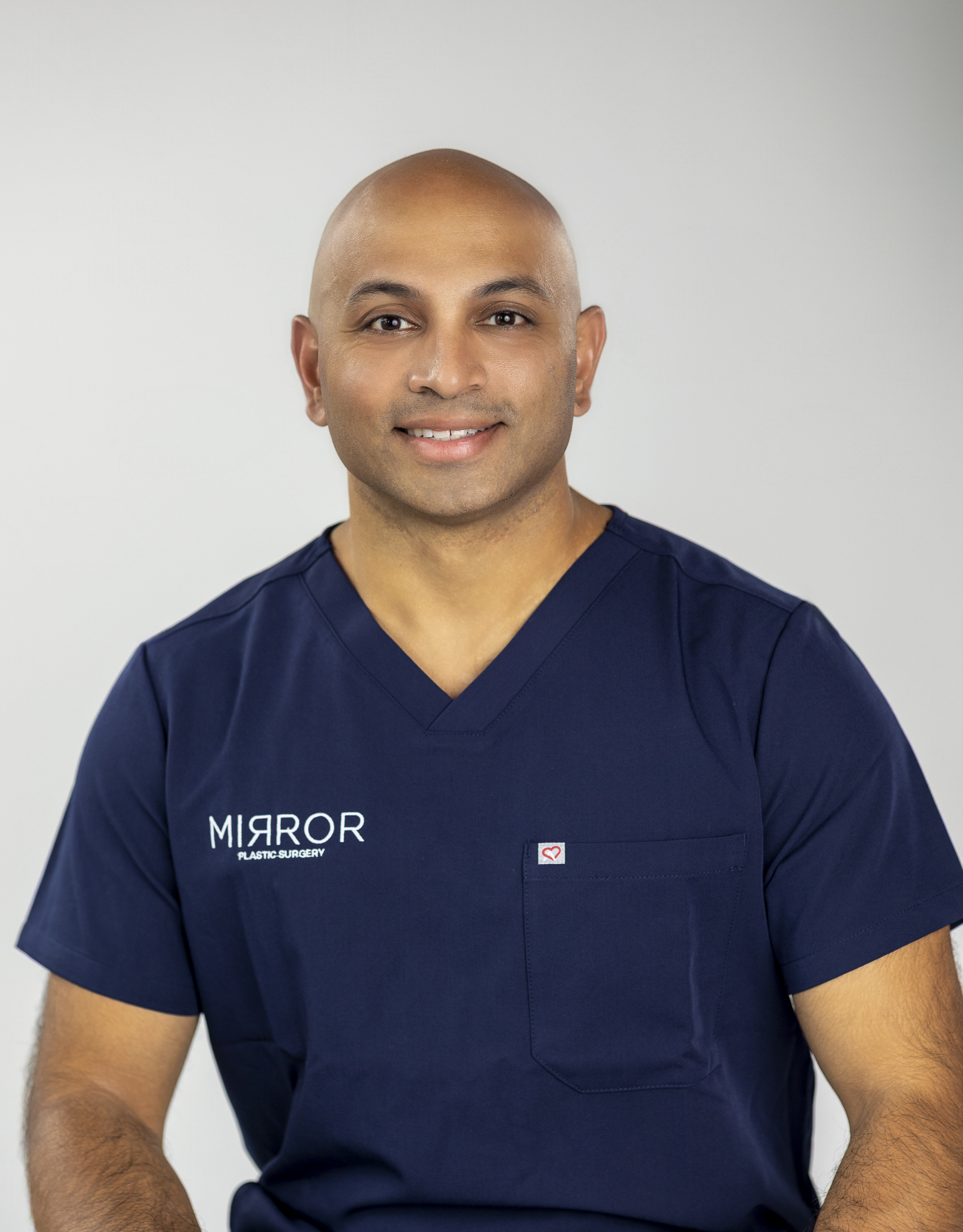
Meet with a surgeon who brings Harvard-MIT-Johns Hopkins training to every hair restoration procedure and request your consultation with Dr. Akash today.
Non-Surgical Early-Intervention Options at Mirror Plastic Surgery
Not every patient with hair loss qualifies immediately for surgery. For patients in early androgenetic alopecia or those who want to preserve current density before considering transplantation, Mirror Plastic Surgery offers hair restoration with Acorn Biolabs Secretome, available as both injectable and topical treatment. This biologic therapy targets follicular health at the cellular level and suits patients whose donor supply, scalp condition, or hair loss stage does not yet support surgery.
Early non-surgical treatment also complements surgical planning. Stabilizing native hair loss before a transplant reduces the chance that ongoing thinning will undermine the cosmetic result in later years. This approach fits directly with Mirror Plastic Surgery’s long-term, function-first philosophy.
Frequently Asked Questions
How do I know if a hair restoration clinic is physician-led or technician-driven?
Ask the clinic who performs follicular extraction, recipient-site creation, and graft implantation. In a physician-led practice, a board-certified surgeon personally performs all medically consequential steps. In a technician-delegated model, the physician usually conducts a brief consultation and then hands off most operative work to unlicensed staff. You can also ask whether the surgeon remains in the operating room for the full procedure and whether the facility is accredited. A board-certified plastic surgeon will hold hospital privileges, which provide a meaningful safety credential that technician-led clinics cannot match.
Am I a good candidate for hair transplant surgery?
Candidacy depends on the degree and pattern of hair loss, donor-zone quality and density, age, scalp health, and whether hair loss has stabilized. Younger patients with active loss require especially careful planning because a hairline designed today must still look natural decades later as native hair thins. Only an in-person physician evaluation, not a photo upload or online calculator, can accurately assess candidacy. At Mirror Plastic Surgery, Dr. Akash conducts a comprehensive, hour-long consultation to review all of these factors before recommending any treatment.
What is a realistic recovery and growth timeline after a hair transplant?
Most transplanted hairs shed between six weeks and three months after surgery. This normal phase, called shock loss, involves shedding of the hair shaft while the follicle remains alive. Visible new growth usually begins between months three and six, with noticeable density improvement by month six and continued changes in texture and caliber through months six to twelve.1 Cosmetic stability typically appears around twelve months, and some patients continue to see improvement up to eighteen months.1 Final results should be judged no earlier than twelve to eighteen months after surgery.
Will I need more than one hair transplant procedure in my lifetime?
Many patients eventually undergo more than one procedure. A hair transplant treats current hair loss but does not stop future thinning of native hair, so the overall appearance can change even when transplanted follicles remain permanent. Roughly one-third of patients seek an additional procedure, and rates are higher among younger patients with aggressive patterns. Age-appropriate hairline design, donor-zone preservation, and medical maintenance with finasteride or minoxidil therefore become essential parts of long-term planning. A physician-led practice plans for your hair at age 60, not just at age 40.
What are the risks of choosing a low-cost or overseas hair transplant provider?
Major risks include graft loss from high transection rates, donor-zone depletion from overharvesting, unnatural hairline design, and complications that require corrective surgery. Most patients have a finite lifetime donor supply, often 4,000 to 7,000 grafts, and overharvesting permanently reduces what remains for future work. Corrective surgery is expensive, time-intensive, and sometimes only partially effective, especially in cases of permanent scarring or nerve damage. The ISHRS has formally identified technician-delegated procedures as a major global patient safety concern in hair restoration, and repair cases from poorly performed procedures continue to rise each year.
Conclusion: Choosing a Tampa Bay Hair Restoration Surgeon for the Long Term
Selecting a hair restoration surgeon in the Tampa Bay area represents a long-term medical decision rather than a simple price comparison. The most important criteria include board certification, direct physician involvement in every surgical step, facial anatomy expertise, accredited facility standards, and honest long-term planning. Patients who evaluate providers using these standards, instead of focusing on cost or advertised graft counts, are more likely to achieve natural, lasting results and avoid corrective surgery.
Mirror Plastic Surgery and Dr. Akash provide a physician-led, concierge approach to hair restoration grounded in the same anatomical precision and safety-first philosophy that guide every procedure at the practice. With training from Harvard-MIT, Johns Hopkins, MEETH, and Stanford, and national recognition for surgical excellence, Dr. Akash offers a level of personal surgical involvement that sets Mirror Plastic Surgery apart from high-volume clinics in the region.
Begin your personalized hair restoration plan at Mirror Plastic Surgery in St. Petersburg, FL and schedule your consultation to discuss a strategy built around your anatomy, your goals, and your long-term results.
1 Results may vary from person to person. Editorial content, before and after images, and patient testimonials do not constitute a guarantee of specific results.