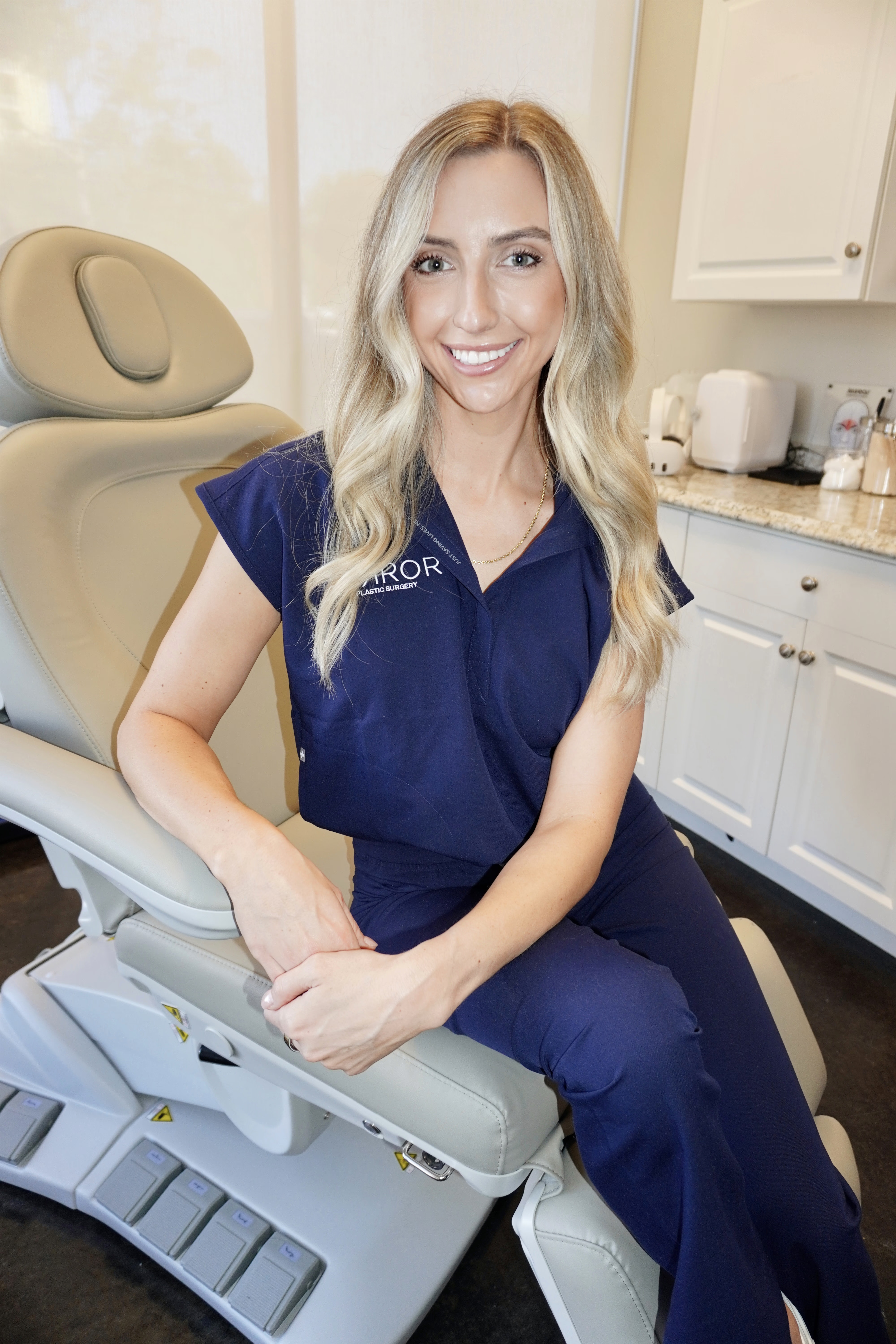
Written by: Ellie Pranckevicius, FNP-BC, Aesthetic Nurse Practitioner & Aesthetic Injector | Facial Restoration & Regenerative Injectable Specialist, Mirror Plastic Surgery
Key BBL Safety Facts for 2026
-
Current U.S. BBL standards require subcutaneous-only fat placement, ultrasound guidance, and strict daily volume limits to reduce risk.
-
Real-time ultrasound and blunt cannulas have replaced older “feel-based” techniques, which has sharply reduced fat embolism events.
-
Florida enforces the strictest BBL rules in the country, including mandatory ultrasound use and a legal cap on daily BBL cases per surgeon.
-
ABPS board-certified plastic surgeons who personally perform every surgical step in accredited facilities now represent the accepted standard of care.
-
Patients who want guidance on BBL safety or non-surgical options can schedule a consultation at Mirror Plastic Surgery to review personalized recommendations.
Official 2026 ASPS/ABCS Subcutaneous-Only Mandate
ASPS, ISAPS, and the ASERF BBL Task Force recommend that fat be injected exclusively in the subcutaneous plane and never into or below the gluteal muscle, where the superior and inferior gluteal veins create direct pathways for fatal fat embolism.
The current multi-society mandate includes the following requirements:
-
Fat must be placed exclusively above the gluteal muscle fascia in the subcutaneous layer
-
Prone patient positioning is required to provide clear anatomical orientation during fat injection
Ultrasound Guidance and Blunt-Cannula Requirements
Real-time imaging now serves as the primary safety tool for confirming fat placement during BBL surgery. The following technique standards apply nationally:
-
Intraoperative ultrasound must visualize the cannula tip in real time, confirming the subcutaneous placement described above
-
Florida HB 1471 (effective July 1, 2023) requires the use of ultrasound guidance for gluteal fat grafting procedures
-
Large, blunt-tipped cannulas are required to reduce the risk of vascular penetration
-
The 2022 Multi-Society Practice Advisory recommends cannulas 4 mm or greater in diameter
-
Injection pressure must remain controlled at all times to avoid forcing fat into vessels
Florida became the first U.S. state to legally mandate ultrasound guidance for all BBL procedures through HB 1471 in July 2023, after the Florida Board of Medicine declared a public health emergency following eight BBL-related deaths in South Florida in 2021.
Volume Limits and Facility Accreditation Standards
The 2022 Multi-Society Practice Advisory on Gluteal Fat Grafting, endorsed by ASPS, ASAPS, and ISAPS, recommends that surgeons perform no more than three gluteal fat grafting cases per day, with data showing lower complication rates at this volume threshold. Florida’s Board of Medicine currently limits BBL surgeries to three per day per surgeon.
BBL procedures must be performed in an accredited surgical facility. Accreditation through AAAASF, AAAHC, or a state-licensed ambulatory surgical center ensures emergency protocols, trained staff, proper monitoring equipment, and regulatory oversight.
The following checklist brings these standards together so you can use it during consultations to confirm that a provider follows current safety rules:
|
Current US BBL Safety Checklist (2026) |
|||
|
Safety Standard |
National Requirement |
Florida Requirement |
Verification Method |
|---|---|---|---|
|
Fat Placement |
Subcutaneous only, never intramuscular |
Subcutaneous only, legally mandated |
Ask surgeon directly, review consent forms |
|
Ultrasound Guidance |
Strongly recommended by ASPS/ISAPS/ASERF |
Legally required |
Confirm ultrasound equipment is on-site |
|
Daily Case Limit |
Three or fewer cases per day recommended |
Ask how many BBLs are scheduled on your surgery day |
|
|
Board Certification |
ABPS certification required |
Surgeon must personally perform all steps, no delegation |
Verify at abplasticsurgery.org |
How to Confirm Surgeon Board Certification
Board certification specifically by the American Board of Plastic Surgery (ABPS) is the credential required for safe BBL practice, and physicians from non-plastic-surgery specialties have performed BBLs with fatal outcomes. Use the following steps to verify any surgeon before you schedule surgery:
-
Visit abplasticsurgery.org and search the surgeon’s name in the public verification tool.
-
Confirm the certification is current and not lapsed or revoked.
-
Verify the surgeon holds hospital privileges for gluteal fat grafting at a licensed facility.
-
Check the Florida Department of Health’s physician license lookup to confirm active, unrestricted licensure in Florida.
Florida-Specific Facility and Licensing Rules
Florida applies the most detailed state-level BBL regulations in the United States. Patients seeking gluteal fat grafting in Florida should confirm the following requirements:
-
HB 1471 (effective July 1, 2023) mandates ultrasound or equivalent board-authorized technology to confirm subcutaneous fat placement
-
Surgeons may not delegate fat extraction or injection to nurses or non-surgeon assistants, and must conduct an in-person examination at least one day before surgery
A 2023 study in the Aesthetic Surgery Journal reviewed BBL-related deaths in South Florida and found that most occurred at high-volume, low-budget clinics, and all fatalities resulted from pulmonary fat embolism.
Non-Surgical BBL Safety Comparison
Biostimulatory injectables offer a lower-risk option for patients who are not surgical candidates, want to avoid general anesthesia, or prefer a gradual approach to gluteal enhancement. Mirror Plastic Surgery’s Ellie Pranckevicius, FNP-BC, performs non-surgical BBL using Radiesse and AlloClae, which stimulate the body’s own collagen production instead of adding a large, immediate gel volume.
Radiesse (calcium hydroxylapatite) and AlloClae work through a regenerative mechanism. They trigger a controlled collagen-synthesis response in the subcutaneous tissue and gradually build structural support and volume over multiple sessions.
This approach differs from surgical fat grafting, which transfers living fat cells that must establish a blood supply to survive. Approximately 20–40% of transferred fat is naturally reabsorbed after surgical BBL, with most patients retaining 60–70%, which introduces volume unpredictability that biostimulatory injectables avoid.1
Collagen-stimulating injectables are generally considered to carry lower vascular and migration risks than high-volume filler approaches because they work gradually through the body’s own biological response rather than adding large immediate gel volume.
This gradual mechanism matters because it avoids the sudden pressure and volume load that can push material into blood vessels, which is the root cause of fat embolism in surgical BBL. By removing general anesthesia, liposuction donor-site trauma, and the intravascular injection pathway, the non-surgical approach eliminates the three main mortality factors seen in surgical BBL.
Non-surgical injectable BBL usually allows return to work the same day with zero to two days of downtime. Surgical BBL typically involves a two-to-three-week sitting restriction and compression garment use.1 Non-surgical options suit patients with lean body types, limited donor fat, or those seeking subtle contouring, hip dip correction, or cellulite improvement rather than large volume increases.
Patient selection still drives overall safety and satisfaction. Ellie begins each case at Mirror Plastic Surgery with a detailed anatomical assessment to decide whether injectables alone can meet a patient’s goals or whether a surgical consultation with Dr. Akash Chandawarkar offers a better path.
Questions to Ask When Choosing a BBL Provider
The following questions help you confirm whether a provider meets 2026 national and Florida-specific BBL safety standards. Ask each one before you commit to any surgical or non-surgical gluteal procedure:
-
How many BBL surgeries do you perform per day? The national advisory recommends three or fewer, and Florida law caps the limit at three. Providers who schedule more than three cases per day operate at the upper boundary of safety guidance.
-
Do you use real-time ultrasound guidance? Florida law requires this. Any surgeon who cannot confirm ultrasound availability on-site does not meet current Florida standards.
-
Will you personally perform both the liposuction and fat injection steps? Delegation of either step to a non-surgeon assistant violates the 2022 Joint Safety Statement and Florida HB 1471.
-
Will I meet you in person before surgery day? Florida law requires an in-person examination at least one day before the procedure. A provider who meets patients for the first time on surgery day does not comply with HB 1471.
-
What is your post-operative monitoring protocol? Accredited facilities maintain emergency equipment and trained staff. Confirm the facility holds AAAASF, AAAHC, or state ASC accreditation.
-
For non-surgical BBL, what products do you use and why? Providers should clearly explain the biostimulatory mechanism of their chosen agents and why a specific product fits your anatomy and goals.
Mirror Plastic Surgery limits surgical volume to one to two procedures per day, which stays well below both the national advisory threshold and Florida’s legal cap. Dr. Akash Chandawarkar, a Johns Hopkins-trained, Harvard-educated plastic surgeon with fellowship training at Manhattan Eye Ear & Throat Hospital, personally oversees all surgical cases. Ellie Pranckevicius conducts non-surgical BBL consultations with the same anatomical rigor used in surgical planning.
Key Safety Takeaways and FAQ
The 2026 BBL safety landscape centers on five verifiable standards: subcutaneous-only fat placement, real-time ultrasound guidance with documented video, daily case volume limits, ABPS board certification with no delegation of critical steps, and accredited facility requirements.
Florida enforces these standards through statute, which makes it the most regulated state for BBL in the country. Patients who confirm each standard before surgery, or who choose biostimulatory injectables such as Radiesse or AlloClae as a lower-risk alternative, receive care that aligns with current national guidelines.
High-volume, budget-oriented clinics remain the main setting for BBL-related mortality in the United States, and provider selection remains the single most controllable risk factor for patients.
Frequently Asked Questions
How safe is a BBL now?
BBL safety has improved significantly since 2018. The procedure was once cited as the cosmetic surgery with the highest mortality rate, at about 1 death per 3,000 procedures under older intramuscular techniques. A 2024 study of 1,815 BBL patients using ultrasound-guided subcutaneous injection reported zero mortalities.
The current risk profile is much lower than historical figures when an ABPS board-certified surgeon operates in an accredited facility using subcutaneous-only placement, real-time ultrasound, blunt cannulas, and a daily limit of three cases.1
Patients who choose high-volume, budget-oriented clinics still face substantially higher risk, and a 2023 study found that most documented BBL deaths occurred in these high-volume, low-budget settings. The 20–40% fat reabsorption rate seen after surgical BBL also affects final volume, which makes realistic expectations and surgeon experience essential.1
What is the safest BBL technique in the USA?
The safest surgical BBL technique in the United States combines subcutaneous-only fat placement, real-time intraoperative ultrasound guidance to confirm cannula position above the gluteal muscle fascia, large blunt-tipped cannulas of 4 mm or greater in diameter, low-pressure manual syringe injection of small volumes per pass, prone patient positioning, and a single-surgeon approach with no delegation of liposuction or fat injection steps. This technique is recommended by ASPS, ISAPS, and the ASERF BBL Task Force and is legally required in Florida under HB 1471.
Patients in Florida also benefit from mandatory ultrasound guidance. For patients who want to avoid surgery, biostimulatory injectables such as Radiesse and AlloClae provide a lower-risk alternative with no general anesthesia, no fat embolism pathway, and minimal recovery time.
Are non-surgical BBL options safer?
Non-surgical BBL using biostimulatory injectables such as Radiesse and AlloClae carries a different and generally lower risk profile than surgical BBL. These agents stimulate the body’s own collagen production gradually and avoid the fat embolism pathway that accounts for all documented surgical BBL deaths.
There is no general anesthesia, no liposuction donor-site risk, and no two-to-three-week sitting restriction. Common side effects such as mild swelling, bruising, and tenderness usually resolve within days to two weeks. Non-surgical options do not suit patients who want large volume increases, and results differ from surgical fat transfer in both size and mechanism. The right choice depends on anatomy, volume goals, and medical history.
At Mirror Plastic Surgery, Ellie Pranckevicius completes a comprehensive anatomical assessment before recommending any injectable protocol and refers patients to Dr. Akash Chandawarkar when surgical evaluation offers a better option.
Disclaimer: Results may vary from person to person. Editorial content, before and after images, and patient testimonials do not constitute a guarantee of specific results.
1 Results may vary from person to person. Editorial content, before and after images, and patient testimonials do not constitute a guarantee of specific results.