
Written by: Dr. Akash Chandawarkar, Board Certified Plastic Surgeon, Mirror Plastic Surgery
Key Takeaways
-
Concierge plastic surgery practices limit daily surgical volume to one or two procedures, which supports undivided surgeon focus and stronger patient safety compared to traditional high-volume models.
-
60-minute consultations with written surgical plans in concierge settings create better expectation alignment, lower revision rates, and higher patient satisfaction than shorter verbal summaries common in traditional practices.
-
Low-volume models support safer staging of procedures and help maintain peak surgeon performance, which reduces fatigue-related risks during complex surgeries.
-
Direct surgeon-managed aftercare in concierge practices allows early detection of healing issues and personalized recovery oversight that high-volume settings relying on extenders cannot consistently match.
How Concierge and Traditional Plastic Surgery Models Differ
Concierge plastic surgery practices deliberately limit daily surgical volume, typically to one or two procedures per day. This ceiling reflects a structural choice rather than a capacity constraint. It keeps the surgeon, anesthesiologist, and support team focused on a single patient throughout the operative day. Consultations in this model commonly run 60 minutes or longer, with dedicated time for goals discussion, physical examination, anatomical assessment, procedure rationale, recovery planning, and patient questions. Post-operative access to the surgeon remains direct and consistent.
Traditional high-volume practices follow a different structure. A surgeon may perform five to ten procedures in a single day, cycling through cases with the assistance of physician extenders who manage portions of the consultation, pre-operative preparation, and post-operative follow-up. Consultation windows are often shorter, and written surgical plans may be replaced by brief verbal summaries. This model can serve patients with straightforward, lower-complexity needs efficiently, but the structural tradeoffs become significant for patients pursuing complex, multi-layered, or anatomically nuanced procedures. One of the most important tradeoffs involves how daily case volume directly affects patient safety outcomes.
Daily Case Volume, Staging, and Patient Safety
Limiting daily surgical volume has direct implications for intraoperative safety. Surgeon fatigue is a documented factor in procedural precision, and a surgeon performing their first case of the day operates under different physiological conditions than one performing their sixth. When a practice caps daily volume at one or two surgeries, every patient benefits from the surgeon’s full cognitive and physical capacity.
Staging procedures across separate operative days, rather than combining multiple surgeries into a single session, offers another safety advantage that low-volume practices can implement more readily. Combining procedures or staging surgery respects safety limitations on operative time and recovery demands. Customized staging plans that prioritize safe recovery over compressing multiple cases into one session are a hallmark of patient-centered surgical planning. Refined instruments and surgical advances reduce tissue trauma and speed healing, so outcomes depend on careful execution more than raw procedure count.
Board certification by the American Board of Plastic Surgery serves as a foundational safety credential. Certification requires completion of an accredited residency, passage of written and oral examinations, and ongoing continuing education. It also confers privileged hospital access, which provides a critical safety net in the rare event of a surgical complication that requires escalated care.
Consultation Depth and Written Pre-Operative Planning
The consultation sets the foundation for surgical outcomes. A thorough plastic surgery consultation at a personalized practice lasts a full 60 minutes, structured across goals discussion and medical history review, physical examination, procedure explanation and alternatives, recovery timeline review, and a dedicated question period.
Longer consultations correlate with lower revision rates.1 Extra time allows the surgeon to identify anatomical nuances, discuss realistic outcomes, and align patient expectations with what surgery can reliably deliver. Patients leave with a clearer understanding of both possibilities and limits.
The format of the surgical plan also shapes outcomes. Research published in the Aesthetic Surgery Journal reports that patients receiving written surgical plans had 34% higher satisfaction than those receiving only verbal communication.1 A quality written plan from a low-volume personalized practice includes detailed anatomical findings, procedure rationale tied to anatomy, alternative approaches considered, surgical technique specifics, anesthesia plan, recovery milestones with dates, and itemized costs. This document functions as both a communication tool and a clinical record.
High-volume practices, working under time pressure, more often deliver verbal summaries and standardized procedure descriptions that do not fully account for individual anatomical variation. For patients with complex goals or prior surgical history, this gap in pre-operative documentation carries meaningful risk. Beyond consultation quality, the safety infrastructure surrounding the procedure determines how well that documented plan translates into actual outcomes.
Safety Standards, Surgeon-Led Aftercare, and Long-Term Results
Accreditation of the surgical facility, use of board-certified physician anesthesiologists, and advanced pre-operative diagnostic tools form a safety framework that concierge practices can maintain more consistently when daily volume is controlled. In-office ultrasound, for example, enables precise pre-operative anatomical assessment that informs surgical planning in ways that surface examination alone cannot.
Post-operative follow-up quality creates another clear distinction. In a low-volume practice, the operating surgeon usually remains the primary point of contact throughout recovery. Patients can reach their surgeon directly, concerns are evaluated by the person with complete operative knowledge, and deviations from expected healing trajectories are identified early. In high-volume settings, post-operative care is more commonly managed by nursing staff or physician assistants, with surgeon involvement reserved for scheduled appointments or escalated concerns.
For patients with significant functional concerns, patient-centered planning that prioritizes quality-of-life gains over procedural throughput produces measurably better long-term outcomes.1 Long-term results in aesthetic surgery also depend on how thoroughly the underlying anatomy was addressed, not only on how the surface appearance looked at the time of surgery.
Expert Perspective: Dr. Akash’s Training and Practice Philosophy
Dr. Akash’s training reflects one of the most rigorous academic and clinical pathways in American plastic surgery. He completed undergraduate studies in neuroscience and nuclear engineering at MIT before earning his M.D. with Honors from Harvard Medical School through the highly selective Harvard-MIT Division of Health Sciences and Technology program. His surgical training took place during a seven-year integrated plastic and reconstructive surgery residency at Johns Hopkins University, which included complex cancer and trauma reconstruction, emergency reconstructive procedures at the R Adams Cowley Shock Trauma Center, and microsurgical training at the Curtis National Hand Center.
After residency, Dr. Akash completed an aesthetic surgery fellowship at the Manhattan Eye, Ear and Throat Hospital (MEETH) at Lenox Hill Hospital, one of the most competitive aesthetic fellowships in the country, with advanced training in facial rejuvenation, breast surgery, and body contouring. He also completed the Stanford University Biodesign Innovation Fellowship, which focuses on identifying unmet clinical needs and developing technological solutions. He is certified by the American Board of Plastic Surgery and has been named to Newsweek’s America’s Best Plastic Surgeons list for two consecutive years.
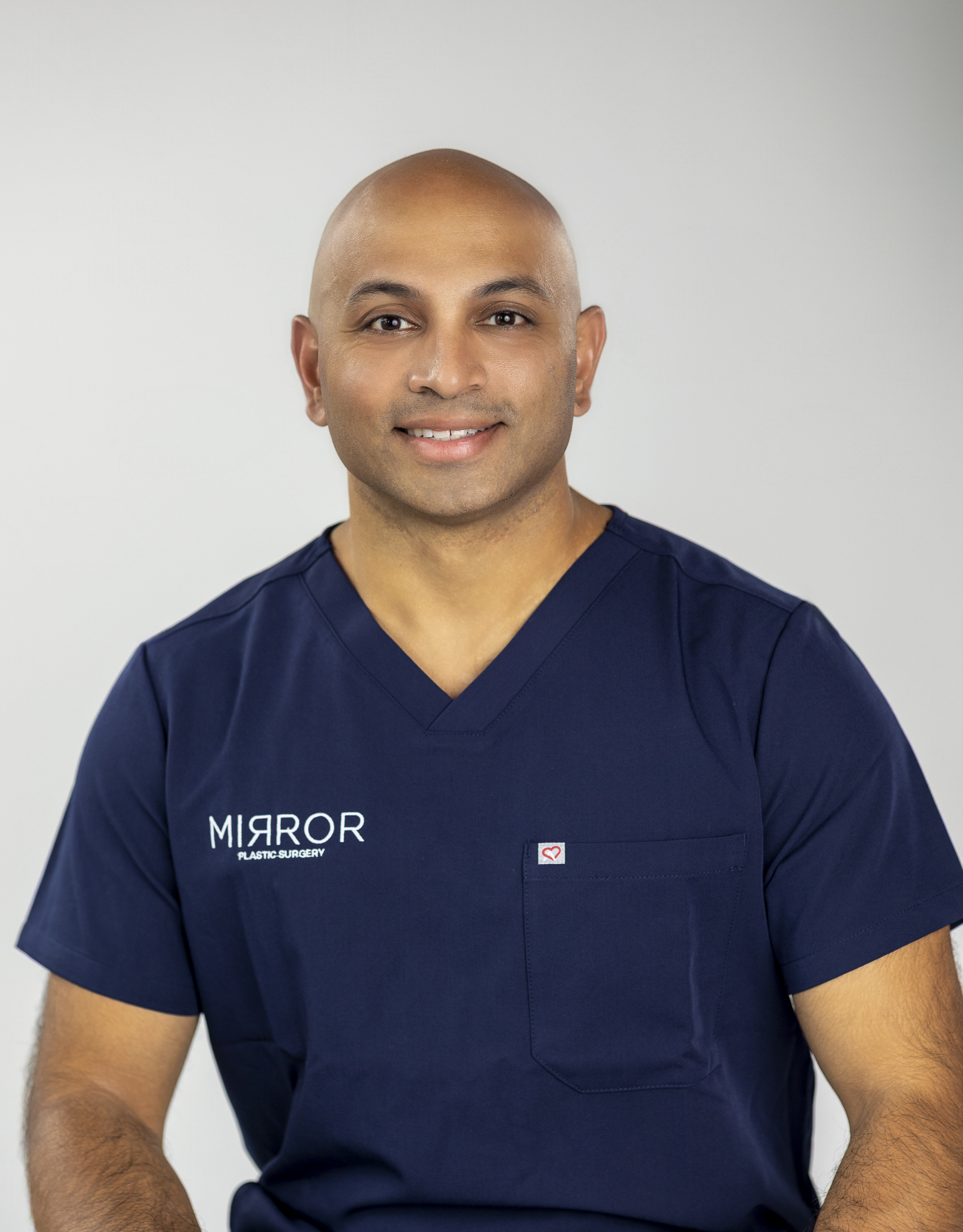
At Mirror Plastic Surgery, Dr. Akash structures his practice around the principle of safety first, function second, and aesthetics third. He maintains this low-volume model so that every patient receives his complete focus before, during, and after their procedure. This structure reflects a clinical decision with direct implications for patient safety and outcome quality.
Book a consultation with Dr. Akash to experience the anatomy-driven assessment described above, tailored to your goals and long-term well-being.
Decision Framework for Comparing Practice Models
Patients evaluating practice models can use a simple sequence of questions to guide their research. Start with surgical volume and ask how many procedures the surgeon performs on the day of your surgery, and whether that number changes based on scheduling demand. This number directly affects the surgeon’s cognitive capacity during your procedure.
Next, examine consultation structure and ask whether you will receive a written surgical plan that includes anatomical findings, technique rationale, and recovery milestones. Written plans create a shared reference that supports clear expectations and lower revision rates. Then review safety infrastructure and confirm that the facility is accredited, that a board-certified physician anesthesiologist will be present, and that the surgeon holds American Board of Plastic Surgery certification with active hospital privileges.
After that, clarify aftercare access and ask who manages your post-operative care and how quickly you can reach your surgeon directly if a concern arises. Finally, discuss staging and ask whether the surgeon recommends staging procedures across separate operative days when combining surgeries, and which criteria guide that recommendation. Together, these questions reveal how closely a practice’s structure matches your safety and outcome priorities.
Patients who prioritize natural results, anatomical precision, and direct surgeon access throughout recovery often find that concierge models align more closely with those priorities than high-volume alternatives.
Frequently Asked Questions
How does daily surgical volume affect complication rates?
Daily surgical volume affects complication rates through several mechanisms. Surgeon fatigue accumulates across a multi-case operative day, and cognitive and physical precision decline with each successive procedure. When a surgeon limits daily volume to one or two cases, every patient benefits from peak operative performance. Low-volume practices are also better positioned to stage procedures across separate days rather than combining multiple surgeries into a single session, which reduces cumulative anesthesia time, physiological stress, and recovery complexity. Accredited facilities with board-certified physician anesthesiologists further reduce intraoperative risk regardless of volume, and the combination of low volume and strong safety infrastructure produces the most favorable risk profile.
What is the typical length of a concierge plastic surgery consultation?
A concierge plastic surgery consultation typically runs 60 minutes. That time covers goals and medical history, a thorough physical examination, a detailed explanation of the recommended procedure and anatomical rationale, discussion of alternatives, recovery timeline, and a dedicated period for patient questions. The output of this consultation in a high-quality concierge practice is a written surgical plan that documents anatomical findings, technique specifics, anesthesia approach, and recovery milestones, not simply a procedure name and a price. This depth of pre-operative documentation is associated with higher patient satisfaction and lower revision rates.
Why do some patients experience fewer revisions with low-volume practices?
Revision rates depend on the quality of pre-operative planning, the precision of surgical execution, and the accuracy of expectation-setting during consultation. Low-volume practices invest more time in each of these phases. Longer consultations allow the surgeon to identify anatomical nuances that affect technique selection, align patient expectations with realistic outcomes, and document a surgical plan that serves as a clinical reference throughout the procedure and recovery. When the surgeon also manages post-operative follow-up directly, early signs of suboptimal healing are identified and addressed before they require revision. Together, these structural advantages lower the likelihood that a patient will need corrective surgery.1
How does concierge aftercare differ from traditional follow-up protocols?
In a concierge model, post-operative care is managed by the operating surgeon, who has complete knowledge of the procedure performed, the anatomical findings encountered, and the specific decisions made intraoperatively. Patients have direct access to their surgeon for questions and concerns, and follow-up appointments are conducted by the surgeon rather than delegated to support staff. In high-volume traditional practices, post-operative care is more commonly managed by physician assistants or nurses, with surgeon involvement at scheduled intervals. For straightforward recoveries, this distinction may be minimal. For complex procedures, combined surgeries, or patients with prior surgical history, direct surgeon oversight throughout recovery provides a meaningful safety and quality advantage.
Making an Informed Choice for Your Aesthetic Journey
Practice structure plays a central role in plastic surgery because it shapes how your surgery is planned, performed, and followed through. The differences between concierge and traditional models are structural and measurable. Daily case volume, consultation duration, written versus verbal surgical planning, direct versus delegated aftercare, and the presence or absence of staged procedure protocols all influence safety margins, revision risk, and long-term satisfaction.
Mirror Plastic Surgery’s concierge model, with one to two surgeries per day, 60-minute anatomy-driven consultations, written surgical plans, an accredited facility, a board-certified physician anesthesiologist, and direct post-operative access to Dr. Akash, reflects evidence-aligned conditions that support safe, functional, and natural outcomes. Dr. Akash’s training at MIT, Harvard Medical School, Johns Hopkins, MEETH, and Stanford, combined with his American Board of Plastic Surgery certification and national recognition for surgical excellence, establishes the clinical foundation that makes this model work.
Patients in the Tampa Bay and St. Petersburg area who want a surgical experience built around their anatomy, their goals, and their safety, rather than a scheduling template, can use Mirror Plastic Surgery as a benchmark when comparing options.
Book a consultation with Dr. Akash at Mirror Plastic Surgery in St. Petersburg and begin your aesthetic journey with the depth of evaluation, honesty, and surgical expertise that your goals deserve.
1 Results may vary from person to person. Editorial content, before and after images, and patient testimonials do not constitute a guarantee of specific results.