
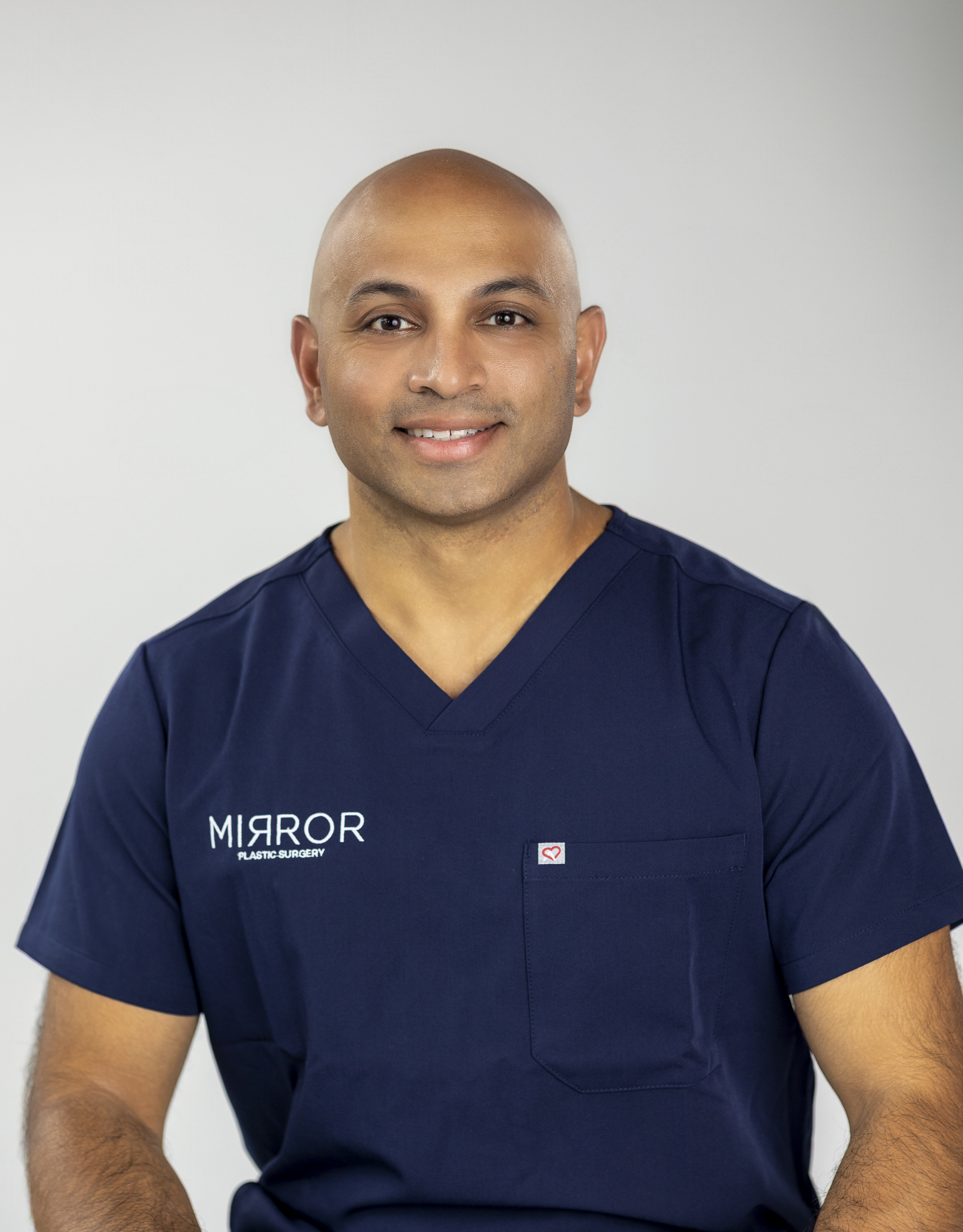
Written by: Dr. Akash Chandawarkar, Board Certified Plastic Surgeon, Mirror Plastic Surgery | Last updated: July 3, 2026
Key Takeaways
-
Hip dips are natural indentations shaped by pelvic bone structure and soft tissue. Augmentation is an elective choice based on your anatomy and goals.
-
Three main techniques, fat transfer, solid implants, and structural fillers, offer different levels of invasiveness, longevity, and recovery time.
-
Each procedure carries specific risks, including fat resorption, implant complications, and injection-related issues, so surgeon experience and technique selection matter.
-
Recovery ranges from a few days for fillers to several weeks for surgical options, and fat transfer results usually stabilize between three and six months.1
-
Patients considering hip dip augmentation can schedule a personalized consultation at Mirror Plastic Surgery to review options that match their anatomy and lifestyle.
How Hip Dips Form on Your Body
Hip dips appear where the greater trochanter of the femur meets the iliac crest of the pelvis. A higher or wider iliac crest, or naturally low subcutaneous fat in the lateral hip, creates a visible inward curve between the hip and thigh.
Several anatomical factors influence how deep or noticeable hip dips appear:
-
Pelvic width and iliac crest height: A wider pelvis or higher iliac crest increases the distance soft tissue must span, which can deepen the indentation.
-
Gluteus medius muscle volume: Lower muscle mass in this region reduces lateral fullness and makes the concavity more pronounced.
-
Subcutaneous fat distribution: Genetic fat distribution patterns determine how much natural padding covers the trochanteric area.
-
Skin laxity and thickness: Thinner or less elastic skin reveals more of the underlying bony contour.
These factors guide technique selection. A patient with minimal subcutaneous fat may not have enough donor tissue for fat transfer, so structural fillers or implants may be more appropriate. A patient with adequate fat stores and good skin quality often fits fat grafting well.
Hip Dip Augmentation Options and How They Compare
Three primary techniques are used to add volume to the lateral hip region. Each option differs in invasiveness, longevity, recovery demands, and how well it matches specific anatomy. The table below summarizes these trade-offs so you can see how each approach fits your recovery capacity and long-term goals.
|
Technique |
Invasiveness |
Expected Longevity |
Typical Recovery |
|---|---|---|---|
|
Fat Transfer (Autologous Fat Grafting) |
Surgical, requires liposuction donor site |
Variable, permanent fat that survives integration (typically 50–70% of transferred volume)1 |
4–6 weeks before return to full activity |
|
Solid Implants |
Surgical, subfascial or intramuscular pocket |
Long-term, implant lifespan varies by material and placement |
6–8 weeks, with more restricted early mobility |
|
Structural Fillers |
Minimally invasive, in-office injection |
Varies by product formulation, maintenance sessions may be needed |
Days to 1–2 weeks of activity modification |
Fat transfer harvests adipose tissue from a donor site, commonly the abdomen, flanks, or thighs, then processes and injects it into the lateral hip. The transferred fat must establish a blood supply to survive, so the final volume is lower than the amount injected.1 Many patients appreciate that the procedure also contours the donor area.
Solid implants provide predictable, stable volume that does not resorb. They introduce device-specific risks, including displacement, capsular contracture, and implant-related infection. Placement as subfascial or intramuscular influences both the final shape and the complication profile.
Structural fillers belong to a newer category of adipose-derived or biologically structured injectable materials. They are placed in-office without general anesthesia, which suits patients who are not surgical candidates or who prefer to test volume changes before choosing surgery.
Risks and Complications by Technique
Safe planning starts with a clear understanding of complication profiles before focusing on aesthetic outcomes. Risk patterns differ between surgical procedures and minimally invasive injections.
Fat Transfer Risks
-
Fat resorption: The variable survival rate mentioned earlier means some patients may need a touch-up procedure to reach their desired volume.
-
Contour irregularities: Uneven fat survival can create asymmetry or surface irregularities at either the recipient or donor site.
-
Oil cysts and calcification: Necrotic fat can form palpable cysts or calcified nodules that sometimes require aspiration or excision.
-
Infection: Any procedure that disrupts tissue carries an infection risk, although rates remain low with careful sterile technique.
-
Seroma and hematoma: Fluid or blood can collect at the liposuction donor site and may need drainage.
Implant Risks
-
Implant displacement or migration: An implant can shift from its intended position, change the contour, and sometimes require revision surgery.
-
Capsular contracture: Scar tissue can tighten around the implant, causing hardness, distortion, or discomfort.
-
Implant-related infection: Infection around a foreign body is harder to treat than a soft-tissue infection and may require implant removal.
-
Nerve injury: The nearby lateral femoral cutaneous nerve can be affected, which may cause temporary or, rarely, permanent sensory changes in the lateral thigh.
-
Revision rates: Implant-based procedures tend to have higher long-term revision rates than fat transfer because of device-related issues.
Structural Filler Risks
-
Bruising, swelling, and temporary tenderness at injection sites are common and usually resolve within days to two weeks.
-
Nodule formation or uneven distribution can occur if injection technique is not ideal.
-
Vascular occlusion is a rare but serious risk with any injectable treatment and highlights the need for physician-performed procedures.
Week-by-Week Recovery After Hip Dip Procedures
Recovery length and restrictions depend on the chosen technique. The outline below reflects typical expectations for surgical hip dip augmentation, while minimally invasive filler treatments usually involve much shorter downtime.
Week 1: Swelling, bruising, and soreness peak during this period. Patients usually rest, avoid pressure on the lateral hip, and wear a compression garment continuously. Sitting and lying directly on the augmented area stay limited, and some surgical cases require drain management.
Weeks 2–3: Swelling starts to decrease. Light walking supports circulation and reduces clot risk. Compression garment use continues. Sitting restrictions relax gradually, although long periods of direct pressure on the hip remain discouraged. Many patients return to sedentary work during this time.
Weeks 4–6: Most acute swelling resolves. Light lower-body activity can resume once the surgeon clears it. Compression garment use usually tapers. For fat transfer patients, surviving fat volume begins to stabilize, although final results appear over the following months.
Weeks 6–12: Most patients return to full physical activity, including exercise involving the hip and lateral thigh, within this window, depending on healing. Implant patients may need a longer delay before high-impact activity.
Months 3–6: Final aesthetic results become visible as residual swelling fades and fat integration completes.1 Follow-up imaging or in-person assessment often occurs during this stage.
How to Assess Surgeon Credentials and Facility Safety
Surgeon selection has the greatest impact on safety and outcome in any elective procedure. Patients should confirm several key qualifications before moving forward.
-
Board certification: Certification by the American Board of Plastic Surgery (ABPS) confirms completion of an accredited residency and successful written and oral plastic surgery examinations.
-
Accredited surgical facility: Procedures performed in accredited operating rooms, whether hospital-based or outpatient, follow standardized safety protocols.
-
Board-certified anesthesiologist: Involvement of a physician anesthesiologist, rather than nurse anesthetist-only coverage, adds another layer of safety oversight.
-
Hospital privileges: A surgeon with active hospital privileges can manage rare but serious complications in a hospital setting, which provides an important safety net.
-
Peer recognition: Independent recognition from credible third-party sources offers an objective signal of clinical standing.
Dr. Akash at Mirror Plastic Surgery holds board certification from the American Board of Plastic Surgery and completed a seven-year integrated plastic and reconstructive surgery residency at Johns Hopkins University, one of the most rigorous training programs in the field. His additional aesthetic surgery fellowship at the Manhattan Eye, Ear and Throat Hospital (MEETH) provided advanced, focused training in body contouring. He has been named to America’s Best Plastic Surgeons by Newsweek for two consecutive years, including 2025. Mirror Plastic Surgery operates in an accredited facility with board-certified physician anesthesiologists and limits surgical volume to one to two procedures per day to support individualized care.
Frequently Asked Questions
Am I a candidate for hip dip augmentation?
Candidacy depends on pelvic anatomy, the depth of the indentation, available fat stores if fat transfer is under consideration, overall health, and expectations. Patients at a stable weight, non-smokers, and in good general health usually make better surgical candidates. A thorough anatomical assessment, not a brief consultation, is necessary to determine which technique, if any, fits your specific structure.
How much of the transferred fat survives long-term?
Fat survival after grafting varies and depends on technique, the quality of harvested fat, the blood supply of the recipient site, and post-operative care. Individual outcomes differ significantly. As noted in the recovery timeline above, final volume stabilizes in the three-to-six-month window.1 Patients should remain open to a touch-up procedure if volume loss is greater than expected.
What is AlloClae and how does it differ from traditional fillers?
AlloClae is a structural adipose-derived filler designed to add volume and support tissue integration in areas such as hip dips, buttocks, and breasts. Hyaluronic acid fillers are gel-based and metabolized relatively quickly, while AlloClae is formulated to integrate with surrounding tissue and provide more durable structural support. It is administered in-office without general anesthesia, which makes it a lower-commitment option for patients who want to test volume changes before surgery or who are not surgical candidates.
What are the revision considerations for hip dip augmentation?
Revision patterns differ by technique. Fat transfer revisions most often add volume after resorption. Implant revisions may address displacement, capsular contracture, or infection. Filler-based approaches can be adjusted with additional treatment sessions. Choosing an experienced, board-certified surgeon with a low daily surgical volume reduces, but does not remove, the chance of needing revision.
How should I prepare for a hip dip augmentation consultation?
Arrive with a clear description of your aesthetic goals, and bring reference images if they help communicate your preferences. Be ready to discuss your medical history, current medications, smoking status, and prior surgeries. Ask your surgeon to explain the anatomical reasoning behind their recommended technique, the specific complication rates they see in their practice, and what revision would involve if results differ from your expectations. A consultation shorter than 30 minutes rarely covers these topics in enough depth.
1 Results may vary from person to person. Editorial content, before and after images, and patient testimonials do not constitute a guarantee of specific results.