
Written by: Ellie Pranckevicius, FNP-BC, Aesthetic Nurse Practitioner & Aesthetic Injector | Facial Restoration & Regenerative Injectable Specialist, Mirror Plastic Surgery | Last updated: July 25, 2026
Key Takeaways for Lip Filler Planning
- Lip filler technique selection works as a clinical decision based on anatomy, product behavior, and patient goals, not stylistic trends.
- Results improve when the technique matches individual anatomy and aesthetic goals, and no single method consistently outperforms all others.1
- Provider expertise and anatomy-aware technique influence safety and outcomes more than the isolated choice of technique or instrument.
- Conservative dosing, correct tissue plane selection, and product-anatomy matching together create the most natural-looking results.1
- Book a consultation with Ellie at Mirror Plastic Surgery for an individualized lip assessment grounded in current evidence and anatomy-first planning.
Russian Lip Filler Technique and Lip Shape
The Russian lip technique places filler using vertical vectors rather than horizontal volume spread. Precise micro-droplet injections are deposited vertically along the vermilion border and inward, building height and Cupid’s bow definition rather than forward projection. The result from the front view is a taller, heart-shaped lip with increased pink lip show and a lifted center. From the side, the profile remains comparatively flat, a deliberate trade-off that reduces the forward “duck lip” projection associated with traditional horizontal methods.
Achieving this vertical emphasis requires repeated fanning passes and multiple injection vectors, which makes the Russian technique more demanding than standard approaches. Improper placement carries higher risks of Tyndall effect, product migration, and uneven peaks. Swelling is usually more pronounced, and final results are typically visible at 10–14 days. Hyaluronidase and a vascular occlusion emergency protocol must be immediately available because of the elevated number of injection passes.
Russian Technique: What Patients Wish They Knew
The Russian technique does not remove the risk of an unnatural outcome; it shifts where that risk shows up. When performed aggressively or on lips with prior filler that has not been dissolved, the structured vertical placement can look stiff instead of sculpted. Both Russian and traditional lip fillers typically last six to twelve months, though longevity varies based on metabolism, lifestyle, product choice, and the volume injected.1 Kissing and normal lip contact are usually acceptable after 24–48 hours once the filler has integrated into the tissue.
Creating Natural-Looking Lip Filler Results
Natural-looking results come from a treatment plan that combines several factors rather than a single named technique.1 Conservative dosing prevents overfilling and keeps the lips in proportion with the rest of the face. Correct tissue plane selection preserves natural movement so the lips still look like your own during speech and expression. Product-anatomy matching ensures the filler integrates with the lip tissue instead of resisting motion or forming visible ridges.
Patient surveys support this approach. When patients review before-and-after photographs, they consistently prefer conservative treatment volumes over dramatic augmentation.1 The micro-droplet approach, which places small superficial aliquots to refine contour and texture, works well when combined with linear threading along the vermilion border. This pairing refines shape and definition while preserving dynamic lip movement.
Softer fillers with lower G prime tend to move with the lips and blend more naturally into the lip body. Products such as Restylane Kysse and Teoxane RHA Kiss feature low elastic modulus, high cohesivity, and smooth flow characteristics that suit the lips’ high mobility. Staging treatment across two sessions, instead of maximizing volume in one visit, allows the injector to assess settling and symmetry before adding more product.
The 2026 expert guidelines presented at IMCAS recommend low-viscosity, highly flexible fillers that preserve natural lip expression during dynamic movement. These recommendations support an anatomy-technique-product (ATP) framework, where the injector first studies the anatomy, then selects the technique, and finally chooses the product that best fits that plan.
Natural Results: What Patients Wish They Knew
Natural expression depends on filler placement and volume, not on a marketing label that calls a method “natural.” When filler sits in the correct tissue plane and in conservative amounts, the lips move freely and feel soft. Excessive volume per session and placement into improper tissue planes are the leading contributors to filler migration and patient dissatisfaction.
Staged results, evaluated at the two-week mark when swelling has resolved, consistently outperform single-session maximization for patients who want subtle, long-term enhancement. This slower approach gives you time to adjust to your new look and decide whether you truly want more volume.
Needle vs. Cannula in Lip Filler Treatment
The needle-versus-cannula choice balances precision against vascular safety. Alam et al. (2021), a retrospective cohort study of 370 board-certified dermatologists reporting on 1.7 million syringe injections, found that cannula injections were associated with 77.1% lower odds of vascular occlusion compared to needle injections. The mechanism is straightforward. Blunt micro-cannulas tend to deflect vessels instead of penetrating them, while sharp needles can directly cut vascular structures.
For lip filler specifically, needles usually work best for vermilion border definition, philtrum work, and Cupid’s bow refinement because these areas demand precise bolus placement. Research has shown that both needle-only and needle-plus-cannula approaches are used with comparable safety profiles. Many experienced injectors use a hybrid approach, with a cannula for broader body volume distribution and a needle for border precision.
Device selection remains secondary to anatomical competence. Injection plane accuracy, knowledge of facial arterial anatomy, injection pressure, and operator experience serve as the main drivers of both safety and cosmetic outcome.
Needle vs. Cannula: What Patients Wish They Knew
Studies have shown that cannulas can produce fewer bruising events than needles, which offers a clear benefit for patients who worry about downtime.1 Bruising risk with either instrument drops significantly when the injector understands labial artery anatomy and uses slow, low-pressure delivery. Swelling peaks at 24–48 hours regardless of instrument choice and usually resolves over one to two weeks.1
What to Avoid After Lip Fillers
Aftercare in the first 48 hours strongly influences swelling, bruising, and how well the filler settles. During this period, patients should use a cold compress for 10–15 minutes at a time, sleep with the head elevated, drink plenty of water, and eat soft cool foods. The following activities should be avoided in the first 48 hours:
- Strenuous exercise and elevated heart rate
- Alcohol consumption
- Direct heat sources including saunas, hot showers, and sun exposure
- Lip makeup and touching or pressing the lips
- Drinking through straws
For the first two weeks, patients should avoid invasive dental procedures, chemical peels, exfoliating treatments, and facials that apply sustained pressure to the lip area. Unsolicited massage of the lips during this period can displace filler and worsen results. Long-term factors that accelerate filler breakdown include prolonged sun exposure without SPF, smoking, and frequent extreme heat environments such as hot yoga.
The settled final result is best assessed at two weeks.1 Maintenance intervals of every 6–12 months are typical and depend on metabolism, lifestyle, and product choice.1 Patients should contact their provider immediately for any of the following red-flag symptoms:
- Skin blanching or dusky discoloration at or near the injection site
- Severe or increasing pain out of proportion to the procedure
- Cold or mottled skin texture
- Sudden vision changes
- Signs of infection including increasing warmth, redness, or discharge
Book a consultation with Ellie to receive a complete aftercare protocol tailored to your treatment plan and lifestyle.
Choosing a Lip Filler Provider in St. Petersburg
Provider selection usually has more impact on your outcome than any single product or technique choice. Current evidence confirms that injector expertise and anatomy-aware technique are more important than the isolated choice of technique or instrument. A qualified provider studies lip structure, perioral balance, dental framework, and facial proportions before recommending any approach.
Ellie Pranckevicius, FNP-BC, brings a rare combination of credentials to lip augmentation at Mirror Plastic Surgery. Her background includes a 600-hour esthetics licensure program, a Master’s in Nursing from the University of South Florida, and four years of critical care experience in the Neuroscience ICU at Tampa General Hospital. This training builds clinical judgment that extends well beyond injection mechanics and includes tissue physiology, vascular risk recognition, and emergency management.
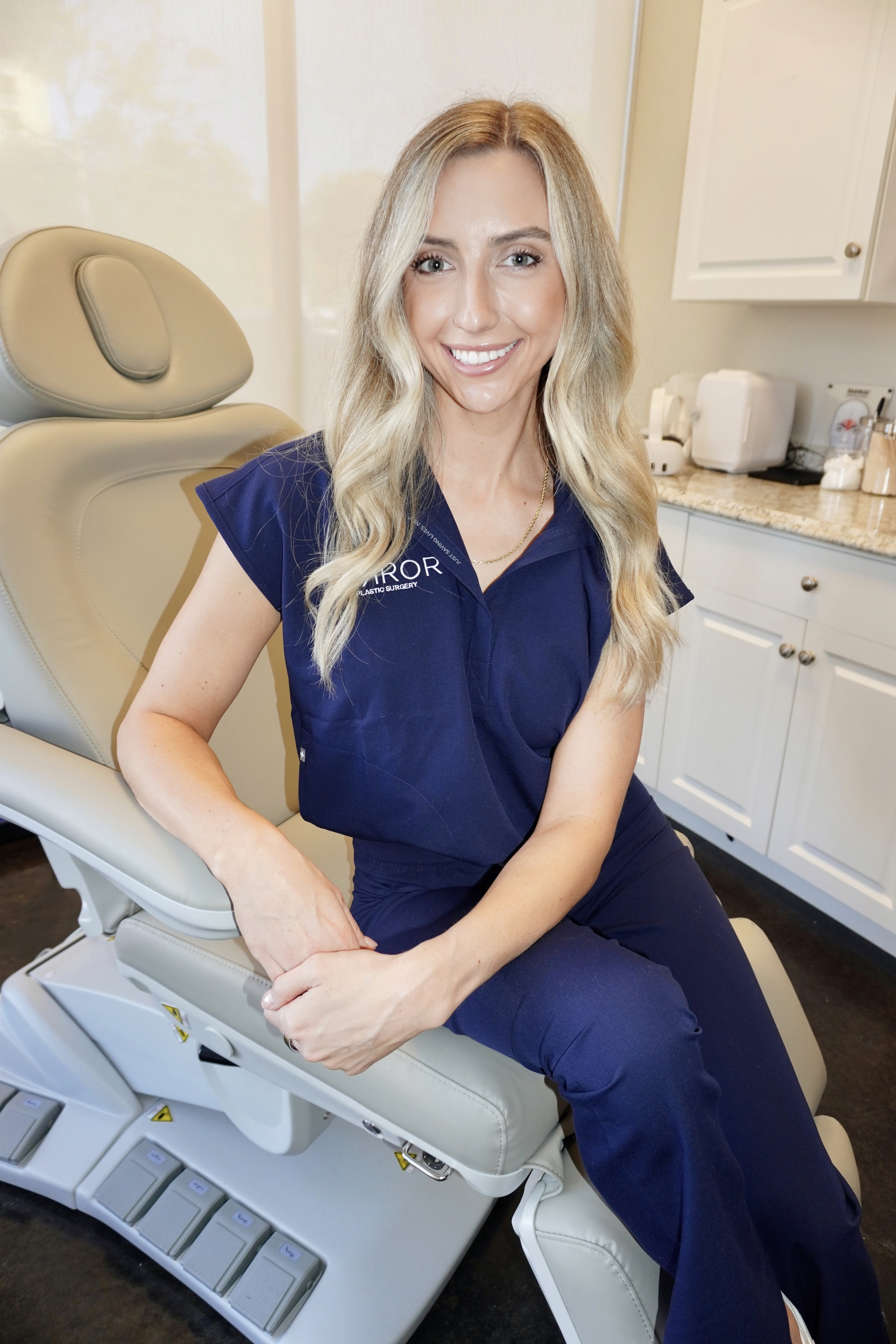
That clinical foundation shapes Mirror Plastic Surgery’s supplier-neutral approach. Product selection is based entirely on patient anatomy and treatment objectives, not on brand relationships or volume quotas. Consultations can extend up to one hour and cover the full perioral unit, emotional drivers for treatment, and realistic maintenance planning.
The following checklist outlines minimum standards for a qualified lip filler provider:
- Board-certified or licensed advanced practice credentials with documented aesthetic training
- Demonstrated knowledge of labial artery anatomy and vascular complication management
- Hyaluronidase available on-site for emergency reversal
- Supplier-neutral product selection based on patient anatomy, not brand affiliation
- Hour-long initial consultation with top-to-bottom anatomical assessment
- Evidence-based communication about realistic outcomes, risks, and maintenance
- Concierge-level follow-up access between appointments
- Willingness to recommend staged treatment or no treatment when appropriate
Comparing Common Lip Filler Techniques
| Technique | Primary Purpose | Preferred Instrument | Natural-Result Likelihood |
|---|---|---|---|
| Linear Threading | Continuous retrograde placement for uniform volume and border definition | Needle or cannula | High when conservative volume is used |
| Retrograde Fanning | Broad coverage from a single entry point, which minimizes punctures | Cannula preferred | High and often associated with reduced bruising and trauma |
| Micro-Droplet | Subtle definition, texture refinement, and superficial contour | Fine needle | Very high and known for preserving dynamic movement |
| Russian Technique | Vertical height, Cupid’s bow lift, and a heart-shaped front profile | Fine needle (29G) | Moderate to high, but highly technique-sensitive |
| Vermilion Border Definition | Restore a crisp border without a visible shelf in the subdermal plane | Needle | High when placed correctly and low when overfilled |
Book a consultation with Ellie at Mirror Plastic Surgery’s St. Petersburg location to determine which technique or combination of techniques fits your lip anatomy and goals.
Frequently Asked Questions
How long do lip fillers last, and what affects their longevity?
As noted earlier, lip fillers typically last six to twelve months. The lips are a high-movement area, and constant activity during speech, eating, and expression accelerates filler breakdown compared with lower-mobility facial zones. Factors that shorten longevity include smoking, frequent extreme heat exposure such as hot yoga or saunas, and prolonged sun exposure without SPF protection. Staged treatment across multiple sessions, rather than maximizing volume in a single visit, often produces results that settle more evenly and last more predictably. Ellie reviews realistic maintenance intervals during the initial consultation so you can plan ahead.
Is lip filler painful, and what should I expect during recovery?
Most patients describe lip filler as mildly uncomfortable rather than painful. Topical numbing cream is applied before treatment, and many filler products contain integrated lidocaine that further reduces discomfort during injection. Swelling peaks within the first 24–48 hours because of the lips’ rich blood supply and loose tissue structure, then eases noticeably by day three. Bruising occurs in approximately 30% of patients and typically resolves within one to two weeks. The final settled result is best assessed at two weeks. Patients with a history of cold sores should inform their provider before treatment, because needle trauma can trigger an outbreak, and antiviral medication started before the procedure reduces this risk.
What makes Mirror Plastic Surgery’s approach to lip filler different from other providers?
Mirror Plastic Surgery follows a concierge medicine model that dedicates up to one hour per consultation to a top-to-bottom anatomical assessment. Ellie evaluates the full perioral unit, including facial proportions, dynamic movement, and your long-term goals, before recommending any technique or product. The practice remains supplier-neutral, so product selection is based entirely on what suits each patient’s anatomy, not on brand relationships or volume incentives.
Ellie’s background combines 600 hours of esthetics training, a Master’s in Nursing, and four years of critical care experience. This training supports a clinical foundation that includes vascular risk recognition and emergency management. Patients often contrast this with high-volume practices where consultations are brief and technique selection follows a standardized template instead of an individualized plan.
Can lip filler be reversed if I do not like the result?
Lip fillers can be dissolved using an enzyme that breaks down the filler material. At Mirror Plastic Surgery, this enzyme is kept on-site as both a safety measure for vascular emergencies and a corrective option for patients who feel unhappy with their results. Reversal usually works within a few days, although some swelling from the dissolving process itself is expected. Ellie’s conservative, staged approach, which starts with lower volumes and reassesses results at two weeks before adding more, significantly reduces the likelihood of needing reversal by avoiding overcorrection.
How do I know which lip filler technique is right for my anatomy?
No single technique suits every patient. The right approach depends on your existing lip structure, the upper-to-lower lip ratio, the definition of your vermilion border and Cupid’s bow, the degree of dynamic movement in your lips, and your specific aesthetic goals. Patients with naturally thin lips and a flat Cupid’s bow may benefit from a combination of micro-droplet and border definition techniques. Patients who want more vertical lift with minimal forward projection may be candidates for Russian technique elements.
Patients with prior filler that has migrated may need dissolution before any new technique is applied. Ellie’s hour-long assessment at Mirror Plastic Surgery evaluates all of these factors before making a recommendation, so the technique selected respects your anatomy instead of overriding it.
Disclaimer: Results may vary from person to person. Editorial content, before and after images, and patient testimonials do not constitute a guarantee of specific results.
1 Results may vary from person to person. Editorial content, before and after images, and patient testimonials do not constitute a guarantee of specific results.