
Written by: Dr. Akash Chandawarkar, Board Certified Plastic Surgeon, Mirror Plastic Surgery | Last updated: June 26, 2026
Key Takeaways
- A quality BBL consultation focuses on your anatomy, waist-to-hip ratio, and clear communication instead of rushed, volume-driven promises.
- Tampa patients increasingly seek surgeons who prioritize safety, long-term fat retention, and proportionate results over quick, sales-focused visits.
- Evidence-based BBL planning follows a strict order: safety first, function second, aesthetics third for natural, lasting outcomes.
- Dr. Akash’s board certification, Johns Hopkins training, and ultrasound-guided technique set a high standard for individualized BBL care in Tampa.
- Schedule your personalized consultation at Mirror Plastic Surgery for a thorough, anatomy-focused evaluation tailored to your goals.
Why Tampa Patients Now Prioritize Consultation Depth
Tampa Bay patients researching Brazilian Butt Lift procedures now look beyond price and social media popularity. Many arrive with specific questions about fat-retention rates, placement technique, and safe surgical volume limits. This shift reflects growing national awareness of BBL safety and a desire for results that still look natural at five years, not just five weeks after surgery.1
Patients who have experienced rushed, template-driven consultations elsewhere now seek practices that treat evaluation as a clinical process. They want a structured visit that reviews health history, anatomy, and realistic goals instead of a brief sales conversation.
How Safety, Function, and Aesthetics Shape Your BBL Result
Evidence-based BBL planning follows a clear hierarchy: safety first, function second, aesthetics third. Safety includes pre-operative health screening, accredited surgical facilities, board-certified anesthesiology, and fat-placement protocols that lower vascular risk. Function focuses on how your new contour affects posture, movement, and long-term tissue health.
Aesthetics, or how your result looks, depends on getting safety and function right first. A consultation that starts with size goals before assessing anatomy reverses this order. That approach often produces results that look unnatural and age poorly.1
Meet Dr. Akash: Training and Experience Behind Your Consultation
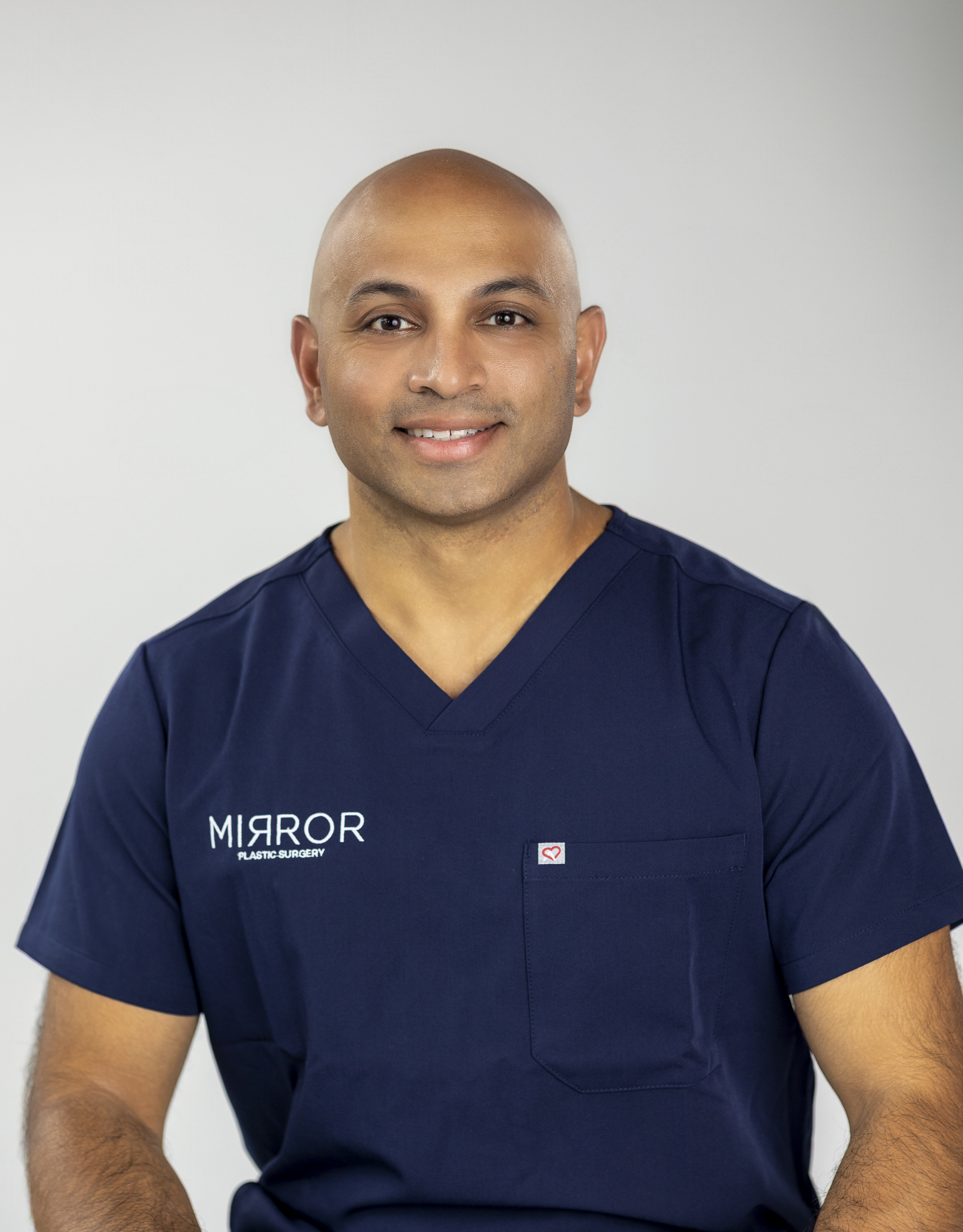
Mirror Plastic Surgery’s lead surgeon, Dr. Akash, holds board certification from the American Board of Plastic Surgery, the recognized credentialing authority for plastic surgery. He completed a seven-year integrated plastic and reconstructive surgery residency at Johns Hopkins University, one of the most rigorous programs in the world. He then completed an aesthetic surgery fellowship at the Manhattan Eye, Ear and Throat Hospital (MEETH), which provides advanced training in body contouring and facial rejuvenation.
His background also includes research and teaching experience at Harvard Medical School, which further supports his evidence-based approach to aesthetic surgery. In addition, Dr. Akash completed the Stanford University Biodesign Innovation Fellowship. This training helps him evaluate and adopt new surgical technologies using data and safety outcomes, not marketing claims.
He has been named in America’s Best Plastic Surgeons 2025 by Newsweek for two years in a row. His hospital privileges through Johns Hopkins-affiliated credentialing add a safety layer that high-volume outpatient-only practices cannot match.
Key Terminology for a Safer, More Informed BBL Consultation
Understanding the technical language used in BBL consultations helps you recognize whether a surgeon follows current safety standards or outdated habits. The terms below highlight concepts that separate safety-focused practices from volume-driven models.
Waist-to-hip ratio: A measurable anatomical proportion that guides a natural-looking BBL outcome. Planning around a target ratio, instead of a raw fat volume number, produces results that match your skeletal frame.1
Subcutaneous versus intramuscular placement: Fat grafted into the subcutaneous layer, above the gluteal muscle, carries a much lower vascular risk than intramuscular injection. The multi-society BBL safety task force recommends subcutaneous placement as the standard of care to reduce the risk of fat embolism.
Ultrasound guidance: Real-time intraoperative ultrasound lets the surgeon see the cannula position in relation to the muscle plane. This confirms subcutaneous placement throughout the procedure and turns a tactile judgment call into a documented safety step.
Fat-retention rates: Not all transferred fat survives. Retention depends on harvesting technique, processing method, injection volume per pass, and post-operative pressure management. Aggressive overfilling to offset expected loss increases the risk of fat necrosis and contour irregularities.
Florida BBL Rules and the Push for Long-Term Results
Florida sits at the center of national BBL safety reform. State rules on office surgery, including BBLs, require physician office registration with the Department of Health, ultrasound guidance during gluteal fat grafting, and limits on daily procedures. These rules do not restrict BBLs to board-certified plastic surgeons, so they set a minimum standard rather than a complete quality guarantee.
These regulations grew from adverse outcome data and now serve as a safety floor. Many patients in Tampa now ask for long-term outcome information during consultations. They want to know how results look at two and five years, not just at six weeks. Practices that cannot answer with specific clinical experience are not prepared to set realistic expectations.
Decision Factors to Review During Your BBL Consultation
A high-quality BBL consultation consistently covers several core elements.
- Surgeon credentials: Board certification by the American Board of Plastic Surgery is the baseline. Fellowship training in body contouring adds meaningful depth.
- Consultation duration: A thorough anatomical assessment, goal-setting discussion, and risk review require time. Consultations of forty-five minutes to one hour support individualized planning.
- Imaging and measurement tools: Ultrasound, body composition analysis, and photographic documentation support objective planning instead of guesswork.
- Daily surgical volume: The number of surgeries a practice performs per day affects how much attention each patient receives. Practices performing one to two surgeries daily can devote more pre-operative, intraoperative, and post-operative focus per patient than those performing five to ten.
- Placement protocol: Confirm that the surgeon uses subcutaneous-only placement and ultrasound guidance during the procedure.
High-Volume BBL Clinics vs. Concierge Care in Tampa
The following table contrasts red-flag consultation patterns with concierge-model protocols and shows how each factor affects safety and long-term results.
| Evaluation Factor | Red-Flag Behaviors | Concierge Protocol | Why It Matters |
|---|---|---|---|
| Consultation duration | Under 20 minutes, template-driven | 45–60 minutes, anatomy-specific | Short consultations skip individualized risk assessment |
| Daily surgical volume | 5–10 procedures per day | 1–2 procedures per day | Lower volume preserves team focus and reduces fatigue-related error |
| Fat placement protocol | Intramuscular or unspecified | Subcutaneous only, ultrasound-guided | Subcutaneous placement follows the multi-society safety standard |
| Goal-setting approach | Volume-first, social-media reference images | Waist-to-hip ratio, skeletal frame analysis | Proportionate goals support natural, lasting results |
What patients are really asking: Forum discussions among BBL patients often repeat the same concerns. Patients want to know whether results will still look natural in three years, how surgeons avoid injecting fat into the muscle, and how many surgeries a surgeon performs in a day. These questions focus on safety and longevity, and a thorough consultation should answer them clearly.
Misconceptions About BBL Volume and Long-Term Shape
More volume does not guarantee better results. Overfilling the gluteal region to offset expected fat loss increases pressure on surviving fat cells, raises the risk of fat necrosis, and often creates a shape that looks disproportionate from the start. As excess volume resorbs unevenly, the result can appear deflated and irregular.
A proportionately planned BBL, calibrated to your frame and realistic fat-retention capacity, usually looks better at five years than an overfilled result.1 Longevity depends on precise technique and thoughtful planning, not on maximum transfer volume.
Frequently Asked Questions
How long does a BBL consultation at Mirror Plastic Surgery typically take?
Dr. Akash’s consultations follow this individualized standard, covering a full anatomical assessment, a review of your health history, and a discussion of realistic goals based on body composition and skeletal frame. He also explains the surgical technique, including fat placement protocol, and reviews risks and recovery expectations in detail. This structured format keeps the focus on safety and long-term results rather than speed.
What makes ultrasound-guided BBL safer than traditional techniques?
Ultrasound guidance lets the surgeon visualize the cannula position in real time during fat injection. This confirms that fat stays in the subcutaneous layer, above the gluteal muscle, instead of entering or passing beneath the muscle. Intramuscular injection carries a higher risk of fat entering the gluteal blood vessels. Ultrasound reduces reliance on feel alone and creates a verifiable safety record for each procedure.
How should I prepare for a BBL consultation to get the most out of it?
Arrive with a clear sense of your proportional goals instead of a specific volume number. Reference images that show natural, frame-appropriate results help more than images focused only on size. Plan to discuss your weight history, any prior liposuction, and your post-operative lifestyle, including how long you can realistically limit sitting pressure on the buttocks.
Honest answers allow Dr. Akash to design a plan that matches your anatomy and recovery capacity.
What is a realistic timeline for BBL recovery and final results?
Initial swelling usually improves within four to six weeks. The final contour, which reflects fat that has integrated and developed a blood supply, typically appears between three and six months.1 Most patients plan for two to three weeks of modified activity and use a positioning cushion to avoid direct pressure on the grafted area.
Full return to exercise usually occurs at six to eight weeks, depending on individual healing and your surgeon’s guidance.1
How does Mirror Plastic Surgery’s daily surgical volume limit affect my care?
Mirror Plastic Surgery performs one to two surgeries per day. This limit concentrates the surgical team’s attention on a single patient at a time, from pre-operative preparation through intraoperative focus and immediate post-operative monitoring. Practices performing five to ten surgeries daily must divide that attention across many patients.
For a technique-sensitive procedure like BBL, where fat harvesting quality, processing, and injection precision all affect outcomes, concentrated focus directly supports safer, more consistent results.
The Value of an Informed BBL Evaluation
A BBL consultation serves as the clinical foundation for every decision that follows, including technique selection, volume planning, placement depth, and recovery protocol. Patients who enter surgery with a detailed, anatomy-specific plan usually have a smoother experience than those who arrive with only a volume target and a rushed approval.
Mirror Plastic Surgery’s concierge model exists to provide that level of planning. The practice limits surgery to one to two cases per day, offers hour-long consultations, uses ultrasound-guided technique, and is led by a surgeon whose credentials span Harvard Medical School, Johns Hopkins, MEETH, and recognition by Newsweek as one of America’s best. This structure supports safety, clarity, and natural, long-term results.
Book a consultation with Dr. Akash
1 Results may vary from person to person. Editorial content, before and after images, and patient testimonials do not constitute a guarantee of specific results.