
Written by: Ellie Pranckevicius, FNP-BC, Aesthetic Nurse Practitioner & Aesthetic Injector | Facial Restoration & Regenerative Injectable Specialist, Mirror Plastic Surgery | Last updated: June 29, 2026
Key Takeaways
-
Board certification through the American Board of Plastic Surgery, fellowship training, and ultrasound-guided fat injection now define baseline BBL safety in 2026.
-
High-volume clinics that perform five to ten procedures daily cannot match the individualized planning and monitoring offered by limited-volume practices.
-
Real-time ultrasound guidance during fat transfer reduces the risk of intravascular injection and fat embolism and now serves as the safety benchmark.
-
Both surgical fat transfer and non-surgical options using Radiesse or AlloClae are available, with candidacy based on anatomy, goals, and recovery tolerance.
-
Schedule a personalized assessment at Mirror Plastic Surgery to verify credentials and select the safest path for your body contouring goals.
How Top-Tier BBL Providers Stand Out in 2026
Premium BBL providers in 2026 follow three core standards. They hold board certification with fellowship-level aesthetic training, use ultrasound-guided fat injection, and maintain a patient volume model that supports detailed anatomical assessment. Practices that perform five to ten surgeries daily cannot provide the same pre-operative planning, intraoperative focus, or post-operative monitoring as those limiting themselves to one or two procedures per day. For Tampa Bay residents evaluating options, these structural differences offer the most reliable predictors of outcome quality and safety. The first step in spotting these differences is verifying the surgeon’s credentials before you schedule a consultation.
Surgeon Credential Verification Checklist for BBL Safety
Review the following credentials for any surgeon performing gluteal fat transfer before you move forward with scheduling.
-
Board Certification: Confirm certification through the American Board of Plastic Surgery (ABPS). This is the only board recognized for plastic and reconstructive surgery training in the United States.
-
Residency Training Institution: Residency at an academic medical center with a dedicated plastic surgery program signals rigorous, supervised training volume.
-
Aesthetic Fellowship: A post-residency fellowship in aesthetic surgery provides focused experience in body contouring, fat grafting, and cosmetic outcomes beyond standard residency exposure.
-
Continuing Education and Innovation Training: Surgeons who pursue medical device innovation or technique refinement training show an ongoing commitment to updated best practices.
-
Ultrasound Guidance Proficiency: Ask directly whether the surgeon uses real-time ultrasound guidance during fat injection. This now functions as a core safety standard for BBL.
-
Surgical Volume Per Day: A surgeon performing more than two BBL procedures daily has less time for individualized anatomical planning. Ask how many surgeries are scheduled on your procedure day.
At Mirror Plastic Surgery, Dr. Akash Chandawarkar meets every criterion on this checklist. He is a Harvard-educated physician, a Johns Hopkins-trained plastic surgeon, and a fellowship-trained aesthetic surgeon through the Manhattan Eye Ear & Throat Hospital (MEETH) and Lenox Hill Hospital in New York. He also completed medical device innovation training at Stanford University. Mirror Plastic Surgery follows a limited-volume model, which keeps the entire clinical team focused on each individual patient.
Verify Dr. Akash’s credentials and discuss your surgical options in a consultation.
Ultrasound-Guided Fat Transfer as the New Safety Baseline
Real-time ultrasound guidance during fat injection represents the most significant advancement in surgical BBL safety over the past several years. The primary risk in gluteal fat transfer has historically been inadvertent intravascular injection, where fat enters the gluteal vasculature and causes a fat embolism. Ultrasound guidance allows the surgeon to see the cannula tip in real time, confirm subcutaneous placement, and avoid deeper vascular structures throughout the injection process.
This technique requires specialized equipment and a trained eye to interpret intraoperative imaging accurately. High-volume practices with compressed surgical schedules are less likely to implement this protocol consistently. At Mirror Plastic Surgery, ultrasound-guided fat transfer forms a standard part of the surgical BBL protocol, not an optional add-on, and reflects a foundational priority of safety before aesthetics.
Surgical BBL vs Non-Surgical BBL: Choosing the Right Path
Not every patient qualifies for surgical fat transfer, and not every aesthetic goal requires surgery. The following table highlights four critical decision factors, including provider type, anesthesia needs, downtime, and mechanism of action, to help you see which approach fits your lifestyle and risk tolerance.
|
Factor |
Surgical BBL (Fat Transfer) |
Non-Surgical BBL (Radiesse / AlloClae) |
|---|---|---|
|
Provider |
Dr. Akash Chandawarkar, MD |
Ellie Pranckevicius, FNP-BC |
|
Anesthesia Required |
Yes (general or sedation) |
No (topical or none) |
|
Downtime |
Several weeks, sitting restrictions apply |
Minimal, return to activity same day |
|
Primary Mechanism |
Autologous fat harvested via liposuction, purified, and injected subcutaneously |
Biostimulatory fillers stimulate collagen and add structural volume |
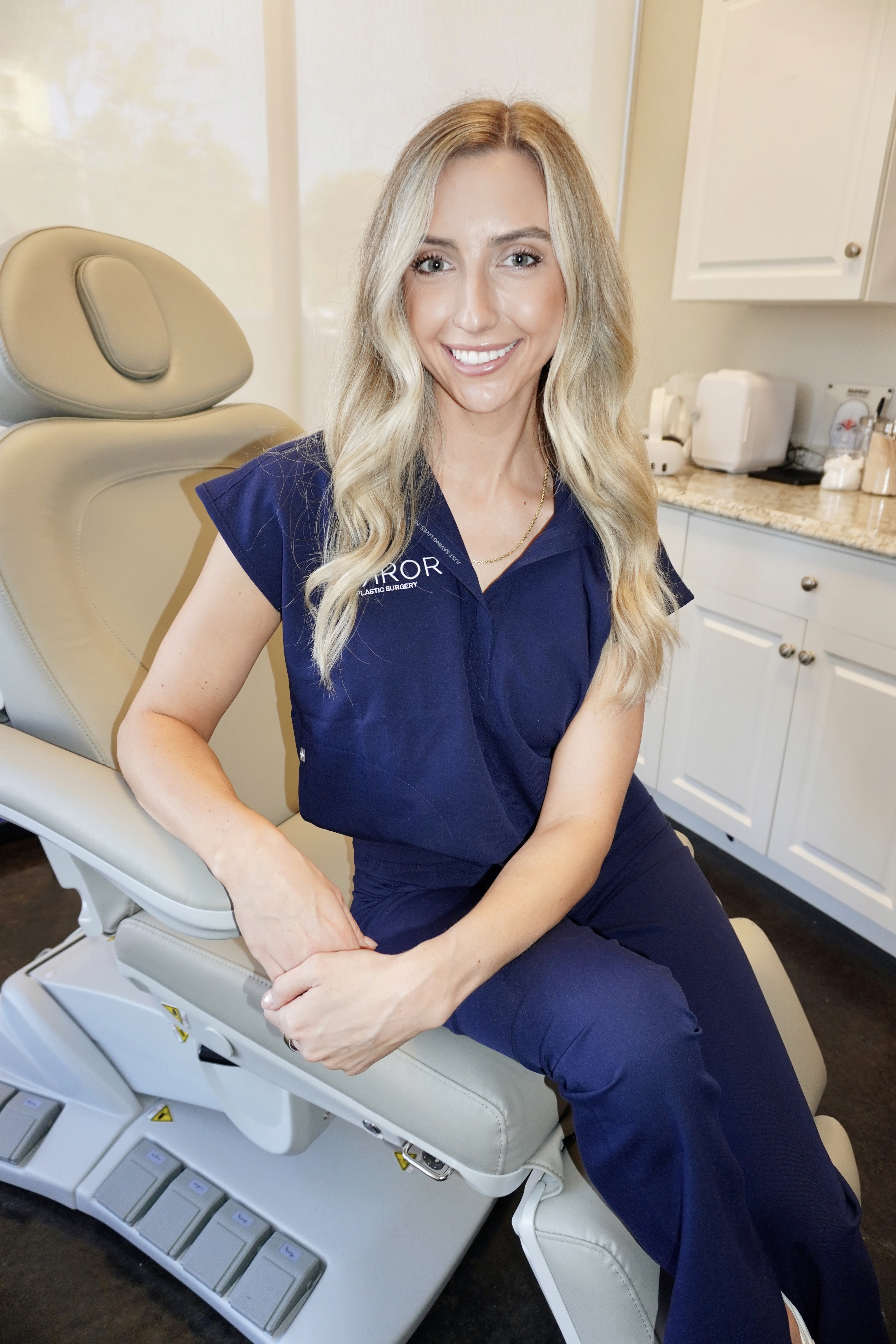
Ellie Pranckevicius, FNP-BC, leads non-surgical BBL services at Mirror Plastic Surgery using Radiesse and AlloClae. Radiesse is a calcium hydroxylapatite biostimulatory filler that adds immediate volume while stimulating the body’s own collagen production over time. AlloClae supports targeted contouring of the buttocks, hip dips, and adjacent areas. Ellie’s dual background in esthetics and advanced nursing, including four years in the Neuroscience ICU at Tampa General Hospital, gives her a clinical depth that sets her apart from standard injector training.
Explore non-surgical BBL options with Ellie in a personalized assessment.
Recovery Realities: Restrictions, Odor, and Healing Timeline
Surgical BBL recovery often dominates patient forums because the restrictions are specific and non-negotiable for optimal fat survival. Patients are typically advised to avoid direct pressure on the buttocks for a minimum of six to eight weeks after surgery. This guidance means sleeping prone or on the side, using a BBL pillow when seated, and avoiding prolonged sitting on hard surfaces. Driving remains restricted during this period as well.
Beyond these physical restrictions, patients often report another unexpected recovery experience that rarely appears in pre-operative discussions. A temporary odor during the healing phase is common and usually normal. This odor reflects a physiological response related to the breakdown of non-viable fat cells and the body’s inflammatory process. It resolves as healing progresses and does not indicate infection when other concerning symptoms are absent.
Full results from fat transfer typically appear at three to six months, once swelling has resolved and surviving fat cells have integrated.1 Fat survival rates vary based on surgical technique, adherence to sitting restrictions, and individual metabolic factors.1
Age, Anatomy, and Candidacy for BBL
Surgical BBL candidacy depends on anatomical, physiological, and psychological factors rather than age alone. Ideal candidates have sufficient donor fat for harvest, stable body weight, no active smoking history, and realistic expectations about outcomes. Patients who are significantly underweight may not have adequate fat volume for meaningful transfer.
Candidacy for non-surgical BBL with Radiesse or AlloClae is broader. Patients seeking subtle contouring, hip dip correction, cellulite reduction, or stretch mark improvement without surgery often match well with injectable approaches. Ellie conducts a thorough assessment during each consultation to determine which modality, or combination of modalities, fits each person’s anatomy and goals.
Downsides of BBL Surgery and Practical Ways to Reduce Risk
Honest candidacy assessment requires clear discussion of the documented downsides of surgical BBL. Fat reabsorption remains variable and unpredictable, and a portion of transferred fat will not survive regardless of technique.1 Asymmetry, contour irregularities, and prolonged swelling can occur.1 The sitting restriction period also disrupts daily life and professional schedules in a meaningful way.
The most effective risk mitigation strategy is choosing a provider whose surgical volume allows for individualized care. When a surgeon limits their schedule to one or two procedures per day, they gain time for thorough pre-operative anatomical mapping, precise intraoperative technique, and attentive post-operative monitoring. High-volume practices cannot offer the same depth of attention. Mirror Plastic Surgery’s limited-volume model follows this principle, and the extended pre-operative assessment ensures individualized planning rather than templated protocols.
Safety Protocol Comparison Table
The following comparison shows why surgical volume per day functions as a reliable proxy for individualized care. High-volume practices cannot deliver the same depth of assessment, monitoring, and intraoperative precision, regardless of marketing claims.
|
Safety Factor |
High-Volume Practice (5–10 surgeries/day) |
Mirror Plastic Surgery (1–2 surgeries/day) |
|---|---|---|
|
Ultrasound Guidance |
Variable, not always standard |
Standard protocol for all surgical BBL |
|
Pre-Op Assessment Time |
Typically 15–30 minutes |
Up to one hour, top-to-bottom |
|
Surgeon Credential Depth |
Varies widely |
Harvard/Johns Hopkins/MEETH fellowship-trained |
|
Post-Op Monitoring |
Standardized, less individualized |
Concierge-level, ongoing communication |
Frequently Asked Questions
Am I a candidate for a non-surgical BBL if I have very little body fat?
Yes. Non-surgical BBL with Radiesse or AlloClae does not require donor fat. These biostimulatory fillers add volume and stimulate collagen directly in the gluteal region, which makes them a viable option for patients who lack sufficient fat for surgical transfer. Ellie will assess your anatomy and goals during a full consultation to determine the appropriate approach and realistic outcomes for your body type.
How long do non-surgical BBL results last?
Results from Radiesse and AlloClae are not permanent but often last longer than many patients expect.1 Radiesse stimulates collagen production that continues beyond the initial filler absorption, so structural improvement can persist after the product itself has metabolized. Longevity varies based on individual metabolism, lifestyle, and the volume of product used.1 Maintenance sessions are typically recommended to sustain and build on results over time.
What is the difference between a board-certified plastic surgeon and a cosmetic surgeon for BBL?
Board certification through the American Board of Plastic Surgery requires completion of an accredited plastic surgery residency and passage of written and oral examinations. The term “cosmetic surgeon” is not a protected designation and does not require the same training pathway. For a procedure like BBL, where anatomical precision and safety protocols are critical, verifying ABPS certification and fellowship training remains essential.
Can I combine a surgical BBL with non-surgical treatments?
In some cases, yes. Surgical fat transfer addresses overall volume and projection, while non-surgical options like AlloClae can refine specific areas such as hip dips or address surface-level concerns like cellulite and stretch marks. Dr. Akash and Ellie collaborate within Mirror Plastic Surgery to develop integrated treatment plans when combination approaches better serve a patient’s goals than either modality alone.
What should I ask during a BBL consultation to assess provider safety standards?
Ask whether the surgeon uses real-time ultrasound guidance during fat injection, how many surgeries are performed on the day of your procedure, what the surgeon’s specific fellowship training covered, and what the post-operative monitoring protocol includes. A provider who answers these questions directly and without hesitation demonstrates the transparency that safe practice requires.
Conclusion: Choosing the Safest BBL Path in Tampa Bay
Choosing a BBL provider in the Tampa Bay area in 2026 deserves the same rigor you would apply to any significant medical decision. Credential verification, ultrasound-guided technique, and a practice model that limits surgical volume form three reliable indicators of a provider who prioritizes safety and outcomes over throughput. Mirror Plastic Surgery’s volume restrictions, extended assessments, and the credential-verified expertise of Dr. Akash Chandawarkar and Ellie Pranckevicius create a standard of care that high-volume clinics cannot structurally match.
Whether you are considering surgical fat transfer or non-surgical contouring with Radiesse and AlloClae, your first step should be an honest, unhurried conversation about your anatomy, your goals, and the evidence behind your options.
Schedule your one-hour assessment at Mirror Plastic Surgery to determine your safest path forward.
Disclaimer: Results may vary from person to person. Editorial content, before and after images, and patient testimonials do not constitute a guarantee of specific results.
1 Results may vary from person to person. Editorial content, before and after images, and patient testimonials do not constitute a guarantee of specific results.