
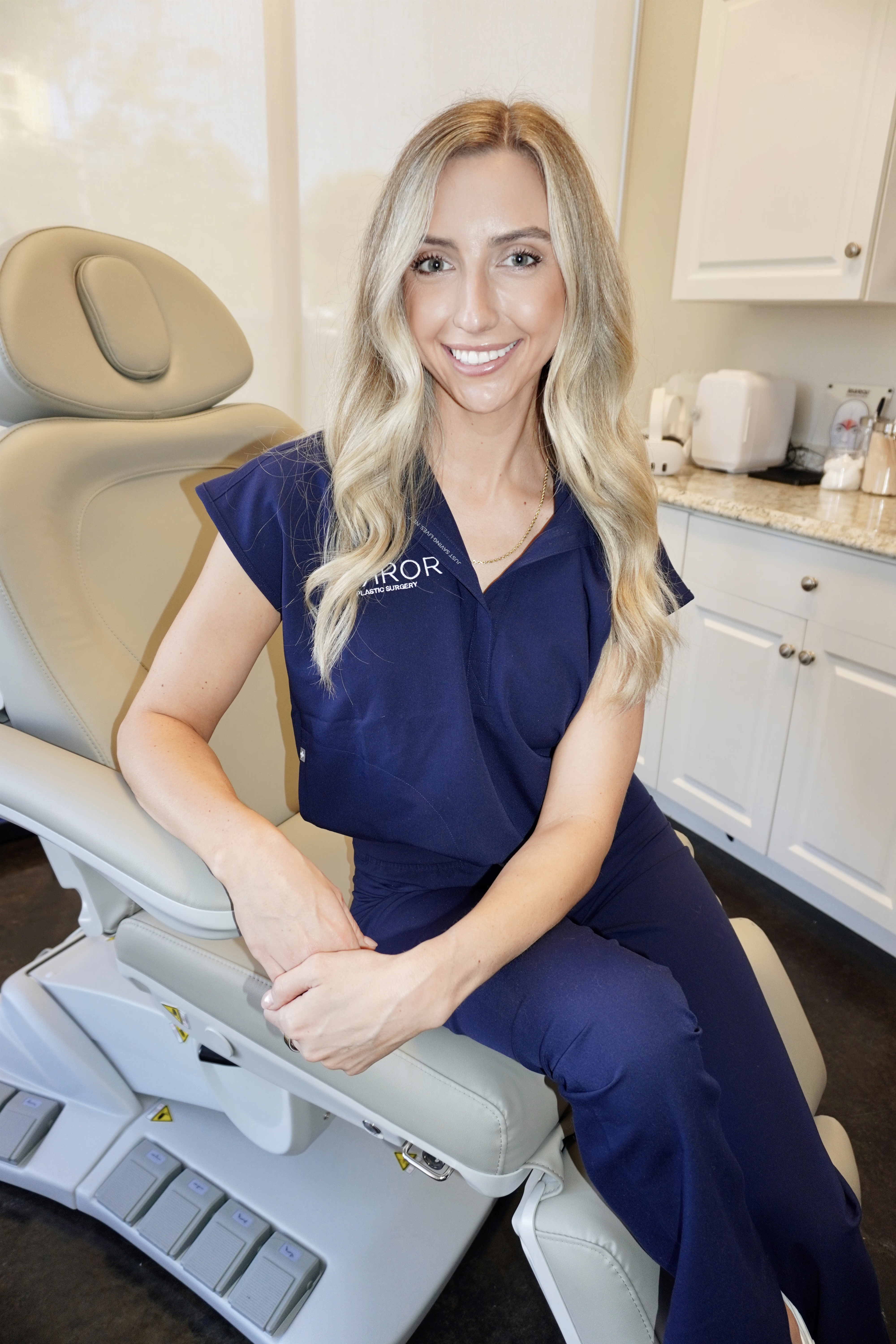
Written by: Ellie Pranckevicius, FNP-BC, Aesthetic Nurse Practitioner & Aesthetic Injector | Facial Restoration & Regenerative Injectable Specialist, Mirror Plastic Surgery | Last updated: July 19, 2026
Key Takeaways
- A natural lip result in 2026 means subtle enhancement that you notice, but others see only as “refreshed,” not “filled.”
- Full-face assessment and precise technique matter more than brand alone, because isolated lip treatment often looks overdone.
- RHA 2/3, Restylane Kysse, Juvederm Volbella, and Restylane Silk perform well for natural movement and low migration at 0.5–1 mL.
- Migration risk drops when your injector uses high-cohesivity products, correct plane placement, and a strict two-week wait before touch-ups.
- Patients who want natural lip enhancement can schedule a full-face, supplier-neutral consultation with Ellie Pranckevicius at Mirror Plastic Surgery.
Why Full-Face Assessment and Technique Shape Natural Results
Natural-looking lips start with how your entire face is evaluated, not with a specific syringe on the tray. Product choice only works when it fits your anatomy and expression.
At Mirror Plastic Surgery, every lip consultation with Ellie Pranckevicius includes a one-hour, top-to-bottom facial assessment. This comprehensive evaluation examines lip architecture at rest and in motion, smile dynamics, dental inclination, facial proportions, and perioral muscle activity before any product is selected or injected. A thorough pre-injection full-face assessment must evaluate lip architecture at rest and in motion, smile dynamics, dental inclination, symmetry, and perioral muscle activity to ensure natural results and avoid asymmetry. Treating the lips in isolation, without this full-face context, often creates the disproportionate or “overdone” appearance many patients want to avoid.
In a retrospective study of 216 female patients spanning 2017–2023 by Buhsem (published 2024), the top-to-bottom needle injection technique achieved greater patient satisfaction and better control of filler migration than bottom-to-top or lateral-to-medial techniques.1 Ellie’s approach applies this evidence directly. She combines sharp needles for precise vermilion border and Cupid’s bow definition with blunt cannulas for safer body volumization, as recommended in the 2026 Sharad and Singh narrative review in the Journal of Cutaneous and Aesthetic Surgery.
Mirror Plastic Surgery is supplier-neutral, so Ellie selects products based on your anatomy and goals, not brand quotas or commission structures.
Book a consultation with Ellie to start with a full-face assessment tailored to you.
Top Lip Filler Choices After Your Assessment
Once your full-face assessment defines your anatomy and goals, product selection becomes the next key decision. Rohrich et al. (Plast Reconstr Surg Glob Open, 2026) state that fillers with a high dynamic range of G’ maintain volumization under facial movement without fragmentation, enabling natural aesthetic outcomes in dynamic superficial fat compartments. For the lips, which move constantly and have thin tissue, Ellie prioritizes fillers with low elastic modulus, high cohesivity, and strong stretch capacity.
The following table compares four leading fillers by estimated duration and typical starting volume. All data points come from cited clinical sources.
| Filler | Duration | Typical Starting Volume |
|---|---|---|
| RHA 2 / RHA 3 | Up to 15 months for dynamic wrinkles and folds and up to 12 months for lip augmentation | 0.5–1 mL |
| Restylane Kysse | Restylane Kysse lasts between 6 and 12 months in most cases | 0.5–1 mL |
| Juvederm Volbella | Up to 12 months | 0.5 mL |
| Restylane Silk | Restylane Silk duration is 6–10 months | 0.5–1 mL |
RHA 2/3 offers excellent stretch capacity for dynamic zones, which suits patients with very expressive faces. Restylane Kysse uses XpresHAn flexible gel technology, and 96% of subjects in clinical studies rated their lips as looking natural.1 Juvederm Volbella’s low-viscosity Vycross formula provides a soft, subtle feel that works well for gentle enhancement and perioral lines, while Restylane Silk’s small particle size supports precise shaping of the vermilion border and Cupid’s bow.
Research in JAMA Facial Plastic Surgery (2017) using morphed images and focus-group rankings found that the most attractive lips showed a 1:2 upper-to-lower lip ratio. Product choice should respect these proportions instead of forcing a one-size-fits-all template.
Migration Risks and Why the 2-Week Wait Protects Your Result
Migration of lip filler means gradual displacement of filler beyond the intended boundary, often creating a blurred vermilion border or fullness above the lip line. Migration usually reflects technique and product selection, not bad luck.
The 2026 Sharad and Singh review identifies precise plane placement, avoidance of overfilling, and high-cohesivity products as key factors for minimizing migration risk in lip augmentation. Targeted compartmental injections reduce migration risk, while overfilling or placement in the SMAS layer can cause spread, backflow, or animation deformity during movement.
A critical safeguard is the two-week wait rule. No touch-up or additional volume should be added until at least 14 days after the initial treatment. Injected filler volume can persist beyond the usual 6–12 month window of visible effect, so early retreatment increases cumulative overfilling risk. Swelling in the first two weeks can hide the true result, and adding volume before it settles often produces an overdone look.
When migration or misplacement occurs, an enzyme can cleave the glycosidic bonds of cross-linked filler, dissolving migrated or misplaced product within hours and restoring natural contours, while native tissue typically replenishes within 15–20 hours through endogenous biosynthesis. Mirror Plastic Surgery keeps this reversal agent on site for immediate use.
Tailored Lip Filler Choices for Older or Thin Lips
Mature lips need a different strategy than young, full lips. In patients over 40, collagen and tissue volume decline in lip tissue, and UV damage or smoking further weaken tissue quality. The focus shifts from adding size to restoring definition and hydration.
For border definition in mature lips, less than 0.25 mL of filler along the vermilion border with a slow threading technique can restore shape without creating a duck-lip deformity. Juvederm Volbella and Restylane Silk both work well for this approach. Juvederm Volbella XC supports subtle volume and smooths fine lines around the mouth, while Restylane Silk provides precise border and Cupid’s bow definition in patients over 50.
Ellie’s full-face assessment is especially valuable for mature patients. Changes in bone support, soft tissue position, and surrounding facial volume all influence how the lips appear. Treating only the lips, without addressing midface volume loss or perioral changes, often produces an unbalanced look.
Consultation Red Flags and Safe Starting Volumes
Rushed consultations often follow a predictable pattern. Patients describe a quick intake, an instant product recommendation, and pressure to buy multiple syringes in one visit.
Red flags of a volume-driven or rushed consultation include:
- No assessment of lip movement, smile dynamics, or facial proportions before treatment
- Recommending more than 1 mL at a first session without clear clinical reasoning
- No discussion of the two-week wait rule or a gradual, staged plan
- Inability to explain which product is being used and why it fits your anatomy
- No hyaluronidase available on site for emergency reversal
- Pressure to treat multiple areas in the same appointment without prior assessment
Modern best practice for natural lip enhancement uses 0.5–1.0 mL of filler for a first treatment and builds gradually over multiple sessions while respecting your baseline anatomy. For thin lips, 0.5 mL is the usual starting point because thin tissue has limited elasticity and excess volume can stretch tissue or compress vessels. A follow-up evaluation at 10–14 days, as outlined in the migration section, helps determine whether any refinement is needed once swelling resolves.
Aftercare Steps That Support Natural, Long-Lasting Results
Evidence-based aftercare influences how natural your lips look and how long your results last. Swelling usually follows a predictable pattern. Day 1 often brings immediate fullness and tightness, Days 2–3 show peak swelling and possible bruising, Days 5–7 reveal a softer, more natural look, and Days 8–14 show the settled result.
Recommended aftercare steps include:
- Apply ice packs wrapped in cloth for 5–10 minutes at a time during the first 48 hours, and sleep with your head elevated on an extra pillow for the first few nights.
- Avoid pressing, squeezing, massaging, or kissing the lips for one week, and skip straws because suction can shift the filler.
- Avoid hot drinks, alcohol, smoking, heavy exercise, and saunas or hot tubs for 1–2 weeks to limit swelling, inflammation, and migration risk.
- Stay well-hydrated, since drinking plenty of water helps hyaluronic acid fillers attract and retain moisture for a plump, natural look.
- Schedule your follow-up evaluation at 10–14 days, as discussed in the migration section, so any touch-up decision happens after swelling has settled.
For long-term maintenance, scheduling maintenance at 10–12 months, when about 60–70% of volume remains, supports stable, natural contours and extends overall filler longevity compared with waiting for full dissolution. Returning before everything fades usually means less product per session and lower cumulative overfilling risk.
Frequently Asked Questions
- Which lip filler migrates the least?
Migration mainly depends on technique and product cohesivity, not brand alone. High-cohesivity fillers placed in the correct plane at conservative volumes carry the lowest migration risk. Among common options, RHA 2/3 and Restylane Kysse are often cited for resistance to spreading because of their dynamic cohesivity properties. Even so, any product can migrate if it is overfilled or placed in the wrong tissue layer. A full-face assessment and adherence to the two-week wait rule before touch-ups provide the most reliable protection.
Hyaluronic acid fillers are considered the safest category for lip augmentation. They are fully reversible with an enzyme, integrate well with lip tissue, and have a strong safety record. Calcium hydroxylapatite and poly-L-lactic acid carry higher risks of nodules, asymmetry, and vascular compromise in the lips, so they are not recommended for this area. Within the HA category, the gentlest approach pairs a soft, high-cohesivity product with a 0.5 mL starting volume, precise plane placement, and an experienced injector who keeps the reversal agent on site.
Mature lips benefit most from restored definition and hydration rather than large volume increases. Juvederm Volbella and Restylane Silk both support this goal. Volbella’s low-viscosity Vycross formula adds subtle volume and smooths perioral lines without an overfilled look. Restylane Silk’s small particle size allows precise border and Cupid’s bow definition. Both should be used at conservative volumes, often less than 0.25 mL along the vermilion border to start, and always within a full-face assessment that considers surrounding tissue changes.
The visible effect of lip fillers usually lasts 6–12 months, although the material itself can remain longer.1 Duration varies with product type, metabolism, activity level, and whether you already have a filler foundation from prior treatments. First-time patients often notice faster fading, around 4–6 months, because their tissue lacks a structural base.1 A maintenance visit at 10–12 months, before full dissolution, can extend longevity and reduce the amount of filler needed per session. Patients with very fast metabolisms or intense activity levels may need earlier maintenance.
A qualified injector for natural lip enhancement will complete a thorough consultation that includes your lips at rest and in motion, your smile dynamics, and full facial proportions before recommending any product. They should clearly explain which filler they recommend and why it fits your anatomy. They should discuss starting volumes, the two-week wait rule, and a gradual plan. They should also keep the reversal agent on site. At Mirror Plastic Surgery, Ellie Pranckevicius brings a dual background in esthetics and advanced nursing, including four years in a Neuroscience ICU, along with oversight from Harvard-educated, Johns Hopkins-trained plastic surgeon Dr. Akash Chandawarkar.
Conclusion: Partnering With the Right Practice for Subtle Lips
The best lip filler for a natural look does not come from a single brand. It comes from an injector’s assessment process, anatomical knowledge, product reasoning, and commitment to conservative, staged outcomes. Evidence consistently supports high-cohesivity fillers such as RHA 2/3, Restylane Kysse, Juvederm Volbella, and Restylane Silk as strong options, each suited to specific anatomies and goals. The difference between effortless and overdone often lies in the hour spent on assessment before any needle touches your lips.
Mirror Plastic Surgery’s concierge model serves patients who have experienced rushed, volume-driven care or results that needed correction. Ellie Pranckevicius offers a full-face, supplier-neutral approach grounded in clinical evidence and direct, honest communication, which reflects the standard of care across the practice.
Disclaimer: Results may vary from person to person. Editorial content, before and after images, and patient testimonials do not constitute a guarantee of specific results.
1 Results may vary from person to person. Editorial content, before and after images, and patient testimonials do not constitute a guarantee of specific results.