
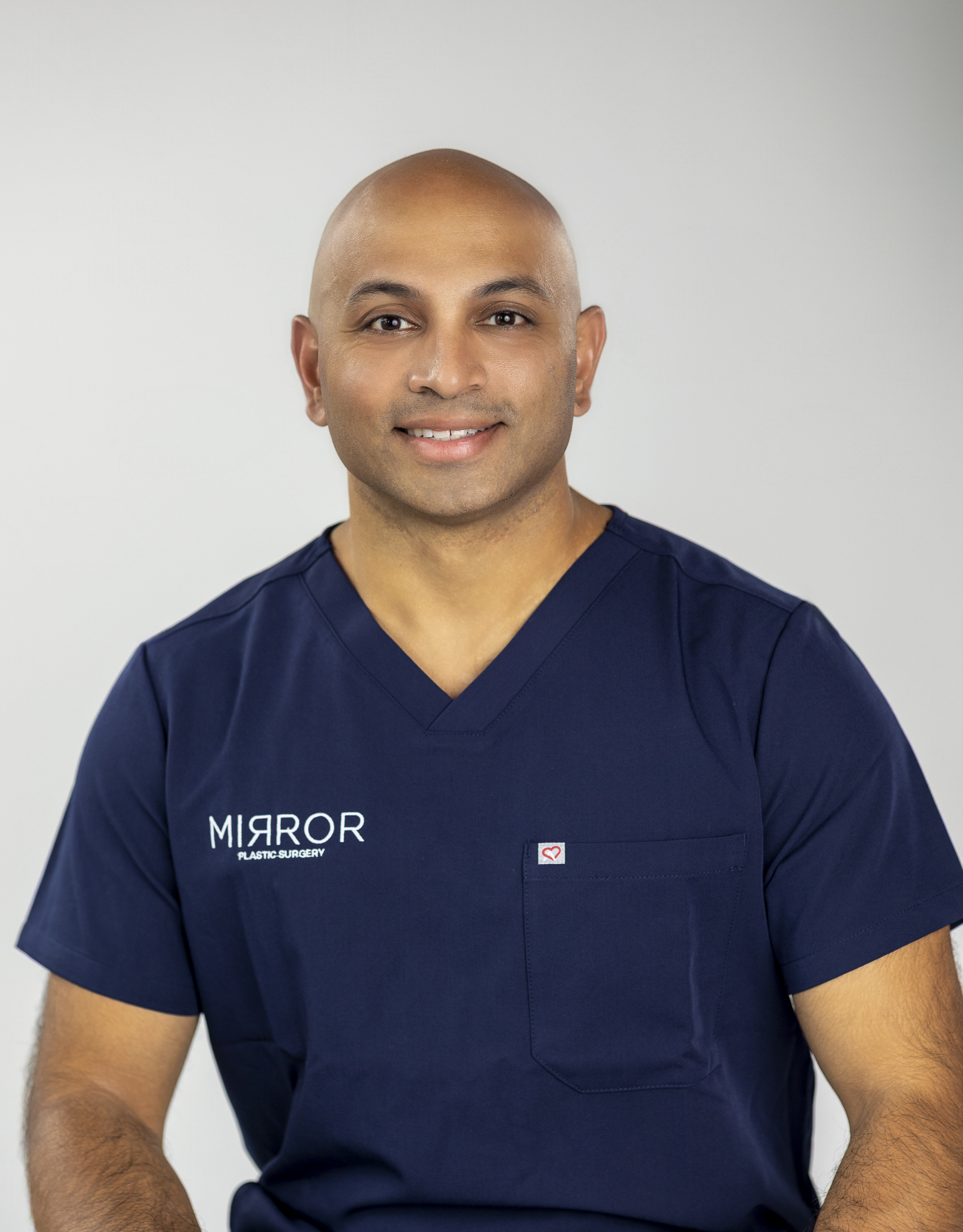
Written by: Dr. Akash Chandawarkar, Board Certified Plastic Surgeon, Mirror Plastic Surgery | Last updated: July 4, 2026
Key Takeaways
- Breast augmentation works best as an anatomy-based decision that starts with a structured, education-first consultation. This approach supports proportionate, long-lasting results and lowers revision risk.1
- The 45/55 breast rule guides natural-looking outcomes by placing 45% of volume above the nipple and 55% below. This ratio helps avoid the overly augmented appearance that comes from poor implant selection or placement.
- Base-width measurement, implant profile, tissue-pinch testing, and placement decisions (submuscular vs. subglandular) are key variables. These choices determine whether results look natural or later need correction.
- Patients should avoid red-flag consultations such as rushed visits under 30 minutes, cup-size-first sizing, or surgeons without board certification. Instead, they should ask detailed questions about revision rates, long-term monitoring, and implant integrity.
- Schedule a personalized anatomical evaluation at Mirror Plastic Surgery for a concierge-level consultation with Dr. Akash that focuses on safety, function, and natural aesthetics.
How the 45/55 Breast Rule Shapes Natural Results
The 45/55 breast rule is an anatomical guideline that defines ideal breast volume distribution as 45% of volume in the upper pole above the nipple and 55% in the lower pole below it. This balance produces a gently sloped upper contour, a fuller rounded lower pole, and a nipple that points slightly upward. Deviating from this ratio through oversized implants, high-profile selections, or subglandular placement often creates the “obviously augmented” appearance most patients want to avoid.
Implants usually take 3–6 months to fully settle into the final 45/55 ratio.1 Extra upper-pole fullness in the first 4–12 weeks is normal and does not signal a permanent problem.1
How Implant Profile, Projection, and Placement Shape Your Outcome
Base-width measurement is the starting point for safe, natural sizing. Breast base width (BWD) varies among women, and the implant diameter is chosen to match or sit just inside the patient’s individual measurement before profile is selected. This precision matters because selecting an implant wider than the natural base width pushes volume toward the armpits or sternum and disrupts proportionality.
Profile selection follows base-width measurement and controls how volume projects forward. High-profile implants have a narrower base and greater forward projection, which concentrates volume and enhances upper-pole fullness. They suit patients with naturally narrow chests or closely spaced breasts. Moderate-profile implants have a wider base and softer projection, which makes them better for patients with wider chests who prefer a gentler slope.
Beyond base width and profile, existing tissue coverage guides placement decisions. The tissue-pinch test is performed during consultation to assess this coverage. Coverage less than 2 cm often favors submuscular placement to reduce rippling and help maintain the 45/55 ratio.
Placement directly influences upper-pole appearance and the chest-to-breast transition. Submuscular placement creates a softer slope along the upper breast and a more natural shift from chest to breast tissue. Subglandular placement tends to produce more upper-pole fullness and works better for patients with adequate existing tissue coverage.
Choosing Between Implants and Fat Transfer for Breast Enhancement
| Factor | Implant-Based Augmentation | Fat Transfer (e.g., AlloClae) |
|---|---|---|
| Volume increase | Significant volume increase depending on frame and implant selection | Approximately 1 cup size of natural volume |
| Candidacy requirement | FDA-approved silicone for women 22+; saline for women 18+ | Sufficient donor fat available for harvest |
| Long-term monitoring | Ultrasound or MRI starting at 5–6 years, every 2–3 years thereafter | Routine mammography schedule |
| Revision complexity | Revision is more technically demanding than primary augmentation | Secondary grafting may be needed if transferred fat does not fully integrate |
For Tampa patients with active lifestyles such as running, yoga, or high-intensity training, moderate implant sizes in the 250–325 cc range often provide visible enhancement without limiting physical activity. Fat transfer works best for patients who want subtle refinement rather than a large volume change and who have adequate donor sites. Mirror Plastic Surgery offers fat transfer using AlloClae, a technology that improves fat integration compared with traditional grafting methods.
Red Flags to Avoid in Tampa Breast Augmentation Consultations
- Consultations under 30 minutes. A thorough anatomical evaluation that includes base-width measurement, tissue-pinch testing, placement discussion, and implant selection cannot be completed responsibly in a rushed visit.
- High daily surgical volume. Practices performing 5–10 surgeries per day divide team attention across multiple patients at once, which reduces the focused oversight each case deserves.
- Cup-size-first sizing methods. Surgeons should use chest width, tissue thickness, and the 45/55 ratio to select implant size, not a chart number or cup-size goal.
- No discussion of revision risk. A significant number of breast revision surgeries occur because patients later want a larger size after their initial augmentation. This pattern highlights the value of proportionate planning from the beginning.
- Absence of implant-specific imaging guidance. The FDA recommends periodic ultrasound or MRI screenings for silicone breast implants. Any surgeon who does not address long-term monitoring is skipping a critical safety conversation.
- No board certification in plastic surgery. Board certification by the American Board of Plastic Surgery is the baseline credential for performing breast augmentation safely.
Essential Questions to Ask Any Breast Surgeon
- Are you board certified by the American Board of Plastic Surgery, and do you hold hospital privileges?
- How many breast augmentations do you perform per day, and how many per year?
- How do you measure base width and tissue thickness, and how do those measurements guide implant selection?
- What is your approach to the 45/55 ratio, and how do you apply it to my specific anatomy?
- What implant brands and surfaces do you use, and why?
- What is your revision rate, and what are the most common reasons your patients return for revision?
- What placement technique do you recommend for my anatomy, and what are the trade-offs?
- How do you monitor implant integrity over time, and what imaging do you recommend?
- What happens if I develop a complication, and do you have hospital access to manage it?
- Can I see before-and-after photos of patients with a similar body type and goals to mine?
Plan a one-on-one consultation with Dr. Akash and bring this checklist so every question can be addressed during a thorough session.
Mirror Plastic Surgery’s Concierge Consultation Model
Mirror Plastic Surgery typically spends up to an hour in consultation with each patient. The appointment covers base-width measurement, tissue-pinch testing, placement options, implant profile selection, long-term monitoring requirements, and a clear discussion of what proportionate enhancement looks like for each patient’s frame.
The practice follows a safety-function-aesthetics hierarchy. Safety is non-negotiable, function is evaluated before aesthetics, and aesthetic outcomes are achieved by restoring underlying anatomy rather than overriding it. This sequence lowers the risk of animation deformity, capsular contracture, and revision surgery.
Mirror Plastic Surgery limits surgical volume to one to two procedures per day, a deliberate constraint that stands in contrast to the high-volume model flagged earlier. This structure ensures that the full surgical team, not a rotating staff, remains focused on each patient before, during, and after the procedure. All surgeries take place in accredited facilities with board-certified physician anesthesiologists.
Dr. Akash’s Training and Professional Leadership
Dr. Akash completed undergraduate studies in neuroscience and nuclear engineering at MIT before earning his M.D. with Honors from Harvard Medical School through the Harvard-MIT Division of Health Sciences and Technology. His surgical training was a seven-year integrated plastic and reconstructive surgery residency at Johns Hopkins University, which included rotations at the Johns Hopkins Hospital, the R Adams Cowley Shock Trauma Center, and the Curtis National Hand Center.
After residency, Dr. Akash completed an aesthetic surgery fellowship at the Manhattan Eye, Ear and Throat Hospital (MEETH), one of the most competitive programs in the country for advanced breast, facial, and body contouring techniques. He also completed the Stanford University Biodesign Innovation Fellowship, training in medical device development alongside engineers and clinicians in Silicon Valley.
Dr. Akash was selected to testify before the U.S. Food and Drug Administration on breast implant safety, serves on the advisory board for Motiva (breast augmentation technology), and sits on the editorial board of the Aesthetic Surgery Journal. He has been named to Newsweek’s America’s Best Plastic Surgeons list two years in a row, including 2025. He is board certified by the American Board of Plastic Surgery and licensed in Florida, New York, and Pennsylvania.
Frequently Asked Questions
How long is recovery after natural-looking breast augmentation?
Most patients return to light daily activity within one to two weeks after breast augmentation.1 Strenuous exercise, heavy lifting, and high-impact activity are usually restricted for four to six weeks. Final results, including full implant settling into the 45/55 ratio, appear at three to six months.1 Patients who choose submuscular placement may feel more initial chest tightness than those with subglandular or supramuscular placement, although this eases as the muscle adapts. Recovery timelines vary based on anatomy, implant size, and placement technique and are reviewed in detail during the consultation.
How should I evaluate before-and-after photos?
Focus on patients whose pre-operative anatomy resembles yours, including chest width, existing breast tissue, and body frame. Check whether the results look proportionate to the patient’s overall build rather than simply large. Assess upper-pole slope, since a natural result shows a gradual transition from chest to breast, not a shelf-like fullness. Confirm that nipple position appears centered on the breast mound. Ask the surgeon whether the photos represent typical outcomes or selected best cases, and request images at multiple time points, such as immediately post-operative and at six to twelve months, to see how results evolve as implants settle.
What long-term maintenance do breast implants require?
Breast implants are not lifetime devices. Most implants last between 10 and 20 years before replacement may be needed because of normal wear, rupture, or changes in personal preference.1 The FDA recommends ultrasound or MRI monitoring for silicone implants beginning at five to six years after surgery and every two to three years after that. Patients should also maintain routine mammography on the schedule recommended by their primary care physician and inform the imaging technician about their implants so appropriate views can be obtained. Any change in breast shape, firmness, or symmetry should prompt evaluation.
When is fat transfer preferred over implants?
Fat transfer works best for patients seeking a modest, natural volume increase of about one cup size who have adequate donor fat available from areas such as the abdomen, flanks, or thighs and who want to avoid a foreign implant device. It also serves as a useful adjunct for patients undergoing implant revision who need improved soft-tissue coverage. Fat transfer does not suit patients who want a large volume change, those with very limited donor fat, or those who want predictable, durable volume without the variability of fat retention. Not all transferred fat permanently integrates, and a secondary grafting session may be needed to reach the target result. Mirror Plastic Surgery uses AlloClae for fat transfer to the breast, a technology designed to improve fat integration compared with traditional grafting methods.
Conclusion: Why Education and Anatomy-First Planning Matter
A natural-looking breast augmentation outcome depends on anatomical measurement, proportionate implant selection, appropriate placement, and a surgeon whose case volume allows true focus on each patient. The 45/55 rule, base-width measurement, tissue-pinch testing, and profile selection are essential variables that shape whether a result looks natural or later needs revision. Patients who enter surgery with a clear understanding of these factors, and who choose a surgeon willing to explain them in depth, consistently achieve more satisfying and longer-lasting outcomes.
Experience a comprehensive anatomy-first evaluation with Dr. Akash at Mirror Plastic Surgery in St. Petersburg, Florida, built around your goals, your measurements, and your long-term well-being.
1 Results may vary from person to person. Editorial content, before and after images, and patient testimonials do not constitute a guarantee of specific results.