
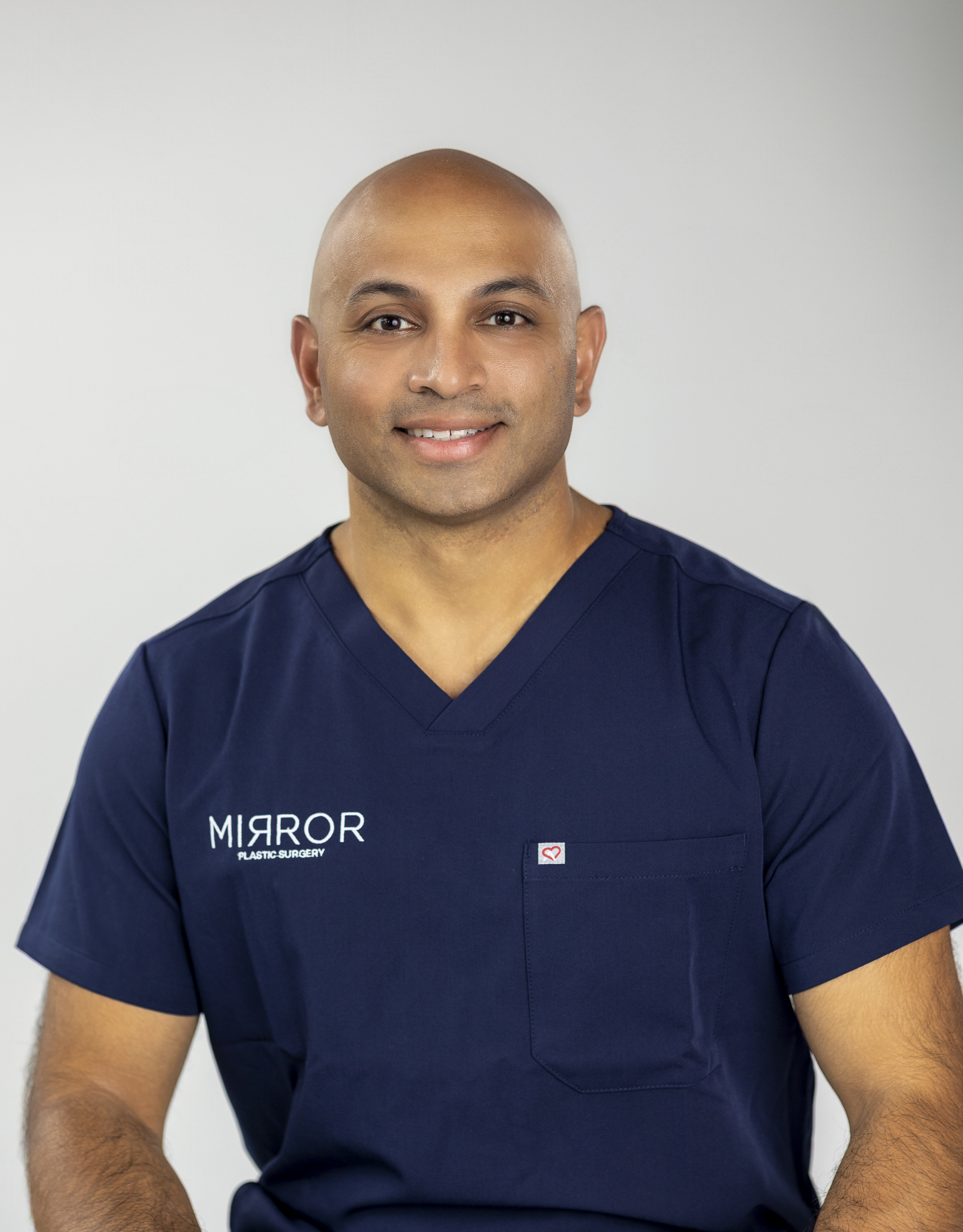
Written by: Dr. Akash Chandawarkar, Board Certified Plastic Surgeon, Mirror Plastic Surgery | Last updated: July 24, 2026
Key Takeaways for Your Breast Augmentation Plan
- Breast augmentation choices include implant material, shape, surface, placement, and incision. Each factor affects safety, feel, and long-term results.
- Silicone implants hold nearly 80% of the market because they feel more like natural breast tissue. Motiva SmoothSilk Ergonomix adds adaptive gel technology with some of the lowest published complication rates.1
- Implant placement options such as submuscular, dual-plane, or subglandular should follow your anatomy, tissue thickness, and lifestyle, not a one-size-fits-all technique.
- Most modern implants last 10 to 20 years with no automatic replacement deadline. Silicone devices still benefit from regular imaging starting 5 to 6 years after surgery.
- Patients who want evidence-based implant selection can book a consultation with Dr. Akash at Mirror Plastic Surgery for a detailed anatomical assessment.
Implant Materials: Silicone vs. Saline in 2026
Silicone-filled implants accounted for 79.6% market share in 2025, largely because their cohesive gel closely mimics natural breast tissue. Fifth-generation cohesive gel technology maintains shape even if the shell is compromised, which supports both safety and aesthetics. Patients often describe silicone gel implants as the most natural-feeling option because the gel density and softness resemble human breast fat.
Saline implants use a silicone shell filled during surgery with sterile saltwater, which allows smaller incisions and real-time volume adjustment. The FDA approves saline implants for augmentation in patients 18 and older, while silicone implants carry a minimum age of 22, so saline can suit younger candidates. These advantages, along with the absence of silent-rupture concerns, have helped structured saline implants become a fast-growing segment, especially among patients who value adjustability and straightforward rupture detection.
A major 2024 milestone reshaped implant choices in the United States. Establishment Labs’ Motiva SmoothSilk Ergonomix received U.S. FDA premarket approval in September 2024 for primary and revision breast augmentation in women 22 and older, marking the first new silicone breast implant PMA since 2013. Dr. Akash serves on the Motiva advisory board and brings first-hand experience with this system into every consultation at Mirror Plastic Surgery.
Motiva SmoothSilk Ergonomix: Adaptive-Gel Implant Technology
Motiva SmoothSilk Ergonomix uses a viscoelastic ProgressiveGel Ultima filling inside a round shell that shifts from a teardrop shape when standing to a rounder form when lying down. This behavior closely follows how natural breast tissue moves with position changes. The device also includes a 4-micron nanotextured SmoothSilk surface, a TrueMonobloc single-structure shell, a BluSeal barrier layer, and a Qid RFID microtransponder for lifelong implant identification and traceability. These design elements work together to support durability, safety monitoring, and soft-tissue integration.
Five-year FDA IDE trial data show a 0.5% Grade III/IV capsular contracture rate, a 0.6% rupture rate, zero reported BIA-ALCL cases across more than three million devices distributed globally since 2010, and high patient satisfaction.1 These outcomes compare favorably with earlier-generation devices and highlight the safety profile of the nano-surface design.1 Unlike traditional anatomical teardrop implants that rely on a pre-shaped firmer gel and can visibly distort if they rotate, Motiva Ergonomix creates a teardrop look through gel movement inside a round shell. This approach removes rotation risk while preserving a natural, position-responsive shape.
Schedule a Motiva evaluation with Dr. Akash to decide whether this adaptive-gel system or another FDA-approved implant best matches your anatomy and goals.
Shape, Surface, and Profile: Matching Implants to Your Anatomy
Round implants currently make up most of the breast implant market, and they can look very natural when placed under the muscle. Anatomical, or teardrop, implants create more fullness in the lower breast and appeal to patients seeking that specific contour. Some datasets report a capsular contracture rate of 3.4% for anatomical implants, which is lower than the 5% to 7% range reported for traditional round textured implants in similar studies, helping explain their projected growth in market share.1
Surface texture directly affects safety. Epidemiologic studies estimate the BIA-ALCL risk between 1:300 and 1:30,000 among textured breast implant users. Researchers link BIA-ALCL risk to textured implant shells rather than the internal fill material, so many U.S. surgeons now favor smooth devices. Motiva’s SmoothSilk nano-surface occupies a distinct regulatory category as the first non-textured nano-surface implant available in the United States, offering a texture-related safety profile that differs from traditional macro-textured shells.
High-profile implants have a narrower base and greater forward projection than moderate-profile implants of the same volume. Because the implant base must fit within your natural breast width without overhang or distortion, surgeons determine profile primarily by measured breast base width rather than aesthetics alone. Tissue-based planning that measures breast base width, nipple-to-inframammary fold distance, and tissue thickness sets a safe size range before any detailed size conversation begins.
Implant Placement: Under vs. Over the Muscle
Implant pocket selection strongly influences appearance, recovery, and long-term comfort. The main options are subglandular placement over the muscle, submuscular or dual-plane placement under the muscle, and subfascial placement between muscle and fascia. Current practice in 2026 favors a tailored approach, so surgeons choose placement based on anatomy and goals rather than a single default technique.
Several anatomical factors guide this decision:
- Skin thickness and elasticity, existing breast tissue volume, chest wall anatomy, degree of sagging, implant size and type, and athletic activity level
- Breast base width, upper-pole tissue thickness, degree of ptosis, pectoralis major activity level, ribcage shape, and long-term plans for revision or pregnancy
- History of capsular contracture and imaging or screening needs
When surgeons evaluate these variables together, dual-plane placement often emerges as a strong choice because it combines upper-breast muscle coverage with lower-pole release for natural shaping and projection. Dual-plane and other submuscular approaches generally show lower capsular contracture rates than purely subglandular placement.1 Above-muscle placement can shorten recovery, avoid animation deformity, and work well for patients with adequate native tissue or for strength athletes.
For patients considering over-the-muscle placement with Motiva’s Preservé system, long-term exercise restrictions do not apply after the initial recovery period. Patients can return to chest press, pull-ups, push-ups, and weightlifting once cleared, which matters for many active Tampa Bay patients.
Incision Options for Breast Augmentation
Roughly 80% of breast augmentations now use the inframammary approach, up from 68% in 2005. The inframammary fold incision gives direct access to the pocket for precise dissection, works with all implant sizes and shell types, and simplifies future revision surgery. The periareolar approach allows combined nipple or areola procedures but can increase the risk of nipple sensation changes. The transaxillary approach hides the scar in the armpit, although it is technically demanding and limits some implant choices.
Complication Rates and Safety Data
A 2026 meta-analysis of primary breast augmentation reported pooled complication rates of approximately 3% to 5% for capsular contracture, 1% to 2% for reoperation within five years, and less than 1% for rupture in modern cohesive silicone devices.1 These figures improve on earlier-generation implants and align with high patient-reported satisfaction across the included studies.
Regarding BIA-ALCL, the FDA updated breast implant safety labeling in February 2025 to include expanded BIA-ALCL information. This texture-associated risk supports the preference at Mirror Plastic Surgery for smooth and nano-surface devices. Patients receive clear counseling on absolute risk, warning signs, and monitoring.
Modern breast implants last on average 10 to 20 years, and neither the American Society of Plastic Surgeons nor the FDA recommends replacing symptom-free implants based only on time. MRI or ultrasound screening begins at 5 to 6 years after surgery for silicone implants and repeats every 2 to 3 years to detect silent rupture.
Dr. Akash was named to Newsweek’s America’s Best Plastic Surgeons list for two consecutive years, 2024 and 2025, and has testified before the U.S. FDA on breast implant safety. His supplier-neutral, evidence-based approach keeps implant selection focused on your anatomy and current safety data rather than brand loyalty.
Get an evidence-based implant assessment to receive a detailed anatomical evaluation and a personalized recommendation grounded in the latest clinical research.
Recovery Timeline After Breast Augmentation
Breast augmentation recovery typically moves through five overlapping stages: acute post-operative phase (days 1 to 5), early recovery (weeks 1 to 2), active healing (weeks 3 to 6), implant settling (months 2 to 6), and long-term maturation (six months to one year and beyond).1 Knowing this framework helps you plan work, childcare, and activity around each phase.
Key milestones by placement type include:
- Days 1 to 5: Patients need a caregiver for at least 24 hours, wear a surgical bra continuously, and take short walks every two hours starting Day 1 to reduce blood clot risk.
- Weeks 1 to 2: Most patients return to non-physical work within about one week and resume most daily activities within one to two weeks.
- Weeks 3 to 6: Light lower-body and core exercise may be cleared after a 4 to 6 week visit, while early high-impact or chest-focused workouts can shift implants or increase swelling.
- Months 2 to 6: Most “drop and fluff” implant settling finishes between three and six months, and scar maturation can continue up to 6 to 12 months.
Acute pain after over-the-muscle augmentation usually resolves faster than after submuscular placement, so pocket choice plays a real role in recovery planning for active patients.1
Mirror Plastic Surgery limits the schedule to one or two surgeries per day so the entire team can focus on each patient’s preparation, procedure, and follow-up without rushing.
Begin your personalized augmentation planning at Mirror Plastic Surgery’s St. Petersburg office with the Newsweek-recognized surgeon and a team committed to attentive, concierge-style care.
Frequently Asked Questions
What is the difference between saline and silicone breast implants, and which is better?
Neither material works best for everyone, so the right choice depends on your anatomy, age, and goals. Silicone gel implants appeal to most augmentation patients because their cohesive gel closely matches the density and softness of natural breast tissue, which supports a natural look and feel. Saline implants use a silicone shell filled with sterile saltwater during surgery, which allows smaller incisions and intraoperative volume adjustment, and they are FDA-approved starting at age 18 compared with 22 for silicone. Newer options such as Motiva SmoothSilk Ergonomix, FDA-approved in September 2024, use a progressive gel that adapts to movement, shifting from a teardrop shape when upright to a rounder form when lying down. Dr. Akash reviews tissue thickness, chest dimensions, lifestyle, and goals before recommending any material so the decision stays anatomy-driven rather than trend-driven.
What is capsular contracture, and how is it prevented?
Capsular contracture occurs when the normal scar capsule around an implant tightens too much and can cause firmness, distortion, or discomfort. It remains the most frequently discussed long-term complication of breast augmentation. Risk factors include implant surface texture, with macro-textured surfaces showing higher rates than smooth or nano-textured surfaces, as well as bacterial contamination, hematoma, and subglandular placement in some patients. Prevention strategies at Mirror Plastic Surgery include meticulous sterile technique, smooth or nano-surface implants such as Motiva SmoothSilk, and precise pocket dissection to reduce tissue trauma. Five-year Motiva Ergonomix data show a Grade III/IV capsular contracture rate of 0.5%, which sits among the lowest published for any FDA-approved device.1 Dr. Akash also performs revision surgery for existing capsular contracture, often by changing implant position and correcting the pocket.
What is BIA-ALCL, and should it affect my implant choice?
Breast implant-associated anaplastic large cell lymphoma, or BIA-ALCL, is a rare lymphoma that develops in the fluid or scar tissue around a breast implant rather than in breast tissue itself. The FDA tracks BIA-ALCL cases worldwide and updates guidance as new data emerge. Critically, BIA-ALCL links to macro-textured implant surfaces, not to silicone gel fill material or smooth shells. As noted earlier, this texture-related risk has not appeared in nano-textured systems such as Motiva SmoothSilk in published data. Dr. Akash testified before the U.S. FDA on breast implant safety and incorporates the latest regulatory guidance into every implant recommendation. Patients who notice late-onset swelling around an implant should seek prompt evaluation because a small portion of late peri-implant effusions relate to BIA-ALCL.
How long do breast implants last, and when do they need to be replaced?
Modern breast implants are built to last 10 to 20 years, and neither the FDA nor the American Society of Plastic Surgeons advises routine replacement on a fixed schedule. Surgeons recommend replacement when a complication develops, such as rupture, capsular contracture, significant malposition, or a change in aesthetic goals, rather than after a set number of years. For silicone implants, the FDA advises MRI or ultrasound screening starting 5 to 6 years after surgery and every 2 to 3 years afterward to detect silent ruptures. Motiva implants include an RFID microtransponder that allows non-invasive serial-number checks and lifelong device traceability, which simplifies long-term monitoring. Mirror Plastic Surgery builds scheduled follow-up into every patient relationship as part of its concierge-style model.
What makes Mirror Plastic Surgery different from other breast augmentation practices in Tampa Bay?
Mirror Plastic Surgery follows a safety-first, function-second, aesthetics-third philosophy that contrasts with many high-volume centers. Dr. Akash, a Harvard Medical School graduate, Johns Hopkins-trained plastic surgeon, and aesthetic surgery fellow at the Manhattan Eye, Ear and Throat Hospital, limits the practice to one or two surgeries per day so each patient receives focused attention from the entire team. He is recognized nationally for surgical excellence and serves on the Motiva advisory board, giving patients early access to current implant technology and data. Consultations often last up to an hour and include a detailed anatomical assessment, tissue-based implant planning, and an honest review of risks and alternatives, including fat transfer breast augmentation for patients who prefer an implant-free option. The practice remains supplier-neutral, so implant recommendations always reflect clinical evidence and patient anatomy rather than manufacturer quotas.
1 Results may vary from person to person. Editorial content, before and after images, and patient testimonials do not constitute a guarantee of specific results.