
Written by: Ellie Pranckevicius, FNP-BC, Aesthetic Nurse Practitioner & Aesthetic Injector | Facial Restoration & Regenerative Injectable Specialist, Mirror Plastic Surgery | Last updated: July 2, 2026
Key Takeaways
- A personalized med spa treatment plan maps anatomy, emotional drivers, and long-term goals to specific treatments, then supports those results with an ongoing maintenance roadmap instead of one-off sessions.1
- St. Petersburg patients can use a five-stage evaluation framework to separate genuine customization from high-volume practices that deliver identical packages to every patient.
- Quality personalization depends on unhurried consultations that include emotional driver exploration, structured anatomical mapping, and clear skin physiology education.
- Evidence-based planning at Mirror Plastic Surgery selects products and modalities based on patient tissue needs, not inventory pressure or promotional incentives.
- Schedule your personalized assessment at Mirror Plastic Surgery to receive a safety-first treatment plan tailored to your anatomy and goals.
What a Truly Personalized Med Spa Treatment Plan Includes
Genuine personalization requires enough time for a complete evaluation. A consultation that runs fifteen to twenty minutes cannot accommodate a full anatomical assessment, an exploration of emotional motivators, a review of skin physiology, and a candid discussion of risks. Practices that book patients back-to-back at high volume structurally cannot deliver this depth, regardless of how their services are described on a website. The evaluation stages below focus on concrete signs that reveal whether a provider has built their model around thorough assessment or rapid throughput.
Stage 1: Spot the Red Flags of High-Volume Practices
Several warning signs of a mill-style operation appear before a single injection is administered:
- Consultation appointments scheduled for thirty minutes or less, which as noted above is insufficient for proper anatomical mapping or goal-setting dialogue
- Sales pressure toward package bundles or promotional add-ons during the first visit, before a full assessment is complete
- Limited or absent discussion of subdermal anatomy, facial compartments, or how volume loss in one zone affects adjacent regions
- Providers who cannot explain why a specific product brand or concentration was selected over alternatives
- No structured follow-up protocol or maintenance timeline offered at the close of the consultation
- Vague or evasive answers when patients ask about the injector’s clinical training background
Any single flag warrants caution. Multiple flags together indicate a practice model that prioritizes throughput over patient outcomes. If you have encountered these red flags elsewhere, the contrast with a true concierge model becomes immediately apparent during the first consultation.
Schedule your assessment with Ellie to experience what a structured, unhurried consultation actually looks like.
Stage 2: Elements of a High-Quality Top-to-Bottom Assessment
A rigorous consultation at a concierge-model practice allocates up to a full hour to several key elements.
Emotional driver exploration. The provider asks open-ended questions to understand why a patient is seeking treatment now and what outcome would feel meaningful. The conversation also covers what past experiences, positive or negative, have shaped expectations. This context directly influences which modalities are appropriate and which should be deferred.
Structured anatomical mapping. The assessment moves systematically from the upper face through the midface and lower face, evaluating volume distribution, skin quality, muscle activity, and symmetry. Severity scales for conditions such as temporal hollowing or malar descent translate subjective concerns into measurable clinical findings that anchor the treatment plan.
Skin physiology education. Patients receive a plain-language explanation of what is happening at the tissue level and why a recommended treatment addresses it. This mirrors the dentistry model. Professional intervention delivers results, and patients who understand the underlying physiology maintain those results more effectively.
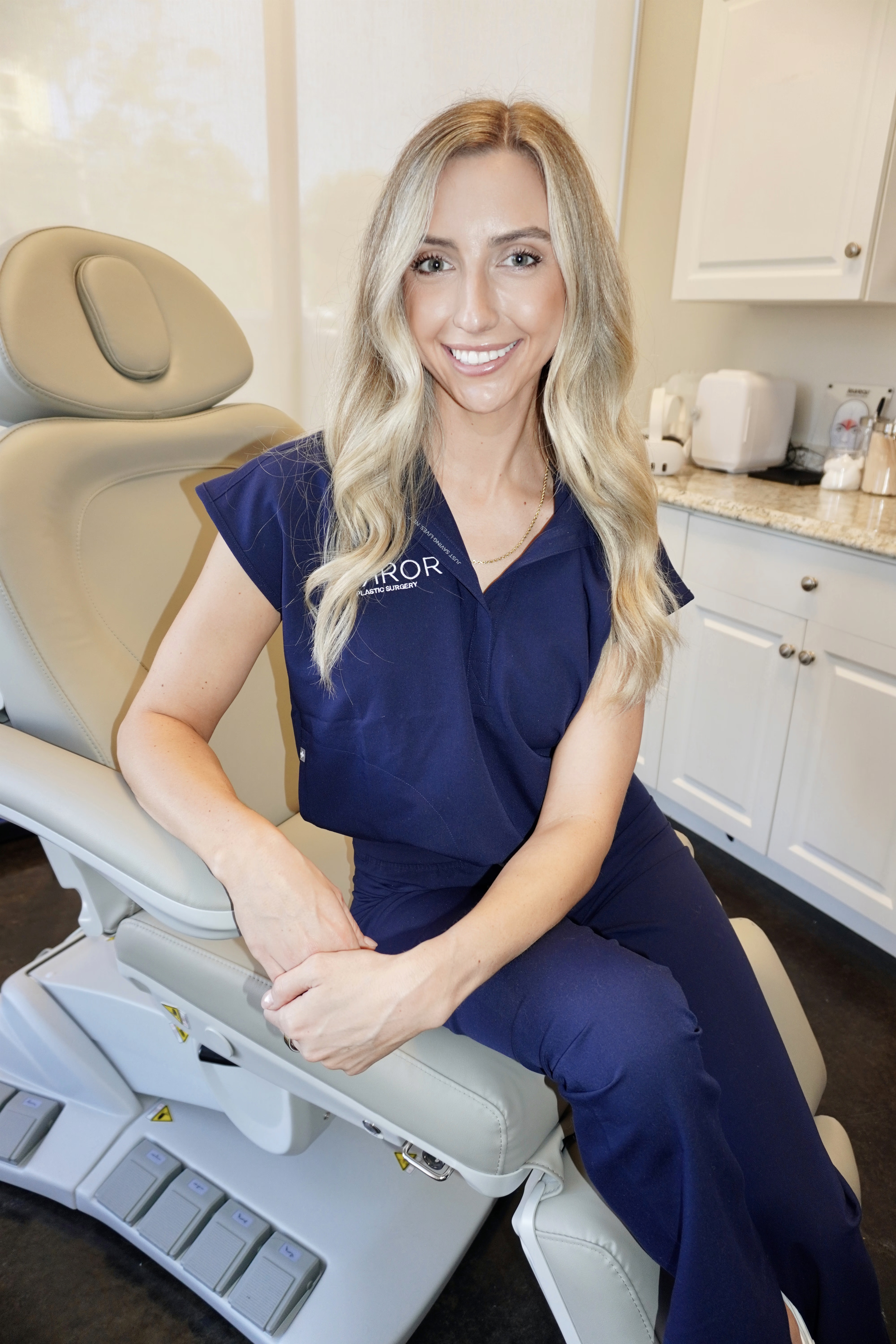
This level of education and mapping requires a provider with both surface aesthetics expertise and deep clinical training. Ellie Pranckevicius, FNP-BC, brings exactly that dual background to the assessment process. Ellie completed a rigorous aesthetics licensure program with 600 hours of hands-on training. Her career began in 2019 at a high-end medical spa on Newberry Street in Boston, followed by a Bachelor’s and Master’s in Nursing from the University of South Florida and four years in the Neuroscience ICU at Tampa General Hospital. That combination, surface skin expertise layered over advanced clinical physiology, supports the kind of full-face harmonization assessment that isolated-area injectors cannot replicate.
Stage 3: Evidence-Based Product and Modality Selection
Assessment findings translate into treatment selection through a supplier-neutral, anatomy-driven process. At Mirror Plastic Surgery, the provider chooses among neuromodulators (Botox, Dysport, Xeomin, Daxxify, Jeuveau), dermal fillers (Juvederm, RHA, Versa, Restylane, Radiesse, Evolysse), and energy-based modalities based on what the patient’s tissue requires. Choices are not based on which product carries the highest margin or which brand the practice is contractually incentivized to move.
The same evidence-based selection framework applies to body contouring procedures. For non-surgical BBL services, Ellie uses biostimulatory fillers such as Radiesse. AlloClae is offered for buttocks procedures to achieve gluteal contouring, cellulite smoothing, stretch mark reduction, and symmetry correction. Product selection for body contouring follows the same anatomy-first logic applied to facial work. The goal, the tissue type, and the patient’s regenerative capacity determine the protocol.
Patients should ask any prospective provider to explain, in specific terms, why one product was chosen over a comparable alternative. A provider who cannot answer that question clearly is not practicing evidence-based planning.
Stage 4: Using the Safety-Function-Aesthetics Hierarchy
Mirror Plastic Surgery operates on an explicit, ordered decision framework. Safety is evaluated first, function second, and aesthetics third. This sequence is not a marketing phrase. It is a clinical discipline that helps prevent the most common errors in aesthetic medicine.
A provider who begins with the aesthetic outcome and works backward may select a volume or placement that achieves the desired look in the short term while compromising vascular safety or creating downstream asymmetry. In contrast, a provider who begins with safety evaluates tissue perfusion and identifies anatomical danger zones first. The provider then selects the modality and dosage that achieves the functional and aesthetic goal within those safety constraints, so the desired look does not come at the cost of tissue health.
During evaluation, patients can test a provider’s adherence to this hierarchy by asking, “What would prevent you from proceeding with this treatment?” A safety-first provider answers that question immediately and specifically. A sales-driven provider deflects or minimizes it.
Stage 5: Building a Long-Term Maintenance Roadmap
A single filler session without a maintenance protocol is not a treatment plan. It is a transaction. Genuine personalized med spa treatment plans in St Petersburg Florida include a timeline for follow-up assessment, guidance on at-home practices that extend clinical results, and a clear explanation of how the plan will evolve as the patient’s anatomy changes over time.
Ellie’s approach explicitly prioritizes foundational restoration before volume augmentation. She revitalizes inherent facial characteristics first, then layers enhancement. This sequence produces results that age gracefully and require fewer corrective interventions.1 Patients who understand their maintenance schedule also make more informed decisions about when to return, which reduces the likelihood of over-treatment or under-treatment between visits.
Book a consultation with Ellie to receive a maintenance roadmap built around your specific anatomy and goals.
Quick Comparison: Consultation Depth, Credentials, and Communication Style
The following table shows how the key attributes discussed in Stages 1 through 5 appear in mill-style versus concierge practices. It highlights how consultation duration, injector background, product selection, and maintenance planning directly affect treatment safety and outcome quality.
| Attribute | Mill-Style Practice | Concierge-Style Practice (Mirror Model) | Why It Matters |
|---|---|---|---|
| Consultation duration | 15–30 minutes | Up to 60 minutes | Longer sessions allow full anatomical mapping and emotional driver exploration |
| Injector background | Variable, often single-discipline training | Dual esthetics + advanced nursing (FNP-BC), ICU clinical experience | Dual training supports surface and subdermal anatomical judgment |
| Product selection basis | Inventory availability or promotional incentives | Supplier-neutral, anatomy and evidence-driven | Neutral selection reduces upselling risk and improves outcome fit |
| Maintenance planning | Reactive, next appointment booked at checkout | Proactive, structured protocol with at-home guidance included | Proactive planning produces more consistent long-term results.1 |
Frequently Asked Questions
Are med spa memberships worth it for long-term plans?
Memberships can deliver value when the underlying practice model supports genuine long-term planning. A membership at a concierge-style practice that conducts thorough assessments, tracks anatomical changes over time, and adjusts protocols accordingly represents a meaningful investment in sustained results. A membership at a high-volume practice that delivers the same treatment regardless of how a patient’s needs have evolved provides discounted transactions, not a plan. Before committing to any membership, patients should confirm that each visit includes a reassessment of current anatomy and goals rather than an automatic repeat of the previous session.
What risks come with rushed med spa care?
Rushed consultations increase the probability of several adverse outcomes. Without adequate anatomical mapping, injectors may place product in or near vascular danger zones, raising the risk of vascular occlusion, a serious complication requiring immediate intervention. Insufficient goal-setting dialogue increases the likelihood of results that do not align with what the patient actually wanted, which leads to dissatisfaction or requests for corrective treatment. Over-treatment of isolated areas without full-face context frequently produces asymmetry or an unnatural appearance that is difficult and costly to reverse. Patients with relevant medical history, prior filler placement, or anatomical variations require additional assessment time that rushed models cannot accommodate. This is precisely why the safety-first hierarchy discussed in Stage 4 begins with vascular assessment before aesthetic planning.
How should patients evaluate injector training and anatomical expertise?
Patients should ask prospective injectors to describe their formal training pathway, including the number of supervised clinical hours completed, the clinical settings in which they have worked, and any advanced coursework in facial anatomy or aesthetic medicine. An injector who has worked in acute clinical environments, such as an ICU or surgical setting, has developed physiological judgment that translates directly to safer aesthetic practice. Patients should also ask how the injector approaches anatomical danger zones and what their protocol is for managing complications. Evasive or vague answers to these questions indicate insufficient preparation for complex cases. Reviewing before-and-after documentation across a range of facial types and treatment goals provides additional evidence of consistent, naturalistic outcomes.
How does a full-face harmonization approach differ from area-by-area treatments?
Area-by-area treatment addresses a patient’s stated concern in isolation. For example, a provider may add volume to the lips without evaluating how that change interacts with the midface, jawline, or overall facial proportion. Full-face harmonization begins with a comprehensive assessment of all facial zones and their relationships to one another before any product is selected or placed. This approach ensures that the upper, middle, and lower face transition seamlessly, which helps prevent the disproportionate or “overdone” appearance that isolated injections frequently produce.1 It also prioritizes foundational restoration, addressing volume loss, skin quality, and structural support before layering enhancement. That sequence produces results that remain natural-looking as the face continues to age.1
Conclusion: Your Evaluation Checklist
Patients can apply the following five criteria when assessing any provider offering personalized med spa treatment plans in St Petersburg Florida:
- Stage 1 — Red flag audit: Confirm appointment duration, absence of sales pressure, and substantive anatomical discussion before committing to a consultation
- Stage 2 — Assessment depth: Verify that the consultation includes emotional driver exploration, structured anatomical mapping, and patient education on skin physiology
- Stage 3 — Evidence-based selection: Confirm that product and modality choices are explained in anatomy-specific terms and are not driven by inventory or promotional incentives
- Stage 4 — Safety hierarchy: Ask directly what clinical factors would prevent the provider from proceeding. A clear, immediate answer indicates safety-first practice.
- Stage 5 — Maintenance protocol: Confirm that a structured follow-up timeline and at-home guidance are included in the plan, not offered as optional add-ons
Mirror Plastic Surgery’s concierge model, led by Ellie Pranckevicius, whose dual aesthetics and ICU nursing background was detailed in Stage 2, is built around every criterion on this list. Located at 780 4th Ave S, St. Petersburg, FL 33701, the practice is currently welcoming new patients seeking full-face restorative treatments and non-surgical BBL services.
Book a consultation with Ellie and receive a treatment plan grounded in your anatomy, your goals, and a safety-first standard of care.
Disclaimer: Results may vary from person to person. Editorial content, before and after images, and patient testimonials do not constitute a guarantee of specific results.
1 Results may vary from person to person. Editorial content, before and after images, and patient testimonials do not constitute a guarantee of specific results.