
Written by: Dr. Akash Chandawarkar, Board Certified Plastic Surgeon, Mirror Plastic Surgery | Last updated: July 17, 2026
Key Takeaways for Tampa Patients
- Non-surgical treatments such as neuromodulators, fillers, ultrasound, and radiofrequency microneedling improve mild-to-moderate facial aging but do not correct deeper structural descent.
- Conditions like SMAS ptosis, platysmal banding, and significant skeletal resorption consistently require surgical repositioning rather than energy-based or injectable treatments.
- Board-certified plastic surgeons provide anatomical expertise and safety infrastructure, including hospital privileges and emergency protocols, that most medspa providers cannot match.
- Patients should evaluate providers on credentials, consultation depth, transparent product sourcing, and on-site complication management before starting any treatment plan.
- A personalized consultation at Mirror Plastic Surgery can clarify whether non-surgical maintenance or surgical correction better fits your anatomy and goals.
Non-Surgical Options That Come Closest to a Facelift
No single non-surgical treatment replicates a facelift. Several options still provide meaningful, clinically documented improvement when chosen for the right patient.
Neuromodulators. Botulinum toxin remains the highest-volume non-surgical aesthetic procedure worldwide. Studies across FDA-approved formulations show peak effect around Day 30, with different responder rates over time depending on the product. Daxxify (daxibotulinumtoxinA-lanm) has demonstrated a median duration of about 6 months in clinical trials.1
Dermal fillers. Hyaluronic acid fillers last 6–18 months depending on product and treatment area and are fully reversible with hyaluronidase.1 A 5-year retrospective review of 380 patients and 1,168 injectable encounters reported a low revision rate, usually driven by perceived ineffectiveness or asymmetry. A small percentage of patients later chose surgery, which reflects the natural ceiling of what injectables can achieve.
Microfocused ultrasound (Ultherapy/MFU-V). Results can last 12 months or longer in suitable candidates and build gradually over 3–6 months through neocollagenesis.1 A 2024 systematic review and meta-analysis of 42 MFU-V studies found that 89% of patients showed investigator-assessed global aesthetic improvement.1 Ultherapy is FDA-cleared for the brow, submental area, and neck, while jawline and mid-face use remains off-label but common.
Radiofrequency microneedling (RFMN). A 2026 systematic review of RFMN for facial rejuvenation reported high rates of aesthetic improvement and patient satisfaction.1 Durability beyond 6–12 months remains uncertain because long-term follow-up data are limited.
PDO threads. A retrospective review of polydioxanone threads in 35 patients showed high satisfaction and low complication rates.1 Threads still provide only temporary lift, lack long-term stability against gravity, and cannot reverse ligament elongation or reposition descended tissue.
These non-surgical options can work well within their intended scope. Patients still need to understand where anatomy limits what non-surgical treatments can realistically achieve.
When Non-Surgical Treatments Fall Short
The anatomical factors that drive non-surgical failure are specific and well documented. Facial aging involves coordinated changes in bone resorption, fat compartment displacement, ligament attenuation, and muscle dynamics. Surface-level or energy-based treatments cannot reverse these deeper changes.
The following anatomical conditions consistently make non-surgical options insufficient:
- SMAS descent. Fillers replace lost volume but do not reposition descended soft tissue, and threads provide only temporary lift without long-term stability against gravity. Once tissue drops past its supporting ligaments, no non-surgical treatment can return it to its original position.
- Platysmal banding. Platysmal bands represent a structural muscular change because the platysma separates at the midline with age. Ultrasound, radiofrequency, and thread devices cannot correct this. Botulinum toxin can soften bands for 3–4 months but becomes less effective as separation progresses.
- Maxillary and skeletal resorption. Age-related bone loss in the maxilla and other facial bones reduces support for soft-tissue correction. When bone loss is pronounced, filler in the deep medial cheek fat can lift the nasolabial fold somewhat but cannot fully compensate.
- Ligament attenuation. Progressive bone remodeling and ligament attenuation reduce structural support and signal that non-surgical treatments will likely underperform. Surgical restoration of support layers becomes necessary.
- Established jowls and neck laxity. Surgery is indicated when deeper tissues have descended enough to create jowls, a softened jawline, or neck laxity, because non-surgical options no longer achieve the goal.
A simple bedside test helps. If skin along the jawline springs back immediately when pinched, the issue is mainly volume loss. If skin stays tented or shows clear jowling, skin laxity with descent is present and non-surgical options are unlikely to suffice.
Deferring needed structural correction in favor of repeated minimally invasive treatments may worsen outcomes over time and complicate later surgery. Volume-driven providers rarely discuss this risk.
How to Evaluate Non-Surgical Providers in Tampa
The non-surgical market is growing quickly. Medical spas are projected to expand at a 12.48% CAGR through 2031, and this rapid growth has outpaced robust safety infrastructure. As a result, provider quality varies widely, which makes careful evaluation essential before you commit to treatment.
- Board certification in plastic surgery. The American Board of Plastic Surgery credential requires proven competency in anatomy, surgical correction, and complication management, not just injectable technique.
- Hospital privileges. A board-certified plastic surgeon holds hospital access for rare surgical complications. Most medspa-only providers cannot offer this safety net.
- Consultation length and anatomical assessment. Face-to-face consultations support accurate anatomical diagnosis, realistic expectations, and better outcomes. Rushed visits that skip structural evaluation are a documented red flag.
- Transparent product sourcing. Clear sourcing and supplier-neutral recommendations protect treatment integrity. Practices should choose products based on anatomy, not sales quotas or exclusive contracts.
- Emergency preparedness. Clinics should keep in-date hyaluronidase on site, maintain a written and rehearsed complication protocol, and document escalation pathways to named secondary-care providers.
- Evidence-based treatment planning. Recommended treatments should rest on peer-reviewed data rather than trends or social media popularity.
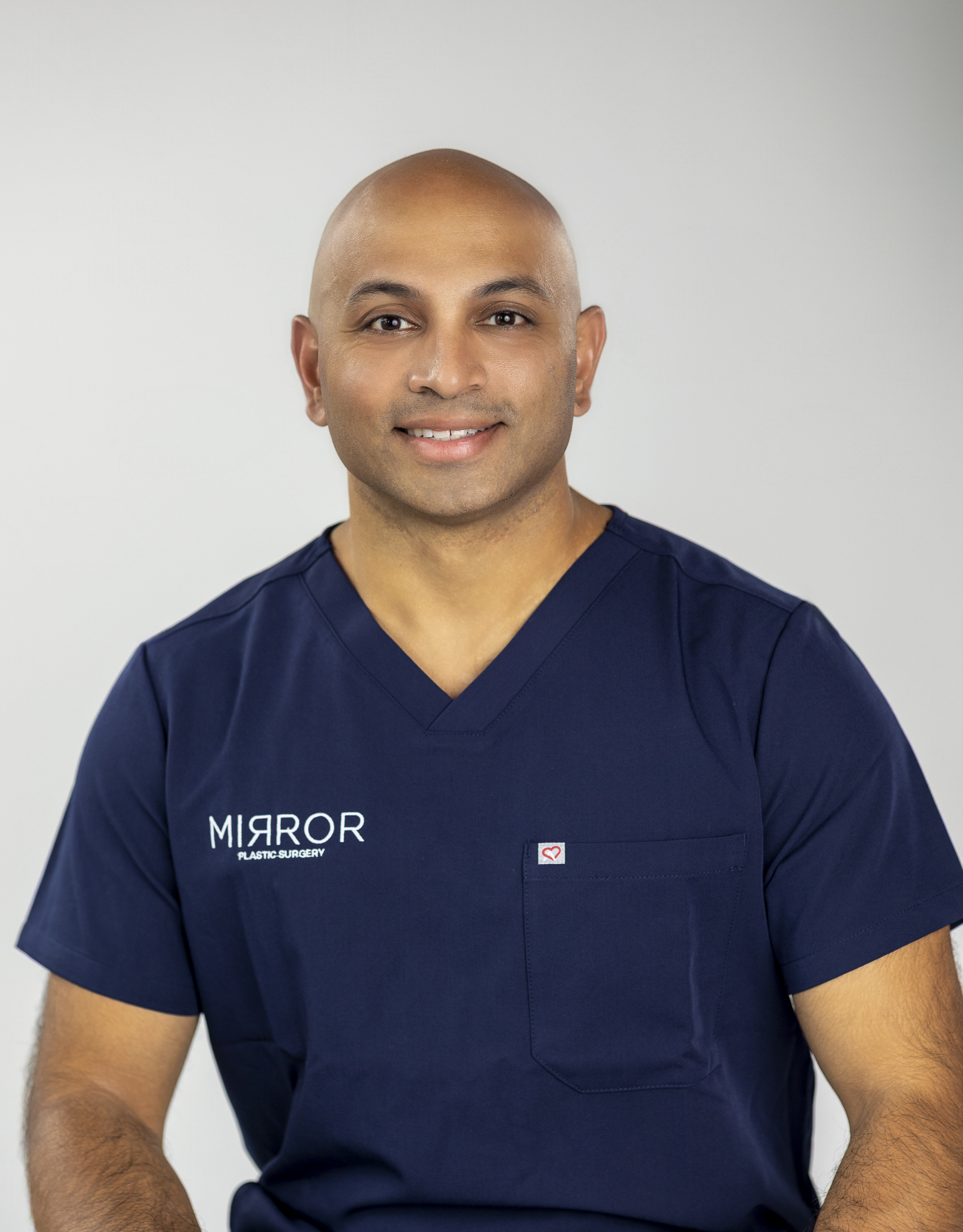
Dr. Akash at Mirror Plastic Surgery holds American Board of Plastic Surgery certification and trained through the Harvard-MIT Division of Health Sciences and Technology. His background includes a seven-year integrated plastic and reconstructive surgery residency at Johns Hopkins University, an aesthetic surgery fellowship at the Manhattan Eye, Ear and Throat Hospital (MEETH), and a Biodesign Innovation Fellowship at Stanford University. He has been named to Newsweek’s America’s Best Plastic Surgeons list for two consecutive years, including 2025, and serves as Next Generation Editor for the Aesthetic Surgery Journal. He also sits on the advisory boards of Motiva, Tiger Aesthetics, Cypris Medical, and Merz Aesthetics, which gives him direct access to the latest evidence on emerging technologies.
Schedule your anatomy-first evaluation to receive a thorough assessment of which non-surgical or surgical approach fits your specific presentation.
When Surgery Becomes the Better Option
Certain anatomical scenarios consistently require surgical repositioning instead of surface-level correction.
- Visible jowls and jawline laxity that filler cannot meaningfully improve
- Neck laxity with platysmal banding that no longer responds to neuromodulator treatment
- Deep nasolabial folds caused by tissue descent rather than volume loss alone
- Significant skin excess after major weight loss or GLP-1 medication use
- Mid-face descent with pronounced skeletal resorption where filler risks distorting proportions
In these situations, facial rejuvenation based on anatomical indication rather than age can deliver predictable healing, durable outcomes, and sustained satisfaction. Surgery often becomes more cost-effective when years of non-surgical maintenance accumulate without correcting the underlying structural deficit.
When surgery is appropriate, the quality of surgical execution matters. Mirror Plastic Surgery performs only one to two surgeries per day so the entire clinical team can focus on each patient before, during, and after the procedure. This schedule contrasts with high-volume practices that perform five to ten surgeries daily. Dr. Akash’s dual-plane facelift approach addresses the structural limitations outlined earlier by combining SMAS and deep-plane techniques to restore anatomical support layers. This method produces natural, durable results instead of the “overfilled” look that can follow repeated filler use to compensate for structural descent.
Determine your personalized treatment path, whether that involves a non-surgical maintenance plan, a surgical correction, or a staged combination of both.
Frequently Asked Questions
How long do non-surgical facial treatments last, and what maintenance is typical?
Longevity varies by treatment type. Neuromodulators usually last 3–4 months for standard formulations, while Daxxify can extend results to about 6 months.1 Hyaluronic acid fillers last 6–18 months depending on product and area.1 Microfocused ultrasound results build over 3–6 months and can last 12 months or more in suitable candidates, with most practitioners recommending repeat sessions every 12–18 months.1 Radiofrequency microneedling results are well documented up to 6 months, and durability beyond that remains under study. All non-surgical treatments require ongoing maintenance, so patients should factor cumulative cost over several years when comparing to surgery.
How safe are non-surgical cosmetic procedures, and what risks matter most?
Qualified clinicians working in properly equipped settings can keep serious complications rare. The most significant risk with dermal fillers is intra-arterial injection, which can cause skin necrosis or irreversible blindness through retrograde embolization to the ophthalmic circulation. No single technique eliminates this risk. It can be substantially reduced through anatomical knowledge, aspiration, cannula use in high-risk zones, and immediate access to hyaluronidase with a written emergency protocol. Laser and energy-based devices carry risks of burns, dyspigmentation, and scarring when settings do not match the patient’s Fitzpatrick skin type. Patients with darker skin tones face higher risk of post-inflammatory hyperpigmentation and should choose providers with documented experience treating skin of color. The safest environment is one where a board-certified plastic surgeon with hospital privileges oversees all procedures and maintains on-site emergency preparedness.
How does a board-certified plastic surgeon’s evaluation differ from a medspa visit?
A board-certified plastic surgeon evaluates all anatomical layers, including skin, subcutaneous fat, SMAS, deep fat compartments, and skeletal structure. This matters because a visible change such as a deepening nasolabial fold may stem from volume loss, fat descent, skeletal resorption, or ligament attenuation. Each cause requires a different treatment plan. A medspa consultation focused on a single modality may treat the symptom without identifying the cause, which leads to repeated sessions that add cost without fixing the structural issue. Dr. Akash spends up to an hour in the initial consultation, performing a top-to-bottom anatomical assessment before recommending any surgical or non-surgical treatment. This evaluation framework underpins Mirror Plastic Surgery’s concierge model and distinguishes it from volume-driven practices.
Who is a good candidate for non-surgical alternatives, and when should surgery be considered?
Non-surgical treatments suit patients with mild-to-moderate laxity, good baseline skin quality, realistic expectations about temporary results, and no major structural descent. Ideal candidates for energy-based devices have stable skin with an intact barrier, no active infection or inflammation, and the ability to follow aftercare and maintenance schedules. Surgery becomes more appropriate when jowling is established, platysmal banding appears, neck laxity persists despite treatment, or deep nasolabial folds result from tissue descent rather than volume loss. Two patients of the same age can show very different facial aging due to genetics, lifestyle, skeletal shape, and tissue quality. Age-based treatment rules therefore fail. An individualized anatomical assessment provides the only reliable basis for deciding between non-surgical and surgical care.
What should Tampa patients prioritize when choosing a non-surgical provider?
Tampa-area patients should look for providers with board certification in plastic surgery, active hospital privileges, and thorough in-person consultations that include anatomical assessment. Practices should use transparently sourced products without quota-driven upselling and maintain on-site emergency preparedness, including hyaluronidase and written complication protocols. Patients should be cautious of providers who treat on the first visit without a dedicated consultation, cannot explain the anatomical reasoning behind recommendations, or lack the credentials to manage complications. The non-surgical cosmetic sector remains largely unregulated in many regions, so quality varies widely. Choosing a practice led by a board-certified plastic surgeon with fellowship-level facial surgery training offers the highest available standard of anatomical expertise and safety for both non-surgical and surgical care.
Schedule Your Anatomy-First Evaluation at Mirror Plastic Surgery
Mirror Plastic Surgery is a concierge plastic surgery practice in St. Petersburg that serves the greater Tampa Bay area. Dr. Akash, whose credentials and recognition were detailed earlier, provides a physician-led evaluation that blends evidence-based non-surgical planning with the anatomical judgment to recognize when surgical correction offers a safer, more durable choice.
Get your evidence-based assessment and receive a comprehensive, unhurried evaluation of your anatomy, your options, and the realistic outcomes of each so you can make an informed decision grounded in science, not sales volume.
1 Results may vary from person to person. Editorial content, before and after images, and patient testimonials do not constitute a guarantee of specific results.