
Written by: Dr. Akash Chandawarkar, Board Certified Plastic Surgeon, Mirror Plastic Surgery | Last updated: July 24, 2026
Key Takeaways
- Neck lift skin excision (direct cervicoplasty) removes excess front-of-neck skin through a midline incision when traditional neck lifts cannot correct severe laxity.
- This approach suits patients with isolated anterior neck redundancy, platysmal banding, minimal jowling, and good chin projection who accept a visible scar as the trade-off.
- Scar placement and closure techniques such as Z-plasty or W-plasty are planned to reduce visibility, with most scars fading into the submental shadow within 3–6 months.1
- Recovery usually involves 1–2 weeks off work, consistent compression garment use, and careful scar care with silicone therapy and sun protection for long-term results.1
- Patients considering neck lift skin excision can schedule a consultation with Dr. Akash at Mirror Plastic Surgery to confirm whether this technique matches their anatomy.
Direct Neck Lift Skin Excision vs. Traditional Techniques
Direct cervicoplasty differs from a traditional neck lift mainly in incision placement and how much extra skin each method can remove. Traditional approaches redrape skin through peri-auricular and post-auricular incisions, hiding scars within natural hairline and ear contours. Direct excision places the incision on the anterior neck itself, a visible location that allows targeted correction when laxity is severe and hidden incisions cannot achieve enough tightening.
| Feature | Direct Cervicoplasty (Skin Excision) | Traditional Neck Lift (Peri-auricular) |
|---|---|---|
| Incision location | Anterior cervical midline | Post-auricular sulcus and submental crease |
| Scar visibility | Visible anteriorly, usually fades into submental shadow by 3–6 months | Concealed in natural folds, subtle texture changes on close inspection |
| Ideal candidate | Isolated anterior neck laxity, minimal jowling, good chin projection | Mild-to-moderate laxity with or without jowling, broader facial aging |
| Operating time | 1–2 hours, often under local anaesthesia | 3–5 hours under general anaesthesia for full neck lift or deep plane facelift |
Incision design within direct cervicoplasty follows several patterns rather than a single template. Techniques such as the Grecian urn pattern with a 60° Z-plasty at the cervicomental angle, W-plasty, T-Z plasty, and Lazy-H are selected to break up a straight vertical line and help the closure settle into natural submental creases and shadows. The TZ-plasty, first described by Drs. Thomas Cronin and Thomas Biggs in 1971, remains a foundational approach for many male patients because beard-bearing skin adds further camouflage.
Who Benefits Most From Neck Lift Skin Excision
Candidacy for direct midline excision depends on a combination of anatomical findings rather than a single measurement. When several specific features are present together, internal redraping alone usually cannot achieve a smooth contour.
- Skin redundancy that exceeds what muscle tightening and fat reduction alone can correct, especially after major weight loss when the platysma has lost fat support
- Ptotic or loose cervical skin that does not extend below the thyroid cartilage
- Significant platysmal banding isolated to the neck
- Minimal jowling and no major midface descent
- Good chin projection and a relatively higher hyoid position
- Little to no significant submental fat, or fat that can be treated with liposuction before excision
Patients who fall outside these criteria, especially those with marked jowling or laxity that extends well below the thyroid cartilage, usually achieve better results with a full deep plane facelift and neck lift. Retrospective series have excluded advanced cases with major skin excess from internal-only neck lift protocols and directed them toward direct skin excision instead. This pattern reflects a modern standard that prioritizes anatomical fit over a preference for hidden incisions.
Rapid or significant weight loss, including changes after bariatric surgery or GLP-1 medications, often produces visible platysmal banding. The platysma loses underlying support and the overlying skin loses elasticity, which makes these patients frequent candidates for excision-based correction.
Scar Placement and Maturation Timeline
The anterior neck scar represents the main trade-off of direct cervicoplasty, and many patients focus on it when researching the procedure. Once candidacy is clear, attention shifts to how the scar will look over time and which design strategies keep it as discreet as possible.
The scar starts out pink and firm, then softens and fades over several weeks and months with silicone gel and careful sun protection.1 In most cases it becomes well concealed within the submental shadow by 3–6 months, although full scar maturation and fading continue for 12 to 18 months after surgery.1 Patients who still notice a central scar at six months remain within the active healing window.
Silicone gel or sheets, started around week two or three once incisions have healed and used consistently for two to three months, offer the strongest topical support for reducing scar height and redness. Beyond topical care, the closure pattern itself helps prevent thickening. Z-plasty and W-plasty configurations break up linear tension that can drive hypertrophic scar formation and support a flatter, softer line over time.
Patients with darker skin phototypes or a personal history of hypertrophic or keloid scarring carry a higher risk of thicker scars, so this history plays a major role in Dr. Akash’s pre-operative evaluation. Direct neck lift with TZ-plasty is generally not performed in women because the anterior neck scar is usually considered unacceptable without beard-bearing camouflage, a point Dr. Akash discusses directly during consultation.
Recovery Timeline and Compression Garment Use
Recovery from neck lift skin excision usually follows a predictable pattern, with tightness and swelling more common than significant pain. Most patients describe pressure and stiffness rather than sharp discomfort.
Visible swelling often peaks around days 3 to 5 instead of immediately after surgery, then settles gradually over the next several weeks.1 The main early recovery phase lasts about 2 to 6 weeks. The following timeline reflects protocols commonly reported across surgical literature.
- Days 1–3: Mild to moderate swelling and bruising, with drains, if placed, usually removed within the first one to two days.
- Days 5–7: Compression garment or chin strap fitted at the first postoperative visit, with sutures removed around days 7–10.
- Weeks 1–2: Return to light daily activities, with most patients taking 1–2 weeks away from work.
- Weeks 2–3: Public-facing work usually resumes, and light exercise often begins around weeks 3–4.
- Weeks 4–6: Full exercise typically resumes with surgeon clearance, while strenuous activity and heavy lifting remain restricted until this point.
- Months 3–6: Final results continue to refine as residual swelling resolves and tissues settle.1
Compression garment use remains a key part of recovery. Most patients wear a compression garment 24 hours a day for the first 1–2 weeks, removing it only for meals or showering. After this period, at least 8 hours of daily wear for one more month supports tissue healing and helps control swelling. Head elevation at 30–45 degrees during sleep usually continues for the first two to four weeks.
Risks Specific to Neck Skin Excision
Direct cervicoplasty carries the general risks of neck lift surgery along with considerations tied to the anterior incision location. Clear discussion of these risks shapes the safety-first approach that guides Dr. Akash’s recommendations.
Complication rates for neck lift surgery remain low overall, and most reported issues tend to be temporary rather than permanent. Careful patient selection and adherence to post-operative instructions further reduce risk.
Risks specific to the anterior excision site include hypertrophic or widened scarring. Active smokers and patients with major scarring-risk factors are poor candidates because they face higher rates of wound healing problems and skin necrosis. Smoking reduces blood flow and stands out as one of the strongest predictors of poor scar outcomes after neck lift. Dr. Akash’s pre-operative protocol requires complete cessation of nicotine products well before surgery, and this requirement reflects safety standards rather than personal preference.
Mitigation strategies within the safety-function-aesthetics framework include Z-plasty and W-plasty closure designs, silicone scar therapy once incisions have healed, strict sun protection for at least 12 months, and scar revision or laser resurfacing when appropriate.
Choosing a Surgeon for Direct Cervicoplasty
Direct cervicoplasty calls for a surgeon with deep knowledge of anterior neck anatomy, clear judgment about candidacy thresholds, and strong technical skill with Z-plasty and W-plasty closures. Patients should confirm board certification, fellowship-level training in facial surgery, and a documented philosophy that places safety ahead of cosmetic goals.
Dr. Akash holds board certification from the American Board of Plastic Surgery and completed his medical degree through the Harvard-MIT Division of Health Sciences and Technology, graduating from Harvard Medical School with Honors. His surgical training included a seven-year integrated plastic and reconstructive surgery residency at Johns Hopkins University, followed by an aesthetic surgery fellowship at the Manhattan Eye, Ear and Throat Hospital (MEETH), one of the most competitive aesthetic fellowships in the country. He also completed the Stanford University Biodesign Innovation Fellowship, which adds a physician-innovator perspective to his surgical planning. He has been named among America’s Best Plastic Surgeons 2025 by Newsweek for two consecutive years.
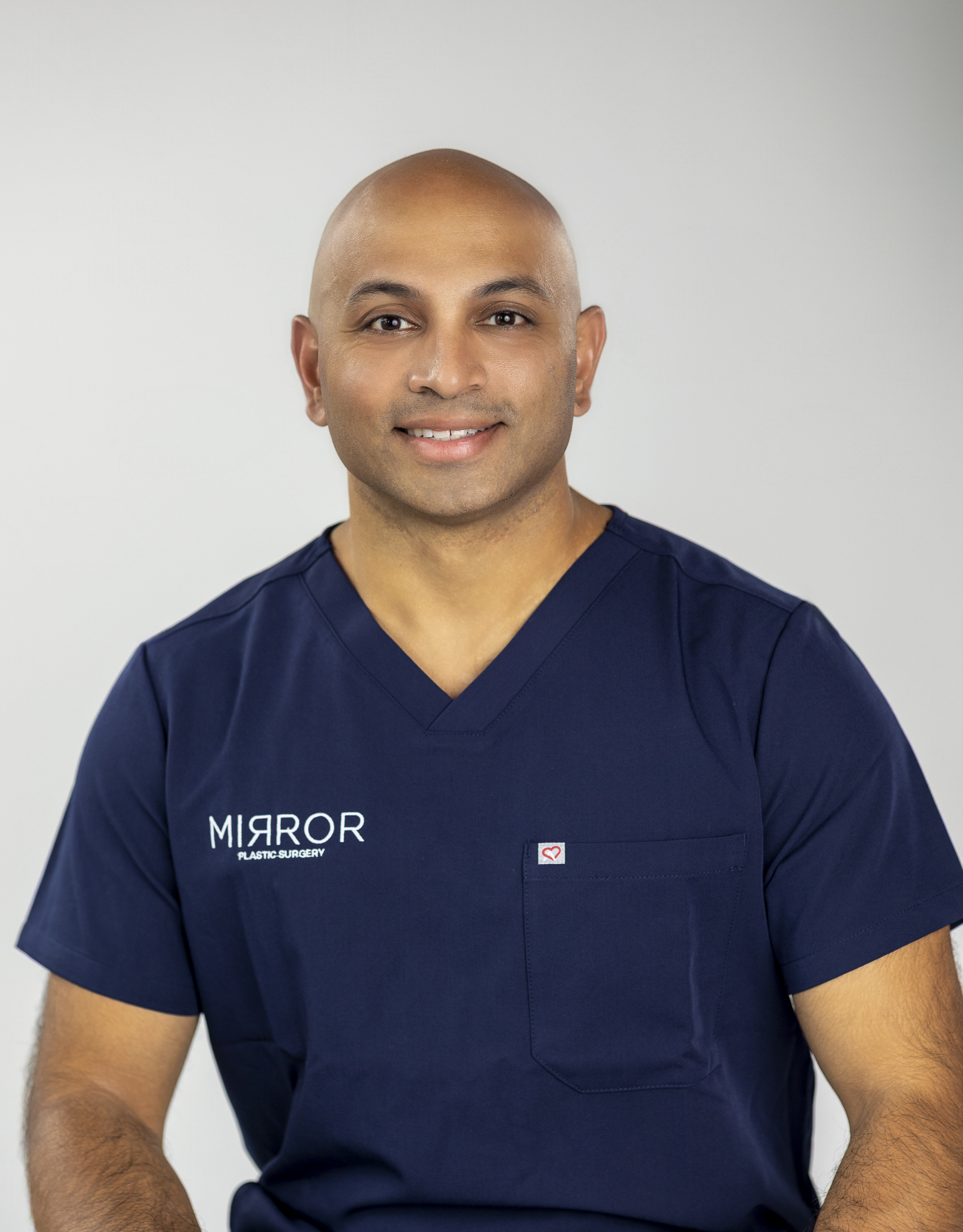
Dr. Akash performs one to two surgeries per day, a deliberate limit that allows the Mirror Plastic Surgery team to focus fully on each patient before, during, and after surgery. This schedule contrasts with high-volume practices where heavy caseloads can dilute individualized care.
Book a consultation with Dr. Akash to review your anatomy, discuss candidacy for direct cervicoplasty, and compare it with other neck rejuvenation options available at Mirror Plastic Surgery.
Frequently Asked Questions
Am I a candidate for neck lift skin excision after major weight loss?
Significant or rapid weight loss often creates the degree of skin redundancy that direct cervicoplasty treats. When fat volume drops, the platysma loses support and the overlying skin loses elasticity, which produces static banding and extra skin that internal redraping alone cannot fully correct. Final candidacy still depends on the full anatomical picture, including whether laxity is isolated to the anterior neck, whether jowling remains minimal, and whether chin projection is adequate. Patients with jowling or midface descent in addition to neck concerns usually benefit more from a combined lower facelift and neck lift. During consultation, Dr. Akash performs a detailed top-to-bottom assessment to define the most appropriate approach for your anatomy.
How visible will the scar be, and how can I reduce it?
The anterior neck scar is real and remains visible during the early healing period. In the first weeks it often appears pink and firm. With consistent silicone gel or sheet use, started once incisions are fully healed around weeks two to three, and strict sun protection for at least 12 months, the scar usually fades and settles into the natural submental shadow. For most patients, the scar becomes difficult to notice in normal social or work settings by three to six months, although full maturation can continue for 12 to 18 months.1 Incision designs such as Z-plasty and W-plasty disrupt straight-line tension and support better long-term camouflage. Men with beard-bearing skin gain additional natural concealment, while patients with a history of hypertrophic or keloid scarring need a personalized risk discussion before proceeding.
Can neck lift skin excision be combined with other procedures?
Direct cervicoplasty works best as an isolated procedure when concerns truly focus on the anterior neck. Combining it with procedures for jowling or midface descent usually does not make sense because those issues require different incision strategies, typically peri-auricular. Platysmaplasty is often performed alongside skin excision when platysmal banding is present, since muscle tightening and skin removal address different contributors. Submental liposuction may also be added when residual fat remains. Mirror Plastic Surgery follows a conservative approach to combining procedures because each additional operation increases recovery demands and complication risk. The consultation process clarifies which combination, if any, safely matches your anatomy and goals.
What is the revision rate, and what might require a revision?
Revision after neck lift skin excision remains uncommon. When revision is needed, common reasons include recurrent platysmal banding, persistent submental fullness, and submandibular gland ptosis rather than scar-related concerns. Scar revision or laser resurfacing may be considered if hypertrophic scarring develops, although this risk drops significantly with careful patient selection, Z-plasty or W-plasty closure design, and diligent post-operative scar care. Patients who smoke, have darker skin phototypes, or have a history of problematic scarring carry higher individual risk and receive detailed pre-operative counseling at Mirror Plastic Surgery.
How long do neck lift skin excision results last?
Direct cervicoplasty produces long-lasting results because excess skin is removed rather than simply repositioned under tension.1 When the platysma is tightened through platysmaplasty, it adds structural support that helps maintain the cervicomental angle over time. Aging still continues after surgery, and factors such as skin elasticity, weight changes, and sun exposure influence how long results remain at their peak. Patients who keep a stable weight and follow sun protection guidance usually preserve their outcomes longest.1 Non-surgical maintenance options, including biostimulatory fillers and skin quality treatments, can complement surgical results over the long term. During consultation, Dr. Akash reviews realistic long-term expectations and any maintenance that may suit your anatomy.
Conclusion
Neck lift skin excision through direct cervicoplasty becomes the right choice when skin redundancy exceeds what traditional redraping can correct. Patients with isolated anterior neck laxity, platysmal banding, minimal jowling, and good chin projection often fit this profile. The anterior scar represents a meaningful trade-off that calls for informed acceptance, realistic expectations about maturation, and consistent post-operative care. When candidacy criteria are met and technique is tailored to the individual neck, direct cervicoplasty can achieve focused correction that internal-only approaches cannot match.
At Mirror Plastic Surgery, every neck lift decision follows the safety-function-aesthetics framework that guides Dr. Akash’s practice. His Harvard-MIT, Johns Hopkins, and MEETH training, combined with his Newsweek recognition, positions him to evaluate your anatomy with the depth and precision this procedure requires.
Book a consultation with Dr. Akash at Mirror Plastic Surgery in St. Petersburg, Florida, and receive an individualized anatomical assessment that clarifies whether direct cervicoplasty, a traditional neck lift, or a combined approach best supports your goals.
1 Results may vary from person to person. Editorial content, before and after images, and patient testimonials do not constitute a guarantee of specific results.