
Written by: Ellie Pranckevicius, FNP-BC, Aesthetic Nurse Practitioner & Aesthetic Injector | Facial Restoration & Regenerative Injectable Specialist, Mirror Plastic Surgery | Last updated: July 23, 2026
Key Takeaways for First-Time Lip Filler Patients
- Beginners benefit from starting with 0.5 mL of hyaluronic acid filler placed by a board-certified injector after a full-face assessment to keep proportions natural.
- Staged treatment over two or three appointments, with a two-week settling period between visits, usually creates more refined results than a single high-volume session.
- Only hyaluronic acid fillers are recommended for first-time patients because they can be fully dissolved with hyaluronidase if results are unsatisfactory.
- Swelling peaks in the first 48 hours and gradually resolves over two weeks, so final results should not be judged before this period ends.1
- Schedule your personalized consultation at Mirror Plastic Surgery to receive a full-face assessment before any treatment decision.
How Full-Face Balance Shapes Natural-Looking Lip Filler
The lips function as part of the entire face, not as a standalone feature. Natural-looking results depend on evaluating the lips within overall facial proportions, including the relationship between the upper and lower lip, the chin, the nose, and the lower face. When volume is added without this context, patients often feel that something looks “off” even if the lips themselves appear technically well shaped.
In youthful and feminine lips, the lower lip is generally fuller than the upper lip, although ideal upper-to-lower lip ratios vary by ethnicity. Maintaining these proportions, instead of simply chasing more volume, forms the anatomical basis of a natural outcome.
Staged treatment works best for most first-time patients. Some of the most natural results develop over two or three carefully planned appointments rather than a single treatment session. Starting conservatively lets the injector see how the tissue responds, reassess proportions after swelling settles, and make precise adjustments, rather than trying to fix an overcorrection.
This principle of conservative, context-driven treatment guides Ellie Pranckevicius at Mirror Plastic Surgery. She begins lip augmentation only after a full-face assessment. Her first priority is restoring foundational facial balance before adding volume, which helps avoid the isolated, single-area injection pattern that most often creates an overdone look.
What Lip Filler Feels Like During and After Treatment
Most patients describe lip filler discomfort as mild to moderate. The lips contain many blood vessels and dense nerve endings, so they feel more sensitive than many other injection sites. Topical numbing cream applied 20 to 30 minutes before treatment significantly reduces discomfort, and most dermal fillers contain lidocaine, which further decreases sensation as the injections continue.
Post-procedure sensations differ from the brief stinging during injections. Many patients notice tenderness, firmness, and swelling. These sensations are expected and usually improve within the first week. Bruising, when it appears, is typically mild and fades within 3 to 10 days, depending on severity.
Best Lip Filler Type for First-Time Patients
Hyaluronic acid dermal fillers are the only filler category recommended for first-time lip augmentation. The comparison below focuses on objective factors that matter most for beginners.
| Filler Type | Reversibility | Longevity in Lips |
|---|---|---|
| Hyaluronic Acid (HA) (e.g., Juvederm, RHA, Restylane, Versa) |
Fully reversible with hyaluronidase | 6–12 months typical |
| Biostimulatory Fillers (e.g., Radiesse, Sculptra) |
Not reversible; higher risk of nodules and asymmetry in lips | Varies; not typically recommended for lips |
| Permanent / Semi-Permanent (e.g., PMMA, silicone) |
Not reversible; complications cannot be corrected and have led to severe long-term outcomes | Indefinite |
HA fillers stand out because they can be dissolved if results are unsatisfactory or a complication occurs. A defensible lip filler practice keeps hyaluronidase on site, in date, and in adequate quantity, with a written occlusion protocol. This standard protects patient safety and should be considered basic, not a special perk.
What to Expect After Lip Filler: Swelling and Healing Timeline
Swelling after lip filler follows a fairly predictable pattern. Patients usually see swelling that makes the lips look larger than the final size during the first 24 hours, which does not represent the final result. Understanding this progression helps patients avoid judging their outcome too early or requesting changes during peak swelling.
- Days 0–2: Peak swelling occurs, with lips appearing 30–50% larger than the final settled result. Firmness, tenderness, and possible bruising are normal.
- Days 3–5: Swelling decreases noticeably as the lips move closer to their final size. Bruising begins to fade. Most patients feel comfortable being in public by Day 5.
- Days 5–7: Most obvious swelling has resolved and lips look much closer to the intended result.
- Days 8–14: Filler continues to soften and integrate, which explains why the two-week rule exists. What looks asymmetric or overly full during peak swelling often evens out as the filler settles.
- Weeks 2–4: True final results become visible once the filler has fully integrated with surrounding tissue and all swelling has resolved.
The team at Mirror Plastic Surgery waits until at least two weeks have passed before discussing dissolution or additional volume. This approach prevents unnecessary changes while the lips are still settling.
How to Prepare for Lip Filler at Mirror Plastic Surgery
One week before: Avoid blood-thinning supplements and medications such as aspirin, ibuprofen, fish oil, vitamin E, and alcohol, because these increase bruising risk. Since bruising can affect comfort during the healing period, disclosing all medications and supplements at your medical history screening helps your provider assess risk and adjust timing if needed.
Cold-sore prevention: Patients with a history of herpes simplex should discuss antiviral prophylaxis with their provider before treatment, because lip injections can trigger an outbreak.
Medical history screening: A good-faith exam screens for active infection or inflammation, bleeding disorders, anticoagulant use, prior filler type and timing, allergies, pregnancy or breastfeeding, and autoimmune conditions. Lip filler is not performed during pregnancy or breastfeeding.
Twenty-four hours before: Arrive with clean skin, no active lip infections, and expectations already discussed during your consultation, rather than decided on the treatment day.
How to Choose a Lip-Filler Injector in St. Petersburg and Tampa
Provider qualification remains the strongest predictor of safety for injectable treatments, and many adverse events trace back to underqualified providers working without proper oversight. In the St. Petersburg and Tampa area, patients can use the criteria below when evaluating an injector.
The checklist reflects the questions Ellie covers during Mirror Plastic Surgery’s hour-long consultation process:
- Is the injector a licensed medical professional (NP, PA, MD, or DO) with documented aesthetic training beyond their core clinical degree?
- Does the practice conduct a full-face assessment, not just a lip assessment, before recommending any treatment?
- Is hyaluronidase stocked on site at every appointment, with a written vascular occlusion protocol?
- Does the injector explain the anatomy of the perioral region and the location of the labial arteries?
- Is the consultation scheduled separately from treatment, with no pressure to proceed the same day?
- Does the injector recommend a conservative starting volume and respect the settling period mentioned earlier before any touch-up?
- Can the injector show consistent before-and-after results across a range of lip anatomies?
- Is the practice supplier-neutral, choosing products based on patient anatomy rather than brand quotas?
- Does the injector discuss dissolution as a realistic option if results are unsatisfactory?
- Is there a clear complication management pathway and after-hours contact available?
Ellie Pranckevicius, FNP-BC, holds a Bachelor’s in Health Science from Boston University, completed a 600-hour aesthetics licensure program, and earned both her Bachelor’s and Master’s in Nursing from the University of South Florida. Four years in the Neuroscience ICU at Tampa General Hospital sharpened her clinical judgment and understanding of physiology, which directly support her injection safety protocols. Her combined background in esthetics and advanced nursing is uncommon and highly relevant to detailed lip anatomy assessment.
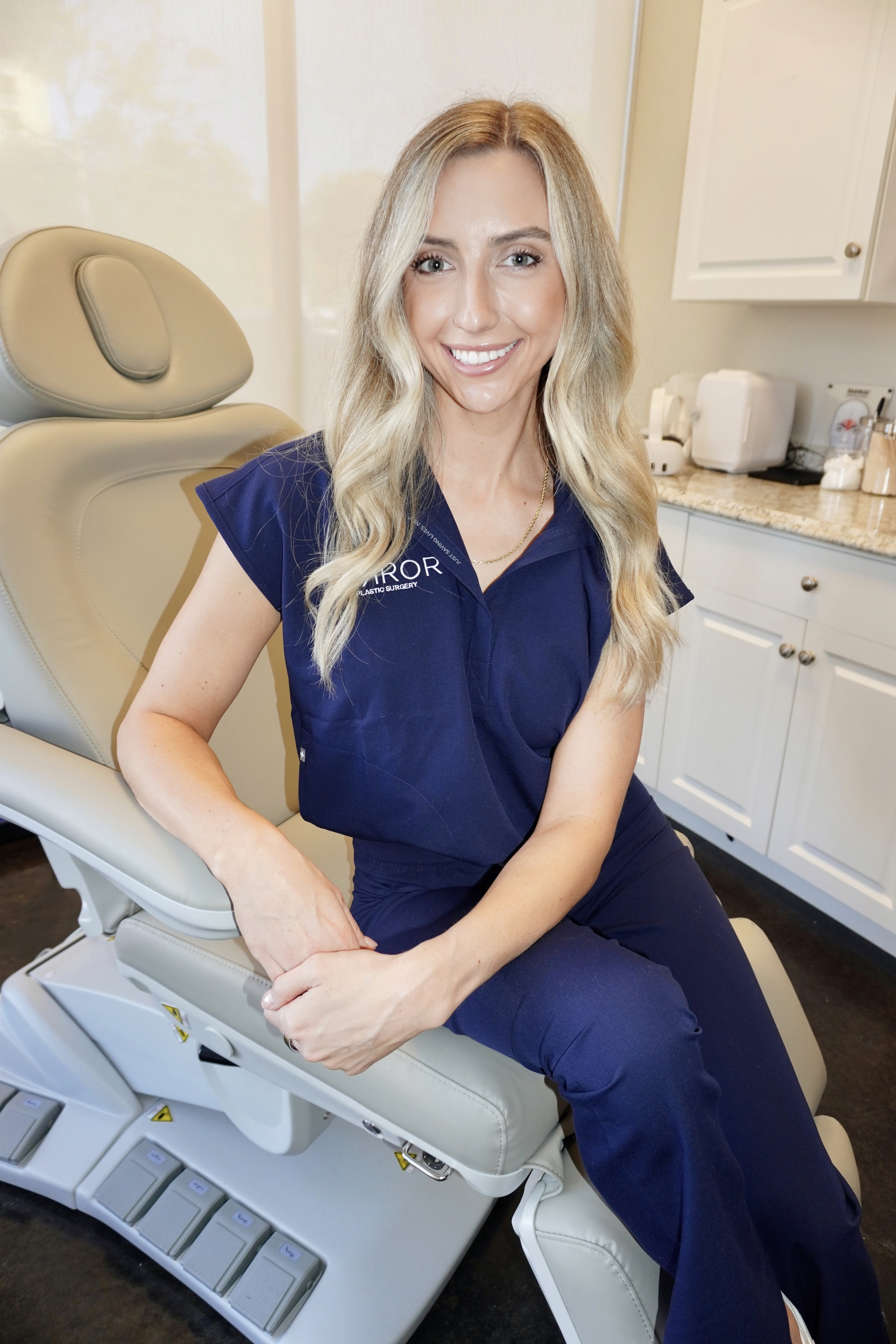
Book a consultation with Ellie to experience Mirror Plastic Surgery’s full-face assessment approach in person.
Frequently Asked Questions
How long does lip filler last for first-time patients?
Dermal lip filler usually lasts between 6 and 12 months in first-time patients, although longevity varies with the specific product, volume placed, metabolism, and lifestyle factors such as sun exposure and hydration.1 First-time patients often notice results closer to the shorter end of this range because the tissue is adapting to filler for the first time.1 Regular maintenance appointments, instead of large single sessions, tend to create more stable long-term results.
Can lip filler be dissolved if I do not like the results?
Hyaluronic acid fillers, which are the only type recommended for first-time lip augmentation, can be dissolved using hyaluronidase, an enzyme that breaks down the filler. Dissolution is a straightforward in-office procedure. At Mirror Plastic Surgery, providers wait through the two-week settling period before deciding on dissolution, because what looks asymmetric or overfilled on Day 3 often improves naturally by Day 14. Hyaluronidase is stocked on site at every appointment as a core safety measure.
Will lip filler make my lips look unnatural or “overdone”?
Unnatural results usually stem from excessive volume, treating the lips without considering the rest of the face, or repeating high-volume sessions without enough time for reassessment. Starting with 0.5 mL, allowing the lips to settle for two weeks, and performing a full-face assessment before treatment are three reliable safeguards against an overdone appearance. Ellie’s method at Mirror Plastic Surgery focuses on restoring facial balance first, which helps her outcomes stay proportional across the entire face instead of isolating the lips.
How many syringes of lip filler do beginners need?
Most first-time patients begin with 0.5 mL, or half a syringe, of dermal filler.1 This amount usually defines the vermilion border, adds subtle projection, and improves symmetry without a high risk of overcorrection. After the two-week settling period, another 0.5 mL can be added at a follow-up visit if more volume is desired. This staged plan consistently delivers more refined and natural results than trying to reach the final outcome in one session.
What is the difference between a lip flip and lip filler?
A lip flip uses a small amount of neuromodulator, such as Botox or Dysport, injected into the orbicularis oris muscle just above the upper lip. This relaxes the muscle and allows the upper lip to roll slightly outward, which creates the appearance of more volume without adding filler. The effect is subtle and usually lasts from two to five months, depending on lifestyle, health, and Botox dosage, and it carries minimal risk.1
Lip filler, in contrast, physically adds volume with a dermal filler product and produces more visible, longer-lasting results. Some patients benefit from combining both approaches, which Ellie evaluates during the full-face consultation.
Book a consultation with Ellie at Mirror Plastic Surgery, located at 780 4th Ave S, St. Petersburg, FL 33701. Call or text 727-361-6515, or email hello@mirrorplasticsurgery.com.
Disclaimer: Results may vary from person to person. Editorial content, before and after images, and patient testimonials do not constitute a guarantee of specific results.
1 Results may vary from person to person. Editorial content, before and after images, and patient testimonials do not constitute a guarantee of specific results.