Written by: Ellie Pranckevicius, FNP-BC, Aesthetic Nurse Practitioner & Aesthetic Injector | Facial Restoration & Regenerative Injectable Specialist, Mirror Plastic Surgery | Last updated: August 24, 2026
Key Takeaways
- Lip augmentation with dermal fillers remains one of the most requested non-surgical aesthetic procedures, with over 1.4 million U.S. treatments performed in 2024.
- National pricing varies significantly based on provider credentials, product selection, and geographic market.
- Provider credentials, product selection, anatomical expertise, and reversibility protocols significantly influence both cost and safety outcomes.
- Patients should verify injector training, on-site reversal enzyme availability, and whole-face assessment protocols before committing to treatment.
- Schedule your personalized consultation at Mirror Plastic Surgery to receive expert guidance tailored to your anatomy and goals.
What Does Lip Augmentation Cost in 2026?
National pricing for lip filler spans a wide range depending on provider type, geographic market, and product. The U.S. national average for lip augmentation with dermal fillers is around $750 per syringe, with a typical range of $500–$1,200. Treatments performed by experienced injectors at established clinics generally range from $700 to $1,500 per syringe depending on qualifications and practice positioning.
Florida sits within the broader Southeast pricing band. Regional pricing varies by geographic location, with Florida markets, particularly Tampa Bay and Miami, trending toward the upper-middle tier because of the concentration of experienced injectors and demand for natural outcomes. Pricing below $450 per syringe in any major metro raises legitimate questions about product authenticity or injector credentials.
Product choice also shapes the final figure. Juvederm Volbella XC typically costs $600–$1,000 per 1.0 mL syringe and is best suited for subtle volume and fine lip lines, while Restylane Kysse typically ranges from $600 to $900 per syringe and is optimized for natural movement and definition. Budget providers charging under $300 per syringe frequently use unapproved or diluted products and unlicensed injectors, which increases complication risks compared to licensed nurse-led clinics using FDA-approved fillers.
Get your personalized quote based on your anatomy, goals, and the right product for your lips.
How Do Temporary Fillers Compare to Permanent Lip Implants on Lifetime Cost?
Patients weighing long-term lip enhancement benefit from seeing how temporary fillers and permanent implants differ over time. The comparison below highlights how upfront cost, longevity, reversibility, and five-year totals stack up so you can align your choice with your comfort level and budget.
| Option | Upfront Cost | Longevity | Reversibility | Estimated 5-Year Total |
|---|---|---|---|---|
| Lip Filler (1 syringe) | $600–$1,200 per session | Longevity varies by product, patient metabolism, and lifestyle factors, with most patients planning periodic maintenance sessions.1 | Most hyaluronic acid lip filler can be reversed with an enzyme, with early effects visible within a couple of days and full settling over about a week.1 | Varies based on frequency of sessions and product longevity, often amounting to several thousand dollars over multiple years |
| PermaLip Silicone Implant | Varies by provider and typically amounts to several thousand dollars | PermaLip silicone implants are designed to provide long-term lip enhancement without ongoing maintenance, though they can be removed if desired. | Surgically removable | The one-time cost with no ongoing maintenance for filler |
Implants often become more cost-effective over a decade for patients who feel confident about permanent volume. Maintaining lip fillers over many years can exceed the one-time cost of lip implants. Reversibility still carries real value for many patients. Filler allows incremental refinement across sessions, adapts to changing aesthetic preferences, and can be dissolved entirely if desired. Implants require surgical removal and carry the inherent risks of any operative procedure. For most patients new to lip augmentation, a staged filler approach with a knowledgeable injector offers a lower-risk starting point before any permanent commitment.
What Factors Influence the Final Price of Lip Augmentation?
The type and amount of filler used, along with provider fees, facility fees, and supplies such as numbing, all contribute to the total cost of lip augmentation. Several additional variables can move the final number significantly.
- Injector credentials and anatomical training. Injector credentials and experience represent the single largest variable in lip filler pricing, as board-certified practitioners with thousands of procedures charge more due to anatomical knowledge of complex lip vascular structures and complication management capabilities.
- Consultation depth. A transparent quote should spell out consultation fee, filler product cost, injector fee, clinical supplies, numbing support, and follow-up policy. Rushed consultations that skip full-face assessment often produce isolated results that require costly correction.
- Product neutrality. Practices tied to a single brand’s incentive programs may recommend products based on volume quotas rather than patient anatomy. A supplier-neutral practice selects the product best suited to each patient’s tissue characteristics and goals.
- Facility type. Outpatient ambulatory surgery centers and med spas typically charge 30–50% less than hospital-based facilities.
- Complication-management readiness. Expert consensus recommends immediate access to reversal enzyme for emergency reversal at any practice performing dermal filler procedures. Practices without this protocol on-site represent an unacceptable safety gap.
- Geographic location. Major metros charge $800–$1,200 per syringe compared to $500–$850 in suburban and mid-size cities and $400–$700 in smaller or rural markets.
How to Confirm an Injector’s Training and Safety Protocols
Safe lip augmentation starts with an injector who understands lip vascular anatomy and has clear emergency protocols. Expert clinicians emphasize careful assessment of the position and depth of the labial arteries and the use of techniques that minimize vascular compromise. Patients evaluating a provider benefit from asking direct, structured questions before committing to treatment.
A rigorous provider evaluation checklist addresses three core safety domains. First, confirm anatomical precision and emergency preparedness. Second, review the scope of aesthetic assessment. Third, verify training, follow-up, and practice philosophy.
- Anatomical precision and emergency readiness. Does the injector assess labial artery position and depth before every treatment? Is reversal enzyme stocked on-site and immediately accessible for vascular emergencies?
- Whole-face assessment and treatment planning. Does the practice conduct a whole-face assessment, including cheek volume, chin width, nasolabial folds, and facial proportions, before addressing the lips in isolation? Does the injector respect conservative volume limits, using modest amounts of filler per session to support natural outcomes and reduce risk?
- Credentials, follow-up, and philosophy. What are the injector’s formal credentials, such as nursing degree, advanced practice licensure, and documented aesthetics training hours? Does the practice offer a follow-up appointment at two weeks to assess results after swelling resolves? Is the practice supplier-neutral, or does it operate under brand-specific volume agreements?
At Mirror Plastic Surgery in St. Petersburg, Ellie Pranckevicius, FNP-BC, brings a rare combination of 600 hours of hands-on aesthetics licensure training, a Master’s in Nursing from the University of South Florida, and four years of clinical experience in the Neuroscience ICU at Tampa General Hospital. Her whole-face approach evaluates upper, middle, and lower facial regions before any volume augmentation is considered. This approach helps prevent the asymmetry and overdone appearance that isolated, single-area injections frequently produce.
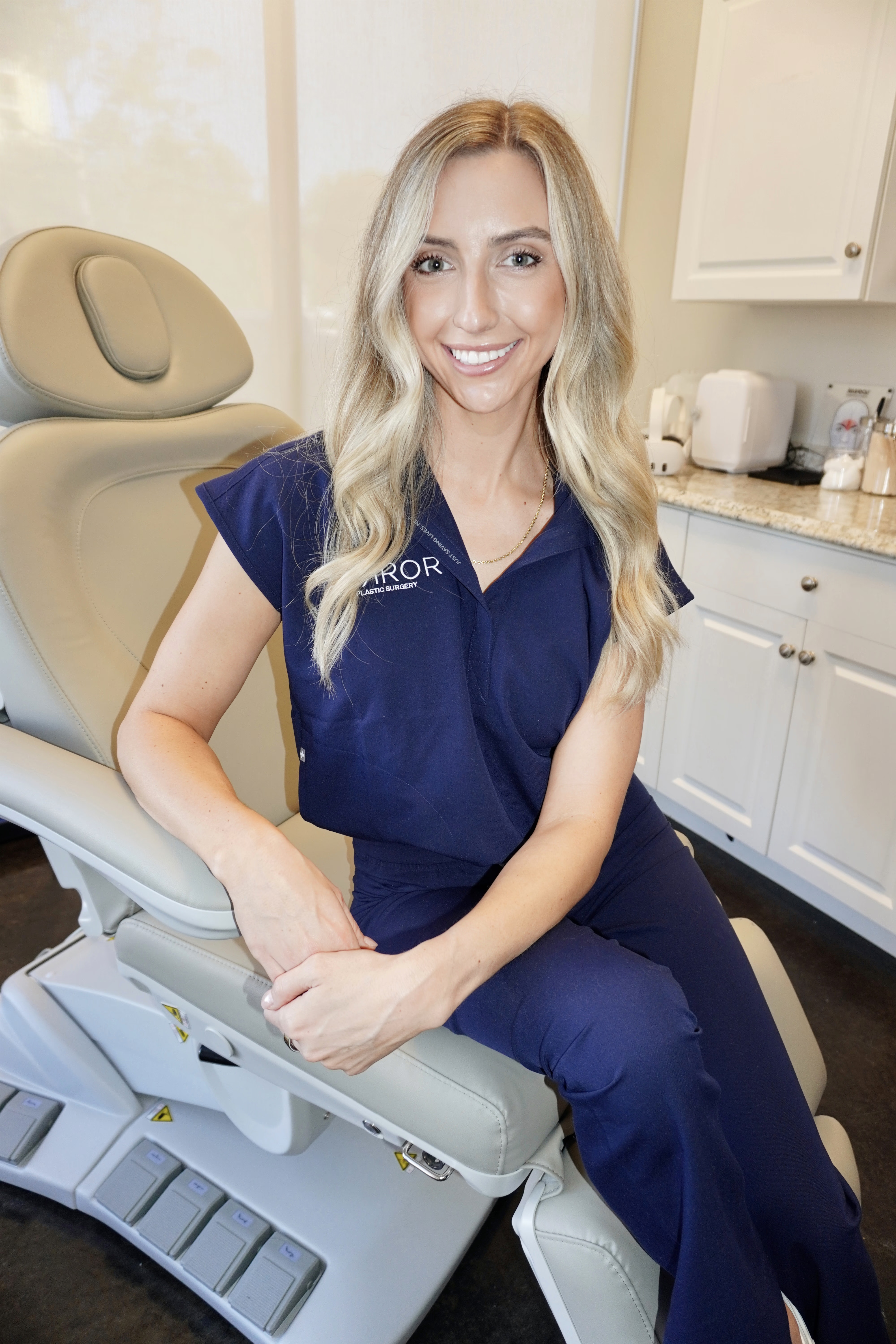
Experience a full hour-long assessment before any treatment recommendation is made.
Recovery, Maintenance, and Long-Term Budgeting
Common injection-site reactions including transient swelling, minor bruising, and tenderness generally resolve within a few days to two weeks.1 Patients should plan for visible swelling during the first 72 hours and avoid assessing final results until the two-week mark, when residual edema has fully resolved.1
A realistic annual maintenance budget accounts for several recurring and potential costs.
- Touch-up frequency. Annual maintenance costs for minimal lip filler upkeep in the U.S. typically range from $1,200 to $1,800 depending on individual metabolism and touch-up frequency.
- Product longevity variation. Different hyaluronic acid lip fillers can last 6–18 months depending on the specific product used, patient metabolism, and lip movement from daily activities.1
- Dissolution costs if correction is needed. Dissolving unwanted lip filler with hyaluronidase typically costs $80–$500 per session (avg $335).
- The cost of choosing the wrong provider initially. Patients who choose unlicensed or underqualified injectors to save $200 often incur $1,000 or more in subsequent costs for dissolution or infection treatment.
- Financing options. Many practices offer financing through CareCredit or in-house plans with various promotional 0% APR periods.
Staged treatment planning builds results gradually across two or three carefully spaced appointments rather than maximizing volume in a single session. This approach consistently produces more natural outcomes and reduces the likelihood of costly correction. Overfilling lips relative to underlying tissue capacity can cause distortion of natural lip shape, product migration, and an overtreated appearance.1
Frequently Asked Questions
Am I a good candidate for lip augmentation?
Most healthy adults seeking subtle volume, improved definition, or age-related lip restoration are candidates for lip filler. Candidacy depends on individual anatomy, tissue quality, existing asymmetries, and overall facial proportions, which require a thorough in-person evaluation. Certain medical conditions, active infections near the treatment area, or unrealistic expectations may affect suitability. A comprehensive consultation remains the only reliable way to determine candidacy.
How much downtime should I expect after lip filler?
Most patients experience swelling, mild tenderness, and possible bruising for 48–72 hours following treatment. Social downtime is minimal for the majority of patients, though visible swelling may persist for up to two weeks. Final results should not be assessed until swelling has fully resolved.1 Strenuous exercise, alcohol, and blood-thinning medications are typically avoided for 24–48 hours before and after treatment to help minimize bruising.
How does Ellie select which filler product to use for my lips?
Product selection at Mirror Plastic Surgery is driven entirely by patient anatomy and goals, not brand agreements or volume incentives. Ellie evaluates tissue thickness, lip mobility, existing volume, and the desired outcome, whether that is subtle hydration, enhanced definition, or structural augmentation, before recommending a specific formulation. Different lip filler products have distinct rheological properties that make them better suited for fine border definition versus central volume. Matching product to anatomy is central to achieving natural results.
Can lip filler be reversed if I do not like the outcome?
Lip fillers can be dissolved with an enzyme that breaks down the filler material, with early effects typically visible within 24–48 hours.1 This reversibility is one of the primary advantages of temporary filler over permanent implants. At Mirror Plastic Surgery, reversal enzyme is stocked on-site as a standard safety protocol, and Ellie is trained to manage vascular complications and patient dissatisfaction with the same clinical rigor she applies to the original treatment.
Why does Mirror Plastic Surgery spend an hour on a consultation before discussing lip augmentation?
The lips do not exist in isolation. Volume added to the lips without accounting for cheek projection, chin proportion, nasolabial folds, and overall facial balance frequently produces results that look unnatural or disproportionate. Ellie’s hour-long assessment evaluates the full face before any treatment recommendation is made. This process helps ensure that lip augmentation, when appropriate, integrates harmoniously with the patient’s existing features rather than drawing attention to itself. The same assessment can reveal cases where foundational restoration elsewhere in the face would produce a more impactful result than lip volume alone.
Next Steps
Lip augmentation cost in 2026 is not a single number. It reflects provider expertise, product selection, anatomical precision, reversibility readiness, and a maintenance plan calibrated to your individual metabolism and goals. Patients who invest in a thorough initial assessment with a credentialed, supplier-neutral injector consistently achieve better long-term value than those who focus only on the lowest per-syringe price.
Ellie Pranckevicius, FNP-BC, leads non-surgical injectable treatments at Mirror Plastic Surgery in St. Petersburg, Florida. Her background spans advanced nursing, ICU-level clinical judgment, and 600 hours of formal aesthetics training, a combination that supports the anatomically precise, natural outcomes her patients seek. Every new patient receives a dedicated hour-long consultation before any pricing discussion or treatment recommendation.
Receive the unhurried, evidence-based assessment your anatomy deserves at Mirror Plastic Surgery.
Mirror Plastic Surgery is located at 780 4th Ave S, St. Petersburg, FL 33701. Reach the practice by phone or text at 727-361-6515 or by email at hello@mirrorplasticsurgery.com.
Disclaimer: Results may vary from person to person. Editorial content, before and after images, and patient testimonials do not constitute a guarantee of specific results.
1 Results may vary from person to person. Editorial content, before and after images, and patient testimonials do not constitute a guarantee of specific results.