
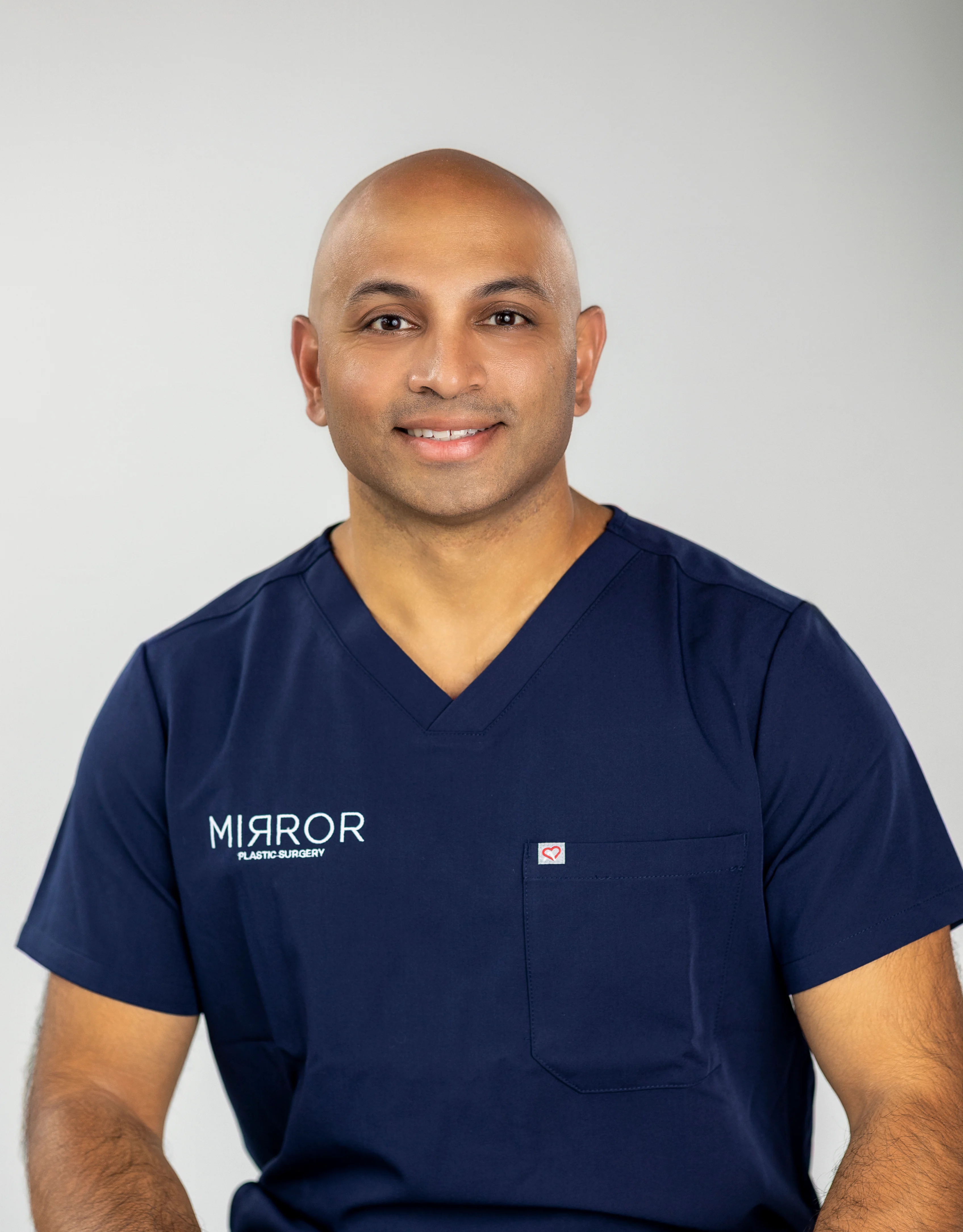
Written by: Dr. Akash Chandawarkar, Board Certified Plastic Surgeon, Mirror Plastic Surgery | Last updated: September 9, 2026
Key Takeaways
- The injector’s skill and anatomical expertise shape your lip filler results more than choosing between Juvéderm and Restylane.
- Juvéderm Volbella XC offers subtle enhancement with minimal swelling, while Restylane Kysse provides flexible structure that moves naturally with expression.
- Both brands deliver similar longevity in the 6–12 month range, with real-world duration driven by metabolism and lifestyle.1
- Expert technique and thoughtful product choice minimize swelling and bruising, and most patients complete recovery within two weeks.1
- A personalized consultation at Mirror Plastic Surgery provides a surgeon-led assessment and treatment plan tailored to your lip anatomy and aesthetic goals.
How Juvéderm And Restylane Actually Differ
Juvéderm and Restylane are both hyaluronic acid (HA) fillers, a substance the body naturally produces. Both are reversible with hyaluronidase and share comparable safety profiles. The meaningful differences come from manufacturing technology, which affects texture, water absorption, flexibility, and how each gel behaves in moving lip tissue.
The FDA-Approved Lip Filler Options
Juvéderm Volbella XC (Allergan/AbbVie): FDA-approved May 31, 2016, for lip augmentation and correction of perioral rhytids in adults over 21. It uses Vycross technology. The lower HA concentration of 15 mg/mL produces a smooth, cohesive gel with a very low G-prime of approximately 45 Pa. This low G-prime allows the gel to integrate seamlessly into superficial tissue and absorb less water, which translates to less post-injection swelling. In the US pivotal study of 168 subjects, approximately two-thirds showed improvement in lip fullness and perioral lines through one year.1
Juvéderm Ultra XC (Allergan/AbbVie): FDA-approved for lip augmentation and the perioral area in adults over 21. It uses Hylacross technology and contains 24 mg/mL of HA. This higher concentration delivers more volume per syringe and tends to create more initial swelling because it draws in more water.
Restylane Kysse (Galderma): FDA-approved March 26, 2020, for lip augmentation and correction of upper perioral rhytids in adults over 21. It uses XpresHAn (Optimal Balance Technology/OBT) with 20 mg/mL HA. This creates a flexible, monophasic gel with a moderate elastic modulus of approximately 150 Pa. Its high flexibility is engineered to move naturally with the lips during speech and expression.
Restylane Silk (Galderma): FDA-approved June 13, 2014, for submucosal lip augmentation and perioral rhytids. It uses NASHA technology and contains the smallest, smoothest HA particles in the Restylane family, with a G-prime of approximately 416 Pa. Results typically last around six months.1
Juvéderm Vs. Restylane For Lips: Key Differences At A Glance
The table below summarizes the four FDA-approved lip fillers and shows how technology and G-prime guide their best uses.
| Product | Technology | FDA Approval (Lips) | Best-Use Case |
|---|---|---|---|
| Juvéderm Volbella XC | Vycross, 15 mg/mL HA, G-prime ~45 Pa | May 31, 2016 | Subtle enhancement, perioral lines, minimal swelling |
| Juvéderm Ultra XC | Hylacross, 24 mg/mL HA, intermediate G-prime | FDA-approved (lips/perioral area) | Moderate-to-significant volume increase |
| Restylane Kysse | XpresHAn/OBT, 20 mg/mL HA, G-prime ~150 Pa | March 26, 2020 | Defined structure with natural movement during expression |
| Restylane Silk | NASHA, fine particles, G-prime ~416 Pa | June 13, 2014 | Subtle enhancement, perioral fine lines |
Matching Filler To Your Aesthetic Goals: Subtle Vs. Structured
Product selection starts with your desired outcome. During a consultation, Dr. Akash evaluates facial proportions, lip anatomy (height, projection, symmetry, Cupid’s bow definition), and your stated goals before recommending a product. He reads the architecture of your face first, then selects the tool.
The choice between products depends on your primary goal. If you want subtle, natural-looking enhancement, Juvéderm Volbella XC is often preferred. Its low G-prime gel adds gentle volume and smooths vertical lip lines without changing your lip’s basic character. Its lower water absorption means less post-injection swelling, and fewer than 5% of patients experience significant swelling in clinical experience.1
If you want defined structure that still moves naturally, Restylane Kysse is a strong option. Its XpresHAn technology creates a flexible gel that moves with the lips during speech and expression and provides more definition along the vermilion border. For patients seeking moderate volume increase, Juvéderm Ultra XC delivers more visible fullness per syringe, and patients should expect more initial swelling because of its higher water-absorption profile.
Most Natural-Looking Lip Filler Outcomes
Both Volbella XC and Restylane Kysse can yield natural results when an expert injects them conservatively. Most patients cannot distinguish which brand was used by feel alone. The “natural” outcome depends more on the injector’s restraint, anatomical precision, and understanding of your unique lip structure than on the brand name. An international consensus framework in the Journal of Cosmetic Dermatology (2026) defines natural outcomes across visual appearance, palpation, patient satisfaction, and dynamic expression, and concludes that technique is as important as product selection.
Swelling And Recovery: What To Expect
Post-injection swelling reflects both product properties and injection technique. Volbella’s lower HA concentration and reduced water absorption correlate with less swelling in clinical experience, while Restylane Kysse’s flexible gel also shows a favorable swelling profile. A general recovery timeline applies to both products:
- Days 0–2: Peak swelling and possible bruising, lips feel full
- Days 3–7: Swelling decreases significantly, bruising fades
- Weeks 1–2: Final results appear as the product settles
Injector technique plays the larger role. A 2021 JAMA Dermatology retrospective cohort study of more than 1.6 million syringes found that microcannulas were associated with a 77.1% lower odds of vascular occlusion compared with sharp needles. At Mirror Plastic Surgery, Dr. Akash’s command of facial and subdermal anatomy, including the superior and inferior labial arteries as primary risk vessels, directly reduces swelling, bruising, and complication risk for every patient. Once recovery is complete, the next question becomes how long your results will last.
Longevity And Maintenance: Planning For The Long Term
Both brands provide similar durability for lip treatments, based on FDA clinical trial data:
- Juvéderm Volbella XC: Results lasting up to 12 months1
- Juvéderm Ultra XC: Results typically 6–9 months1
- Restylane Kysse: Results lasting up to 12 months, with an 88% responder rate on lip fullness at week 8 in the pivotal trial1
- Restylane Silk: Results approximately 6 months1
Which Filler Tends To Last Longer?
As these data show, both brands offer lip products in the 6–12 month range. Real-world longevity varies with metabolism, lifestyle, and injected volume more than with brand choice.1 Lips metabolize filler faster than static facial areas because the orbicularis oris muscle moves constantly, speeding lymphatic clearance. A skilled injector plans for maintenance from the start, explains realistic timelines, and builds a long-term treatment relationship, which is the Mirror Plastic Surgery approach.
Schedule a consultation to discuss a personalized maintenance plan with Dr. Akash.
The Injector Factor: Why Expertise Matters More Than Brand
Injector expertise is the most important variable in your outcome. The difference between Juvéderm and Restylane in experienced hands is usually smaller than the difference between two injectors using the same product. Inexperienced injectors are more likely to create overfilled “duck lips,” asymmetry, lumps, and in rare cases vascular complications that require urgent treatment.
A 2026 narrative review in the Journal of Cosmetic Dermatology identifies greater bolus volumes, high injection pressure, and limited anatomical awareness as primary risk factors for vascular occlusion. Injector technique controls these variables, not brand selection. The same review confirms that vascular occlusion incidence is below 0.1%, with higher risk in the glabella, forehead, and nose due to anastomoses with the ophthalmic artery.
Dr. Akash Chandawarkar personally performs every injection at Mirror Plastic Surgery. As a board-certified plastic surgeon with fellowship training in aesthetic surgery, he brings a surgeon’s knowledge of facial and subdermal anatomy to each treatment. His advisory board roles at Merz Aesthetics and Tiger Aesthetics keep him current on injectable science and support evidence-based, supplier-neutral product recommendations.
A 2026 multidisciplinary expert safety consensus in the Journal of Drugs in Dermatology reached full agreement that risk reduction for filler complications depends on comprehensive preprocedure assessment and technique choices. Product selection plays a role, but injector judgment guides safety.
How To Choose: A Step-By-Step Decision Framework
This framework reflects the process Dr. Akash uses during every lip filler consultation:
- Define Your Aesthetic Goal. Decide whether you want subtle hydration and definition or more visible fullness. Write down what you hope to change about your lips before your appointment.
- Consider Your Lip Anatomy. Thin lips, asymmetry, undefined borders, and vertical lip lines each respond differently to specific products. Your anatomy guides the recommendation.
- Seek An Expert Injector. Choose a board-certified plastic surgeon or dermatologist who performs injections personally, rather than delegating to staff.
- Ask Key Questions Before Committing. Use the questions below as a starting point for your consultation.
Questions to ask any injector before your treatment:
- What product do you recommend for my anatomy, and why?
- How will you minimize swelling and bruising?
- Do you have hyaluronidase on-site to reverse the filler if needed?
- What is your protocol if I experience a vascular complication?
- How many lip filler treatments do you perform per month?
- What does a realistic result look like for my specific lip structure?
Common Misconceptions About Lip Fillers
Several myths still surround lip fillers. Here is what the evidence and expert experience show:
- “One brand is universally better.” Juvéderm and Restylane are both excellent FDA-approved fillers. The right choice depends on your anatomy and goals rather than brand loyalty.
- “Lip filler always looks fake.” Unnatural results usually come from providers who prioritize volume over proportion. Expert consensus guidance notes that chasing “perfect” symmetry or “ideal” proportions instead of respecting individual anatomy often creates artificial-looking lips.
- “All injectors are equally skilled.” A 2024 international survey estimated that practitioners need about 3.85 years and nearly 800 filler injections to reach advanced competency. Training, experience, and anatomical knowledge vary widely.
- “A cheaper syringe is a better deal.” Poorly placed lip filler often requires dissolving with hyaluronidase. Correcting a bad result usually costs more than choosing an expert injector from the beginning.
Frequently Asked Questions
Which Filler Looks Most Natural?
As discussed earlier, both Juvéderm Volbella XC and Restylane Kysse can look very natural when an experienced injector uses conservative technique. Volbella’s low G-prime gel integrates subtly with minimal swelling, and Kysse’s flexible XpresHAn formula moves smoothly during expression. Your injector’s anatomical knowledge and restraint shape the outcome more than the brand.
How Long Do Lip Fillers Last?
As noted in the longevity section, both brands offer lip fillers that can last up to 12 months. Juvéderm Volbella XC and Restylane Kysse show similar durability in FDA trials. Your metabolism, lip movement, and injected volume influence duration, so maintenance planning remains important regardless of product.
What Are The Downsides Of Restylane For Lips?
Some older NASHA-based Restylane products can feel firmer and more palpable than Juvéderm’s cohesive Vycross gels. Restylane Kysse’s XpresHAn technology addresses this with a flexible, monophasic gel designed for lip movement. In skilled hands, Kysse feels soft and natural, and most patients cannot distinguish it from Volbella by touch.
What Lip Filler Works Best For Lip Lines?
Juvéderm Volbella XC and Restylane Silk are both FDA-approved for perioral rhytids (vertical lip lines). Their thin, low-G-prime formulas smooth fine lines effectively without adding unwanted bulk. Volbella suits patients who also want subtle lip volume, while Silk focuses on line correction alone.
Can Lip Filler Be Reversed?
Yes. Both Juvéderm and Restylane are hyaluronic acid fillers that can be dissolved with hyaluronidase, an enzyme that breaks down the gel. This reversibility is a key safety advantage and a major reason board-certified plastic surgeons favor HA fillers for lip augmentation. At Mirror Plastic Surgery, hyaluronidase is always available on-site.
The Best Filler Is The One Your Surgeon Recommends
Juvéderm and Restylane are both proven, FDA-approved hyaluronic acid fillers with strong clinical records for lip augmentation. The real decision is between injectors, not brands. The right product, matched to your anatomy and goals by a surgeon who understands both, creates results that look natural, feel soft, and last. An inexperienced injector is more likely to create the same overfilled look regardless of which brand sits in the syringe.
At Mirror Plastic Surgery, Dr. Akash Chandawarkar brings a board-certified plastic surgeon’s command of facial anatomy to every lip filler treatment. His concierge approach means your consultation is unhurried, your treatment plan is personalized, and your outcome is guided by your goals rather than volume quotas or brand commissions. If you are considering lip enhancement in the St. Petersburg or Tampa Bay area, the first step is a thoughtful conversation.
Ready To Explore Lip Enhancement With A Surgeon’s Precision?
Schedule your consultation with Dr. Akash at Mirror Plastic Surgery, located at 780 4th Ave S, St. Petersburg, FL 33701. Call or text 727-361-6515, or book your consultation online with Ellie today.
Disclaimer: Results may vary from person to person. Editorial content, before and after images, and patient testimonials do not constitute a guarantee of specific results.
1 Results may vary from person to person. Editorial content, before and after images, and patient testimonials do not constitute a guarantee of specific results.