
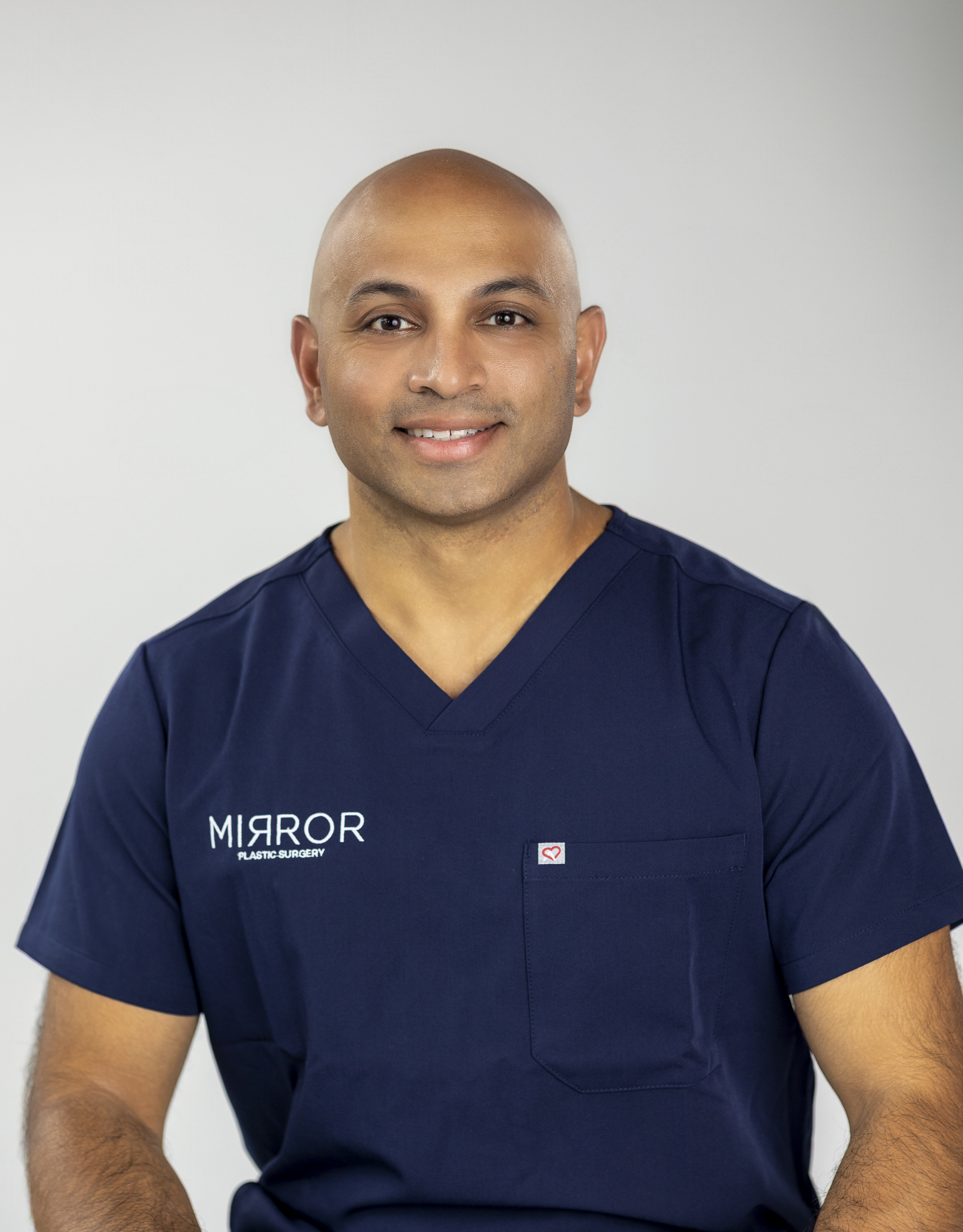
Written by: Dr. Akash Chandawarkar, Board Certified Plastic Surgeon, Mirror Plastic Surgery | Last updated: July 4, 2026
Key Takeaways
- Hip dips come from skeletal geometry and genetics, so they rarely change with diet or exercise. A BBL reshapes the entire buttock area using higher-volume fat transfer.
- Targeted hip-dip correction uses lower fat volumes placed only into the lateral indentation. A full BBL usually requires 300–500 cc per side and 360° liposuction for more dramatic reshaping.
- Fat-graft survival rates of 60–80% apply to both procedures, with final results usually visible after three to six months once resorption stabilizes.1
- Safety improves when patients choose board-certified surgeons, accredited facilities, ultrasound guidance, and practices that limit daily case volume. These factors significantly reduce risks such as fat embolism.
- Patients who want a personalized anatomical assessment and evidence-based guidance for hip shaping can book a consultation at Mirror Plastic Surgery to explore surgical and non-surgical options, including AlloClae.
How Hip Dips Differ from Brazilian Butt Lift Procedures
Hip dips form where the skin attaches directly to the deeper portion of the femur. Pelvic bone width, fat and muscle distribution, and connective-tissue thickness all influence how visible they appear. Because skeletal geometry and genetics drive this contour, hip dips occur across all body sizes and fitness levels and usually do not respond to diet or exercise. Targeted hip-dip correction focuses only on this lateral indentation. A Brazilian Butt Lift (BBL) instead uses 360° liposuction and reshapes the waist, hips, thighs, and entire buttock complex. Both procedures use autologous fat transfer, yet they differ in volume, anatomical target, recovery course, and risk profile.
Why Personalized, Evidence-Based Evaluation Matters
A meaningful consultation starts with a complete anatomical assessment, not a preselected procedure. At Mirror Plastic Surgery, Dr. Akash often spends up to an hour per consultation evaluating skeletal structure, soft-tissue distribution, donor-fat availability, and aesthetic goals. The practice follows a clear hierarchy of safety first, function second, and aesthetics third. That sequence directly shapes how body-contouring candidates are evaluated.
This philosophy also guides surgical volume. Mirror Plastic Surgery limits itself to one to two surgeries per day, which supports focused clinical attention before, during, and after each procedure. A 2023 analysis of BBL deaths in South Florida linked higher risk to clinic working environments and short operative times, and the 2022 multi-society Practice Advisory on Gluteal Fat Grafting lists performing more than 3 BBLs per day as a risk factor due to surgeon fatigue. All procedures at Mirror Plastic Surgery take place in accredited surgical facilities with board-certified physician anesthesiologists.
Schedule your personalized anatomical assessment with Dr. Akash before committing to any procedure.
Evaluating a Surgeon’s Training and Credentials
The American Board of Plastic Surgery (ABPS) is an ABMS-approved board whose residency training pathway includes liposuction and fat transfer procedures, and ABPS certification is the gold standard recognized by the American Board of Medical Specialties for plastic surgery. Fellowship training in aesthetic surgery beyond residency adds focused procedural experience that directly affects body-contouring outcomes.
Dr. Akash holds board certification from the American Board of Plastic Surgery and completed his plastic and reconstructive surgery residency at Johns Hopkins University, one of the world’s leading training programs. His aesthetic surgery fellowship at the Manhattan Eye, Ear and Throat Hospital (MEETH) provided advanced body-contouring training at one of the most competitive programs in the country. He also completed the Stanford University Biodesign Innovation Fellowship and trained at the Harvard-MIT Division of Health Sciences and Technology. Dr. Akash serves on the advisory board for Tiger Aesthetics, the company behind AlloClae adipose filler, and has been named to Newsweek’s America’s Best Plastic Surgeons list for two consecutive years, including 2025.
Key Anatomical and Procedural Terms for Hip Shaping
Trochanteric depression (“trench”): This term describes the lateral hip indentation between the hip bone and upper thigh, often called “violin hips.” The contour reflects a genetic structural deficiency rather than a simple excess or deficit of fat mass. Targeted correction fills only this specific zone.
Blending techniques: Surgeons feather fat deposits at the edges of the trench to create a smooth transition between the filled area and surrounding tissue. Asymmetry that appears in early recovery usually improves between months three and six as swelling resolves and fat stabilizes.
Fat-graft survival: Approximately 60–80% of transferred fat survives long term in hip-dip correction. Because of this predictable resorption, surgeons inject more than the desired final volume at surgery, knowing that a portion will be absorbed. The surviving fat generally stabilizes and becomes permanent after three to six months, so early results often predict longer-term outcomes.1
AlloClae adipose filler: AlloClae is a structural adipose filler offered as a non-surgical in-office option for hip dips and buttock augmentation. Unlike traditional fat transfer or biostimulatory fillers, it provides structural support that encourages fat integration. Dr. Akash serves on the Tiger Aesthetics advisory board and offers AlloClae at Mirror Plastic Surgery for patients who are not surgical candidates or who prefer a non-surgical pathway.
Fat Transfer Safety and Data in 2025–2026
The primary safety guideline for gluteal fat transfer, per ASPS, ISAPS, and the ASERF BBL Task Force, is strict placement of grafts only in the subcutaneous layer above the gluteal muscle. Surgeons avoid intramuscular or submuscular injection to reduce the risk of fatal fat embolism. Early ASERF multi-society task force estimates placed the mortality rate at approximately 1 in 3,000 BBL procedures due to fat embolism from deep injection. Adherence to subcutaneous-only protocols has substantially reduced that figure.
To support subcutaneous-only placement and reduce the deep-injection risk that drove those mortality rates, the safest technique combines subcutaneous-only fat grafting with intraoperative ultrasound guidance. Ultrasound allows the surgeon to monitor cannula depth in real time and confirm placement above the muscle fascia. Professional safety guidelines also recommend large blunt-tipped cannulas, prone patient positioning, controlled injection pressure, accredited facilities, and board-certified anesthesiologists.
Volume thresholds also separate these procedures clearly. A noticeable BBL typically requires 300 to 500 cc of purified fat per side, while subtle hip-dip correction uses significantly less volume focused only on lateral filling. Patients with limited donor fat can still achieve subtle hip contouring when expectations remain modest and sufficient fat is available from the waist, lower back, or thighs. Fat transfer in this setting cannot safely deliver dramatic projection or large volume increases.
Decision Factors: Comparing Hip-Dip Correction and BBL Goals
The following comparison shows how differences in volume and anatomical targets translate into distinct donor-fat requirements, recovery timelines, and long-term expectations.
| Factor | Targeted Hip-Dip Correction | Full Brazilian Butt Lift (BBL) |
|---|---|---|
| Anatomical target | Lateral trochanteric depression only | Entire buttock complex, waist, hips, thighs |
| Donor-fat requirement | Lower volume, modest donor sites sufficient | High volume (see above) |
| Fat survival (long-term) | ~60–80% after 3–6 months1 | ~60–80% after 3–6 months, with higher absolute volume loss |
| Recovery activity restriction | Return to exercise around 3 weeks, pressure off-loading up to 6 weeks | Longer restriction, no sitting directly on buttocks for several weeks |
Treatment Pathways: Focused Hip-Dip Correction vs Full BBL
Targeted hip-dip correction is a focused procedure that harvests a limited volume of autologous fat from donor sites such as the abdomen, flanks, or thighs and deposits it only into the lateral hip indentation. Surgeons frequently perform it as an adjunct to standard tummy tuck surgery when 360° liposuction is not planned. The goal is subtle localized enhancement rather than a dramatic hourglass transformation. AlloClae adipose filler offers a non-surgical alternative for patients who lack sufficient donor fat or who prefer to avoid surgery.
Full BBL is a higher-volume intervention designed to increase posterior projection and create a comprehensive hourglass silhouette. Surgeons use 360° liposuction of the waist, flanks, and thighs combined with large-volume gluteal fat grafting. The procedure requires greater donor-fat availability, longer recovery, and stricter post-operative positioning protocols. Patients seeking both volume and hip-dip correction may need a combined approach, yet each procedure still targets distinct anatomical regions.
Common Misconceptions About Hip Shaping
BBL is always required to address hip dips. A full BBL targets the entire gluteal complex and is unnecessary when the only concern is the lateral trochanteric indentation. Targeted hip-dip fat transfer addresses the genetic indentation without reshaping the upper or lower buttocks.
All transferred fat survives permanently. Fat resorption occurs predictably after transfer. Surgeons inject more than the desired final volume to account for this resorption, and surviving fat is generally considered permanent after three to six months. Weight fluctuations after that point can still change volume.
Surgical environment does not affect safety. A 2023 analysis of BBL deaths in South Florida linked higher risk to clinic working environments and short operative times. Accreditation, board-certified anesthesiology, and daily case-volume limits function as safety variables with documented outcome differences, not cosmetic preferences.
Non-surgical fillers are equivalent to fat transfer. Poly-L-lactic acid carries risks of subcutaneous papule formation and often requires repeat treatments compared with autologous fat transfer. Using large volumes of dermal filler in non-standard areas such as the hips increases risks of lumps, asymmetry, and vascular complications compared with smaller-volume facial use. AlloClae is a structurally distinct adipose filler that differs from conventional HA or PLLA products and is evaluated separately.
Clarify which pathway aligns with your anatomy and goals in a consultation with Dr. Akash before making any procedural decision.
Frequently Asked Questions
Will a BBL get rid of hip dips?
A full BBL can improve the appearance of hip dips as part of comprehensive gluteal reshaping, yet it is not designed solely for that purpose.1 BBL focuses on posterior projection and overall hourglass transformation through high-volume fat grafting and 360° liposuction. Hip dips represent a lateral anatomical feature caused by skeletal geometry. A surgeon may address both concerns in a combined approach, but patients whose only concern is the lateral indentation usually benefit more from targeted hip-dip correction, which uses lower volumes and focuses exclusively on that zone.
Does a BBL widen the hips?
BBL can create the appearance of wider hips by adding volume to the upper and lateral buttock regions and by removing fat from the waist through liposuction, which accentuates the hip-to-waist ratio.1 The skeletal width of the pelvis does not change. The degree of apparent widening depends on the patient’s existing anatomy, the volume of fat transferred, and the surgeon’s placement strategy. Patients with narrow pelvic structures may see more modest widening than those with broader underlying bone architecture.
How does fat survival affect long-term results?
As noted earlier, the resorption phase usually finishes by three to six months after the procedure. Surgeons plan for this by injecting a calculated excess volume at the time of surgery. Fat that survives beyond six months is generally considered permanent, though significant weight changes can still alter the volume of surviving fat cells. Patients should evaluate their final results after the six-month mark, because earlier assessments often reflect residual swelling rather than true outcomes.1
What is AlloClae and how does it differ from traditional fat transfer?
AlloClae is a structural adipose filler used for hip dips, buttock augmentation, and breast augmentation. Traditional autologous fat transfer harvests and reinjects the patient’s own fat cells, which show variable survival rates. AlloClae instead provides a processed adipose matrix that supports fat integration and structural volume. It is available as an in-office, non-surgical procedure at Mirror Plastic Surgery, making it an option for patients who are not surgical candidates, lack sufficient donor fat, or prefer to avoid general anesthesia. Dr. Akash serves on the Tiger Aesthetics advisory board and has direct clinical experience with this technology.
What questions should I ask a surgeon before a hip-shaping procedure?
Relevant questions include: Are you board certified by the American Board of Plastic Surgery? How many hip-dip corrections and BBL procedures do you perform annually? Do you use ultrasound guidance during fat injection? Is the surgical facility accredited? Will a board-certified physician anesthesiologist be present? How many surgeries do you perform per day? What criteria would lead you to recommend against surgery? A surgeon who answers these questions transparently and without pressure demonstrates the kind of evidence-based, patient-centered practice that supports safe outcomes.
Choosing the Right Approach for Your Goals
Hip-dip correction and BBL serve different purposes. They address different anatomical structures, require different volumes of donor fat, involve different recovery timelines, and suit different patient goals. The decision between them, or between surgery and a non-surgical option like AlloClae, depends on a thorough evaluation of skeletal anatomy, soft-tissue characteristics, donor-fat availability, and realistic expectations.
Safety protocols, facility accreditation, daily case-volume limits, and surgeon credentials function as primary decision points, not secondary details. These factors help determine whether a procedure is appropriate for a specific patient. An anatomy-first evaluation by a board-certified plastic surgeon with fellowship training in aesthetic surgery offers the most reliable starting point for any body-contouring decision.
Dr. Akash brings the training and recognition detailed above to every consultation at Mirror Plastic Surgery in St. Petersburg, Florida, working within a concierge model that limits the practice to one to two surgeries per day. The practice’s commitment to safety before aesthetics supports patients who want evidence-based guidance rather than a sales experience.
Begin your anatomy-first evaluation of hip-shaping options with Dr. Akash at Mirror Plastic Surgery.
1 Results may vary from person to person. Editorial content, before and after images, and patient testimonials do not constitute a guarantee of specific results.