
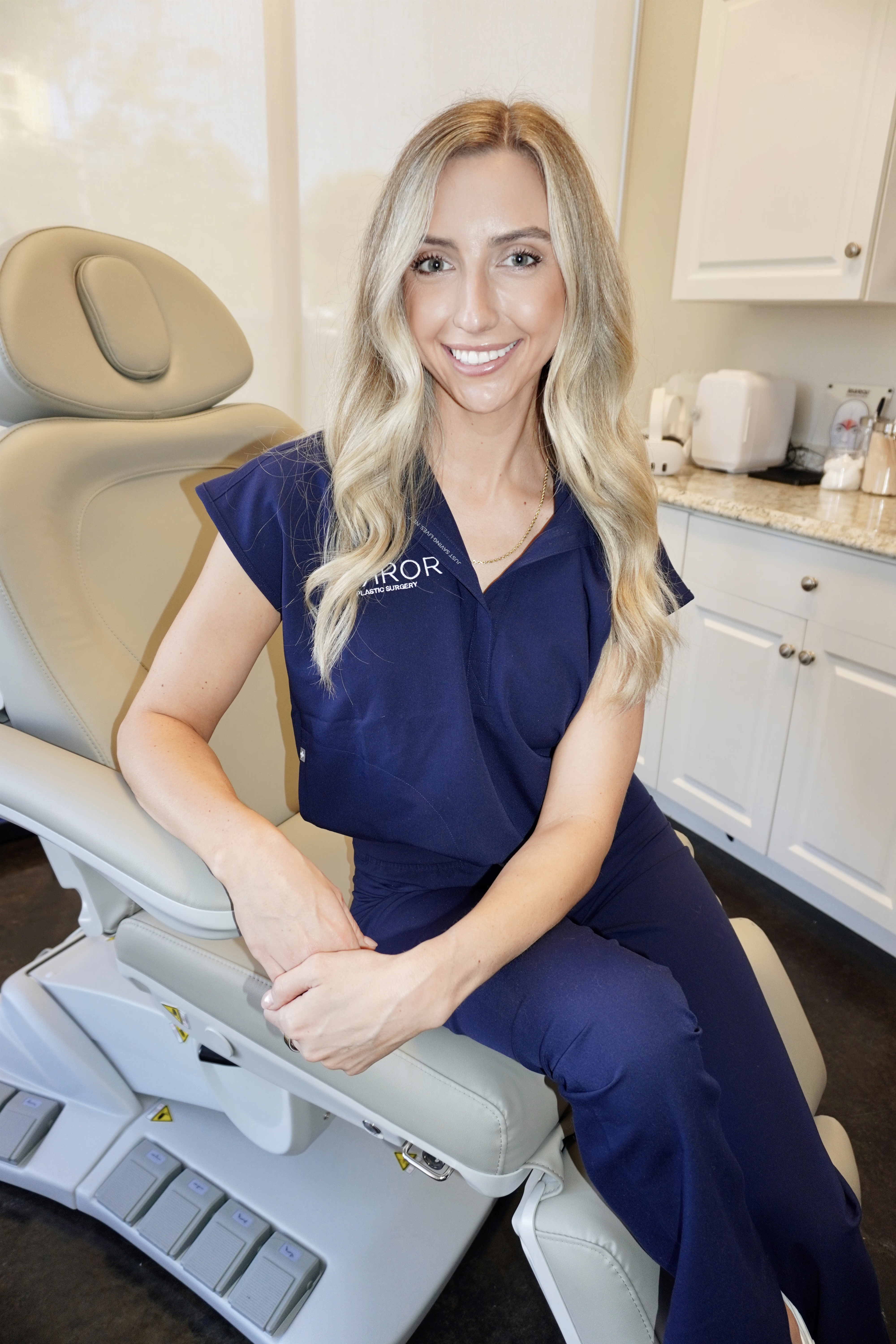
Written by: Ellie Pranckevicius, FNP-BC, Aesthetic Nurse Practitioner & Aesthetic Injector | Facial Restoration & Regenerative Injectable Specialist, Mirror Plastic Surgery | Last updated: July 12, 2026
Key Safety Takeaways for Hip-Dip Filler and Non-Surgical BBL
- Non-surgical BBL and hip-dip filler both use biostimulatory agents, and risk levels rise sharply as total volume increases.
- Targeted hip-dip correction uses low volumes (<20 mL) and carries lower risks of vascular complications, nodules, and migration than moderate or high-volume non-surgical BBL.
- Embolism and vascular occlusion remain possible even at low volumes, so precise anatomical knowledge and injector expertise are essential for safety.
- Biostimulatory fillers like Sculptra and Radiesse are not reversible, unlike hyaluronic acid, so thorough pre-treatment assessment is critical before any gluteal procedure.
- At Mirror Plastic Surgery, Ellie Pranckevicius provides individualized anatomical evaluations to determine safe volume thresholds. Schedule your consultation today to establish your personal baseline.
Volume Risk Matrix for Gluteal Fillers by mL Range
The table below synthesizes available 2024–2026 clinical commentary on how total filler volume in the gluteal region correlates with three primary complication categories. Because gluteal filler research remains limited, not all volume ranges have established incidence percentages, so the table presents qualitative risk gradients where quantitative data is unavailable.
| Volume Range | Vascular Complication Risk | Nodule / Inflammatory Reaction Risk | Migration Risk |
|---|---|---|---|
| <20 mL (targeted hip-dip correction) | Lower, dispersed placement creates less immediate vascular pressure | Low nodule incidence, technique-dependent | Low, limited tissue displacement at small volumes |
| 20–60 mL (moderate non-surgical BBL) | Moderate, increased tissue pressure begins to compromise circulation | Elevated, delayed inflammatory nodules more likely with larger volumes | Moderate, gravity and tissue movement increase shift risk |
| >60 mL (high-volume non-surgical BBL) | High, larger, deeper gluteal vessels magnify severity of any intravascular event | High, volume correlates directly with delayed nodule likelihood | High, asymmetry requiring dissolution is a documented outcome |
Individual anatomy and provider technique influence outcomes at every volume tier, so these ranges serve as reference points rather than universal thresholds.
Safe Volume Ranges for Hip-Dip Filler
Targeted hip-dip correction uses a comparatively small volume of biostimulatory filler, typically Sculptra or Radiesse, placed directly into the lateral femoral depression. This low-volume, high-precision approach differs from a full non-surgical BBL, which distributes product across the entire gluteal region.
Both procedures share potential complications, yet their incidence shifts significantly as volume increases.
- Migration: Product migration occurs especially in large-volume buttock treatments because gravity and tissue movement cause filler to shift, potentially resulting in asymmetry that requires dissolution to correct. At the smaller volumes used for hip-dip correction, this risk decreases but still requires careful placement and follow-up.
- Vascular occlusion: Gradual, low-volume filler approaches place less immediate pressure on blood vessels than high-volume buttock injections. Careful aspiration, cannula choice, and depth control further reduce this risk.
- Inflammatory nodules: Delayed inflammatory nodules occur more often when large volumes of filler are used in the buttocks compared with gradual, low-volume approaches, and management may require steroids or filler dissolution. Conservative dosing and staged sessions help limit this complication.
No universal “safe” milliliter number exists for hip-dip filler. Individual anatomy and provider technique determine outcomes, and the appropriate volume for any patient is set only after a thorough anatomical assessment.
Embolism Risk with Hip-Dip Filler
Embolism represents a rare but serious risk in any gluteal injection procedure. The gluteal region contains larger, deeper blood vessels than facial injection sites, meaning that if injection depth is incorrect, the severity of a vascular event, including embolism affecting vital organs, is substantially greater. Patients with vessel locations that are difficult to map or who have vascular anomalies face elevated risk for accidental intravascular injection.
Volume amplifies this risk mechanically. High-volume filler injections increase tissue pressure, which compromises circulation and blood flow. At the smaller volumes used for targeted hip-dip correction, the pressure gradient is lower, yet risk persists. Because of the larger, deeper vasculature in this region, even low-volume procedures require an injector with precise subdermal anatomical knowledge.
In Florida, the Department of Health requires that injectable procedures be performed by or under the supervision of a licensed medical professional. Ellie Pranckevicius, FNP-BC, holds a Master’s in Nursing from the University of South Florida and spent four years in the Neuroscience ICU at Tampa General Hospital before specializing in aesthetic injectables. This clinical background directly informs her vascular risk management during every gluteal procedure.
Patient Factors That Disqualify Non-Surgical BBL
Several anatomical, medical, and lifestyle factors elevate risk to a level that warrants deferral or disqualification from large-volume gluteal filler procedures. A responsible provider identifies these factors before any product is ordered.
Anatomical and vascular contraindications:
- Known vascular anomalies or vessel locations that are difficult to map in the gluteal region
- Pre-existing circulatory vulnerabilities that cannot tolerate reduced perfusion from elevated tissue pressure
Medical contraindications:
- Known allergy to PLLA or lidocaine (for Sculptra-based protocols)
- Pregnancy or breastfeeding
- Active skin infection in the intended injection area
- History of keloid formation
- History of nodule formation, which correlates with elevated recurrence risk
Lifestyle factors:
- Body habits or occupational demands that create sustained friction and pressure on the buttock area, slowing healing and increasing infection risk
The decision pathway begins with a full assessment, not a product menu. Patients who present with one or more of these factors may still qualify for a modified, lower-volume protocol or an alternative treatment such as AlloClae, which Mirror Plastic Surgery also offers for buttock and hip-dip correction. When contraindications narrow the field of suitable candidates, the ability to reverse or adjust a treatment becomes even more critical in the decision-making process.
Reversibility of HA Fillers Versus Biostimulatory Permanence
Reversibility functions as a primary safety consideration in any body filler decision. The two categories of agents used in non-surgical gluteal enhancement differ fundamentally on this point.
Hyaluronic acid fillers are fully reversible using hyaluronidase, which can dissolve the product within 24–48 hours in cases of vascular occlusion, migration, or dissatisfaction. This reversibility provides a safety net. However, large-volume HA filler use in the gluteal region carries a high risk of vascular occlusion, delayed inflammatory responses, and long-term risks including late-onset infections or biofilm formation. For this reason, Mirror Plastic Surgery does not recommend large-volume HA filler as a standard approach for non-surgical BBL. Radiesse and AlloClae represent the preferred, evidence-supported methods for gluteal volume and contouring.
Biostimulatory agents, Sculptra (PLLA) and Radiesse (CaHA), work by stimulating the body’s own collagen production rather than depositing a gel mass. Sculptra is not reversible, the injected material cannot be dissolved or removed, and the resulting collagen diminishes naturally over approximately 2–3 years.1 Sculptra results show gradual onset with visible improvement starting around week four and continuing through collagen remodeling up to month six.1 Radiesse results last 12–18 months.1
Regarding 2025–2026 regulatory context, the FDA has not issued new body-specific labeling for PLLA or CaHA biostimulators as of mid-2026. Patients should confirm that their provider discloses the regulatory status explicitly during the informed consent process, which is standard practice at Mirror Plastic Surgery.
Frequently Asked Questions About Hip-Dip Filler and Non-Surgical BBL
Can you fill hip dips without a BBL?
Hip-dip correction can be performed as a targeted, low-volume procedure that addresses only the lateral femoral depression, the indentation between the hip and thigh. This approach does not require the broader gluteal volume placement involved in a non-surgical BBL. Biostimulatory fillers such as Sculptra or Radiesse can be deposited precisely into the hip-dip area to restore contour. Because the volume used is substantially lower than a full BBL protocol, the risk profile is correspondingly reduced, though not eliminated. An in-depth anatomical assessment determines whether isolated hip-dip correction is appropriate or whether a more comprehensive gluteal approach would better match the patient’s goals.
What is safer, BBL or injections?
Safety comparisons depend on which BBL technique is under discussion. Surgical BBL carries well-documented mortality risk associated with fat embolism when fat is injected into the deep gluteal muscle. Non-surgical BBL using biostimulatory injectables avoids surgical risk but introduces its own vascular, migration, and nodule risks that scale with volume. Targeted hip-dip filler at low volumes carries a lower complication profile than high-volume non-surgical BBL. No procedure is categorically “safe” without an individualized assessment, because anatomy, health history, provider technique, and total volume placed all shape the actual risk for a specific patient.
Are BBLs out of style in 2026?
Aesthetic preferences in 2026 favor more proportional, natural-looking gluteal enhancement rather than maximum volume. This trend aligns with the approach Mirror Plastic Surgery has always taken, where volume is considered only after a full anatomical assessment establishes what is appropriate for the individual patient’s frame and goals. Non-surgical BBL remains a relevant and requested procedure in 2026. The clinical emphasis has shifted toward biostimulatory agents that build collagen gradually rather than large-volume gel deposits, a change driven by both aesthetic preference and an improving understanding of long-term safety profiles.
How long will hip-dip filler last?
Duration depends on the agent used and the individual patient. Sculptra (PLLA) results for hip-dip correction can last 2 years or more as the body’s own collagen provides the volume.1 Radiesse (CaHA) results can last 12–24 months.1 Individual metabolism, activity level, and the number of sessions completed all influence how long results remain visible.1
Conclusion and Next Steps with Mirror Plastic Surgery
Total volume placed, not the treatment label, functions as the primary driver of vascular complication risk, nodule incidence, and migration in non-surgical gluteal enhancement. Targeted hip-dip filler at low volumes carries a meaningfully different risk profile than high-volume non-surgical BBL, yet neither procedure is appropriate without first establishing what an individual patient’s anatomy can safely accommodate. The gluteal region’s larger, deeper vasculature, combined with the irreversibility of many biostimulatory agents, makes a thorough pre-treatment assessment essential.
At Mirror Plastic Surgery, Ellie Pranckevicius conducts up to an hour-long, top-to-bottom anatomical consultation before any volume recommendation is made. Her dual background in advanced nursing and aesthetics, combined with four years of ICU clinical experience, positions her to evaluate vascular risk, contraindications, and realistic outcomes with a depth that high-volume clinics rarely match.
Disclaimer: Results may vary from person to person. Editorial content, before and after images, and patient testimonials do not constitute a guarantee of specific results.
1 Results may vary from person to person. Editorial content, before and after images, and patient testimonials do not constitute a guarantee of specific results.