
Written by: Ellie Pranckevicius, FNP-BC, Aesthetic Nurse Practitioner & Aesthetic Injector | Facial Restoration & Regenerative Injectable Specialist, Mirror Plastic Surgery | Last updated: August 6, 2026
Key Takeaways
- Natural facial volume restoration with dermal fillers usually starts with 2–4 syringes total, spread across several facial zones instead of packed into one area.1
- Conservative per-zone volumes, such as 0.5–1.5 mL for cheeks, 0.5–1 mL for lips, and 0.5–1 mL per side for temples, help maintain proportion and avoid an overfilled look.1
- A staged treatment plan that begins with 2–3 syringes and a four- to six-week follow-up lowers the risk of overcorrection and lets you adjust gradually.1
- Age, skin quality, prior filler history, and product characteristics all shape the exact volume and placement strategy for each person.
- Schedule your personalized consultation at Mirror Plastic Surgery for a top-to-bottom facial assessment and a conservative, anatomy-guided filler plan.
Cheek Filler Volumes for a Natural Midface
The cheeks act as the structural anchor of the midface. As the malar fat pad descends with age, the cheekbone loses its highlight and the nasolabial fold deepens. Conservative cheek restoration usually requires 0.5–1.5 mL per side, based on volume loss and underlying bone structure.1
Patients with prominent native cheekbones often need less product to restore projection, while those with flatter midface anatomy or significant fat pad descent may require the higher end of that range. Regardless of starting anatomy, placing filler directly on the periosteum, the tissue layer closest to bone, produces the most natural lift with the least product.1 Deep anatomical knowledge therefore matters more than volume alone.
Putting 2 mL in Context
In a single facial zone, 2 mL represents a meaningful amount of filler. Across the full face, 2 mL functions as a conservative starting point. Context shapes how that volume appears.
Two syringes placed only in the lips create an obviously augmented result. The same two syringes divided between the temples, cheeks, and jawline look subtle and are nearly imperceptible to anyone who did not know the patient before treatment.1 The concern behind “is 2 mL a lot” centers on whether a recommended volume will look natural. The answer depends on placement, product choice, and how the injector distributes filler relative to existing anatomy.
Natural-Looking Lip Filler Volumes
Lip augmentation carries the strongest association with overdone results, so conservative volume matters most in this zone. For patients who have never had lip filler, 0.5 mL usually works well as a starting point. This amount adds definition to the vermilion border and gentle fullness without disrupting the natural lip-to-face ratio.1
Patients who want to restore age-related volume loss, rather than augment beyond baseline, often do well with 0.5–1 mL.1 The focus shifts to rehydrating the lip body and softening perioral lines instead of increasing projection. For first-time patients, using more than 1 mL in a single session rarely produces a natural outcome.
Temple Filler for a Smooth Upper Face
Moving to the upper face, temple hollowing appears early and often goes unnoticed. The temporal fat pad thins through the 30s and 40s, which creates a skeletonized look at the outer brow and upper face. Correcting this zone restores the smooth convex curve from forehead to cheek that signals a youthful face.
Conservative temple restoration typically requires 0.5–1 mL per side.1 The temporal region contains important vascular structures, including the middle temporal vein, so injector anatomy knowledge directly affects safety rather than serving as a marketing phrase. In this zone, undercorrection is safer and more discreet than overcorrection. A slight concavity draws less attention than an overfilled, rounded temple.
Staged Filler Plans for Subtle Change
A staged filler approach spreads treatment across multiple sessions instead of placing the full estimated volume during one visit. This method allows the injector to see how the tissue responds before adding more product. It also gives the patient time to adjust to each change.
For a patient who may ultimately benefit from 4–6 syringes for full-face restoration, starting with 2–3 syringes and reassessing at four to six weeks reflects standard conservative practice.1 Staged treatment reduces the risk of overfilling, allows for asymmetry correction between sessions, and builds patient confidence in the process.
Facial Filler Volume Ranges by Zone
The following table outlines conservative, anatomy-guided starting ranges. Individual needs vary with volume loss, skin quality, prior filler history, and product selection. Treat these figures as starting estimates for a staged plan rather than treatment maximums.
| Zone | Conservative mL Range (per session) | Product Considerations | Age-Related Adjustments |
|---|---|---|---|
| Temples | 0.5–1 mL per side | Soft, low-G-prime filler, deep plane placement for vascular safety | 30s: minimal; 40s–50s: full range often needed |
| Cheeks / Midface | 0.5–1.5 mL per side | Cohesive, lifting filler, periosteal placement preferred | 30s: 0.5–1 mL; 50s+: up to 1.5 mL per side |
| Lips | 0.5–1 mL total | Soft, hydrophilic filler, RHA or Versa for natural movement | 30s: 0.5 mL augmentation; 40s–50s: 0.5–1 mL restoration |
| Jawline / Chin | 0.5–1.5 mL total | Firm, structural filler, supraperiosteal placement | 30s: definition; 40s–50s: definition plus jowl transition |
Common Patient Concerns About Filler
Most patients researching fillers worry about looking overfilled, with pillow face, duck lips, or a frozen expression. This concern has a real anatomical basis. Overfilling happens when volume is added without respecting the relationship between zones, when product sits in the wrong tissue plane, or when the injector skips a full assessment of existing anatomy.
Many patients also want to restore lost volume without looking fake. Achieving that goal requires a provider who begins with a full-face assessment instead of treating only the area a patient points to in the mirror. Isolated injections, such as cheeks only or lips only, often create imbalance that draws more attention to the treated zone than the patient expected.
Patients who had filler elsewhere and now want correction or a more natural look benefit from a provider who evaluates what product remains, where it has migrated, and whether dissolving prior filler should come first.
Ellie’s Comprehensive Facial Assessment
Ellie Pranckevicius, FNP-BC, begins every new patient visit with a structured top-to-bottom facial assessment before discussing treatment. The evaluation starts at the temples and forehead, moves through the midface and periorbital region, reviews the lips and perioral area, and finishes with the jawline and chin. This sequence keeps volume recommendations aligned with the entire facial frame instead of isolated concerns.
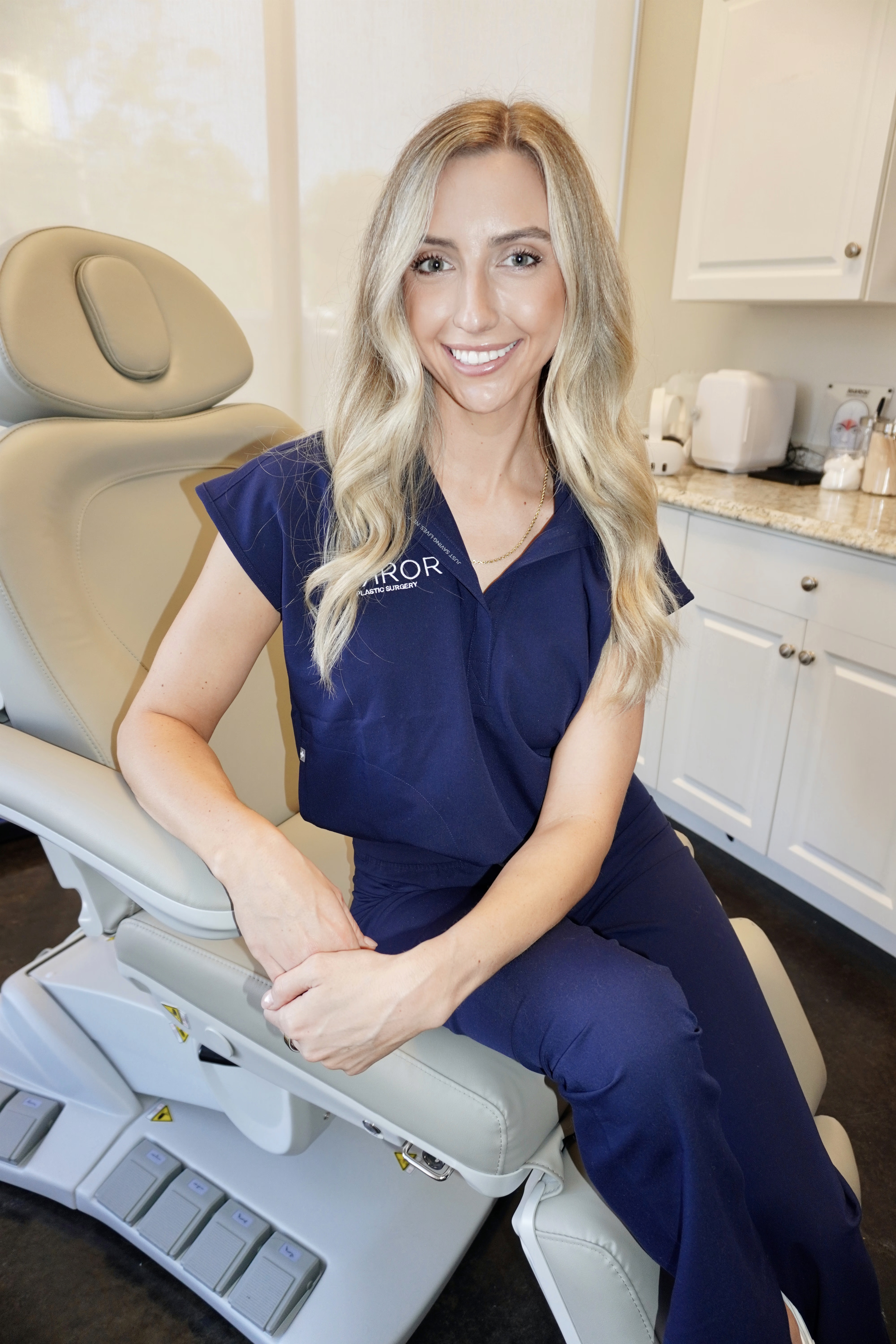
The assessment also considers skin quality, tissue thickness, and prior filler history. A patient with thin, sun-damaged skin needs a different product and placement strategy than a patient with thicker, more resilient tissue. This level of clinical discernment comes from Ellie’s background, which includes esthetics licensure, 600 hours of hands-on training, a Master’s in Nursing from the University of South Florida, and four years in the Neuroscience ICU at Tampa General Hospital. That experience shapes her injection safety protocols and her core philosophy: restore inherent facial characteristics first, then consider augmentation only when appropriate.
Volume enters the plan only after the foundational assessment confirms that filler aligns with the patient’s anatomy and goals.
Factors That Shape Your Filler Plan
Several variables determine the appropriate filler volume for any individual patient:
- Age and degree of volume loss: Patients in their 30s usually need less product to restore baseline than patients in their 50s, who often show cumulative fat pad atrophy and bone resorption.
- Skin thickness and quality: Thinner skin reveals product irregularities more easily and may require softer, more hydrophilic formulations placed conservatively.
- Prior filler history: Residual product from earlier treatments affects how new filler integrates and sometimes requires dissolution before retreatment.
- Product rheology: Different fillers vary in stiffness, lift capacity, and longevity. Matching product properties to the tissue plane and zone matters as much as choosing the right volume.
- Facial proportions and symmetry: Every face has natural asymmetry. Treatment plans that ignore it risk amplifying unevenness instead of improving it.
Choosing Between Filler and Surgery
Dermal fillers treat volume loss effectively, but they do not correct skin laxity, significant ptosis, or structural changes that require tissue repositioning. A patient with moderate jowling and marked skin redundancy along the jawline may see only limited improvement from filler alone and may benefit more from a surgical consultation with Dr. Akash Chandawarkar, the Harvard-educated, Johns Hopkins-trained plastic surgeon who leads Mirror Plastic Surgery’s surgical practice.
Ellie’s assessment framework includes a direct evaluation of whether non-surgical treatment makes sense as the primary approach. When filler would deliver a temporary or clearly suboptimal result compared with surgery, patients hear that clearly. This transparency reflects a core principle of Mirror Plastic Surgery’s concierge model. The priority is the right treatment for the patient’s anatomy, not the option that is easiest to schedule.
Frequently Asked Questions
How long does dermal filler last in the face?
Longevity varies by zone, product, and individual metabolism. Lip filler usually lasts six to twelve months. Cheek and temple filler placed deep on the periosteum often lasts longer. Biostimulatory fillers like Radiesse stimulate collagen production and may provide longer-lasting structural support than hyaluronic acid products alone. Maintenance intervals are discussed during the initial consultation based on the products used and the patient’s goals.
Can filler be dissolved if I do not like the result?
Certain fillers can be dissolved with an enzyme that breaks down the product. This reversibility is one reason some fillers are recommended for first-time patients. Biostimulatory fillers such as Radiesse do not dissolve with the same enzyme and require a different management plan if correction becomes necessary. Ellie reviews reversibility as part of every treatment discussion.
Is it safe to get filler in multiple zones in one session?
Treating multiple zones in a single session is common and generally safe when an injector has strong anatomical knowledge and uses conservative volumes. Total volume, tissue planes, and the patient’s vascular anatomy all factor into session planning. Some patients still prefer a staged approach across two visits for comfort and to review results gradually before completing the full plan.
What is the difference between a soft filler and a structural filler?
Filler products differ in G-prime, a measure of stiffness and lift capacity. Soft, low-G-prime fillers integrate smoothly into mobile areas such as the lips and under-eye region. Firm, high-G-prime fillers provide structural support in areas like the cheeks, jawline, and chin, where lift and projection matter most. Matching product properties to each treatment zone supports natural-looking outcomes.
How do I know if I need filler or a neuromodulator like Botox?
Fillers restore volume and structural support. Neuromodulators such as Botox, Dysport, or Daxxify relax muscles that create dynamic wrinkles, which appear with expression. Many patients benefit from a combination of both. For example, cheek filler paired with neuromodulator in the crow’s feet area addresses volume loss and dynamic wrinkling in the same region. Ellie’s top-to-bottom assessment identifies which modality, or combination, fits each patient’s specific concerns.
Your Next Step With Mirror Plastic Surgery
Natural-looking filler volume depends on your anatomy, degree of volume loss, skin quality, and goals. Ellie evaluates all of these factors during a thorough, unhurried consultation at Mirror Plastic Surgery in St. Petersburg, Florida. Her concierge approach includes a full top-to-bottom evaluation, direct guidance on what suits your face, and a staged treatment plan designed to age gracefully rather than require frequent correction.
Mirror Plastic Surgery serves the Tampa Bay area from its St. Petersburg location at 780 4th Ave S, St. Petersburg, FL 33701. New patients can reach the practice by phone or text at 727-361-6515 or by email at hello@mirrorplasticsurgery.com.
Disclaimer: Results may vary from person to person. Editorial content, before and after images, and patient testimonials do not constitute a guarantee of specific results.
1 Results may vary from person to person. Editorial content, before and after images, and patient testimonials do not constitute a guarantee of specific results.