
Written by: Ellie Pranckevicius, FNP-BC, Aesthetic Nurse Practitioner & Aesthetic Injector | Facial Restoration & Regenerative Injectable Specialist, Mirror Plastic Surgery | Last updated: August 6, 2026
Key Takeaways
- Concierge medicine doctor-patient ratios typically range from 300 to 600 patients per physician, compared with 2,000 to 3,000 in traditional primary care.
- Smaller panels support same-day access, longer appointments of 30 to 90 minutes, and deeper preventive care. Larger panels can erode these benefits.
- MDVIP-affiliated physicians cap panels at 600, while ultra-premium or boutique practices may limit panels to 50 to 150 patients.
- Panel-size limits create trade-offs. Very small panels can strain unit economics, while larger panels may compromise access and retention.
- Schedule a personalized consultation at Mirror Plastic Surgery to experience concierge-level care with individualized attention and lab-guided protocols.
Concierge Panel Size Benchmarks for 2026
The Macbach 2026 Concierge Medicine Benchmark Report and related analyses show that classic concierge practices often operate with 300 to 600 patients per physician. Panels that are too small can struggle with unit economics, while panels that grow too large can weaken the access promise and affect retention.
The gap between concierge and traditional primary-care panel sizes is substantial. Traditional primary-care panels are often cited at 2,000 to 2,500 patients. This difference allows concierge physicians to handle a much lower daily visit volume. Smaller panels support fewer patient visits per day in a four-day clinical week, which makes same-day appointments and longer visits more realistic. Physicians who transition to concierge models frequently report sharp reductions in daily patient volume compared with traditional settings.
In many traditional practices, patients often wait two weeks or more for an appointment, with limited same-day availability. This reality makes the smaller panel sizes in concierge medicine especially valuable for timely access. Traditional primary-care appointments average 15 minutes, with roughly 7 minutes of actual face time after documentation, while concierge appointments typically run 30 to 90 minutes.
MDVIP Panel Caps as a Real-World Example
MDVIP-affiliated physicians cap patient panels at approximately 600, compared with 2,000 or more in a typical primary-care practice. As of 2025, MDVIP reported more than 1,300 affiliated physicians serving over 400,000 patients across 45 states, which makes it the largest concierge network in the United States.
The 600-patient MDVIP ceiling sits at the upper boundary of the standard concierge range. A smaller MDVIP-style panel allows substantially more physician time per patient compared with a traditional primary-care panel. Independent boutique practices often operate with smaller panels than standard concierge models. Ultra-premium or executive-tier models, such as MD2, cap each physician at 50 families total.
Ultra-premium concierge practices usually maintain panels under 200 patients per doctor, and often under 100, according to industry references. The financial tradeoff at these lower panel sizes is significant. A physician with a smaller panel must charge more per patient to generate revenue comparable to a physician managing a larger panel.
Panel Size and Daily Visit Volume by Practice Model
| Model | Typical Panel Size | Daily Visits (Approx.) | Source |
|---|---|---|---|
| Traditional Primary Care | 2,000–3,000 | 20–30 | Industry benchmarks; BLS |
| Standard Concierge (Classic) | 300–600 | 6–10 | Industry benchmarks |
| MDVIP-Affiliated | Up to 600 | 8–12 | DirectMedicine; MDVIP |
| Executive / Boutique | 50–150 | 2–5 | Industry benchmarks |
Concierge Panel-Size Challenges and Trade-offs
Panel-size limits in concierge medicine create problems across equity, economic sustainability, and care delivery. These issues shape how different models balance access, affordability, and long-term stability.
Equity concerns. Robust randomized controlled evidence on concierge medicine outcomes does not exist as of 2026. Available data comes from observational studies that face selection bias, because concierge patients tend to have higher health literacy and socioeconomic status. This pattern makes it difficult to separate the effect of panel size from patient-level factors.
Economic sustainability across panel sizes. Practices with very small patient panels can face unit-economics pressure, because fixed overhead costs such as staffing, technology, EHR systems, office space, and malpractice coverage do not shrink proportionally. At the other end of the spectrum, practices with larger concierge panels may struggle to maintain promised access levels, which can reduce patient satisfaction and retention.
Access and continuity risks. When panels grow too large within a concierge model, same-day or next-day access becomes harder to deliver consistently. Longer waits and shorter visits can make the experience feel closer to traditional primary care, which undermines the value proposition and may drive higher turnover.
Legal and corporate-model disputes. MDVIP has faced litigation related to its transition model, where existing primary-care patients who cannot afford or choose not to join the concierge program lose access to their long-standing physician. Critics argue that this shift disproportionately affects lower-income and older patients who rely on established physician relationships for chronic disease management.
Evidence limitations for panel-size guidance. A 2019 VA Evidence Synthesis Program systematic review found the literature on primary care panel size and outcomes to be limited. The small number of available studies showed variable, null, or modestly negative associations with larger panel sizes. Current panel-size recommendations rely more on historical experience and practice economics than on controlled evidence.
Practitioner Spotlight: Concierge Peptide Care with Ellie Pranckevicius, FNP-BC
At Mirror Plastic Surgery in St. Petersburg, Florida, peptide therapies are led by Ellie Pranckevicius, a board-certified Family Nurse Practitioner. Her background includes four years in the Neuroscience ICU at Tampa General Hospital, a Master’s in Nursing from the University of South Florida, and prior esthetician training at a high-end medical spa. This blend of critical-care and aesthetic experience informs her concierge-level peptide practice.
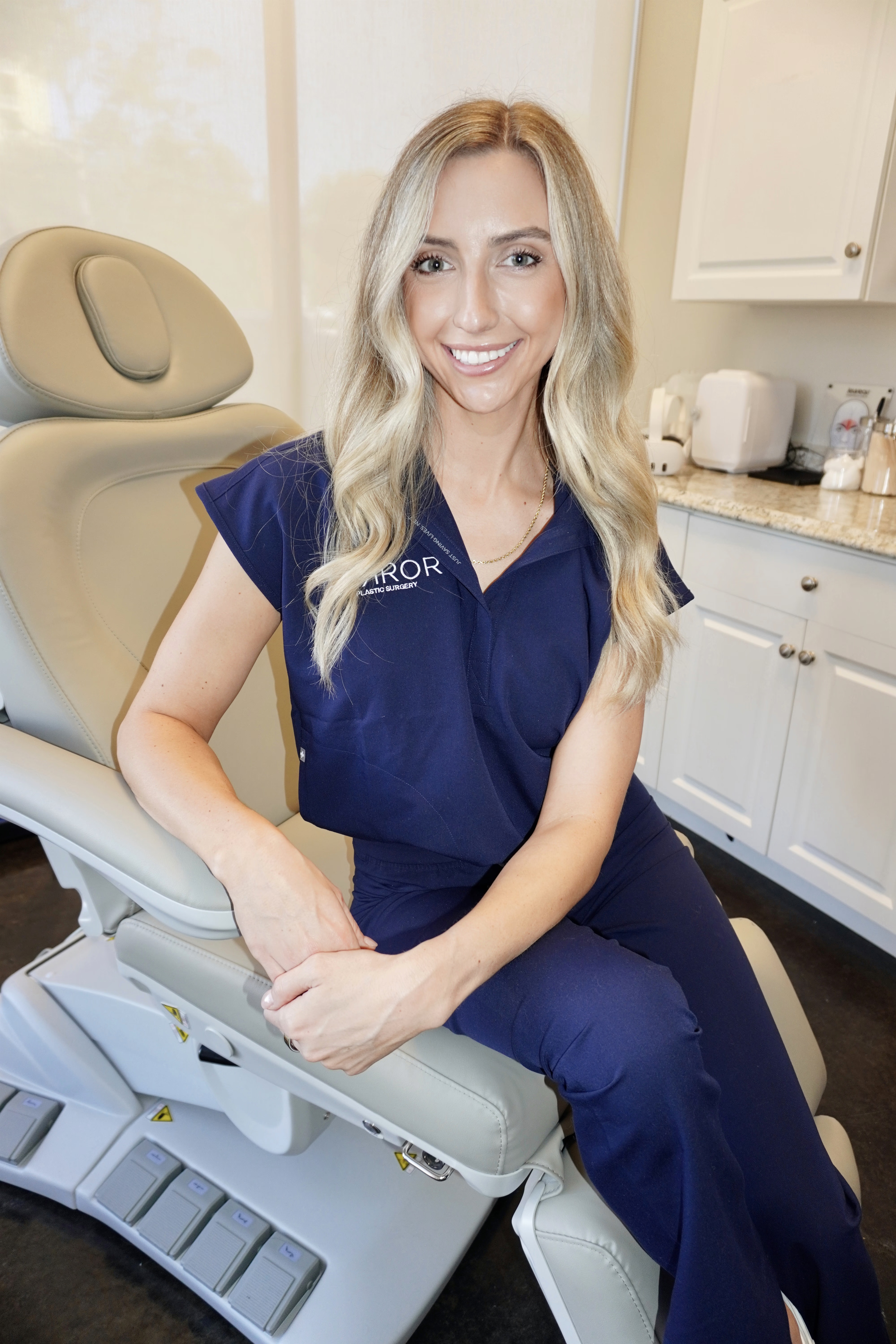
Ellie’s model centers on one-on-one oversight. Each patient receives a 30- to 60-minute consultation, in-depth lab analysis when indicated, and a custom peptide protocol built around specific health goals. These goals may include managing chronic inflammation, supporting weight management, or addressing skin aging and energy.1 Ongoing support flows directly through Ellie, which distinguishes this approach from less supervised online peptide sources or high-volume wellness platforms.
Schedule your personalized peptide consultation to discuss a protocol grounded in lab analysis and one-on-one clinical oversight.
How to Assess a Concierge or Peptide Practice
Adults in Florida can use several practical checks before committing to any concierge or membership-based practice. These factors help reveal whether the practice can deliver the access and depth of care it advertises.
- Panel size disclosure: Ask the practice how many active patients the practitioner carries. Compare the answer with typical benchmarks, such as around 300 to 600 for classic concierge models and smaller ranges for boutique and ultra-premium tiers.
- Daily visit volume: Ask how many patients the clinician sees per day. A practitioner seeing 20 or more patients per day operates closer to a traditional primary-care model, regardless of the membership label. Smaller panels usually translate into fewer visits per day, which supports extended appointments.
- Access guarantees: Confirm whether same-day or next-day access appears in the membership agreement or only in marketing language. Across five specialties the average wait for a new-patient appointment is 31 days, while family medicine averages 23.5 days. A concierge practice should demonstrate a meaningfully shorter timeline.
- Retention data: Ask about annual retention rates. Lower retention can reduce recurring revenue and may signal that the access or care-quality promise is not being met.
- Lab and protocol depth: For peptide and wellness-focused practices, ask whether the intake process includes lab panels, medical history review, and individualized protocol design. A standard protocol applied to all patients suggests a less personalized model.
- Florida-specific considerations: Confirm whether the practice offers remote or telemedicine options, since Florida’s geography and traffic patterns affect in-person access. Verify that the practitioner is licensed in Florida and that peptides come from suppliers with documented batch testing.
- Sustainability signals: Ask how the practice balances panel size with financial stability and visit length. Extremely small or very large panels both warrant additional scrutiny.
Experience Ellie’s concierge-level intake process, including medical history review, lab analysis, and a custom peptide protocol instead of a one-size-fits-all plan.
Frequently Asked Questions
How does a concierge medicine doctor-patient ratio affect same-day access?
Panel size serves as the primary structural driver of same-day access. A physician carrying more than 2,000 patients must schedule a high number of visits per day to maintain continuity, which leaves little room for unscheduled appointments. A physician carrying 300 to 600 patients sees far fewer patients per day, which creates scheduling flexibility for same-day or next-day visits. The relationship is not automatic, because a poorly managed panel can still produce long wait times, but daily capacity math makes same-day access more feasible at smaller panel sizes.
Is there a meaningful difference between a 400-patient and a 600-patient concierge panel?
The difference between a 400-patient panel and a 600-patient panel often shows up in access and appointment length. Smaller panels support fewer visits per day, which allows longer appointments and greater scheduling flexibility. Larger panels within the classic range require more daily visits, which can compress appointment slots. Patients should evaluate practices based on actual daily-visit volume and access performance, not the panel-size label alone.
Do smaller patient panels in concierge medicine produce better health outcomes?
The evidence suggests potential benefits but remains inconclusive. A 2018 review in the Journal of the American Board of Family Medicine reported associations between smaller direct primary care panels and longer appointment times, higher patient satisfaction, and improved continuity of care.1 A 2018 systematic review in BMJ Open found that continuity of care with a consistent physician is associated with lower mortality.1 However, a 2019 VA Evidence Synthesis Program systematic review found that the overall literature on panel size and clinical outcomes is limited, with results that are variable, null, or modestly negative for larger panels.1 Selection bias, because concierge patients tend to have higher health literacy and socioeconomic resources, makes it difficult to attribute outcome differences to panel size alone.
What panel-size considerations apply specifically to nurse practitioner-led concierge peptide practices?
Nurse practitioner-led specialty practices, such as concierge peptide programs, follow different panel-size conventions than primary care concierge models. The most relevant metrics include the depth of intake, the frequency of follow-up, and the availability of direct communication. A well-structured NP-led peptide practice should provide a comprehensive initial consultation, lab review when indicated, a customized protocol, and ongoing one-on-one access. These elements become diluted as patient volume increases. The same sustainability logic applies, because a practice carrying too few patients to cover fixed overhead, or too many to provide individualized attention, falls outside the range that supports both financial viability and care quality.
How can I verify that a Florida concierge or peptide practice is operating at a sustainable panel size?
Ask the practice for its current active patient count and average appointment length. Request details on how same-day or next-day access works and whether that access appears in the membership agreement. For peptide-specific practices, ask whether lab panels are included in the intake process, how protocols are individualized, and how ongoing support and protocol adjustments are handled. In Florida, also confirm that the practitioner holds an active state license and that peptides come from suppliers with third-party batch testing, which is an important safeguard because many peptides are not FDA-regulated.
Conclusion: Using Panel Size to Choose Concierge and Peptide Care
Concierge medicine doctor-patient ratios range from under 100 patients in ultra-premium executive models to 600 in network-affiliated practices such as MDVIP, compared with over 2,000 in traditional primary care. Industry benchmarks often identify 300 to 600 as a stable range for classic concierge practices. Access quality can degrade at higher numbers, while unit economics can become challenging at lower numbers.
Daily visit volume, not panel size alone, determines whether same-day access and extended appointments actually occur. For Florida adults evaluating concierge or specialty wellness practices, the most reliable indicators include direct panel-size disclosure, documented daily-visit volume, clear access guarantees, and evidence of individualized intake processes with lab analysis and custom protocols.
Begin your peptide journey with Ellie at Mirror Plastic Surgery in St. Petersburg through a comprehensive consultation that includes lab review, individualized protocol design, and ongoing one-on-one support.
Medical Disclaimer: The information in this article is intended for general educational purposes only and does not constitute medical advice, diagnosis, or treatment. Peptide therapies discussed on this page are not FDA-approved for all indications referenced. Consult a qualified, licensed healthcare provider before beginning any new treatment or wellness protocol. Individual results vary. Mirror Plastic Surgery’s peptide services are led by a board-certified Family Nurse Practitioner and are available in-person in St. Petersburg, Florida, and remotely across the United States.
1 Results may vary from person to person. Editorial content, before and after images, and patient testimonials do not constitute a guarantee of specific results.
Peptide therapy is intended for wellness and optimization purposes and is not prescribed to diagnose, treat, cure, or prevent disease unless specifically stated. Many peptides are not FDA-approved and may be used off-label. Some have limited long-term safety data, with a potential for unknown risks, complications, or desensitization with prolonged use.